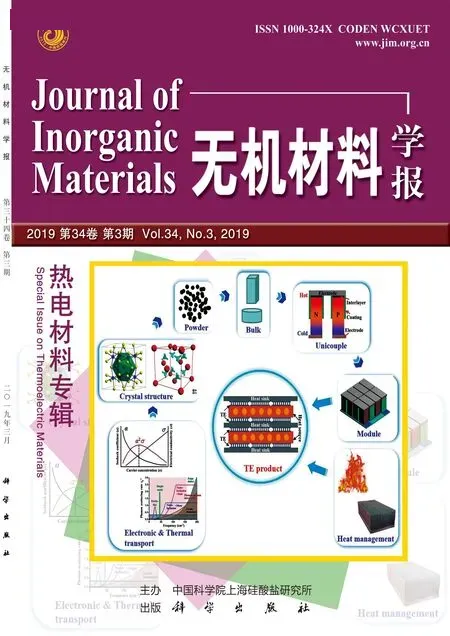
熱電材料中的晶格熱導率
2019-04-02 05:12:58沈家駿方騰傅鐵錚忻佳展趙新兵朱鐵軍
無機材料學報 2019年3期
沈家駿, 方騰, 傅鐵錚, 忻佳展, 趙新兵, 朱鐵軍
?
熱電材料中的晶格熱導率
沈家駿, 方騰, 傅鐵錚, 忻佳展, 趙新兵, 朱鐵軍
(浙江大學 材料科學與工程學院, 硅材料國家重點實驗室, 杭州 310027)
隨著可再生能源及能源轉換技術的快速發展, 熱電材料在發電及制冷領域的應用前景受到越來越廣泛的關注。發展具有高熱電優值材料的重要性日益突出, 如何獲得低晶格熱導率是熱電材料的研究重點之一。本文闡述了熱容、聲速及弛豫時間對晶格熱導率的影響, 介紹了本征低熱導率熱電材料所具有的典型特征, 如強非諧性、弱化學鍵、本征共振散射及復雜晶胞結構等, 并分析了通過多尺度聲子散射降低已有熱電材料晶格熱導率的方法, 其中包括點缺陷散射、位錯散射、晶界散射、共振散射、電聲散射等多種散射機制。此外, 總結了幾種預測材料最小晶格熱導率的理論模型, 對快速篩選具有低晶格熱導率的熱電材料具有一定的理論指導意義。最后, 展望了如何獲得低熱導率熱電材料的有效途徑。
熱電材料; 晶格熱導率; 熱容; 弛豫時間; 綜述


1 晶格熱導率的影響因素
1.1 熱容
從晶格熱導率的公式可以看出, 晶格熱導率與定容熱容V成正比, 所以降低V有利于獲得低晶格熱導率。杜隆-珀蒂定律指出構成固體的各個原子在高溫時的熱容趨近于極限值3B, 其中B為玻爾茲曼常數, 因此通過改變熱容來降低熱導率通常比較困難。然而研究人員發現中溫Cu2–xSe熱電材料的熱容隨著溫度升高會逐漸減小[10-11]。如圖1(a)所示, 固體的V為3B,為總原子數。而在液體中, 大部分橫向振動波無法傳遞,V減小到2~2.5B。隨著溫度升高, Cu2–xSe中Cu離子的高度離域性使材料在一定程度上表現出類液體的行為, 大大降低了橫向聲學波對熱容的貢獻, 使得Cu2–xSe在高溫條件下的V接近2B。
根據德拜熱容模型, 熱導的貢獻主要來自于聲學波。這是由于光學波的波速趨近于0, 對熱導率的貢獻基本可以忽略[17]。對于多原子體系, 假設每個原胞中的原子數為, 總原胞數為, 則體系總的自由度為3。其中, 聲學支有3個, 光學支有3(-1)個[18]。根據能量均分原理可得, 聲學支貢獻的熱容為/, 光學支為(-1)/。因此, 原胞中原子數越多, 聲學支對總熱容的貢獻越小, 越有利于獲得低晶格熱導率。這在許多具有復雜晶胞結構的熱電材料中得到了印證(如圖1(b)所示)。例如:Yb14MnSb11與PbTe具有相似的德拜溫度, 平均原子質量, 熱容及格林內森參數[19-20], 但是由于Yb14MnSb11原胞中原子數為104, 而PbTe只有2, 使得Yb14MnSb11的室溫晶格熱導率僅有0.6 W·m-1·K-1, 遠低于PbTe的2 W·m-1·K-1[21]。
1.2 聲速
在熱導率公式中,g為聲子的群速度, 可以根據聲子譜中聲學支的斜率得到。在實際研究中, 為了便于測量, 通常假設群速度g與固體聲速s相等。研究表明具有弱化學鍵的化合物通常具有低聲速,例如,在-MgAgSb中由于Mg原子本身不存在d軌道, 無法與近鄰原子形成強d-d鍵, 導致Mg原子與Ag原子之間的共價鍵較弱, 晶格發生一定的扭曲[22]。這種弱鍵的存在使得-MgAgSb的聲速僅有1920 m/s。Ag8GeTe6等體系中也存在同樣的現象[23-24], 由于Ag原子與Te原子之間較弱的鍵合使得Ag8GeTe6聲速低至1000~1500 m/s。

圖1 (a) Cu2-xSe化合物的熱容與溫度關系圖[11]和(b) 室溫晶格熱導率與原胞中原子數關系[12-16]
此外, 通過引入重原子的方式也能降低聲速,比較典型的例子有籠式化合物及填充方鈷礦[25-28]。如圖2(a)所示, 在Ba8Ga16Ge30籠式化合物中, Ba原子占據由Ga原子及Ge原子構成的晶格間隙中。若將Ba原子單純看作散射中心, 則理論預測的聲子弛豫時間應為0.18 ps。然而, 中子三軸光譜分析表明加入Ba原子僅僅使縱波弛豫時間L由2.6 ps降為1.3 ps。因此, 低晶格熱導率不能只歸因于弛豫時間的降低, 聲速的降低也起到了重要的作用。如圖2(b)和(c)所示, 在籠式結構中, 由于聲學聲子模與填充原子產生的低頻光學支之間存在“避免交叉”現象, 使得聲學支的頻率進一步降低, 從而具有更低的聲速[29]。
1.3 弛豫時間


圖2 (a)Ba8Ga16Ge30晶體結構示意圖, (b)未填充及填充籠式結構的彈簧模型及(c)色散關系[29]
點缺陷散射是一種非常有效的降低材料熱導率的方法, 包括質量波動散射與應力場波動散射[54], 二者分別與原子間質量差和半徑差有關, 原子間質量差及半徑差越大, 點缺陷散射越強。合金化是目前應用最廣的增強點缺陷散射的手段, 在Bi2Te3[55-56]、Pb(Te,Se)[57]、CuInTe2[58]、Mg2(Si,Sn)[59-60]、SiGe合金[61]以及Half-Heusler(HH)合金[62-69]中都有應用。以FeNbSb基HH合金為例, 研究表明Nb位Ta合金化可以有效降低FeNbSb的晶格熱導率[70]。如圖4(a)及(b)所示, 雖然Nb和Ta之間較小的原子半徑差使應力場波動散射較弱, 但兩者較大的原子質量差可以引入強烈的質量波動散射, 使其最小晶格熱導率降至1.3 W·m–1·K–1。除了合金化之外, 空位與間隙原子也屬于一種較為特殊的點缺陷散射機制。19電子HH合金Nb0.8CoSb中存在近20%的本征Nb空位,使Nb0.8CoSb合金具有相對較低的晶格熱導率[71]。Cu2SnSe4等熱電材料中也存在同樣的現象[72]。
晶界散射及位錯散射也是非常重要的降低晶格熱導率的方法[73]。常用的增強晶界散射的手段有球磨[74-75]和甩帶[76-79]兩種方法, 廣泛應用于Bi2Te3[79]、SiGe[80]以及Half-Heusler合金[81]等熱電材料中。對于位錯散射, 有報道稱在Bi0.5Sb0.15Te3中通過過量Te液相燒結的手段可以增加晶界位錯陣列[8]。另外, 通過向材料中添加第二相的方式也能增加位錯密度[82], 這一現象在PbTe-PbS體系中得到了印證[83]。

圖3 格林內森常數與室溫晶格熱導率的關系圖[6, 22, 39-53]

圖4 (a)(Nb0.6Ta0.4)0.8Ti0.2FeSb和Nb0.8Ti0.2FeSb的晶格熱導率與聲子頻率的依賴關系和(b)Ta摻雜量與無序散射因子及晶格熱導率的關系圖[70]
此外, 位錯還可以通過自身空位的聚集產生。如圖5所示, 在Mg2Si1–xSb材料[84]中, Sb的高劑量合金化產生大量Mg空位, 使得空位濃度遠高于平衡空位密度, 多余的Mg空位自發地發生聚集從而形成位錯。在Mg2Si0.5Sb0.5中, 位錯密度高達2.8×10¹⁶m?2。圖5(b)為Sn及Sb元素合金化對Mg2Si晶格熱導率的不同影響。由于Sn元素的加入不會增加Mg空位的濃度從而產生位錯, 晶格熱導率的降低主要來自點缺陷散射的作用。而Sb合金化不僅能增強點缺陷散射, 而且能增強位錯散射, 因此具有更低的晶格熱導率。此外, 在NaEu0.03Pb0.97–yTe體系[7]中也觀察到類似的現象。研究表明隨著Na摻雜量的增加, 體系中的主要微觀缺陷由點缺陷逐步過渡到位錯及納米顆粒。位錯散射使PbTe的晶格熱導率下降到0.4 W·m-1·K-1以下。

圖5 (a) Mg2Si0.5Sb0.5中位錯的IFFT圖及相應的應力掃描圖, (b) Mg2Si1-xSbx及Mg2Si1–zSnz的室溫晶格熱導率對比圖[84]
除此之外, 共振散射一般出現在具有特殊晶體結構的熱電材料中, 如籠式化合物及方鈷礦等[29, 85-86]。通過加入填充原子, 可以引入特定頻率的共振譜, 從而降低材料熱導率。在S0.5Co4Sb10.5Te1.5中S作為填充原子, 可以在聲子譜中引入一段頻率較低的光學支, 與聲學支發生光聲耦合現象, 增強共振散射, 最終使得CoSb3材料獲得極低的晶格熱導率[87]。另外, 最近的研究表明一些具有拓撲絕緣性的熱電材料中也存在共振散射。如圖6所示, 在BiSe材料中額外的Bi2原子層同樣可以引起局域共振效應, 強烈的光聲耦合顯著降低了BiSe的晶格熱導率, 使其室溫晶格熱導率僅為0.6 W×m-1×K-1[88]。
相比于其他類型的散射機制, 電聲散射的研究相對較少。然而, 對于具有較大載流子有效質量的體系, 通常需要較高的載流子濃度使其電性能達到最佳[89-92]。因此, 在這些體系中需要考慮電聲散射對晶格熱導率的影響。如圖7所示, 在多晶硅中摻入P使其晶格熱導率顯著降低, 0.1at%的P摻雜量就可以使多晶硅室溫時的晶格熱導率降低60%。但由于P與Si在元素周期表中的位置接近, 具有相似的質量和半徑, 因此點缺陷散射不足以解釋其晶格熱導率的大幅度降低, 必然存在其他散射機制的作用。研究表明P元素的摻雜作用可以引起多晶硅中載流子濃度的增加, 使電聲相互作用顯著增強。當摻入6at%的P時, 電聲散射對晶格熱導率的降低作用占所有散射機制的36%, 接近晶界散射的作用[93]。

圖6 BiSe晶體結構示意圖(a)和Bi2Se3及BiSe的晶格熱導率對比圖(b)[88]

圖7 電聲散射示意圖(a)和硅樣品晶格熱導率的實驗值與Callaway模型計算值的對比圖(b)[93]
2 最小晶格熱導率


圖8 (a)擴散子模型及聲子模型的差別示意圖和(b)Cahill模型及擴散子模型預測的最小晶格熱導率對比圖
雖然最小晶格熱導率的計算模型有所不同, 但不同模型預測出的結果大都比較接近。這主要由兩方面原因造成的:首先, 大多數材料達到最小晶格熱導率時, 溫度均遠遠高于德拜溫度, 此時, 熱容已經趨近于極限值3; 其次, 所有模型都假設對熱導率的貢獻全部由平均自由程等于原子間距尺度的聲子貢獻, 這一假設使得晶體中尺度大于原子間距的缺陷, 如位錯、第二相等不會對最小晶格熱導率的預測產生影響。


圖9 獲得低晶格熱導率的幾種途徑
3 結束語
晶格熱導率是一個可以相對獨立調控的影響材料熱電性能的參數。本文分別闡述了熱容、聲速及弛豫時間等三個物理量對晶格熱導率的影響, 并介紹了幾種不同類型的預測材料最小晶格熱導率的理論模型, 對降低材料的晶格熱導率具有重要的指導意義。那么如何從實驗上獲得較低的晶格熱導率呢? 主要可以從以下兩方面考慮:
第一、尋找并制備具有本征低熱導率的熱電材料。具有本征低熱導率的熱電材料一般具有以下幾個特征:1. 強非諧性。非諧性強弱主要與化學鍵及原子平衡位置的對稱性有關。原子在振動過程中, 若其對稱中心發生偏移越大, 則非對稱性越強。具有孤對電子的材料往往由于電子云分布不均勻, 晶體結構會發生一定的變形, 非對稱性顯著增強, 有利于獲得強非諧性; 2. 弱化學鍵。化學鍵弱的材料具有較低的聲速, 原子在其平衡位置附近具有更大的活動空間, 電子云分布更為彌散。在聲子譜中, 弱化學鍵往往對應一些低頻段的聲子模, 更容易與聲學支發生耦合作用, 從而進一步降低聲學支對熱導的貢獻; 3. 復雜的晶胞結構。一方面可以降低聲學支對總熱容的貢獻比重, 另一方面可以降低聲學支聲子的群速。
第二、通過多尺度聲子散射降低已有熱電材料的熱導率。由于在德拜溫度以上, 聲子頻率分布在0到德拜頻率之間, 同時抑制所有波長段的聲子模能夠有效降低晶格熱導率, 如點缺陷散射、位錯散射、晶界散射、共振散射和電聲散射等(如圖9所示)。
近年來有研究表明, 弱拓撲絕緣體能實現極低的晶格熱導率[101-103], 并且其特殊的表面傳導特性有望沖破半導體基熱電材料的禁錮, 實現電性能及熱性能的真正解耦。然而, 拓撲絕緣體的晶格動力學、聲子輸運等機制仍需要人們進一步研究與探索[104-105]。總的來說, 不論是研究發現新型的具有本征低晶格熱導率的熱電材料, 還是對現有的熱電材料熱導率進一步的降低, 通過多種手段的并用, 一定會對未來的熱電材料領域的可持續發展產生實質的積極促進作用。
[1] BELL L E. Cooling, heating, generating power, and recovering waste heat with thermoelectric systems., 2008, 321(5895): 1457–1461.
[2] SNYDER G J, TOBERER E S. Complex thermoelectric materials., 2008, 7:101–110.
[3] XIN J Z, TANG Y L, LIU Y T,Valleytronics in thermoelectric materials., 2018, 3(1): 9.
[4] LI W, ZHENG L L, GE B H,Promoting SnTe as an eco-friendly solution for p-PbTe thermoelectricband convergence and interstitial defects., 2017, 29(17): 1605887-1-8.
[5] BISWAS K, HE J Q, BLUM I D,High-performance bulk thermoelectrics with all-scale hierarchical architectures., 2012, 489: 414–418.
[6] ZHAO L D, LO S H, ZHANG Y S,Ultralow thermal conductivity and high thermoelectric figure of merit in SnSe crystals., 2014, 508: 373–377.
[7] CHEN Z W, JIAN Z Z, LI W,Lattice dislocations enhancing thermoelectric PbTe in addition to band convergence., 2017, 29(23): 1606768-1-8.
[8] KIM S I, LEE K H, MUN H A,Dense dislocation arrays embedded in grain boundaries for high-performance bulk thermoelectrics., 2015, 348(6230): 109–114.
[9] CHEN Z W, ZHANG X Y, PEI Y Z. Manipulation of phonon transport in thermoelectrics., 2018, 30(17): 1705617-1-12.
[10] HE Y, DAY T, ZHANG T S,High thermoelectric performance in non-toxic earth-abundant copper sulfide., 2014, 26(23): 3974–3978.
[11] LIU H L, SHI X, XU F FCopper ion liquid-like thermoelectrics., 2012, 11: 422–425.
[12] VINING C B, LASKOW W, HANSON J O,Thermoelectric properties of pressure-sintered Si0.8Ge0.2thermoelectric alloys., 1991, 69(8): 4333–4340.
[13] PEI Y Z, LALONDE A, IWANAGA S,High thermoelectric figure of merit in heavy hole dominated PbTe., 2011, 4(6): 2085–2089.
[14] ZEVALKINK A, TOBERER E S, ZEIER W G.,Ca3AlSb3: an inexpensive, non-toxic thermoelectric material for waste heat recovery., 2011, 4(2): 510–518.
[15] MAY A F, TOBERER E S, SARAMAT A,Characterization and analysis of thermoelectric transport in n-type Ba8Ga16?xGe30+x., 2009, 80(12): 125205-1-12.
[16] COX C A, TOBERER E S, LEVCHENKO A A,Structure, heat capacity, and high-temperature thermal properties of Yb14Mn1?xAlSb11., 2009, 21(7): 1354–1360.
[17] SLACK G A. The thermal conductivity of nonmetallic crystals., 1979, 34: 1–71.
[18] TOBERER E S, ZEVALKINK A, SNYDER G J. Phonon engineering through crystal chemistry., 2011, 21(40): 15843–15852.
[19] WANG Y, HU Y J, FIRDOSY S A,First-principles calculations of lattice dynamics and thermodynamic properties for Yb14MnSb11., 2018, 123(4): 045102-1-10.
[20] BROWN S R, KAUZLARICH S M, GASCOIN F,Yb14MnSb11:? new high efficiency thermoelectric material for power generation., 2006, 18(7): 1873–1877.
[21] CHEN Z, LI D C, DENG S P,Thermoelectric properties and thermal stability of Bi-doped PbTe single crystal., 2018, 538: 154–159.
[22] YING P J, LI X, WANG Y C,Hierarchical chemical bonds contributing to the intrinsically low thermal conductivity in-MgAgSb thermoelectric materials., 2016, 27(1): 1604145-1-8.
[23] LI J Q, LI L F, SONG S H,High thermoelectric performance of GeTe–Ag8GeTe6eutectic composites., 2013, 565: 144–147.
[24] FUJIKANE M, KUROSAKI K, MUTA H,Thermoelectric properties of Ag8GeTe6., 2005, 396(1): 280–282.
[25] HOU Y H, CHANG L S. Optimization on the figure-of-merit of p-type Ba8Ga16Ge30type-I clathrate grownthe Bridgman method by fine tuning Ga/Ge ratio., 2018, 736: 108–114.
[26] YAN X L, IKEDA M, ZHANG L,Suppression of vacancies boosts thermoelectric performance in type-I clathrates., 2018, 6(4): 1727–1735.
[27] BEEKMAN M, VANDERGRAAFF A. High-temperature thermal conductivity of thermoelectric clathrates., 2017, 121(20): 205105.
[28] GONZALEZ-ROMERO R L, ANTONELLI A. Estimating carrier relaxation times in the Ba8Ga16Ge30clathrate in the extrinsic regime., 2017, 19(4): 3010–3018.
[29] CHRISTENSEN M, ABRAHAMSEN A B, CHRISTENSEN N B,Avoided crossing of rattler modes in thermoelectric materials., 2008, 7: 811–815.
[30] CALLAWAY J. Model for lattice thermal conductivity at low temperatures., 1959, 113(4): 1046–1051.
[31] CHUNG J D, MCGAUGHEY A J H, KAVIANY M. Role of phonon dispersion in lattice thermal conductivity modeling., 2004, 126(3): 376–380.
[32] SLACK G A, GALGINAITIS S. Thermal conductivity and phonon scattering by magnetic impurities in CdTe., 1964, 133(1A): A253–A268.
[33] HEREMANS J P. Thermoelectric materials: the anharmonicity blacksmith., 2015, 11: 990–991.
[34] QIU W J, XI L L, WEI P,Part-crystalline part-liquid state and rattling-like thermal damping in materials with chemical-bond hierarchy., 2014, 111(42): 15031–15035.
[35] TYAGI K, GAHTORI B, BATHULA S,Thermoelectric properties of Cu3SbSe3with intrinsically ultralow lattice thermal conductivity., 2014, 2(38): 15829–15835.
[36] DELAIRE O, MA J, MARTY K,Giant anharmonic phonon scattering in PbTe., 2011, 10: 614–619.
[37] LEE S, ESFARJANI K, LUO T F,Resonant bonding leads to low lattice thermal conductivity., 2014, 5: 3525-1-8.
[38] MURPHY R M, MURRAY éD, FAHY S,Ferroelectric phase transition and the lattice thermal conductivity of Pb1?xGeTe alloys., 2017, 95(14): 144302-1-8.
[39] CHEN Y, HE B, ZHU T J,Thermoelectric properties of non-stoichiometric AgSbTe2based alloys with a small amount of GeTe addition., 2012, 45(11): 115302.
[40] ZHANG Y, KE X Z, CHEN C F,Thermodynamic properties of PbTe, PbSe, and PbS: first-principles study., 2009, 80(2): 024304-1-12.
[41] MILLER A J, SAUNDERS G A, YOGURTCU Y K. Pressure dependences of the elastic constants of PbTe, SnTe and Ge0.08Sn0.92Te., 1981, 14(11): 1569–1584.
[42] ALEXANDER F Z, VOLKER L D, RALF P S,lattice dynamics and thermochemistry of layered bismuth telluride (Bi2Te3)., 2016, 28(11): 115401-1-7.
[43] RINCóN C, VALERI-GIL M L, WASIM S M. Room-temperature thermal conductivity and grüneisen parameter of the I-III-VI2chalcopyrite compounds., 1995, 147(2): 409–415.
[44] WANG H F, JIN H, CHU W G,Thermodynamic properties of Mg2Si and Mg2Ge investigated by first principles method., 2010, 499(1): 68–74.
[45] BERNSTEIN N, FELDMAN J L, SINGH D J. Calculations of dynamical properties of skutterudites: thermal conductivity, thermal expansivity, and atomic mean-square displacement., 2010, 81(13): 134301-1-11.
[46] BHASKAR A, PAI Y H, WU W M,Low thermal conductivity and enhanced thermoelectric performance of nanostructured Al-doped ZnTe., 2016, 42(1, Part B): 1070–1076.
[47] KATRE A, TOGO A, TANAKA I,First principles study of thermal conductivity cross-over in nanostructured zinc-chalcogenides., 2015, 117(4): 045102-1-6.
[48] NUNES O A C. Piezoelectric surface acoustical phonon amplification in graphene on a GaAs substrate., 2014, 115(23): 233715-1-7.
[49] REEBER R R. Thermal expansion of some group IV elements and ZnS., 1975, 32(1): 321–331.
[50] QIN L, TEO K L, SHEN Z X,Raman scattering of Ge/Si dot superlattices under hydrostatic pressure., 2001, 64(7): 075312-1-5.
[51] SILPAWILAWAN W, KUROSAKI K, OHISHI Y,FeNbSb p-type half-Heusler compound: beneficial thermomechanical properties and high-temperature stability for thermoelectrics., 2017, 5(27): 6677–6681.
[52] BOSONI E, SOSSO G C, BERNASCONI M. Grüneisen parameters and thermal conductivity in the phase change compound GeTe.,2017, 16 (4): 997–1002.
[53] LI W, LIN S, GE B,Low sound velocity contributing to the high thermoelectric performance of Ag8SnSe6., 2016, 3 (11): 1600196-1-7.
[54] CALLAWAY J, VON B, HANS C. Effect of point imperfections on lattice thermal conductivity., 1960, 120(4): 1149–1154.
[55] HAO F, QIU P F, TANG Y S,High efficiency Bi2Te3-based materials and devices for thermoelectric power generation between 100 and 300 ℃., 2016, 9(10): 3120–3127.
[56] HU L P, ZHU T J, LIU X H,Point defect engineering of high-performance bismuth-telluride-based thermoelectric materials., 2014, 24(33): 5211–5218.
[57] PEI Y Z, SHI X Y, LALONDA A,Convergence of electronic bands for high performance bulk thermoelectrics., 2011, 473(7345): 66–69.
[58] QIN Y T, QIU P F, SHI X,. Thermoelectric properties for CuInTe2–xS(= 0, 0.05, 0.1, 0.15) solid solution., 2017, 32(11): 1171–1176.
[59] JIANG G Y, HE J, ZHU T J,High performance Mg2(Si,Sn) solid solutions: a point defect chemistry approach to enhancing thermoelectric properties., 2014, 24(24): 3776–3781.
[60] LIU X H, ZHU T J, WANG H,Low electron scattering potentials in high performance Mg2Si0.45Sn0.55based thermoelectric solid solutions with band convergence., 2013, 3(9): 1238–1244.
[61] TRIPATHI M N, BHANDARI C M. High-temperature thermoelectric performance of Si-Ge alloys., 2003, 15(31): 5359–5370.
[62] FU C G, ZHU T J, PEI Y Z,High band degeneracy contributes to high thermoelectric performance in p-type half-Heusler compounds., 2014, 4(18): 1400600-1-6.
[63] YU J J, XIA K Y, ZHAO X B,High performance p-type half-Heusler thermoelectric materials., 2018, 51(11): 113001.
[64] SHEN J J, FU C G, LIU Y T,Enhancing thermoelectric performance of FeNbSb half-Heusler compound by Hf-Ti dual-doping., 2018, 10: 69–74.
[65] ZHU T J, LIU Y T, FU C G,Compromise and synergy in high-efficiency thermoelectric materials., 2017, 29(14): 1605884-1-26.
[66] FU C G, WU H J, LIU Y T,Enhancing the figure of merit of heavy-band thermoelectric materials through hierarchical phonon scattering., 2016, 3(8): 1600035-1-6.
[67] ZHU T J, FU C G, XIE H H,High efficiency half-Heusler thermoelectric materials for energy harvesting., 2015, 5(19): 1500588-1-7.
[68] FU C G, BAI S Q, LIU Y T,Realizing high figure of merit in heavy-band p-type half-Heusler thermoelectric materials.., 2015, 6: 8144.
[69] XIE H H, WANG H, PEI Y Z,Beneficial contribution of alloy disorder to electron and phonon transport in half-heusler thermoelectric materials., 2013, 23(41): 5123–5130.
[70] YU J J, FU C G, LIU Y T,Unique role of refractory ta alloying in enhancing the figure of merit of NbFeSb thermoelectric materials., 2018, 8(1): 1701313-1-8.
[71] XIA K Y, LIU Y T, ANAND S,Enhanced thermoelectric performance in 18-electron Nb0.8CoSb half-heusler compound with intrinsic Nb vacancies., 2018, 28(9): 1705845-1-7.
[72] LI W, LIN S Q, ZHANG X Y,Thermoelectric properties of Cu2SnSe4with intrinsic vacancy., 2016, 28(17): 6227–6232.
[73] KLEMENS P G. The scattering of low-frequency lattice waves by static imperfections., 1955, 68(12): 1113–1128.
[74] ZHANG S N, HE J, JI X H,Effects of ball-milling atmosphere on the thermoelectric properties of TAGS-85 compounds., 2009, 38(7): 1142–1147.
[75] LI Y, MEI D Q, WANG H,Reduced lattice thermal conductivity in nanograined Na-doped PbTe alloys by ball milling and semisolid powder processing., 2015, 140: 103–106.
[76] HONG M, CHEN Z G, ZOU J. Fundamental and progress of Bi2Te3-based thermoelectric materials., 2018, 27(4): 048403-1-46.
[77] XIE J, OHISHI Y, ICHIKAWA S,Naturally decorated dislocations capable of enhancing multiple-phonon scattering in Si-based thermoelectric composites., 2018, 123(11): 115114-1-8.
[78] YU Y, HE D S, ZHANG S Y,Simultaneous optimization of electrical and thermal transport properties of Bi0.5Sb1.5Te3thermoelectric alloy by twin boundary engineering., 2017, 37: 203–213.
[79] XIE W J, HE J, KANG H J,Identifying the specific nanostructures responsible for the high thermoelectric performance of (Bi,Sb)2Te3nanocomposites., 2010, 10(9): 3283–3289.
[80] YANG X Y, WU J H, REN D D,Microstructure and thermoelectric properties of p-type Si80Ge20B0.6-SiC nanocomposite., 2016, 31(9): 997–1003.
[81] YU C, XIE H H, FU C G,High performance half-Heusler thermoelectric materials with refined grains and nanoscale precipitates., 2012, 27(19): 2457–2465.
[82] HU L P, WU H J, ZHU T J,Tuning multiscale microstructures to enhance thermoelectric performance of n-type bismuth-telluride-based solid solutions., 2015, 5(17): 1500411-1-13.
[83] HE J Q, GIRARD S N, KANATZIDIS M G,Microstructure-lattice thermal conductivity correlation in nanostructured PbTe0.7S0.3thermoelectric materials., 2010, 20(5): 764–772.
[84] XIN J Z, WU H J, LIU X H,Mg vacancy and dislocation strains as strong phonon scatterers in Mg2Si1?xSbthermoelectric materials., 2017, 34: 428–436.
[85] SHI X, BAI S Q, XI L L,Realization of high thermoelectric performance in n-type partially filled skutterudites., 2011, 26(15): 1745–1754.
[86] KEPPENS V, MANDRUS D, SALES B C,Localized vibrational modes in metallic solids., 1998, 395: 876–878.
[87] DUAN B, YANG J, SALVADOR J R,Electronegative guests in CoSb3., 2016, 9(6): 2090–2098.
[88] SAMANTA M, PAL K, PAL P,Localized vibrations of bi bilayer leading to ultralow lattice thermal conductivity and high thermoelectric performance in weak topological insulator n-type BiSe., 2018, 140(17): 5866–5872.
[89] UHER C, YANG J, HU S,Transport properties of pure and doped MNiSn (M=Zr, Hf)., 1999, 59(13): 8615–8621.
[90] LI J F, LIU W S, ZHAO L D,High-performance nanostructured thermoelectric materials., 2010, 2(4): 152–158.
[91] FANG T, ZHAO X B, ZHU T J. Band Structures and transport properties of high-performance half-heusler thermoelectric materials by first principles., 2018, 11(5): 847.
[92] TANG Y L, LI X S, MARTIN L H J,Impact of Ni content on the thermoelectric properties of half-Heusler TiNiSn., 2018, 11(2): 311–320.
[93] ZHU T J, YU G T, XU J,The role of electron-phonon interaction in heavily doped fine-grained bulk silicons as thermoelectric materials., 2016, 2(8): 1600171.
[94] ABELES B. Lattice thermal conductivity of disordered semiconductor alloys at high temperatures., 1963, 131(5): 1906–1911.
[95] CLARKE D R. Materials selection guidelines for low thermal conductivity thermal barrier coatings., 2003, 163: 67–74.
[96] CAHILL D G, POHL R O. Heat flow and lattice vibrations in glasses., 1989, 70(10): 927–930.
[97] CAHILL D G, WATSON S K, POHL R O. Lower limit to the thermal conductivity of disordered crystals.1992, 46(10): 6131–6140.
[98] ALLEN P B, DU X Q, MIHALY L,Thermal conductiity of insulating Bi2Sr2YCu2O8and superconducting Bi2Sr2CaCu2O8: failure of the phonon-gas picture., 1994, 49(13): 9073–9079.
[99] FELDMAN J L, ALLEN P B, BICKHAM S R. Numerical study of low-frequency vibrations in amorphous silicon., 1999, 59(5): 3551–3559.
[100] AGNE M T, HANUS R, SNYDER G J. Minimum thermal conductivity in the context of diffuson-mediated thermal transport., 2018, 11(3): 609–616.
[101] POHL R O. Lattice vibrations of glasses., 2006, 352(32): 3363–3367.
[102] FU C G, ZHU T J, LIU Y T,Band engineering of high performance p-type FeNbSb based half-Heusler thermoelectric materials for figure of merit>1., 2015, 8(1): 216–220.
[103] WEI P, YANG J, GUO L,Minimum thermal conductivity in weak topological insulators with bismuth-based stack structure., 2016, 26(29): 5360–5367.
[104] RASCHE B, ISAEVA A, RUCK M,Stacked topological insulator built from bismuth-based graphene sheet analogues., 2013, 12(5): 422–425.
[105] PAULY C, RASCHE B, KOEPERNIK K,Subnanometre-wide electron channels protected by topology., 2015, 11(4): 338–343.
Lattice Thermal Conductivity in Thermoelectric Materials
SHEN Jia-Jun, FANG Teng, FU Tie-Zheng, XIN Jia-Zhan, ZHAO Xin-Bing, ZHU Tie-Jun
(State Key Laboratory of Silicon Materials, School of Materials Science and Engineering, Zhejiang University, Hangzhou 310027, China)
With rapid development of sustainable energies and energy conversion technologies, application prospect of thermoelectric (TE) materials in power generation and cooling has received increasing attention. The requirement of improving TE materials with high figure of merit becomes much more important. How to obtain the low lattice thermal conductivity is one of the main concerns in TE materials. In this review, the influences of specific heat, phonon group velocity and relaxation time on the lattice thermal conductivity are discussed, respectively. Several typical features of TE materials with intrinsic low lattice thermal conductivity are introduced, such as strong anharmonicity, weak chemical bonds and complex primitive cells. Introducing multiscale phonon scatterings to reduce the lattice thermal conductivity of known TE materials is also presented and discussed, including but not limited to point defect scattering, dislocation scattering, boundary scattering, resonance scattering and electron-phonon scattering. In addition, some theoretical models of the minimum lattice thermal conductivity are analyzed, which has certain theoretical significance for rapid screening of TE materials with low lattice thermal conductivity. Finally, the efficient ways to obtain the low lattice thermal conductivity for TE property optimization are proposed.
thermoelectric materials; lattice thermal conductivity; specific heat; relaxation time; review
TB34
A
1000-324X(2019)03-0260-09
10.15541/jim20180320
2018-07-16;
2018-09-03
國家自然科學基金(51725102, 51761135127, 11574267) National Natural Science Foundation of China (51725102, 51761135127, 11574267)
沈家駿(1992-), 男, 博士研究生. E-mail: 11626058@zju.edu.cn
朱鐵軍, 教授. E-mail: zhutj@zju.edu.cn