Archaeological Discovery Confirms the Ancient Past of Yin County
2019-03-18 02:00:12MaLiYangLinxi
文化交流 2019年3期
Ma Li Yang Linxi
An archaeological excavation conducted from December 2015 to February 2018 confirms that City Hill, a nondescript earth mound no more than 50 meters above sea level, was where the capital of Yin County was situated. Yin County no longer exists since it merged as a district into Ningbo, a port city in eastern Zhejiang, in 2002. When Yin became a county 222 BC under the rule of the Qin, then a mighty state in the northwest of China in its ambitious undertaking to unify the whole China, the present-day Ningbo, the central city in the east of Zhejiang did not exist at all.
For a long time, archaeologists of today did not know exactly where the capital of the ancient county was in the beginning centuries, though they knew for certain how the county evolved in the past 2,500 years from ancient history records. The city existed for nearly eight hundred years until 589 AD in the Sui Dynasty when it was absorbed into Juzhang, a prefecture-level city in eastern Zhejiang. It was not until 909 that Yin County was reestablished into the national government system, but the capital was constructed somewhere else. The previous capital city ceased to exist for more than 1,400 years. No wonder it gradually vanished into the past and remained unknown.
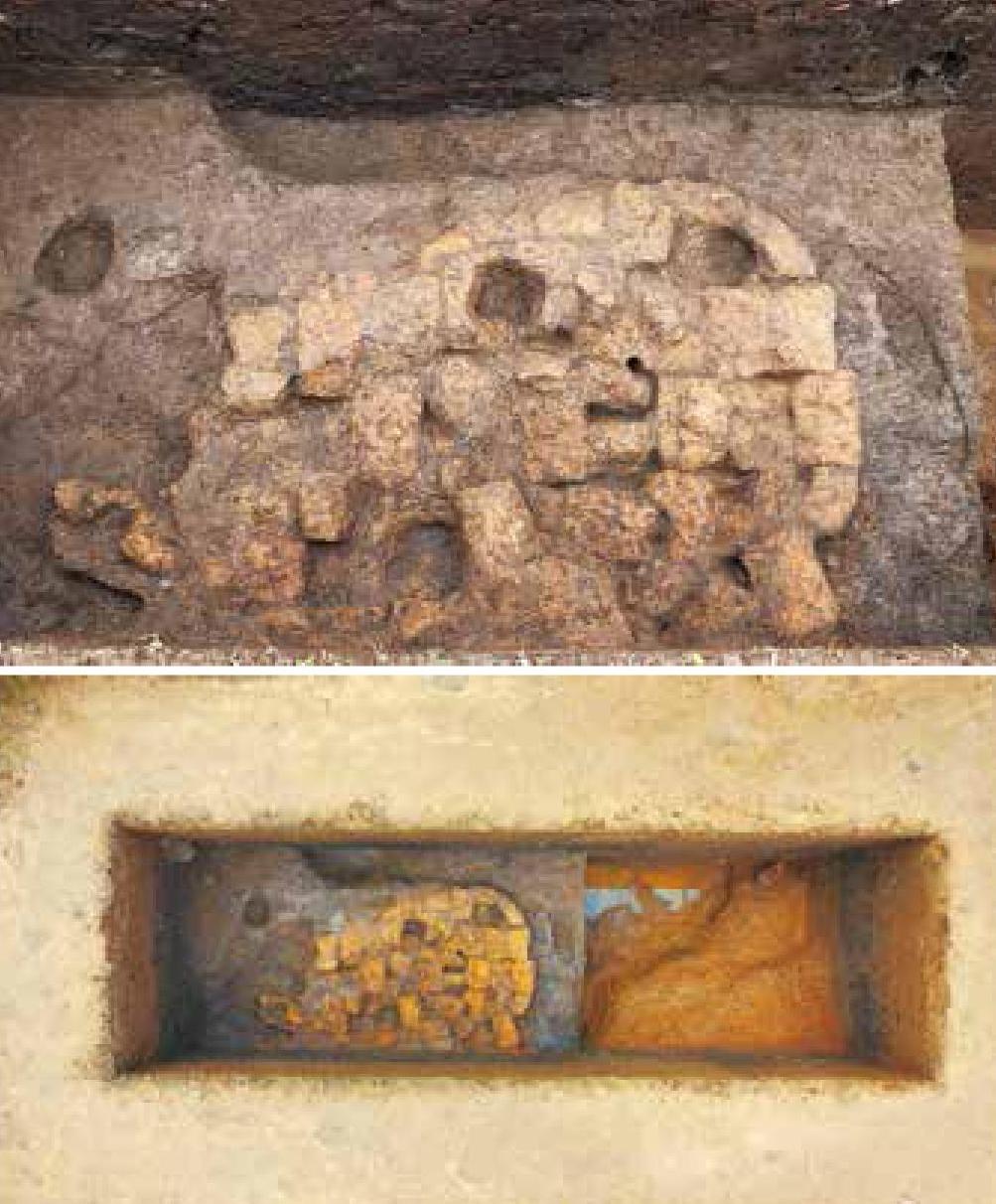
鄞縣故城外發現的坯料作坊遺址。The ruins of workshops located outside?the capital seat of ancient Yin County
Thanks to a combined undertaking that included thorough textual research, field studies, trial excavations, comparisons of geographic information, and analyses, archaeologists zeroed in onto the site, which is Chengshan (City Hill) near Shanchang, a village in Fenghua District, Ningbo. About 20 kilometers south of the downtown Ningbo, the site snuggles at the northern tip of Tiantai Mountain in the region.
The archaeologists explored an area of 800,000 square meters in this project and they discovered that the capital site measures only no more than 40,000 square meters, which classifies the county capital into a category of very small cities. As the capital was located far from anywhere, it can be reasoned that it did not have a big population back then.
The city used to be encircled by a wall. At present, only three sections of the city wall have been found. They are altogether 360 meters long. Of the three, the section in the north is relatively well preserved. It measures 4.1 meters wide at the top and 7.5 meters wide at the bottom and 1.6 meters tall. It isnt easy to figure out exactly how tall the original was, for the wall is no longer what it was. It is concluded on the basis of stoneware, potteries found in the earth of the wall that the wall must have been built in the years either in the late period of the Eastern Han Dynasty or in the early years of the Wu Kingdom.
The city didnt have a city wall for hundreds of years after it came into being. In 132 AD, the east of Zhejiang came under attack by armed bandits from the sea and local county magistrates were killed. In 240, King Sun Quan of the Eastern Wu ordered local cities to build city walls and moats to prevent armed invasions from the sea. It can be reasoned that the city had a wall in the second to third centuries.
The east and the south to the City Hill is relatively low and encircled by a river. The archaeologists explored the river section in the east and discovered many hard pottery objects that can be traced to the Warring Period and Han Dynasty. It is agreed that the city wall and the river pointed to where the city was and where the outside started. The living quarters are located on the south side of City Hill, near the river. Many building materials such as various types of roof tiles and tile ends as well as bricks have been excavated from the living quarters. As in these centuries tile ends were only used in government offices, public and religious buildings, it can be reasoned that these building materials are convincing testimonials that the area must have been used for that purpose. Archaeological finds indicate that workshops and tombs existed in separate areas outside the city proper.
Before the city project started in 2015, archaeologists had excavated hundreds of ancient tombs ranging from the Shang, the Zhou and up to the Ming and the Qing dynasties. During the city project, archaeologists discovered 91 more ancient tombs, which had been robbed in the past.
Why was the county capital located at such a spot? From ancient geographic features, it was a strategically convenient place. It had Taizhou to the south and the Dongqian Lake to the east. The lake back then was not a closed water system. Ships could reach through the lake many other places. The capital was located at the hill also for reasons of security. Most importantly, the spot had been a population center for centuries before it was turned into the county capital.
In January 2019, the ancient capital cite of Yin County archaeological project was designated as one of the key archaeological finds of 2018.