Diversity and distribution patterns of non-volant small mammals along different elevation gradients on Mt.Kenya,Kenya
2019-03-04 10:55:28SimonMusilaZhongZhengChenQuanLiRichardYegoBinZhangKennethOnditiImmaculateMuthoniShuiWangHeSamsonOmondiJamesMathengeEstherKiokoXueLongJiang
Zoological Research 2019年1期
Simon Musila,Zhong-Zheng Chen,Quan Li,Richard Yego,Bin Zhang,Kenneth Onditi,2,Immaculate Muthoni,Shui-Wang He,Samson Omondi,James Mathenge,Esther N.Kioko,Xue-Long Jiang,*
1Mammalogy Section,Department of Zoology,National Museums of Kenya,Nairobi 40658-00100,Kenya
2Kunming Institute of Zoology,Chinese Academy of Sciences,Kunming Yunnan 650223,China
3Anhui Province Key Laboratory for Conservation and Exploitation of Biological Resource,College of Life Science,Anhui Normal University,Wuhu Anhui 241000,China
4Kenya Wildlife Service,Mweiga Research Station,Nyeri 753-10100,Kenya
5Sino-Africa Joint Research Center,Chinese Academy of Sciences,Nairobi 62000-00200,Kenya
ABSTRACT The distribution of small mammals in mountainous environments across different elevations can provide important information on the effects of climate change on the dispersal of species.However,few studies conducted on Afromontane ecosystems have compared the altitudinal patterns of small mammal diversity.We investigated the species diversity and abundance of non-volant small mammals(hereafter‘small mammals’)on Mt.Kenya,the second tallest mountain in Africa,using a standard sampling scheme.Nine sampling transects were established at intervals of 200 m on the eastern(Chogoria)and western(Sirimon)slopes.A total of 1905 individuals representing 25 species of small mammals were trapped after 12240 trap-nights.Abundance was highest at mid-elevations on both slopes.However,species richness and their distribution patterns differed between the two slopes.More species were recorded on Chogoria(24)than on Sirimon(17).On Chogoria,species richness was higher at mid-high elevations,with a peak at mid-elevation(2800m a.s.l.),whereas species richness showed little variation on the Sirimon slope.These results indicate that patterns of species diversity can differ between slopes on the same mountain.In addition,we extensively reviewed literature on Mt.Kenya’s mammals and compiled a comprehensive checklist of 76 mammalian species.However,additional researchisrequiredtoimproveourunderstandingofsmall mammal diversity in mountain habitats in Africa.
Keywords: Small mammals;Species richness;Abundance;Elevation;Mt.Kenya
INTRODUCTION
Baseline information on biodiversity is important in ecosystem management planning.Clarifying species distribution provides useful information on ecology,habitat preference,and species replacement(Goodman et al.,1996;Malonza et al.,2018;Stanley&Kihaule,2016).Studies investigating the relationship between speciesrichnessandaltitudehaveyieldeddiversepatterns(Taylor et al.,2015).For instance,previous studies on non-volant small mammals have observed hump-shaped diversity curves,with the highest richness found at mid-elevations(McCain,2005).The montane mammal communities of sub-Saharan Africa have been sporadically studied,with research on mountain elevation distribution relatively well documented,including that of the Ruwenzori Mountains(Kerbis et al.,1998),Udzungwa Mountains(Stanley&Hutterer,2007),and Mt.Kilimanjaro(Mulungu et al.,2008;Stanley et al.,2014).However,studies of small mammals along different elevation gradients on Mt.Kenya are lacking.
Mt. Kenya is the second tallest mountain in Africa and one of the most important ecosystems for the conservation of biodiversity. It is recognized internationally both as an Important Bird Area and World Heritage site and is a vital water catchment area in Kenya(Bennun&Njoroge,1999).The mountain has diverse habitats,including montane forest,bamboo,moorland,and alpine tussock grasslands(Happold&Happold,1989;Yalden,1988;Young&Evans,1993).Although several notable studies have been conducted on the diversity of mammals on Mt.Kenya(Coe&Foster,1972;Hollister,1918,1919;Moreau,1944;Thomas,1900;Young&Evans,1993),these previous surveys were of short duration or opportunistic and did not focus on small mammal elevational distribution(Coe&Foster,1972).Information on the distribution of animals along different elevations on Mt. Kenya can be used as a baseline for monitoring future changes in the distribution of species,especially due to the effects of climate change,compared with that in previous collections(e.g.,Hollister,1918,1919). In the present study,we conducted a comparative analysis of small mammal species richness on the Chogoria and Sirimon slopes of Mt.Kenya to understand their diversity and distribution patterns.
MATERIALS AND METHODS
Study area
This study was conducted on Mt.Kenya in September and October 2015.The mountain is located at S0°10′,E37°20′and has an altitudinal range of 1600-5200 m a.s.l.(Bennun&Njoroge,1999).The Kenya Forest Service manages the lower elevation forests,whereas the moorland(above 3000 m a.s.l.)is managed as a National Park(71500 ha)by the Kenya Wildlife Service(Bennun&Njoroge,1999).The forest has an estimated total area of 271000 ha.Blackett(1994)estimated that of the 199500 ha of forest reserve area,closed canopy forest accounted for 61000 ha,bamboo forest mosaic for 63000 ha,forest scrub for 20000 ha,exotic plantation forest for 20500 ha,and non-forest habitat for 35000 ha.The windward eastern slope of the mountain includes much of Chogoria and Meru towns,whereas Nanyuki and Naromoru towns are found on the leeward western slope.The current study was undertaken on both slopes.Highland forest starts at 1800 m a.s.l.on Chogoria,but at 2400 m a.s.l on Sirimon(Figure 1).
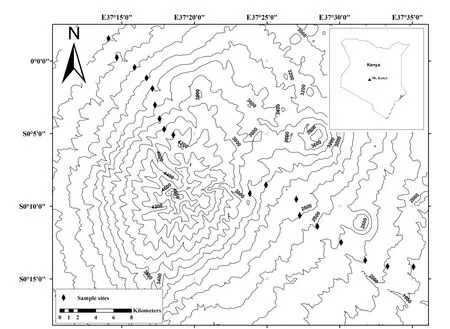
Figure 1 Map of Mt.Kenya showing the nine elevation transects sampled on the Chogoria and Sirimon slopes
Sampling methods
We conducted small mammal surveys from 1800 m to 3400 m a.s.l.on the Chogoria slope and from 2400 m to 4000 m a.s.l.on the Sirimon slope(Figure 1).The broad vegetation characteristics of each elevation gradient are brie fl y described in Table 1.Sampling stations were established at nine sites at intervals of 200 m on both slopes(Figure 1,Table 1).At each site,six trap lines were established,each with 25-30 trap stations at intervals of 10 m.At each trap station,one Sherman trap and one metallic snap trap was set at 1-2 m apart.The Sherman traps were baited with oat fl akes,whereas the snap traps were baited with raw peanuts.In addition,six bucket pitfalls were used to capture shrews along each trap line.Traps were set in microhabitats with suspected small mammal occurrence,including under tree logs,along rodent runs,in thick grass,or under shaded vegetation.Traps were checked once in the morning,re-baited and left in their original position for two consecutive nights,before being moved to the next transect.Six hundred and eighty(680)trap nights were accumulated at each transect.Measurements were taken for each individual,including lengths of head and body(HB),tail(TL),hind foot(HF),and left ear(EL),as well as weight(WT).Vouchers of each species were prepared either as stuffed museum specimens or preserved whole as wet specimens in 70%ethanol and deposited in the Mammalogy Section Laboratory,National Museums of Kenya(NMK).For each specimen,muscle and/or liver tissue samples were obtained and preserved in absolute ethanol for further DNA work.We also recorded large-and medium-sized mammals encountered during the survey by direct(sightings)or indirect observation(scats and footprints).In addition,we extensively reviewed literature on Mt.Kenya’s mammals to compile a list of all mammals(Baker,1971;Bennun&Njoroge,1999;Butynski&de Jong,2007;Carleton&Byrne,2006;Coe&Foster,1972;Flux&Flux,1983;Hollister,1918,1919;Kingdon et al.,2013;Mbau et al.,2009,2010;Monadjem et al.,2015;Musila et al.,2019;Musser&Carleton,2005;Stanley et al.,2015;Taylor et al.,2011;Young&Evans,1993).Taxonomic statuses and species names followed Kingdon et al.(2013)and Musila et al.(2019).
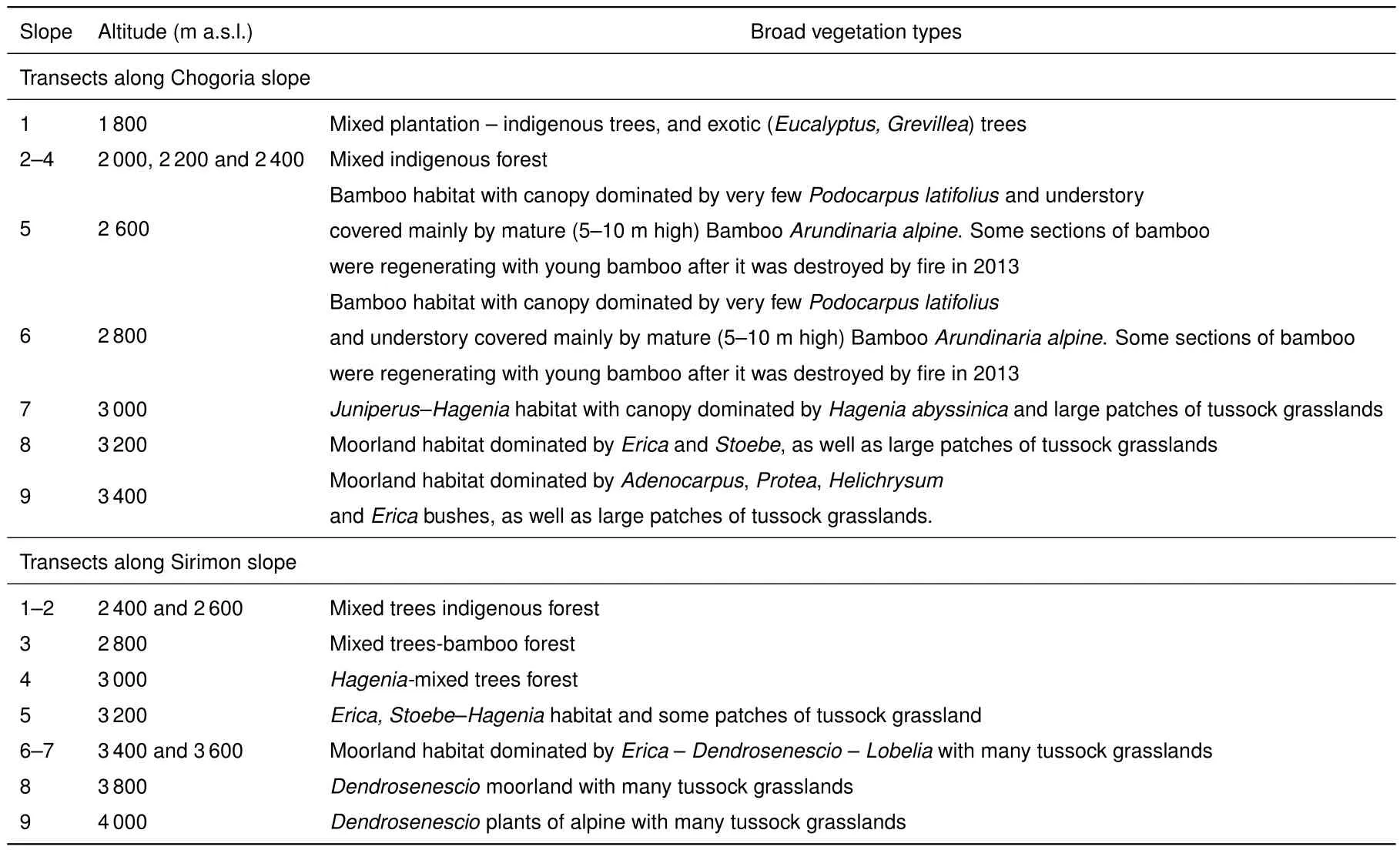
Table 1 Broad vegetation characteristics of the sampled elevation gradients on the Chogoria and Sirimon slopes of Mt.Kenya
Data analysis
All trapped individuals were identi fi ed to genus or species level based on external and craniodental morphology and distribution using Hollister(1919),Kingdon et al.(2013),and Monadjem et al.(2015). In addition,specimens that could not be identi fi ed to species level were further analyzed using molecular and morphometric data.We ampli fi ed the complete mitochondrial cytochromebgene(cytb)and/or cytochrome oxidase I gene(COI)for all specimens. We identi fi ed the haplotypes from both genes using DnaSP v.5.10(Librado&Rozas,2009).Phylogenetic relationships among the haplotypes were constructed by Bayesian inference in BEAST v1.8.2(Drummond et al.,2012).Each major monophyletic clade in the Bayesian tree was recognized as a putative species.These putative species were then identi fi ed following Hollister(1918,1919),Kingdon et al.(2013),and Monadjem et al.(2015),and by comparing the molecular and morphometric data with specimens in the NMK and Field Museum of Natural History collections.The number of individuals of each small mammal species was compiled for each transect and slope.The Shannon-Wiener index(Shannon et al.,1963)of diversity was used to calculate species diversity.All statistical analyses were performed using SPSS(IBM Corporation,2013).Species identified from opportunistic surveys and literature review were not included in the analyses of species richness and distribution.
RESULTS
Small mammal species richness and distribution patterns
A total of 76 species of mammals were recorded from Mt.Kenya,including 35 from systematic and opportunistic surveys in the current study and 41 from the literature review.Of the 76 species,46 were small mammals(less than 1.5 kg)and the rest(30)were medium-or large-sized mammals(Supplementary Table S1).
In the current study,we captured 25 small mammal species from three orders(Table 2).Many species(16)were shared between the two slopes,but more species were recorded on Chogoria(24)than on Sirimon(17).The mean number of species at each elevation was lower on Chogoria(9.00±2.50)than that on Sirimon(9.22±1.30).Although the number of species captured per elevation was more varied for Chogoria(4-12)than for Sirimon(7-11)(Table 3),the Shannon-Weiner index of diversity was lower for Chogoria(2.26±0.24)than for Sirimon(2.34±0.27).
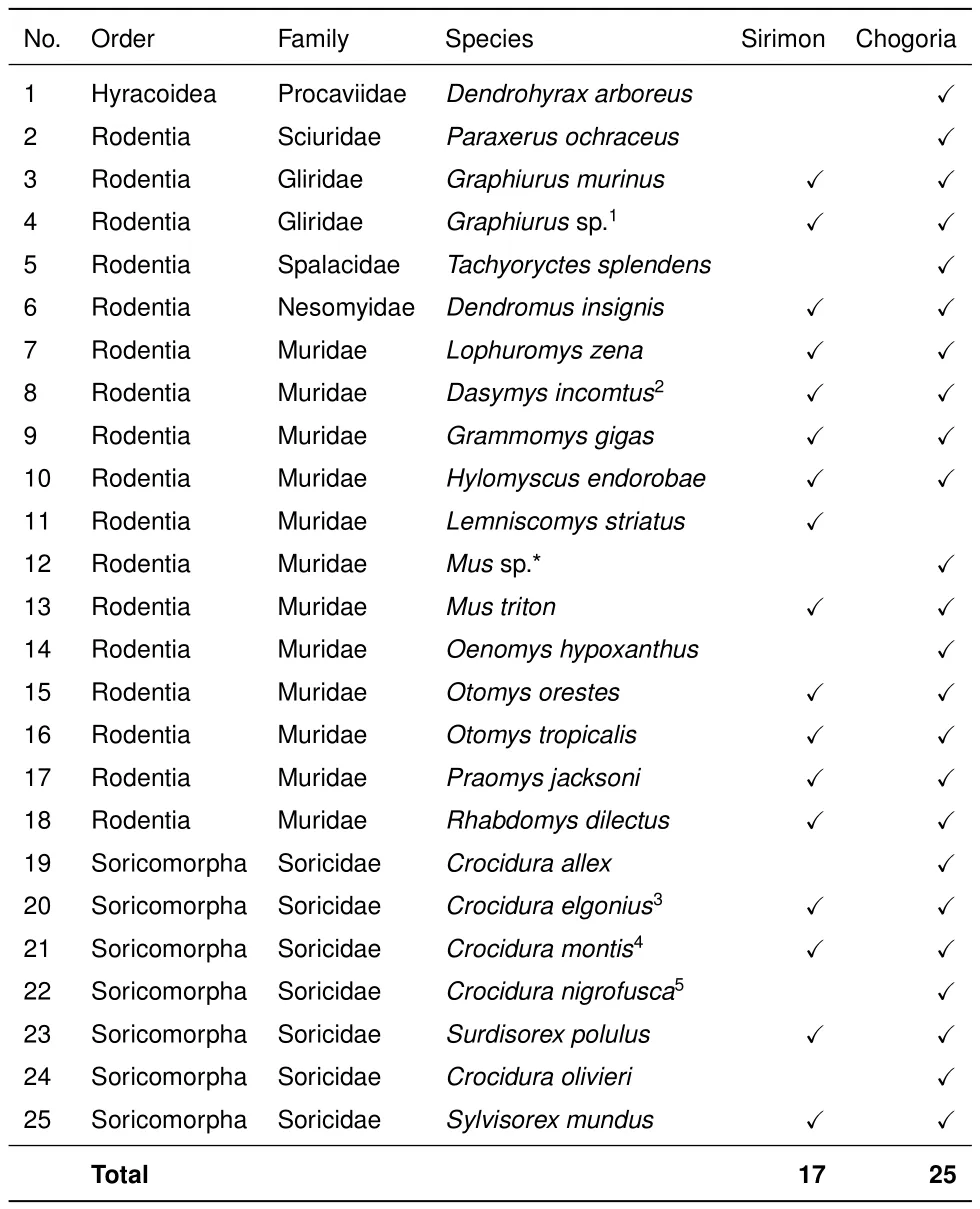
Table 2 Species of small mammals captured on the Chogoria and Sirimon slopes of Mt.Kenya
Elevational distribution varied among species and between slopes.Species inLophuromysandCrocidurawere the most abundant and were recorded at all sampling elevations on both the Sirimon and Chogoria slopes.One species in the genusMus(hereafter ‘Mussp.’) differed from any known form and may represent an undescribed species.The Mt.Kenya mole shrew(Surdisorex polulus),endemic to Mt.Kenya,was recorded from 2400 to 3400 m a.s.l.,except for 2600 and 3200 m a.s.l.,on Chogoria but at 3200-3800 m a.s.l.on Sirimon.Lemniscomys striatuswas recorded at 2400 m a.s.l.on Sirimon but not on Chogoria.Dendromus insigniswas recorded from all elevation transects on Sirimon,except at 2800 m a.s.l.,but only at 3000-3400 m a.s.l.on Chogoria.Praomys jacksoniwas recorded from three elevations between 2400-2800 m a.s.l.on Sirimon but in fi ve sampling elevations between 1800-2600 m a.s.l.on Chogoria.Otomys tropicaliswas recorded at all elevations on Sirimon,except 2800 m a.s.l.,but only occurred at higher elevations on Chogoria(2600-3400 m a.s.l.).Sylvisorex munduswere recorded at 2400-2800 m a.s.l.on Sirimon and at 2600-2800 m a.s.l.on Chogoria.
The species richness and distribution patterns were different between Chogoria and Sirimon. On Chogoria,species richness was highest at mid-high elevations,with a peak at mid-elevation(2800 m),whereas the lowest species richness was recorded at the lower elevation of 2200 m a.s.l.(Figure 2).On Sirimon,species richness peaked at 1800 m and 3200 m a.s.l.,with the lowest species richness found at 2800 m a.s.l.Species richness on Chogoria was relatively even across the different elevations,with only a marginal decline along the sampled gradients(Figure 2).
Small mammal abundance along elevation gradients
A total of 1905 small mammal individuals were captured after 12240 trap-nights,with a trap success rate of 15.5%.Eight hundred and ninety-eight(898)individuals were trapped on Chogoria and 1007 on Sirimon.As expected,rodents were the most abundant along both transects:Chogoria(693)and Sirimon(823)(Table 3).Mean small mammal abundance for each elevation was 99.6±33.5 on Chogoria and 111.9±27.5 on Sirimon.The most abundant species wasLophuromys zena(27.7%),followed byHylomyscus endorobae(15.5%),Crocidura montis(15.6%),andPraomys jacksoni(12%).
The number of individuals captured per elevational transect varied from 62 to 162 on Chogoria and from 75 to 142 on Sirimon. On Chogoria,there were apparent peaks in small mammal abundance at 2800 m and 3000 m a.s.l.(Figure 3),where bamboo forest andJuniperus-Hageniawith large patches of tussock grassland were the main vegetation.The abundances in low elevation natural forest and high elevation moorland were relatively low.On Sirimon,abundance was higher at mid-elevations from 2800-3800 m a.s.l.,except for an apparent dip at 3400 m a.s.l.
Medium-and large-sized mammals
Mt.Kenya is one of the largest forest conservation areas in Kenya.Although we focused on small mammals,we also conducted opportunistic recordings of medium-and large-sized mammals encountered both directly and indirectly.Most large mammals recorded,such asLoxodonta africanaandSyncerus caffer,were dif fi cult to observe directly because of thick forest cover,but we often encountered fresh tracks and scats of these species. Individuals ofKobus ellipsiprymnuswere fairly easily seen in the open grasslands at lower elevations.Cercopithecus mitis kolbiandColobus guereza kikuyuensiswere very common in the forest canopies,especially on Chogoria.Dendrohyrax arboreuswould call in the evening at lower elevations(1800-3000 m a.s.l.),especially in areas with continuous tree cover.The duiker(Cephalophus nigrifrons),hare(Lepus victoriae),spotted hyaena(Crocuta crocuta),and skunk(Ictonyx striatus)were rarely spotted.The giraffe(Giraffa camelopardalis)was only documented to occur on Chogoria by three teeth found near Lake Ellis at an elevation of 3500 m(Mwebi et al.,2019).
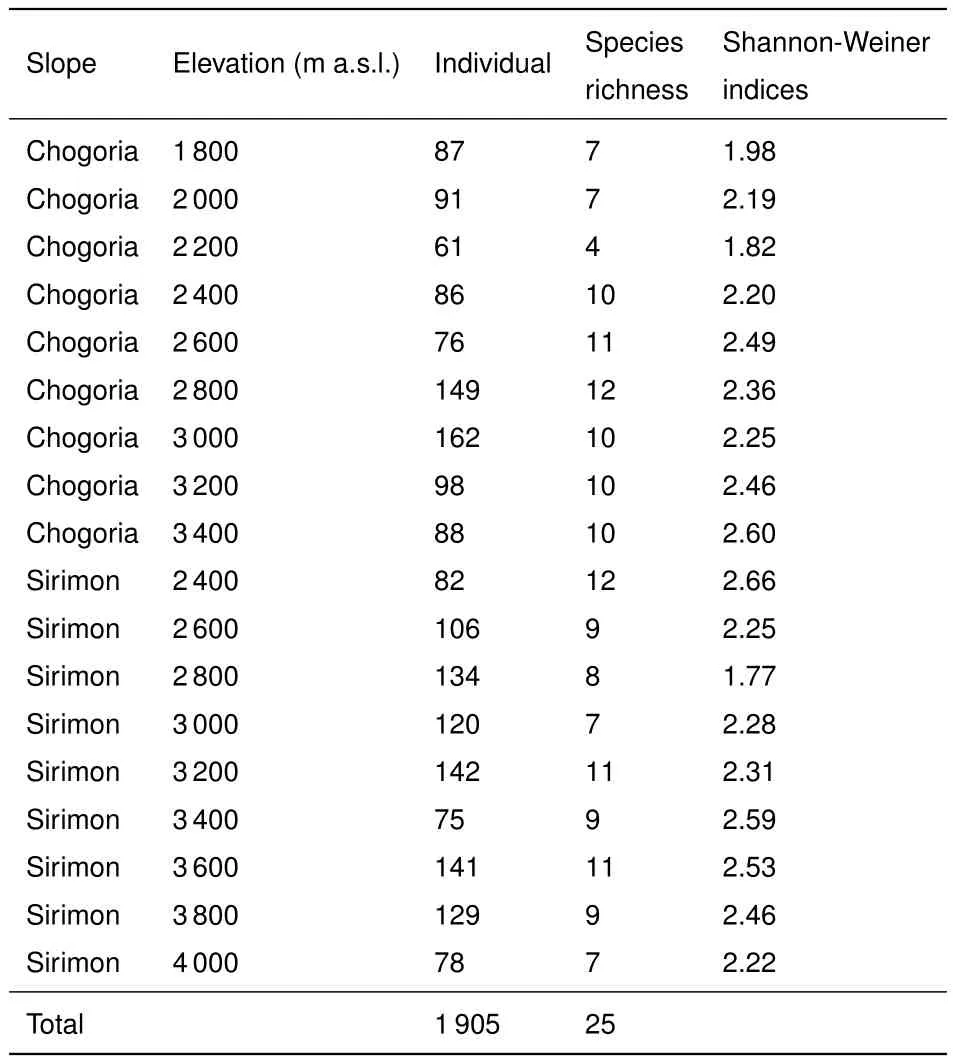
Table 3 Number of individuals and species richness at each elevational site on Mt.Kenya
DISCUSSION
This study investigated the diversity and distribution patterns of small mammals on Mt. Kenya along different elevation gradients.We also compiled a checklist of mammals known to occur in the area.A total of 76 mammal species were recorded,including 46 small mammals and 30 large-or medium-sized mammals.We found higher small mammal species richness on Chogoria(24)compared to that on Sirimon(17).Chogoria had higher species diversity,probably because it occurs on the windward side of Mt.Kenya and receives more rainfall than the western leeward side(Sirimon).In addition,Chogoria had more diverse habitat types;six sampling transects between 1800 m and 2800 m a.s.l.occurred in forested habitats compared to four(2400-3000 m a.s.l.)on Sirimon.Thus,the larger forested habitat area and associated diversity of habitat niches on Chogoria may have contributed to the higher diversity of small mammals.
The compiled checklist of mammals is still incomplete as only a small part of Mt.Kenya’s ecosystem(271000 ha)has been well surveyed.Most past surveys were only conducted for short periods over small areas and were generally opportunistic in nature.As such,a complete mammal list of the expansive and diverse habitats of the mountain has not yet been completed.Indeed,during the current fi eld work,we trapped 25 species of small mammals,including at least one putative new species(Mussp.).Importantly,we found that many taxa need revision.For example,individuals of the genusCrocidurawere very dif fi cult to identify using external morphology alone;hence,we used both molecular and morphometric characters to identify and classify these individuals.There were at least fi ve species ofCrocidurafrom the 345 individuals captured.However,most checklists of Mt. Kenya include only two species(C.allexandC.olivieri),except for Hollister(1919)who recognizes fi ve. Similarly,two species ofGraphiurus(G.murinusandG.microtis saturates)were recorded from Mt.Kenya by Hollister(1919).However,onlyG.murinusis widely accepted in recent publications(Young&Evans,1993;Happold&Happold,1989).Our Bayesian tree revealed two distinct clades in the genusGraphiuruswith a genetic distance of 11.2%,suggesting an additional species,which may beGraphiurus microtis saturatesrecorded by Hollister(1919)or an undescribed species.
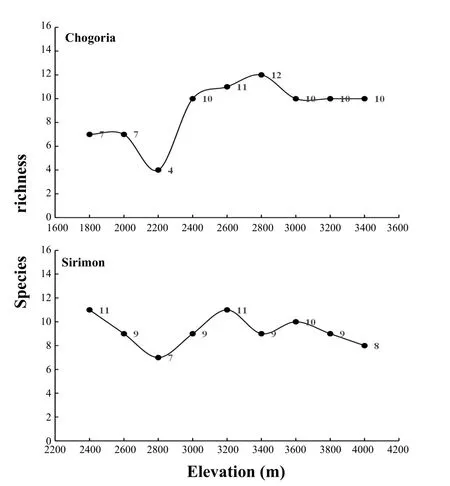
Figure 2 Distributionpatternsofsmallmammalspeciesrichness with elevation on the Chogoria and Sirimon slopes of Mt.Kenya
Other species of interest recorded in this survey included those of the genusTachyoryctes;although we only trapped three individuals of this genus,many of their active and old nests were encountered in the grasslands,indicating that large numbers likely occur on Mt. Kenya. The taxonomy ofTachyoryctesis complex and is not well resolved in current work. For example,Musser&Carleton(2005)considersT.ankoliae,T.annectens,T.audax,T.daemon,T.ibeanus,T.naivashae,T.rex,T.ruandae,T.ruddi,T.spalacinus and T.storeyas valid species,whereas Monadjem et al.(2015)con fi rms onlyT.rex,T.annectens,T.ibeanus,T.spalacinus,andT.ruddias valid species from Kenya based on morphometric analysis and distinct biogeographical and ecological distributions of each species in the country.According to Monadjem et al.(2015),only two(T.spalacinusandT.rex)species ofTachyoryctesoccur on Mt.Kenya.Thus,this taxonomic confusion of the genusTachyoryctesin Kenya requires further research.In addition,although 104 bat species are known from Kenya(Musila et al.,2019),no bat survey has been undertaken on Mt.Kenya,and those listed in our supplementary table were recorded by opportunistic methods only.Furthermore,during a carnivore scat survey undertaken at the same time and on the same slopes as our survey,species ofAcomysandThamnomyswere identi fi ed from animal remains collected on Mt.Kenya(Mwebi et al.,2019),which have not been reported previously on this mountain.Hence,it is expected that the species list of mammals from Mt.Kenya will increase in the future with additional surveys on bats,shrews,and rodents and as the taxonomic statuses of small mammals from this mountain become better understood.
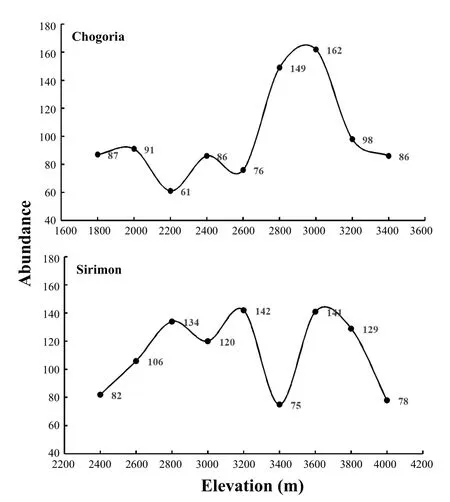
Figure 3 Distribution patterns of small mammal abundance with elevation on the Chogoria and Sirimon slopes of Mt.Kenya
As regions with high species abundance often occur at intermediate elevation bands(Bateman et al.,2010;Whittaker et al.,2001),the high abundance at mid-elevations on both the Chogoria and Sirimon slopes may be due to the interaction of temperature,water,and vegetation(Curran et al.,2012;Kok et al.,2012;Kry?tufek et al.,2011;Linden et al.,2014;McCain,2007).On Chogoria,small mammal abundance increased at 2800-3000 m a.s.l.in grassland and bamboo forest;whereas,on Sirimon,small mammals were most abundant in the tussock grassland(Tables 1 and 3).The bamboo forest and tussock grassland had high habitat heterogeneity and complexity as well as water availability(e.g.,streams).Interestingly,there was an apparent dip in abundance at 3400 m a.s.l.on Sirimon.This anomalous decrease could be attributed to low habitat heterogeneity and high human disturbance(e.g.,roads and settlements)due to the fl atter terrain.
Our results revealed different species richness patterns between the two slopes of Mt. Kenya. On Chogoria,species richness was higher at high altitudes and peaked at mid-elevations(2800 m a.s.l.). However,species richness showed little variation on Sirimon,which exhibited two peaks,one at mid-elevation(3200 m a.s.l.)and one at lower elevation(2600 m a.s.l.). These results are supported by previous studies that have shown that even different slopes of the same mountain habitat can possess distinct patterns of mammal distribution(Chen et al.,2017). Differences in climate and vegetation between slopes may also partly explain this phenomenon. Previous studies have revealed mostly hump-shaped distributions of small mammal species along elevation gradients,with richness peaking at mid-elevations(McCain,2005,2007).However,such elevational patterns of species richness between two opposing slopes of the same mountain ecosystem are,in general,rare.Interestingly,most previous studies on African mountains have not followed the hump-shaped distribution pattern(Kerbis et al.,1998;Kasangaki et al.,2003;Taylor et al.,2015).However,additional surveys are required to clarify these differences in elevational species richness patterns in African mountain ecosystems.
The Mt. Kenya ecosystem faces many conservation challenges,including annual fi res,tree poaching,cultivation of the illegal but lucrativeCannabis sativa,and uncontrolled livestock grazing(Bennun&Njoroge,1999).These habitat disturbances and fragmentation activities affect the distribution of both small and large mammals on Mt.Kenya.For instance,21 individuals ofSurdisorex poluluswere recorded in the moorland and tussock grassland.Large areas of this habitat are razed at least once every two years,yet it is unclear howSurdisorex polulusindividuals are affected by these fi res.Furthermore,Tragelaphus euryceroshas become rare on Mt.Kenya due to illegal bush-meat poaching,and it is likely that the abundance of this species may have declined dramatically over the years.Although Mt.Kenya is a large ecosystem with diverse habitats capable of sustaining a high diversity of mammals,biodiversity is increasingly threatened by human activities.
In conclusion,we examined small mammal diversity and distribution on the Chogoria and Sirimon slopes of Mt.Kenya and compiled a comprehensive checklist of mammals found on the mountain.Results demonstrated that there were more individuals of small mammal species on Sirimon than on Chogoria.Furthermore,although the highest abundance was observed at mid-elevations on both slopes,elevational species richness patterns differed between the slopes.The results of this study provide baseline information that can be used to monitor the effects of climate change on the distribution of mammal species in this ecosystem.In addition,to compile a comprehensive checklist of mammals of this mountain,more surveys,especially on bats,are needed.
COMPETING INTERESTS
The authors declare that they have no competing interests.
AUTHORS’CONTRIBUTIONS
X.L.J.,Z.Z.C.,and S.M.designed and performed the study.Q.L.,R.Y.,B.Z.,I.M.,J.M.,and S.O.contributed to the fi eld work.K.O and S.W.H.performed the molecular work.Z.Z.C.and S.M.analyzed the data.S.M,Z.Z.C.,K.O.,and X.L.J.wrote and revised the manuscript.E.N.K.contributed to the development of the idea.All authors read and approved the fi nal version of the manuscript.
ACKNOWLEDGEMENTS
We thank the Kenya Wildlife Service and Kenya Forest Service for granting us access to the study area,and for providing rangers for security in the fi eld.We are also grateful to Ogeto Mwebi,Laban Njoroge,Phillip China,Samuel Maina,James Onyango,and Robert Kurui for their assistance with various logistics.