
Guidelines to Authors
2019-02-16 12:38:58
1. Aims and scope
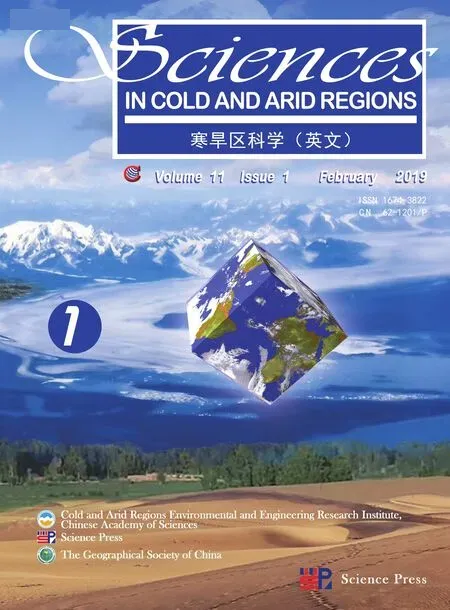
The international journal Sciences in Cold and Arid Regions, is devoted to publishing the latest research achievements in processes and the patterns of the Earth surface system in cold and arid regions. Research in cold regions emphasize particularly on the cold-region-characterized physical, chemical and biological processes and their interactions, and on the response of cryosphere to global change and human activities as well as their effects on environment and the acclimatizable strategies; focus on the objects of glacier, snow,river, lake, sea ice, permafrost and seasonal frozen ground, and periglacial geomorphology, etc.; and think much of cold regions engineering and technology. Research in arid regions emphasize particularly on the arid-region-characterized physical, chemical and biological processes and their interactions, and on the response of arid regions to global change and human activities as well as their effects on environment and the acclimatizable strategies; focus on the objects of desert, oasis, loess, and aeolian landforms, etc.; and support integrated studies on mountain-desert-oasis system in arid watershed with water resources as masterstroke, so as to provide reliable technological support for water safety, ecology safety and food safety in arid regions.
2. Manuscript submission
SCAR operates an online submission and peer review system that allows authors to submit articles online and track their progress via a web interface. To submit a manuscript, please enter Journal’s Homepage, http://www.scar.ac.cn or directly enter https://mc03.manuscriptcentral.com/scars, get an account, and follow the instructions to upload the paper files (in Word format). The signed Copyright Transfer Form (Download on Journal’s Homepage) should be scanned and uploaded as "Supplementary files not for review" with the online submission of your article. Authors are encouraged to suggest the names and full contact details of potential referees on the understanding that the Editor has the final decision on the selection of referees. Submission of a manuscript will be held to imply that it contains original unpublished work and is not being submitted for publication elsewhere at the same time.
3. Manuscript types
? Review: authoritative and foresighted articles, which review the present research status, progress and problems of active, rapidly developing research fields, and bring forward perspicacious assume for future study; summarize the representative achievements of a certain important field, findings, progresses and problems in the emerging research fields and make suggestions for the future work.
? Research articles: report innovative, systematic and integrated study results.
? Brief express: report prominently innovative investigation with great academic significance. Text comprises only a heading (no subhead) and a brief abstract, totaling less than 3,000 words (two page spaces). The full text of final investigation results can still be published in "Research articles" of this Journal.
? Forum or news: introduce and comment on quality monographs of natural sciences, discuss and make reply to the contributions published in Sciences in Cold and Arid Regions, or introduce and comment on a controversial issue of general interest; report important scientific news, information, and academic affairs, as well as the significant international conferences held in China (800 words).
4. Manuscript composition (in the order given)
1) Title: Concise and informative title is often used in information-retrieval systems, so it is suggested avoiding abbreviations and formulae where possible.
2) Author names and affiliations: Please give full name details for all authors who are responsible for the paper’s gist and data, cited with given name before family name (e.g., YaFeng Shi, James S. Gardner). Where the family name may be ambiguous (e.g., a double name), please connect them with hyphen. Present the authors’ affiliation addresses (where the actual work was done) below the names.Indicate all affiliations with a superscript number immediately after the author’s name. Provide the full postal address of each affiliation, including the country name.
3) Corresponding author: Please clearly indicate who will handle all stages of refereeing, publication, and post-publication. Ensure his or her complete postal address, telephone and permanent E-mail.
4) Abstract: Abstracts should state briefly the purpose and method of the study, the principal results and major conclusions. An abstract is often presented separate from the article, so references, non-standard or uncommon abbreviations should be avoided.
5) Keywords: Immediately after the abstract, provide a maximum of 6 keywords, avoiding general and plural terms and multiple concepts (avoid, for example, "and", "of").
6) Introduction: State the objectives, the method of the work and provide an adequate background, avoiding a detailed literature survey or a summary of the results.
7) Materials and methods: Provide sufficient detail to allow the work to be reproduced. Methods already published should be indicated by a reference.
8) Discussion and conclusions: Please relate your findings to past and current published work, indicating the significance of your contribution, with its limitations, advantages and possible applications.
9) Acknowledgments: Acknowledgments include information on grants received, and if applicable, the information regarding fund;recognition of people who assisted in the research or article.
10) References: Please ensure that every reference cited in the text is also present in the reference list (and vice versa). Unpublished results and personal communications should not be in the reference list, but may be mentioned in the text, e.g., (Smith J, personal communication, 2006). In the text, references are cited as (Harris, 2009) for single author, as (Osterkamp and Romanovsky, 1999) for two, and as (Bhandarkar et al., 2006) for three or more authors. Citations may be made directly (or parenthetically). Groups of references should be listed first chronologically, then alphabetically. In the reference list, references should be arranged first alphabetically and then further sorted chronologically if necessary. More than one reference from the same author(s) in the same year must be identified by the letters "a", "b", "c", etc., placed after the year of publication. Note: All authors should be listed by family name.Examples:
? Reference to a journal publication:Yao TD, Zhang YS, Pu JC, et al., 2011. Hydrological and climatological glaciers observation 20 years on Tanggula Pass of Tibetan Plateau: its significance and contribution. Sciences in Cold and Arid Regions, 3(3): 187–196. DOI:10.3724/SP.J.1226.2011.00187.
? Reference to a book:Cooke RU, Warren A, Goudie A, 1993. Desert Geomorphology. 2nd edition. London: UCL Press, pp. 10–20.
? Reference to a chapter in an edited book:Brouwer R, Dewit CT, 1969. A simulation model of plant growth with special attention to root growth and its consequences. In:Whittington WJ (ed.). Root Growth. London: Butterworth, pp. 224–244.
? Reference a paper in a conference proceeding:Sterk G, van Boxel J, Zuurbie R, 2002. Interactions between turbulent wind flow and saltation sand transport. In: Lee JA, Zobeck TM(eds.). Proceedings of ICAR5/GCTE-SEN Joint Conference, International Center for Arid and Semiarid Lands Studies. Lubbock:Texas Technology University, pp. 63.
? Reference to a thesis or dissertation:Amory JY, 1996. Permaian sedimentation and tectonics of southern Mongolia. M.S. Thesis, Stanford University, pp. 183.
? Internet publication/Online document:UNESCO, 2012. Tara Oceans Expedition: Call in New York (Feb. 17, 2012). http://www.unesco.org/new/en/natural-sciences/. Cited in Feb.22, 2012.
5. Manuscript format (please find "The sample of manuscript" in Journal's Homepage)
1) Please write your text in good English (American or British usage is accepted, but not a mixture of them). The manuscripts should be organized in a 10.5 pt Times New Roman font with 1 line spacing.
2) Tables should be concise and exact and must be edited in Microsoft Word easily (should not be in picture format). Tables are required to be numbered consecutively with Arabic numerals and placed in their corresponding places in the main text.
3) Figure captions should be concise, precise guides to the interpretation of each figure. Figure captions are required to be numbered consecutively with Arabic numerals placed in their corresponding places in the main text.
4) It is strongly recommended that all figures are properly processed and then inserted in a Word file "Paper figures", being compressed while uploading if necessary.
● Figure size: 70–80 mm in width (half column); 140–160 mm in width (single column); 160mm×240mm (within the page space,including figure caption).
● Font size: letters and numerals are in Times New Roman font and their sizes are commonly not larger than 8 pt. Other symbols should be clearly legible.
● Photographs (or combined with drawings) should be applied with high-resolution (over 600 dpi).
6. Reviewing, revision and acceptance of manuscripts
Every manuscript is independently reviewed by peers. If two or more reviewers consider the manuscript unsuitable for publication in this journal, a statement for the decision will be sent to authors within two months of the submitting date. A manuscript sent back to corresponding author for revision should be returned to the editor without delay. One to two months before the manuscript is published, a press proof in".pdf" format will be emailed to authors. Authors check and approve the press proof, then upload or email back in 5 days.
7. Publishing
Once the article is published in this journal, we’ll email you the up-to-date PDF version of our journal contents. You can also freely download the papers you are interested in from SCAR’s Homepage. In addition, three samples (extra requirement just contact the editorial office) will be provided to the corresponding author. So, the information of Corresponding author is very important (Note: the complete postal address in Chinese is also necessary for authors from China. Please write it in cover letter).
For more information, please go to:http://www.scar.ac.cn
 Sciences in Cold and Arid Regions2019年1期
- Sciences in Cold and Arid Regions的其它文章
- Increase in medium-size rainfall events will enhance the C-sequestration capacity of biological soil crusts
- How changes of groundwater level affect the desert riparian forest ecosystem in the Ejina Oasis,Northwest China
- Accumulation and geochemical evidence for the Little Ice Age episode in eastern Antarctica
- Primary investigation of statistical correlation between changes in ice volume and area of glaciers
- Vulnerability and adaptation of an oasis social–ecological system affected by glacier change in an arid region of northwestern China
- The analysis of heat and water fluxes in frozen silty soil