為時(shí)代增輝,與世界同行
2018-12-13 04:49:54徐繼宏
文化交流 2018年12期
徐繼宏
何水法喜歡穿大紅色的衣服。用他自己的話說,紅色象征著活力,紅色代表著繁榮,紅色蘊(yùn)含著希望。
筆者與何水法相見時(shí),今年72歲的他穿著依然是那樣的紅,說話依然是那樣的豪放和不拘。
今年是改革開放40周年。何水法說,作為改革開放的見證人、偉大時(shí)代的受益者、中華文化的傳播者,有著更多的感悟、思考和期許。
不拘一格降人才
“我沒讀過大學(xué),是1978年不拘一格降人才的政策,讓我成為改革開放的直接受益者。可以說,沒有改革開放,就沒有我的今天。”作為改革開放的見證者,何水法開門見山地說。
從1978年到2018年,40年過去了,何水法還清晰地記得,是改革開放的春風(fēng),讓他有幸成為改革開放后全國(guó)第一批國(guó)畫系花鳥專業(yè)的研究生。
1978年,剛過而立之年的何水法遇到了改變?nèi)松\(yùn)的大好機(jī)遇——國(guó)家出臺(tái)了一系列加緊人才選拔培養(yǎng)的政策,打破唯學(xué)歷、唯資歷的限制,唯才是舉、唯才是用,不拘一格降人才。出于對(duì)繪畫藝術(shù)的摯愛,這一年他選擇了報(bào)考中國(guó)美術(shù)學(xué)院(前身為浙江美術(shù)學(xué)院)研究生。
為了復(fù)習(xí)迎考,他帶上干糧,在位于杭州市大學(xué)路的浙江圖書館一待就是一整天。《中國(guó)美術(shù)史》中的內(nèi)容當(dāng)時(shí)是必考的,但書買不到,他就到圖書館去借閱。后來(lái),他干脆開始動(dòng)手抄書,抄了3天,只抄到一半。再后來(lái),這種刻苦用功的勁頭把圖書館管理員給打動(dòng)了,剩下的部分,圖書管理員允許他把書借回家去抄。就這樣,用了一周的時(shí)間,他硬是把一本《中國(guó)美術(shù)史》給抄完了。后來(lái),學(xué)校又臨時(shí)通知要加考《西方美術(shù)史》,他又去圖書館抄書。前后一個(gè)多月時(shí)間,他基本上都是在圖書館度過的。
功夫不負(fù)有心人,由于準(zhǔn)備充分,何水法如愿以償。何水法說,不拘一格降人才的政策好,但還要有扎實(shí)的基本功和文化積淀才能支撐藝術(shù)的發(fā)展。比如,1975年和1977年中國(guó)有兩次赴日本開書法展,他的作品都被選中。1975年的那一次,全國(guó)共入選67件作品,浙江入選6件,分別是陸維釗、吳茀之、諸樂三、陸抑非、駱恒光、何水法。第二次是1977年,全國(guó)共入選63件作品,浙江又有4件入選,分別是陸維釗、吳茀之、諸樂三、何水法。當(dāng)時(shí),國(guó)家對(duì)書畫藝術(shù)十分重視,其作品兩次入選書法展,對(duì)順利考上中國(guó)美術(shù)學(xué)院研究生也發(fā)揮了很大的作用。
“盡管從小就習(xí)書畫畫,但系統(tǒng)學(xué)習(xí)中國(guó)畫藝術(shù),還是從讀研究生開始的。”何水法說,是1978年改革開放好政策,讓他走進(jìn)了真正的藝術(shù)殿堂,也讓他的藝術(shù)生涯從此豐富而多彩。
筆墨當(dāng)隨時(shí)代
藝術(shù)源自生活,筆墨當(dāng)隨時(shí)代。這是何水法常說的一句話。在他看來(lái),藝術(shù)離開生活,就等于無(wú)源之水;筆墨離開時(shí)代,則將失去藝術(shù)的高度,因而變得貧乏從而失去蓬勃向上的精神和意義。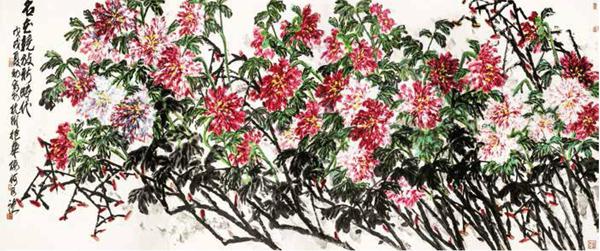
自幼就喜愛書法繪畫的何水法,愛思考,喜創(chuàng)新,重探索。所以他的作品能夠守正出奇、食古化今。從他屢屢創(chuàng)作的精品力作中,可以看到他的刻苦追求和堅(jiān)定執(zhí)著。
從1990年開始,何水法就開始嘗試中國(guó)花鳥畫技法和表現(xiàn)形式的創(chuàng)新。“搬掉大石頭。從看一枝到看一片,這是我對(duì)花鳥畫技法的一個(gè)突破。”何水法翻開了他的畫冊(cè),指著作品《爛漫秋光》對(duì)筆者說,這幅畫能獨(dú)樹一幟,避開古人“石頭、花朵、枝葉”的傳統(tǒng)構(gòu)圖方式,運(yùn)用全景式構(gòu)圖,全畫幅呈現(xiàn)花鳥畫的張力和氣勢(shì),畫出了情感,畫出了氛圍,畫出了中國(guó)花鳥畫的時(shí)代氣息和精神風(fēng)貌。這個(gè)探索過程他用了足足7年時(shí)間。
牡丹花是何水法的最愛,也是他作品表現(xiàn)的主要內(nèi)容。“牡丹花就像是我的‘老朋友,每年我都會(huì)去看她,用畫筆與她對(duì)話。而且,‘老朋友每年都不一樣,每年都有新的變化。”何水法說,藝術(shù)生涯的幾十年,先后14次赴山東菏澤等牡丹花產(chǎn)地寫生、繪畫。
在藝術(shù)界,何水法還是出了名的愛管“閑事”之人,除了繪畫,他十分關(guān)注民生民意民情。從2008年開始,兩屆浙江省政協(xié)常委、全國(guó)政協(xié)委員的履職經(jīng)歷中,他提交的提案就達(dá)50余件之多,平均一年5件。其中不乏諸如美術(shù)館、博物館免費(fèi)開放,政府購(gòu)買公共服務(wù)等關(guān)乎民生、民情、民意的優(yōu)秀提案。
藝術(shù)家要有家國(guó)情懷。何水法說,2010年的《富春山居圖》“合璧”就是出自他的提案。2010年是黃公望創(chuàng)作《富春山居圖》660周年。作為文化藝術(shù)界的政協(xié)委員,何水法認(rèn)為這是一個(gè)契機(jī),也有特別的紀(jì)念意義,就大膽地提出《關(guān)于將〈富春山居圖〉合二為一建議》的提案。沒想到,在當(dāng)年全國(guó)兩會(huì)的記者招待會(huì)上,得到了社會(huì)各界的一致贊同和共鳴。最終,海峽兩岸的《富春山居圖》“合璧”展出,成為當(dāng)年的文化盛事。“沒有好時(shí)代,也就沒有我這些好提案。”何水法至今仍記憶猶新。
讓世界了解中國(guó)
藝術(shù)無(wú)國(guó)界,文化無(wú)疆域。文化是民族的,也是世界的。何水法說,優(yōu)秀的傳統(tǒng)文化是一個(gè)國(guó)家的底蘊(yùn)、底氣所在。中華優(yōu)秀文化要世界共享,要立于世界之林,就必須“走出去”,更要“走進(jìn)去”。
近年來(lái),何水法對(duì)中國(guó)傳統(tǒng)文化“走出去”有了更多的思考和感悟。如今,何水法的作品不僅走進(jìn)了釣魚臺(tái)國(guó)賓館、北京人民大會(huì)堂、中國(guó)國(guó)家博物館,還走進(jìn)了世界上多個(gè)國(guó)家的國(guó)家博物館。中國(guó)花鳥畫藝術(shù)也引起了一些國(guó)家政要和精英人士的喜愛和關(guān)注。英國(guó)主流媒體BBC也專門對(duì)何水法進(jìn)行專題采訪。
2013年,何水法在意大利西西里島建立了何水法藝術(shù)中心,此后,波蘭盧布林市也建立了何水法藝術(shù)中心。這些藝術(shù)中心開館六七年來(lái),先后接待了一批又一批中外藝術(shù)家朋友和市民觀眾。“一個(gè)中國(guó)畫家的作品能夠在異國(guó)他鄉(xiāng)受到重視和喜愛,說明中國(guó)的傳統(tǒng)文化藝術(shù)也就是世界傳統(tǒng)文化藝術(shù)。文化互鑒,民心相通。從某種意義上講,中外文化交流互鑒對(duì)于加強(qiáng)中國(guó)與世界的交流,起到了積極的推動(dòng)作用。”
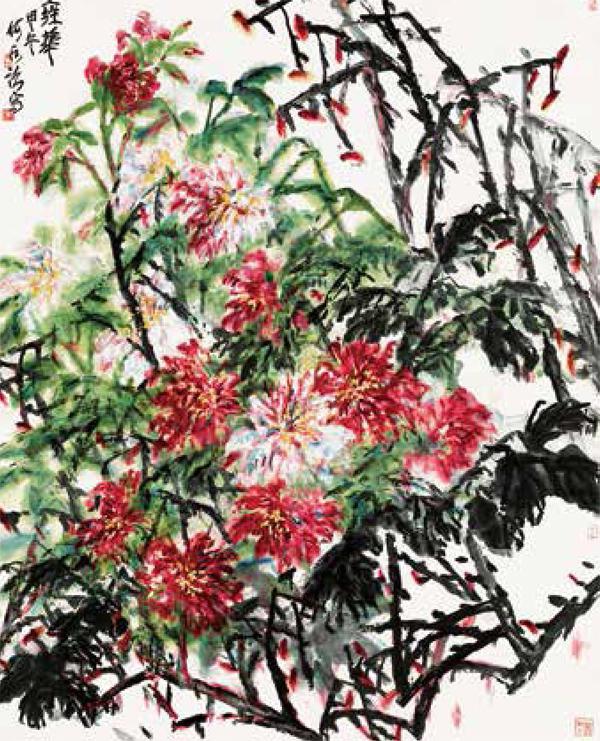
在何水法看來(lái),中國(guó)畫的筆墨精神就是新時(shí)代的中國(guó)文化精神。這些年,何水法除了赴國(guó)外辦個(gè)展外,還把很大一部分時(shí)間用在了引進(jìn)國(guó)外優(yōu)秀文化藝術(shù)交流上。座落在杭州富陽(yáng)的抱華樓是何水法的個(gè)人藝術(shù)館,也是與國(guó)外優(yōu)秀文化藝術(shù)交流的窗口。抱華樓建成后,已先后引進(jìn)烏克蘭油畫展及玻璃藝術(shù)展,波蘭版畫、攝影及平面設(shè)計(jì)展以及美國(guó)、德國(guó)、日本等國(guó)的油畫展等系列活動(dòng)。
藝術(shù)家的宿命就是探尋和表達(dá)。何水法有一個(gè)心愿,就是等到80歲生日的時(shí)候,他要在聯(lián)合國(guó)舉辦一場(chǎng)大型的中國(guó)花鳥畫展覽,這個(gè)展覽的題目已經(jīng)想好了,就是《絲路百花——100個(gè)國(guó)家國(guó)花畫展》,內(nèi)容就是100個(gè)國(guó)家的國(guó)花。
何水法說,他要通過100個(gè)國(guó)家的國(guó)花畫展,讓中華傳統(tǒng)文化與世界接軌;他要用傳統(tǒng)的中國(guó)繪畫技法,向世界人民展現(xiàn)各美其美、美美與共的社會(huì)大同愿景。他希望用這盛開的百花,祈愿世界各國(guó)和平安定,如花絢爛。
He Shuifa:
Add Color and Glory to Our Era and World
By Xu Jihong
He Shuifa loves to dress himself in red. In his words, red symbolizes energy, prosperity, hope. When I met him for this interview, the 72-year-old artist was dressed in red, and he spoke ebulliently and freely. He said reform and opening up to the outside world, which started in China 40 years ago, changed his life completely. He is a witness to all the wonders and marvels that have emerged in China. He is a beneficiary of the great modernization drive, and he considers himself a promoter of Chinese culture at home and abroad. He has a solid understanding of the past and the present and has expectations for the future.
“I didnt have four-year undergraduate studies in college. The talent policy adopted in 1978 benefited me directly. Reform and opening up to the outside world made what I am,” declared He emotionally in this opening statement in the interview.
In 1978, he was 30. The national government issued a series of policies for finding talents and putting them into good places. That year, Zhejiang Academy of Fine Arts, the predecessor of China Academy of Art today, was to enroll anyone who passed the entrance examination for graduate studies. He Shuifa qualified for taking the entrance examination even though he had no college degree. He started a crash course for himself. He spent days at Zhejiang Library boning up on . The book wasnt available anywhere else. Then he began to copy the book word by word. After three days, the librarian allowed him to check the book out so that he could transcribe it at home. After learning that the history of western art was to be part of the examination, he began to copy the book at the library. For about a month, he prepared himself for the examination.
Artistically, He Shuifa had overqualified. In 1975 and 1977, his calligraphies were selected for two exhibitions in Japan. The two exhibitions displayed his works side by side with works of artists and calligraphers of national renown. His virtuosity helped him pass the examination smoothly.
Though he had started learning calligraphy and painting since childhood years, it was the graduation course that gave him a systematic training in Chinese art. The reform and opening up to the outside world which started in 1978 have defined him and answered the three philosophical questions for him. He knows who he is, where he came from and where he will be.
If reform and opening up to the outside world changed He Shuifa, the artist has brought breakthrough innovation into flower-bird painting, a key subgenre in traditional Chinese art. In 1990 he started exploring possibilities in techniques and expressions of flower-bird painting. He opened an album and pointed to a painting of his titled “Autumnal Lights” and explained why it was a breakaway from tradition. The painting presents flowers in a panorama instead of a traditional format of stones, flowers, and branches. It took him a good seven years to find this perfect modern way to express the verve of today.
He Shuifa has a passion for painting peonies. The flower stands for his art, in a sense. “Peonies are my old friends. I travel every year to pay them a visit. They present differences year in year out and introduce new changes constantly,” said He. The artist was referring to his visit to Heze in Shandong Province and other places famed for peonies. In his career, he has visited Heze fourteen times.
Hes artworks are now in the collections of Diaoyutai State Guesthouse, the Great Hall of People, China National Museum as well as major museums overseas. BBC has interviewed the artist.
He Shuifa Art Center in both Sicily, Italy and Lublin, Poland is a place where art enthusiasts and artists visit and exchange ideas. He Shuifa is proud of the centers. “The centers mean that traditional Chinese culture and art communicate a universal beauty. In a sense, the centers play an active part in enhancing the bond between China and the rest of the world,” he said proudly.
In recent years, He Shuifa has worked to introduce international artists to China. He Shuifa Art Museum in Fuyang, Hangzhou has held quite a few art exhibitions featuring oil paintings, glass art, woodprints, photography, and graphic design by artists from Ukraine, Poland, the United States, Germany, and Japan.
An artist who is destined to explore and express, He Shuifa wishes to hold a solo show of flower-bird painting at the United Nations when he is 80 years old. He has already dreamed up a title for the would-be exhibition: 100 Flowers of Silk Road. He is going to paint and exhibit the national flowers of 100 countries.
猜你喜歡
中國(guó)德育(2022年12期)2022-08-22 06:16:18
湖北教育·綜合資訊(2022年4期)2022-05-06 22:54:06
金橋(2022年2期)2022-03-02 05:42:50
金橋(2022年1期)2022-02-12 01:37:04
兒童繪本(2018年22期)2018-12-13 23:14:52
小天使·一年級(jí)語(yǔ)數(shù)英綜合(2018年9期)2018-10-16 06:30:16
讀者·校園版(2018年13期)2018-06-19 06:20:12
Coco薇(2016年2期)2016-03-22 16:58:59
讀者(2016年7期)2016-03-11 12:14:36
爆笑show(2014年10期)2014-12-18 22:27:48