水分虧缺程度對變量灌溉水分傳感器埋設位置預判的影響
2018-11-24 01:37:08李秀梅趙偉霞李久生栗巖峰
農業工程學報 2018年23期
李秀梅,趙偉霞,李久生,栗巖峰
?
水分虧缺程度對變量灌溉水分傳感器埋設位置預判的影響
李秀梅,趙偉霞,李久生※,栗巖峰
(中國水利水電科學研究院 流域水循環模擬與調控國家重點實驗室,北京 100048)
基于土壤黏粒含量遴選可代表平均土壤含水率的點位,是確定變量灌溉系統土壤水分傳感器網絡埋設位置的重要方法。為了評估水分虧缺程度對傳感器埋設位置的影響,該研究通過在不同土壤可利用水量管理區內設置不同的水分虧缺灌溉處理,基于土壤含水率時間穩定性原理,分析了水分虧缺程度和土壤性質對冬小麥主要根系層內土壤含水率空間分布結構相似性和直接代表平均土壤含水率點位的影響。結果表明,受土壤性質和水分虧缺程度的影響,在土壤砂粒含量隨土層深度增加而增大的1區,土壤含水率空間分布結構相似性僅在2016年的雨養處理達到了顯著水平(0.05),而在土壤剖面質地均勻的2區,2016年的雨養和高、中、低水分虧缺處理和2017年的中、低水分虧缺處理均達到了顯著水平(0.05)。在冬小麥主要根系層內,不同土壤性質管理區直接代表平均土壤含水率點位占總測點數的比例基本相等。受水分虧缺程度的影響,1區直接代表平均土壤含水率的測點比例隨水分虧缺程度減小而增加,2區則呈先減小后略有增加趨勢。除2016年高水分虧缺處理外,0~0.2、>0.2~0.4、>0.4~0.6 m土層代表平均土壤含水率點位的黏粒含量與該土層平均黏粒含量之間均存在顯著的線性關系(0.05),2 a擬合系數變化范圍為0.66~1.03,且2017年擬合系數隨土壤水分虧缺程度增加呈增大趨勢。因此,在砂壤土地塊變量灌溉管理區內,基于管理區平均土壤黏粒含量進行土壤水分傳感器埋設位置遴選時,需根據擬采用的水分虧缺管理模式對擬合系數進行修正。
土壤;水分;傳感器;網絡;時間穩定性;埋設位置;冬小麥;變量灌溉
0 引 言
變量灌溉處方圖的生成依賴于各種傳感器網絡實時監測和反饋不同管理區內土壤水分、作物生長和氣象條件等信息[1-2]。土壤水分傳感器用于監測土壤水分對作物的滿足程度,是生成變量灌溉處方圖常用的工具之一[3-5]。因為每種類型的土壤水分傳感器均有一定的測量范圍,因此確保土壤水分傳感器埋設位置處所測定的土壤含水率對田塊內平均值的代表性是變量灌溉技術應用時面臨的主要任務[4]。
自1985年Vachaud等[6]介紹了土壤含水率時間穩定性概念后,國內外學者先后應用土壤含水率時間穩定性原理在不同土壤物理性質[7-10]、海拔[11-12]、研究尺 度[13-14]和植被覆蓋[15]條件下開展了直接代表平均土壤含水率(以下簡稱為“代表含水率”)的樣點位置研究。2017年,Zhao等[16]在變量灌溉管理中開展了基于時間穩定性原理的土壤水分傳感器埋設位置研究,通過在不同土壤可利用水量管理區設置相同的灌水下限,以均一灌溉管理為對照,研究了變量灌溉管理下主要根系層的土壤含水率空間結構相似性和時間穩定性,證明了當作物耗水主要來源于灌溉時,變量灌溉管理雖會改變農田內土壤水分空間格局的整體相似性,但每個管理區內的土壤含水率時間穩定性依然存在。研究還發現,每個管理區內代表含水率點位的黏粒含量與對應管理區的平均黏粒含量之間存在的線性關系,可用于土壤性質變異較大的農田中土壤水分傳感器埋設位置的預判。
因為濕潤土壤中具有時間穩定性的測點在土壤干燥過程中,其穩定性可能消失[17-18],因此在不同的土壤水分狀態下,代表平均土壤含水率的點位并不完全相同[19]。Zhang等[20]也發現不同土壤水分條件下的土壤含水率大小在空間上的排序并不相同。因此,尋找不同水分虧缺程度下平均土壤含水率點位的“平均屬性”對確定平均土壤含水率點位更具指導意義[21]。
為了充分發揮變量灌溉技術在干旱半干旱地區的節水潛力,將非充分灌溉原理與變量灌溉技術相結合是發展干旱半干旱條件下作物變量灌溉管理的關鍵[3-4, 22],因此本文基于不同水分虧缺灌溉管理條件下的土壤含水率時間穩定性分析,研究不同濕潤程度下土壤含水率空間分布格局的相似性,分析土壤性質和土壤水分虧缺程度對遴選代表含水率點位的影響,并驗證非充分灌溉制度下,以管理區內平均土壤黏粒含量作為代表含水率點位的預判方法的可行性,研究結果將為非充分變量灌溉管理條件下土壤水分傳感器網絡布設方法的制定提供依據。
1 材料與方法
1.1 試驗地概況
試驗在河北省涿州市東城坊鎮進行(39°27¢N,115°51¢E,海拔42 m)。該試驗場位于河北省中部,坐落于太行山山洪沖積扇平原上,屬暖溫帶半濕潤季風區。多年平均降水量563.3 mm,年平均溫度11.6 ℃。土壤質地以壤土和砂壤土為主。
試驗區為圓形噴灌機變量灌溉系統[23]控制區域的1/4,面積1.64 hm2。基于土壤可利用水量(available soil water holding capacity, AWC)將試驗區劃分為4個管理區,1~4區0~0.6 m田間持水量分別為0.21、0.22、0.23和0.25 cm3/cm3;0~1.0 m深度AWC變化范圍依次為152~161、>161~171、>171~185、>185~205 mm[24]。因為4區0.4 m以下土層主要為南水北調管道工程回填的砂礫石,本文分析未包含4區。在1~3區,土壤性質沿垂直剖面表現出不同的分層特征,1區0~0.2、>0.2~0.4、>0.4~0.6 m土層土壤砂粒體積分數隨深度增加呈明顯增加趨勢(57.8%~89.5%);2區土壤砂粒和黏粒體積分數隨深度變化較小,分別為59.8%~65.8%和4.6%~5.7%;3區>0.2~0.4 m土層存在明顯的黏土夾層,該土層砂粒和黏粒體積分數分別為47.9%和8.6%[25]。
1.2 試驗設計
3個管理區內,分別按照面積相等的原則設置灌水處理。1區和3區分別劃分為4個子區,2區劃分為5個子區,每個子區為1個灌水處理。2015—2016年冬小麥生育期內(以下簡稱2016年冬小麥),設置為雨養和不同灌水下限(為田間持水量百分比)的處理(表1),灌水定額為20 mm。因為每個子區內到達灌水下限的時間不同,所以采用部分噴頭開啟式變量灌溉方法進行每個子區的灌溉管理[23]。試驗結果表明,由于黏土夾層對入滲水流的阻水作用[26],3區0.2~0.4 m土層土壤含水率較低,灌溉次數較多,難以實現基于灌水下限的水分虧缺管理。因此,2016—2017年冬小麥生育期內(以下簡稱2017年冬小麥),除雨養處理外,各灌水處理灌水量設置為不同灌水定額(為設定灌水定額的百分比)(表1),采用脈沖式變量灌溉方法通過調節電磁閥占空比[23]進行每個子區的灌溉管理。所有子區均采用相同的灌水時間,灌水下限值設計為AWC最小的1區田間持水量的70%。揚花期之前灌水定額設定為20 mm,之后為30 mm。2 a雨養處理除了苗期灌水(20 mm)和施肥期間灌水(20 mm)外,其他時間均不灌溉。
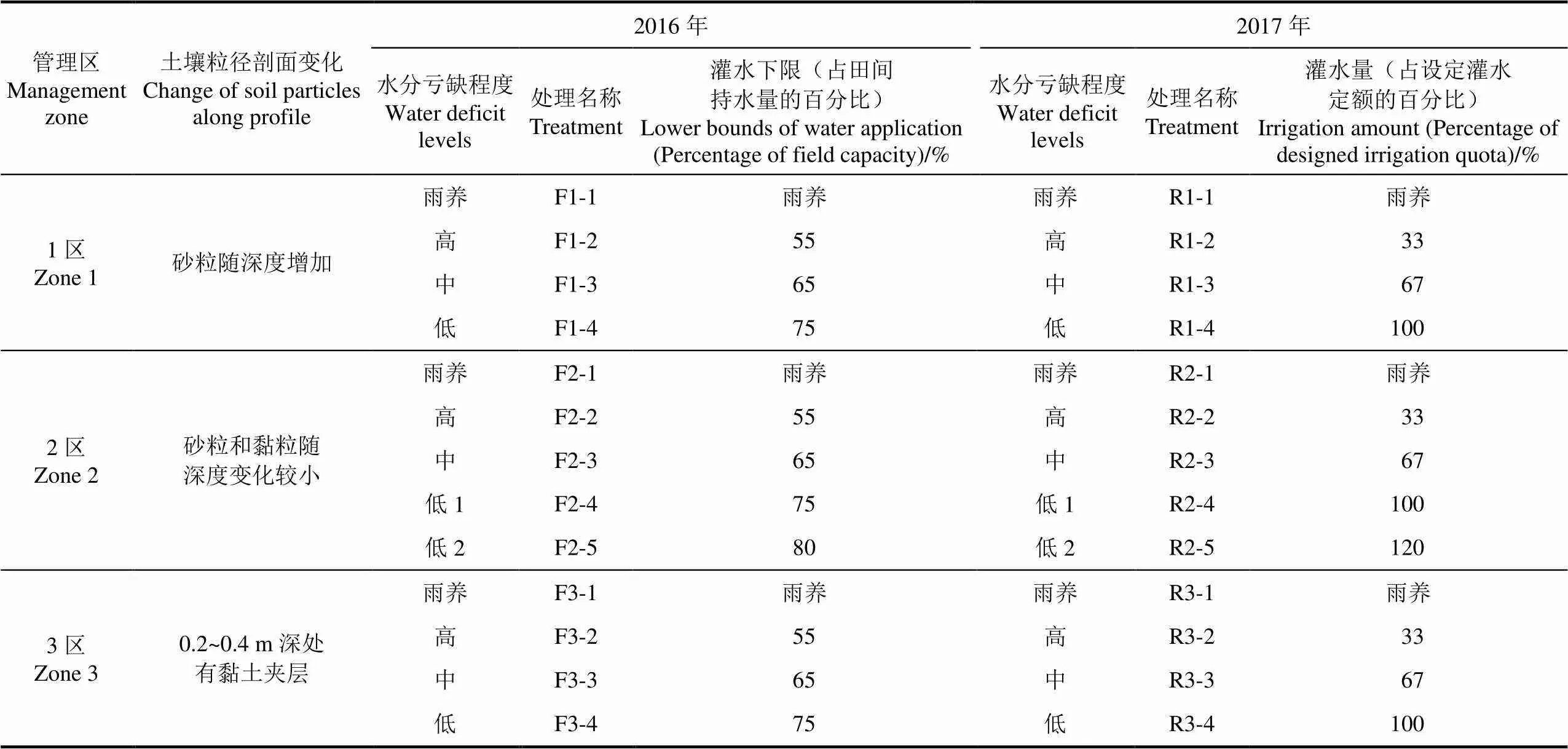
表1 田間試驗處理設置
注:水分虧缺程度設置為雨養、高、中和低4個水平。雨養處理僅在苗期和施肥期時進行灌水,其他時間均不灌溉;2區低水分虧缺設置了2個處理,分別記為低1和低2。
Note: A total of 4 water deficit levels include rain-fed, severe, medium, and low deficit levels in each management zone. There is no additional irrigation except for seedling emergence and fertilization stages in rain-fed treatments. In zone 2, 2 low deficit levels (Low 1 and Low 2) are included.
將整個田塊劃分成12 m×12 m的網格,Trime-T3管式土壤水分探管(IMKO,德國)埋設在每個網格的中心,1區、2區和3區的每個灌水處理內分別布置6個、10個和3個探管,共86個。判斷灌水時間時,2016年每日測量所有灌水處理0.2~0.4 m土層的土壤含水率,2017年每日測量R1-4處理0~0.4 m土層的平均土壤含水率,當土壤含水率下降到設定下限時進行灌水。為評估土壤含水率時間穩定性,每7~10 d分層測量1次所有處理的土壤含水率,每0.2 m 1層,測量至1.2 m深度。2016年和2017年冬小麥生育期內分別測量了10次和13次,共23次。因為3區每個子區內布置的測量點數較少(3個),因此在土壤含水率時間穩定性分析時未考慮3區。
1.3 數據分析
根據Spearman秩相關系數(r)原理[6]評價土壤含水率在不同時間的空間分布格局相似性:
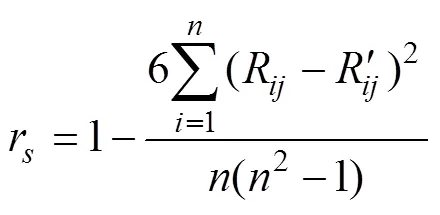
式中R是任一測點在第次觀測時土壤含水率測量值的秩,R'為測量值在相同測點、不同觀測次數時的秩。r越趨于1表示土壤含水率在2個測量時間下空間分布格局相似性越強。為測點數,1區4個子區測點數量均為6個,2區5個子區測點數量均為10個。
計算每個測點的相對差分值[6],以判斷特定測點土壤含水率在時間尺度的穩定性:
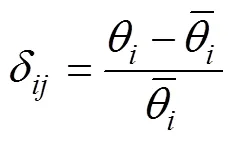

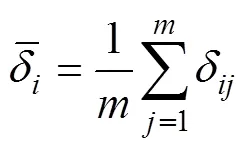
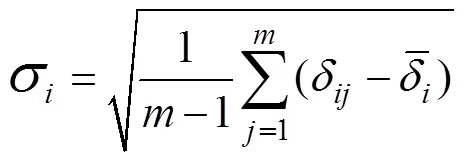
式中為土壤含水率觀測次數。2016年和2017年冬小麥生育期內分別監測10次和13次。
為了準確捕捉不同采樣時間的土壤含水率均值,并有效地減少系統偏差,應綜合考慮均值和方差,因此利用均方根誤差(root mean square error,RMSE)確定最佳的測點位置。
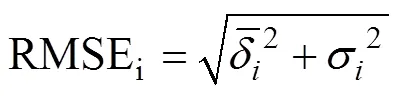
RMSEi值最趨于0的測點可設置直接代表平均土壤含水率的傳感器。
2 結果與分析
2.1 不同灌溉制度下土壤含水率的空間結構相似性
2 a冬小麥生育期內,不同灌水處理的累積灌水量和降水量如圖1所示。2016年和2017年總降水量分別為80.1和80.3 mm,遠小于華北地區冬小麥400 mm的平均需水量[27]。由于初始土壤含水率的空間變異性和管理區之間不同的土壤分層特征,2016年不同灌水處理累積灌水量并不總是隨灌水下限降低而減少,1區最大累積灌水量(380 mm)發生在F1-3處理,分別比雨養、F1-2和F1-4處理多334、80和40 mm;2區最大累積灌水量發生在F2-5處理(416 mm),分別比雨養、F2-3、F2-2和F2-4處理多370、190、110和60 mm。3區最大累積灌水量發生在F3-3處理(396 mm),分別比雨養、F3-1、F3-2處理多350、16和16 mm。與1區相比,2區(不包括F2-5)累積灌水量減少132 mm。2017年,1區、2區和3區相同處理的累積灌水量相同,雨養處理和3個灌水處理的累積灌水量分別為40、153、263和370 mm;R2-5處理累積灌水量為436 mm。
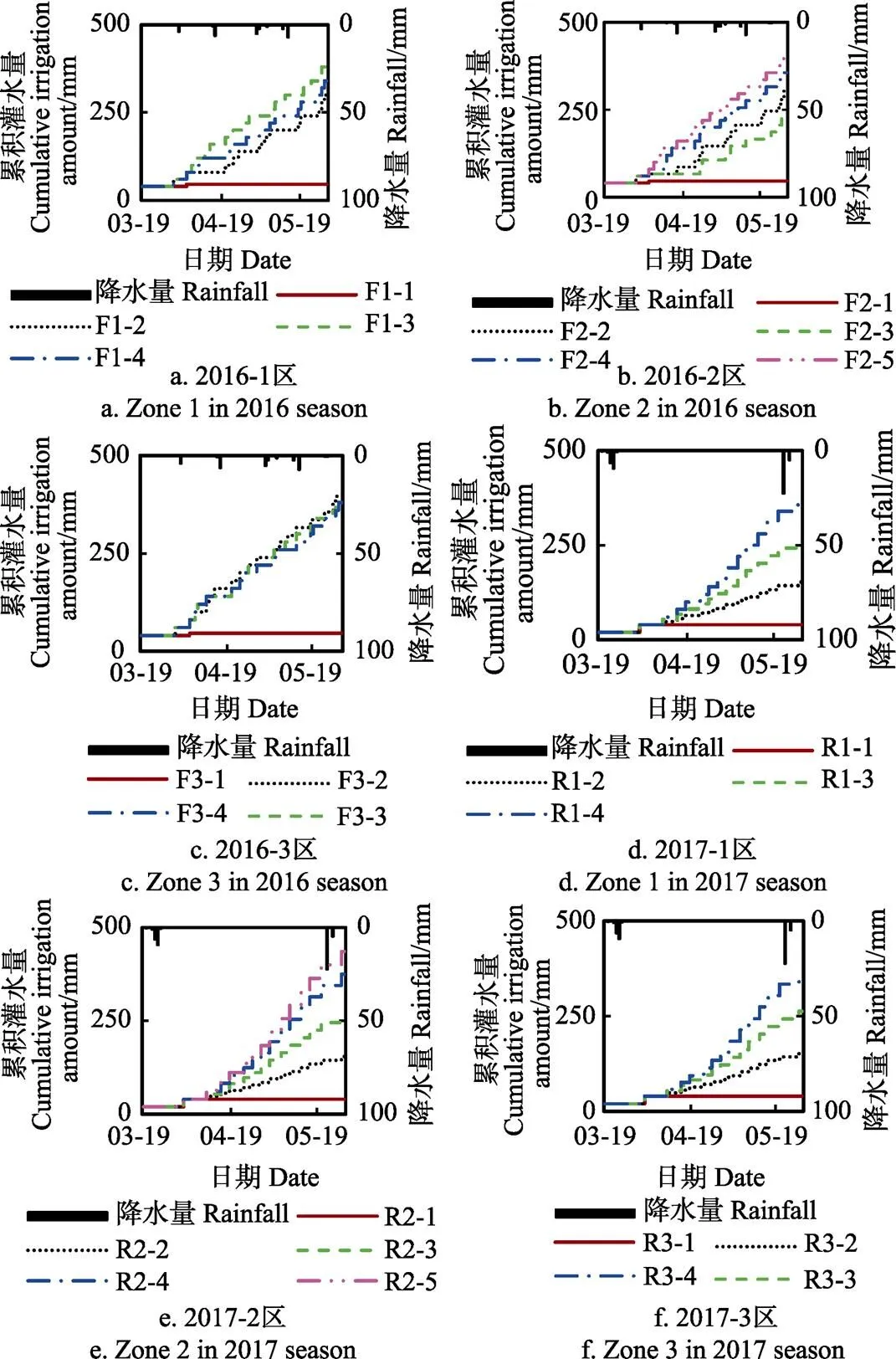
圖1 冬小麥生育期內各區灌水量和降水量

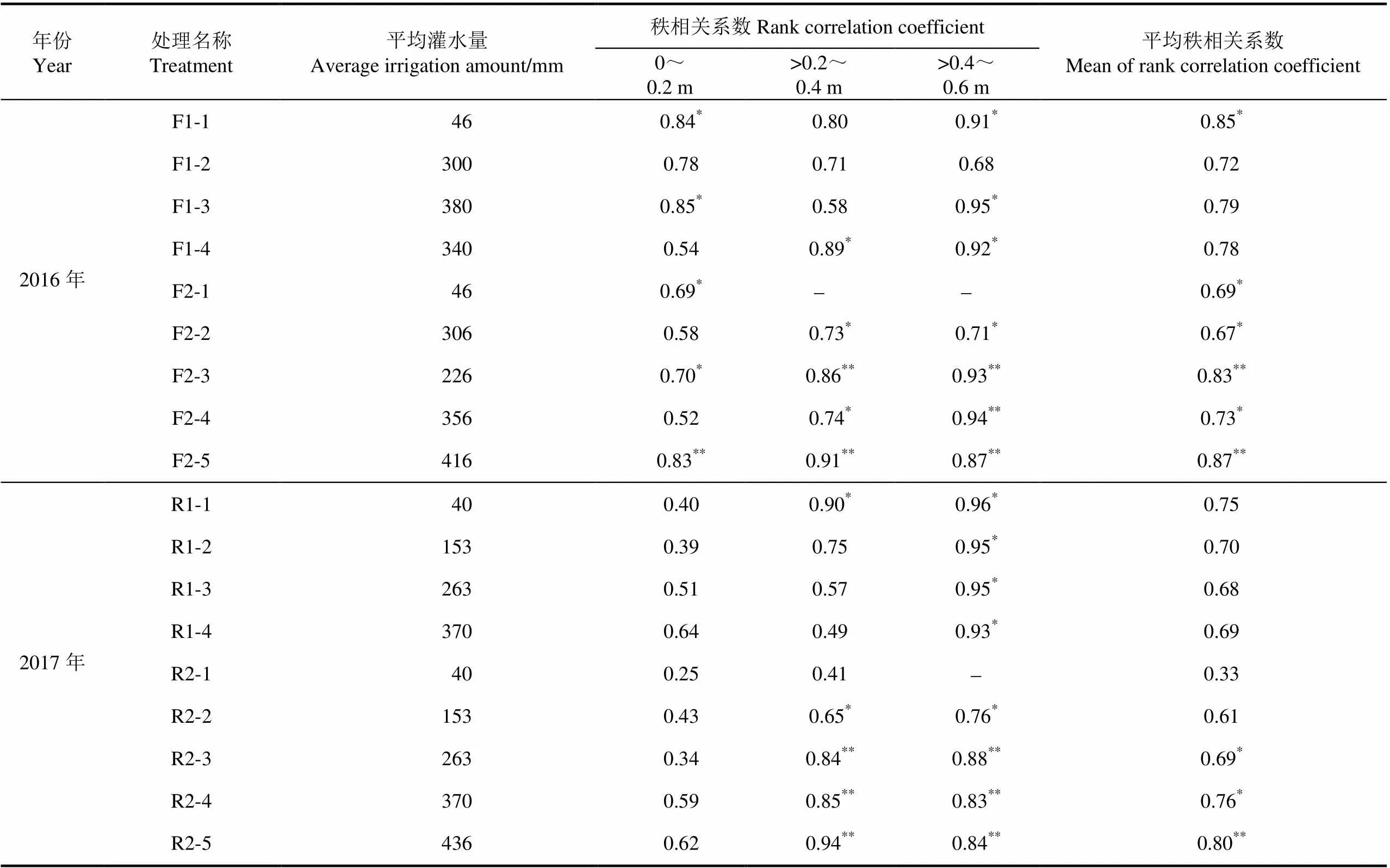
表2 不同水分虧缺處理土壤含水率秩相關系數
注:*和**分別表示在0.05和0.01水平上顯著。下同。
Note: Symobol*and**mean significance at probability levels of 0.05 and 0.01, respectively. Same as below.
2.2 不同測點土壤含水率的時間穩定性
每個測點的δ在時間尺度上的標準差σ如圖2所示。根據Starks等[29]的劃分標準,當σ<0.05時,測點具有時間穩定性。2016年1區所有處理0~0.2、>0.2~0.4和>0.4~0.6 m土層σ<0.05的測點數量占總測點的比例分別為83%,91%和65%;2區所有處理相應土層該比例分別為85%,92%和80%。2017年1區相應土層該比例分別為91%、91%和95%;2區分別為96%、100%和93%。這說明大部分測點都具有較強的時間穩定性,尤其是0~0.4 m土層,且除了2017年的>0.4~0.6 m土層外,2區任一土層具有時間穩定性的測點數量均高于1區。
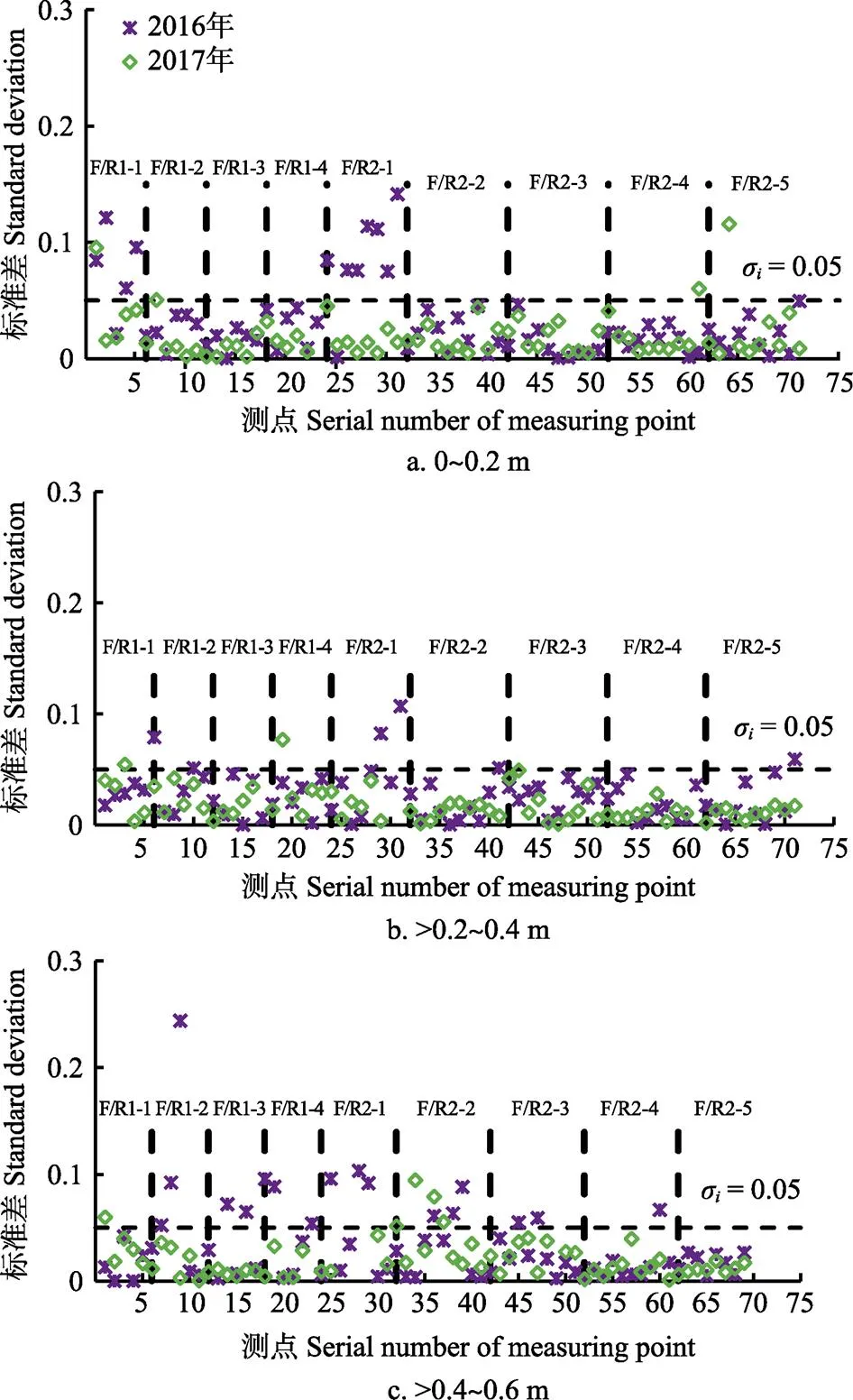
圖2 各測點不同土層土壤含水率標準差
每個測點均方根誤差RMSE值如圖3所示。在任一土層,所有測點的RMSE均在不同土層深度表現出明顯的波動,且>0.4~0.6 m土層RMSE波動幅度最大,這表明各測點在剖面方向偏離平均土壤含水率的程度與深度有關,代表平均土壤含水率的測點和深度具有不一致性。2 a同一測點的RMSE值不完全相等,2016年RMSE值整體上大于2017年,但各測點的變化趨勢基本保持一致,說明各測點與平均土壤含水率的相對偏離程度具有年際間的時間穩定性。
將RMSE<0.1[30]的點作為代表含水率的點位,代表含水率的測點個數占總測點數的比例如表3所示。代表含水率的測點個數占總測點個數的比例與水分虧缺程度密切相關。2016年1區雨養和高、中、低水分虧缺處理0~0.6 m土層代表含水率的測點數量占總測點數量的比例分別為17%、22%、28%和33%;2區雨養和高、中、低水分虧缺處理0~0.6 m土層代表含水率的測點數量占總測點數量的比例分別為31%、33%、13%和38%(F2-4和F2-5處理均值)。2017年1區相應水分虧缺處理該比例分別為39%、34%、44%和53%;2區則分別為52%、43%、43%和49%(R2-4和R2-5處理均值)。2 a試驗,除中水分虧缺處理外,2區任一水分虧缺處理代表含水率的測點比例均高于1區。2016年1區0~0.2、>0.2~0.4和>0.4~0.6 m土層代表含水率的測點比例分別為25%、46%和4%;2區0~0.2、>0.2~0.4和>0.4~0.6 m土層代表含水率的測點比例分別為36%、40%和17%。2017年1區和2區相應土層代表含水率的測點分別為57%、44%、27%和72%、48%、22%,除1區>0.2~0.4 m土層外,該比例明顯高于2016年。這與2 a水分管理方法一致時,代表含水率的測點個數占總測點個數的比例在年際間變化較小[23]的規律不同。另外,2 a試驗1區和2區0~0.2、>0.2~0.4、>0.4~0.6 m土層代表含水率的測點比例平均值分別為41%、45%、16%和54%、44%、19%,具有不同土壤剖面特征的管理區同一土層代表含水率的測點比例差別較小的結果表明,代表含水率的測點個數占總測點個數的比例受土壤剖面的分層特征影響相對較小。
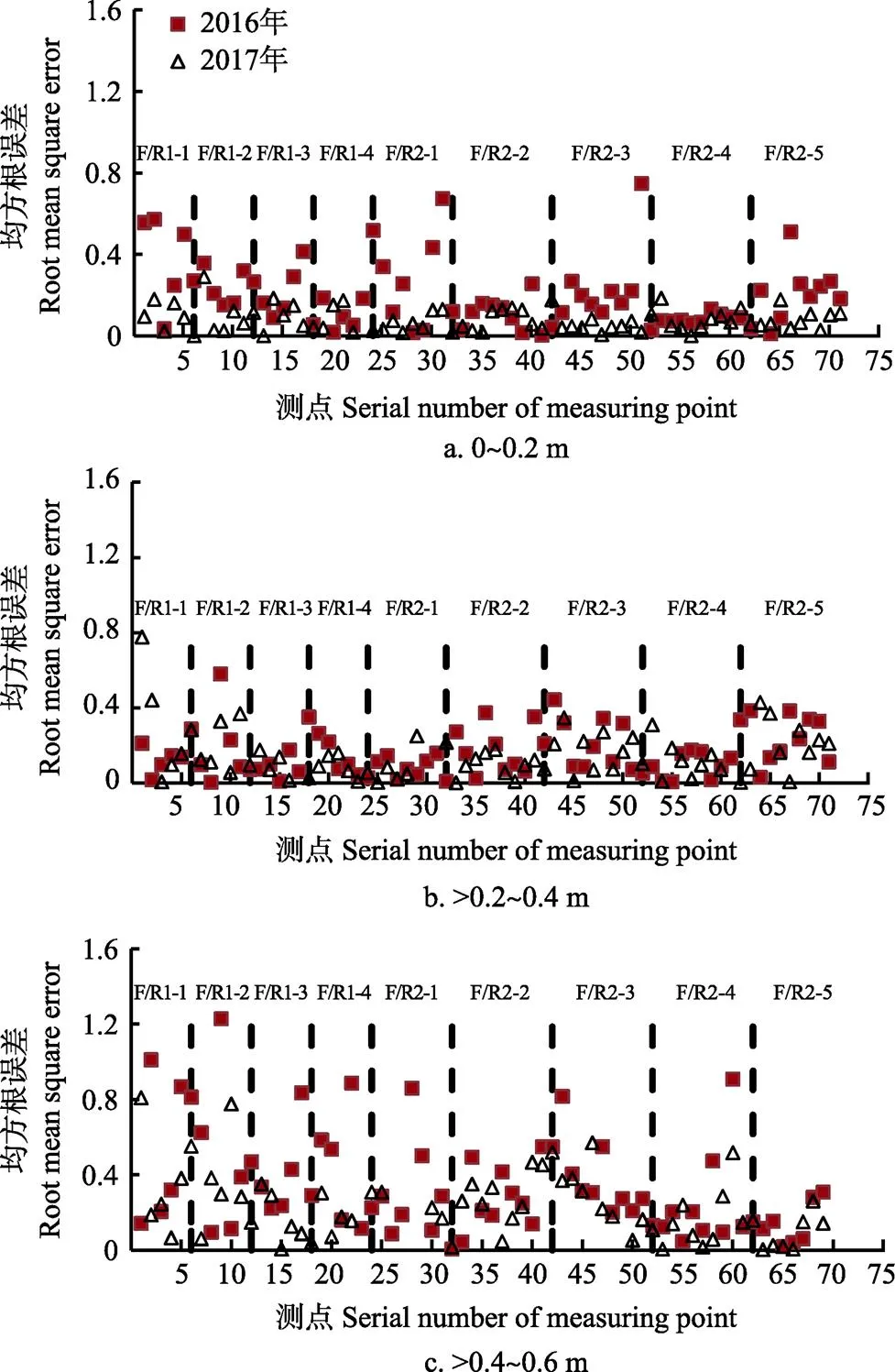
圖3 各測點土壤含水率均方根誤差
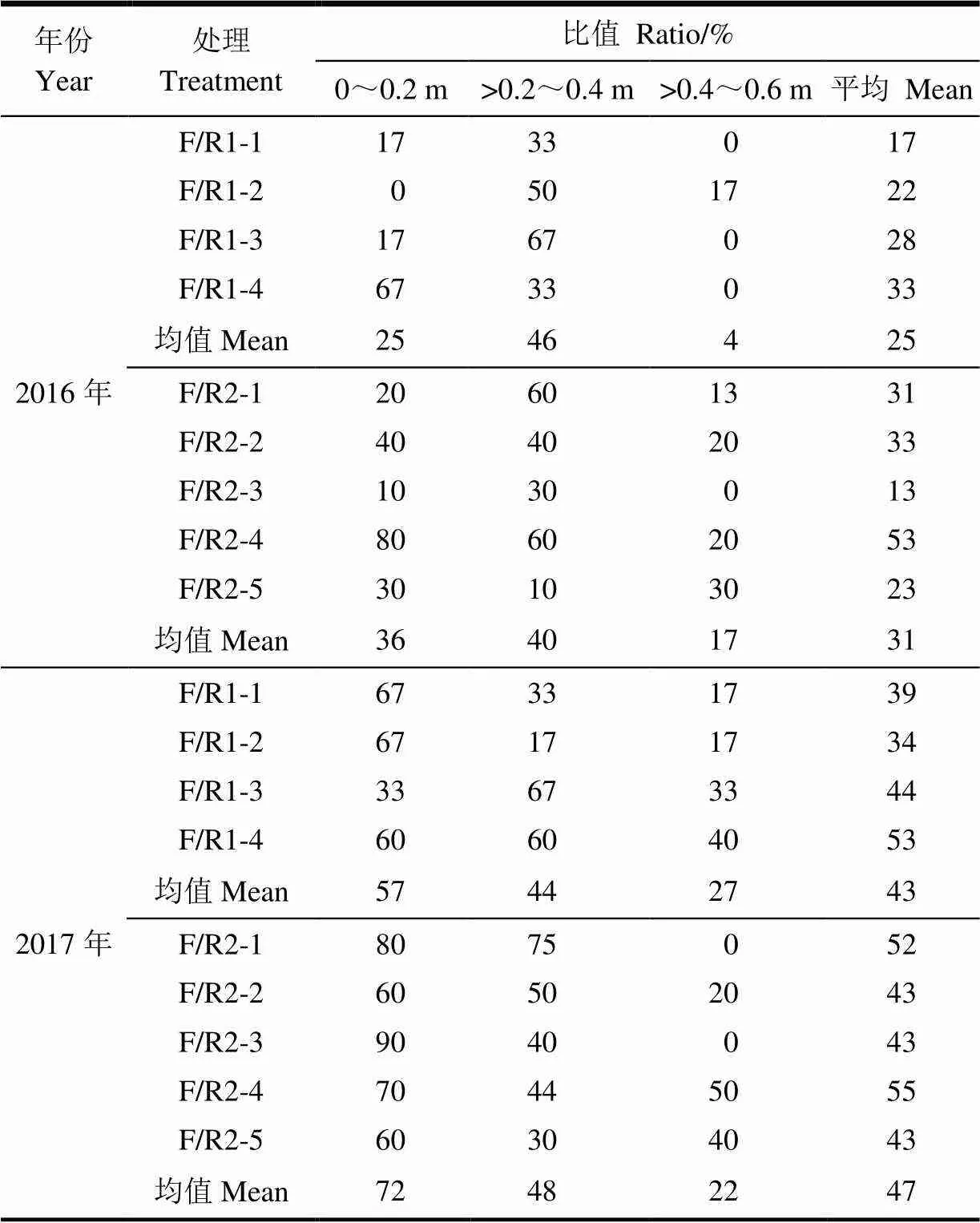
表3 不同土層代表含水率的測點與總測點數的比值
2.3 代表平均土壤含水率點位的確定方法
為研究土壤水分虧缺程度對代表含水率點位“平均屬性”的影響,分別將所有管理區雨養和高、中、低水分虧缺處理內不同土層RMSE<0.1的測量點的平均黏粒含量作為自變量,將對應土層內代表含水率點位的黏粒含量當作因變量,對二者進行線性擬合(=,為擬合系數),結果如表4所示。
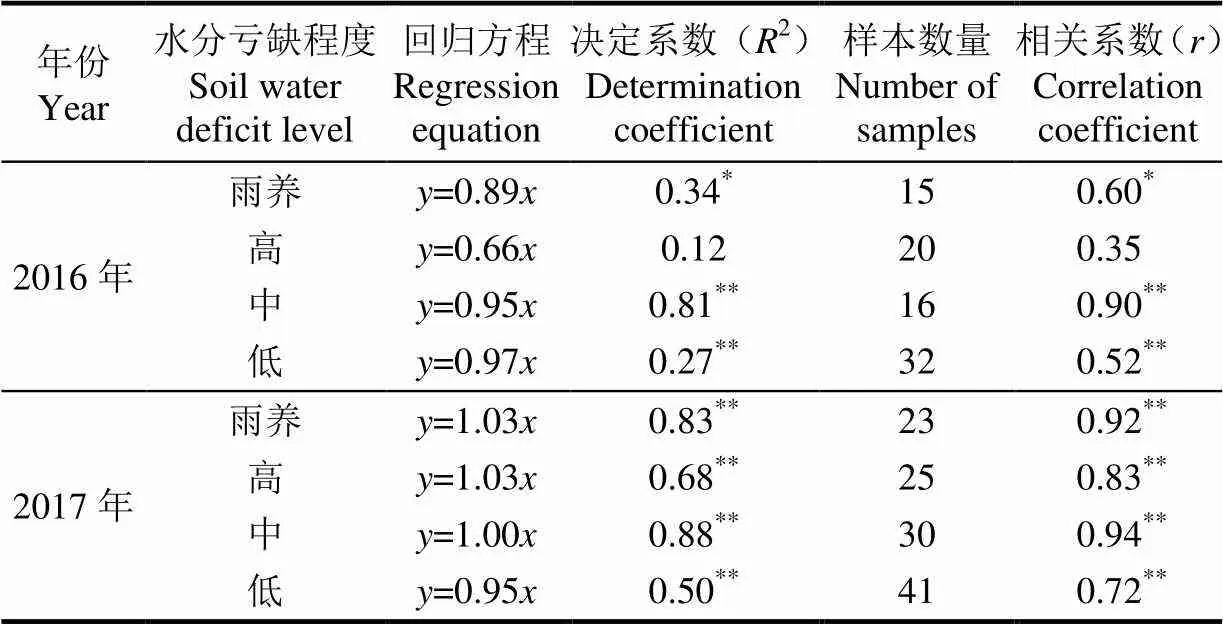
表4 0~0.6 m土層含水率代表測點的黏粒體積分數(y)與管理區平均黏粒體積分數(x)的擬合關系
注 Note:*,<0.05;**,<0.01。
2016年雨養、中、低水分虧缺處理和2017年所有水分虧缺處理和之間均呈顯著的線性關系,2016年雨養和高水分虧缺處理值低于中、低水分虧缺處理,2017年值隨土壤水分虧缺程度增加呈增大趨勢。值隨水分虧缺程度的變化趨勢在年際間存在差異,這主要是因為土壤分層特征的影響使得2016年各處理灌水量并未隨灌水下限的降低而減少(圖1)。2 a擬合系數的變化范圍為0.66~1.03,小于前期在該地塊不同管理區灌水下限均設置為0.45 AWC時得出的值(1.15)[11],這再次表明代表含水率的點位主要受土壤黏粒含量的影響,但與土壤黏粒含量的值在2017年隨土壤水分虧缺程度增加呈增大趨勢。
3 結 論
在華北平原土壤可利用水量變異較大的地塊,分別基于雨養和3種非充分灌溉制度開展了為期2 a的冬小麥變量灌溉試驗,利用冬小麥生育期內布設的86個測點,共23次觀測值,分析了水分虧缺程度和土壤質地對土壤含水率空間分布時間穩定性的影響。主要結論如下:
1)受水分虧缺程度和土壤剖面分層特征的影響,在砂粒含量隨土層深度增加的1區,0~0.6 m土層的平均土壤含水率空間分布格局相似性隨土壤水分虧缺程度減小呈先減小后增加趨勢,且相似性僅在2016年的雨養處理達到了顯著水平。在沿垂直剖面方向砂粒含量分布均勻的2區,0~0.6 m土層平均土壤含水率空間分布格局相似性雖然隨水分虧缺程度減小呈增加趨勢,但2016年所有處理和2017年中、低水分虧缺處理相似性均達到了顯著水平。
2)受水分虧缺程度的影響,2 a試驗不同土層代表含水率的測點數量占總測點的比例差異較大。但受土壤剖面分層特征的影響較小,1區和2區同一土層代表含水率的測點比例平均值并無明顯差別,0~0.2、>0.2~0.4、>0.4~0.6 m土層該值分別為41%、45%、16%和54%、44%、19%。
3)2 a試驗中,除2016年高水分虧缺處理外,其他所有處理0~0.2、>0.2~0.4、>0.4~0.6 m土層所有測量點的平均黏粒含量與對應土層內代表含水率點位的黏粒含量之間均存在顯著的線性關系(<0.05),線性方程擬合系數為0.66~1.03,且2017年隨土壤水分虧缺程度增加呈增大趨勢。
[1] Howell T A, Evett S R, O'Shaughnessy S A, et al. Advanced irrigation engineering: Precision and precise[J]. Journal of Agricultural Science and Technology, 2012, 29(1): 1-9.
[2] O’Shaughnessy S A, Evett S R, Colaizzi P D. Dynamic prescription maps for site-specific variable rate irrigation of cotton[J]. Agricultural Water Management, 2015, 159: 123-138.
[3] O'Shaughness S A, Rush C. Encyclopedia of Agriculture and Food Systems[M]. New York: Academic Press, 2014.
[4] Evans R G, LaRue J, Stone K C, et al. Adoption of site-specific variable rate sprinkler irrigation systems[J]. Irrigation Science, 2013, 31(4): 871-887.
[5] Sui Ruixiu, Baggard J. Wireless sensor network for monitoring soil moisture and weather conditions[J]. Applied Engineering in Agriculture, 2015, 31(2): 193-200.
[6] Vachaud G, Passerat D S A, Balabanis P, et al. Temporal stability of spatially measured soil water probability density function[J]. Soil Science Society of American Journal, 1985, 49(4): 822-828.
[7] Mohanty B P, Skaggs T H. Spatio-temporal evolution and time-stable characteristics of soil moisture within remote sensing footprints with varying soil, slope, and vegetation[J]. Advances in Water Resources, 2001, 24(9): 1051-1067.
[8] Western A W, Zhou S L, Grayson R B, et al. Spatial correlation of soil moisture in small catchments and its relationship to dominant spatial hydrological processes[J]. Journal of Hydrology, 2004, 286(1): 113-134.
[9] Ran Youhua, Li Xin, Jin Rui, et al. Strengths and weaknesses of temporal stability analysis for monitoring and estimating grid-mean soil moisture in a high-intensity irrigated agricultural landscape[J]. Water Resources Research, 2017, 53(1): 283-301.
[10] Hu Wei, Shao Mingan, Han Fengpeng, et al. Watershed scale temporal stability of soil water content[J]. Geoderma, 2010, 158(3): 181-198.
[11] 胡偉. 黃土高原小流域土壤含水量與飽和導水率的時空變異[D]. 北京: 中國科學院研究生院, 2009.
Hu Wei. The Mean Clay Percentile was Used for a Priori Identification for Pplacement of Soil Moisture Sensors[D]. Beijing: Graduate University of Chinese Academy of Sciences, 2009.
[12] Jacobs J M, Mohanty B P, Hsu E C, et al. SMEX02: Field scale variability, time stability and similarity of soil moisture [J]. Remote sensing of Environment, 2004, 92(4): 436-446.
[13] Go'mez-Plaza A, Alvarez-Rogel J, Albaladejo J, et al. Spatial patterns and temporal stability of soil moisture across a range of scales in a semi-arid environment[J]. Hydrological Processes, 2000, 14(7): 1261-1277.
[14] Li B, Rodell M. Spatial variability and its scale dependency of observed and modeled soil moisture over different climate regions[J]. Hydrology Earth System Sciences, 2013, 17(3): 1177-1188.
[15] López-Vicente M, álvarez S. Stability and patterns of topsoil water content in rainfed vineyards, olive groves, and cereal fields under different soil and tillage conditions[J]. Agricultural Water Management, 2018, 201: 167-176.
[16] Zhao Weixia, Li Jiusheng, Yang Rumiao, et al. Determinging placement criteria of moisture sensors through temporal stability analysis of soil water contents for a variable rate irrigation system[J]. Precision Agriculture, 2018, 19(4): 648-665.
[17] Schneider K, Huisman J A, Breuer L, et al. Temporal stability of soil moisture in various semi-arid steppe ecosystems and its application in remote sensing[J]. Journal of Hydrology, 2008, 359(1): 16-29.
[18] Zhao Long, Yang Kun, Qin Jun, et al. Spatio temporal analysis of soil moisture observations within a Tibetan mesoscale area and its implication to regional soil moisture measurements[J]. Journal of Hydrology, 2013, 482(5): 92-104.
[19] Gao Lei, Shao Mingan. Temporal stability of soil water storage in diverse soil layers[J]. Catena, 2012, 95(95): 24-32.
[20] Zhang Pingping, Shao Mingan, Zhang Xingchang. Temporal stability of soil moisture on two transects in a desert area of northwestern China[J]. Environmental Earth Sciences, 2016, 75(2): 161-175.
[21] Grayson R B, Western A W. Towards areal estimation of soil water content from point measurements: Time and space stability of mean response[J]. Journal of Hydrology, 1998, 207(1): 68-82.
[22] Evans R G, Sadler E J. Methods and technologies to improve efficiency of water use[J]. Water Resources Research, 2008, 44(7): 1-15.
[23] 趙偉霞, 李久生, 楊汝苗, 等. 田間試驗評估圓形噴灌機變量灌溉系統水量分布特性[J]. 農業工程學報, 2014, 30(22): 53-62. Zhao Weixia, Li Jiusheng, Yang Rumiao, et al. Field evaluation of water distribution characteristics center pivot irrigation system[J]. Transactions of the Chinese Society of Agricultural Engineering (Transactions of the CSAE), 2014, 30(22): 53-62. (in Chinese with English abstract)
[24] 趙偉霞, 李久生, 楊汝苗, 等. 基于土壤水分空間變異的變量灌溉作物產量及節水效果[J]. 農業工程學報, 2017, 33(2): 1-7. Zhao Weixia, Li Jiusheng, Yang Rumiao, et al. Yields and water-saving effects of crops as affected by variable rate irrigation management based on soil water spatial variation[J]. Transactions of the Chinese Society of Agricultural Engineering (Transactions of the CSAE), 2017, 33(2): 1-7. (in Chinese with English abstract)
[25] Zhao Weixia, Li Jiusheng, Yang Rumiao, et al. Crop yield and water productivity responses in management zones for variable-rate irrigation based on available soil water holding capacity[J].Transactions of the ASABE, 2017, 60(5): 1659-1667.
[26] 李久生, 楊風艷, 栗巖峰. 層狀土壤質地對地下滴灌水氮分布的影響[J]. 農業工程學報, 2009, 25(7): 25-31. Li Jiusheng, Yang Fengyan, Li Yanfeng. Water and nitrogen distribution under subsurface drip fertigation as affected by layered-textural soils[J]. Transactions of the Chinese Society of Agricultural Engineering (Transactions of the CSAE), 2009, 25(7): 25-31. (in Chinese with English abstract)
[27] 胡瑋, 嚴昌榮, 李迎春, 等. 冀京津冬小麥灌溉需水量時空變化特征[J]. 中國農業氣象, 2013, 34(6): 648-654. Hu Wei, Yan Changrong, Li Yingchun, et al. Spatial and temporal variation of irrigation water requirement for winter wheat in Jijingjin region[J]. Chinese Journal of Agrometeorology, 2013, 34(6): 648-654. (in Chinese with English abstract)
[28] Van W B, Mulligan M, Poesen J. Spatial patterns of soil water balance on intensively cultivated hillslopes in a semiaridenvironment: The impact of rock fragments and soil thickness[J]. Hydrological Process, 2000, 14(10): 1811-1828.
[29] Starks P J, Heathman G C, Jackson T J, et al. Temporal stability of soil moisture profile[J]. Journal of Hydrology, 2006, 324(1): 400-411.
[30] Dettori M, Cesaraccio C, Motroni A, et al. Using CERES- Wheat to simulate durum wheat production and phenology in Southern Sardinia, Italy[J]. Field Crops Research, 2011, 120(1): 179-188.
Influence of water stress level on determination of soil moisture sensor position under variable rate irrigation
Li Xiumei, Zhao Weixia, Li Jiusheng※, Li Yanfeng
(100048,)
Determining positions to represent mean soil water content based on soil clay contents is an alternative method for positioning soil water content sensors in wireless sensor networks for a variable rate irrigation system. The field was divided into 4 management zones according to available soil water holding capacity (AWC). Two of the 4 management zones were selected to arrange the rain-fed treatment and 3 irrigation treatments representing different water stress levels to assess the effect of the levels on the placement of soil water content sensors under variable rate irrigation system. In zone 1, sand fraction largely increased with depth with AWC within 1-m soil profile ranging from 152 to 161 mm. In zone 2, a relatively uniform profile was observed along the profile with AWC within 1-m soil profile ranging from 161 to 171 mm. Based on the temporal stability of soil water content, the effects of soil water status and soil properties on the similarity of soil water spatial pattern and the positions directly representing the plot-mean soil water content were studied. Results showed that both of soil texture and water stress had effect on the structure similarity of soil water content distribution. In zone 1, the average Spearman’s rank correlation coefficient of 0-0.6 m was significant at the probability level of 0.05 only in the rain-fed treatment in the 2016 season. In zone 2, the Spearman’s rank correlation coefficient was significant at the probability level of 0.05 in all treatments in the 2016 season and in the medium and low water stress treatments in the 2017 season. The percentages of positions directly representing the mean soil water content were almost the same in zones 1 and 2. Affected by soil water status, the percentages increased as the level of soil water stress decreased in zone 1. While in zone 2, as the severity of water stress decreased, the percentages decreased and then had a slight increase. In general, significant linear regressions (0.05) between the mean clay content and the clay content representing the mean soil water content sites were found in layers 0-0.2, 0.2-0.4, and 0.4-0.6 m for all the treatments in 2016 and 2017, except for that in the severe water stress treatment in 2016. The fitted equation coefficients ranged from 0.66 to 1.03 in the 2 seasons, demonstrating a clearly increasing trend as the severity of water stress increased in 2017. When the mean clay content was used for a priori identification for positioning soil water content sensors in the management zones under variable rate irrigation system in a field with sandy loam soil, the strategies of water stress management should be considered in determining a fitted equation coefficients.
soils; water content; sensors; networks; time stability; placement; winter wheat; variable rate irrigation
李秀梅,趙偉霞,李久生,栗巖峰. 水分虧缺程度對變量灌溉水分傳感器埋設位置預判的影響[J]. 農業工程學報,2018,34(23):94-100.doi:10.11975/j.issn.1002-6819.2018.23.011 http://www.tcsae.org
Li Xiumei, Zhao Weixia, Li Jiusheng, Li Yanfeng. Influence of water stress level on determination of soil moisture sensor position under variable rate irrigation[J]. Transactions of the Chinese Society of Agricultural Engineering (Transactions of the CSAE), 2018, 34(23): 94-100. (in Chinese with English abstract) doi:10.11975/j.issn.1002-6819.2018.23.011 http://www.tcsae.org
2018-06-24
2018-08-10
“十三五”國家重點研發計劃(2016YFC0400104);中國水科院科研專項(2016TS05)共同資助
李秀梅,河北邯鄲人,博士生,主要從事灌溉原理與技術方面的研究。Email:lixiumei11126@126.com
李久生,河北邢臺人,研究員,博士生導師,主要從事灌溉原理與技術方面的研究。Email:lijs@iwhr.com
10.11975/j.issn.1002-6819.2018.23.011
S274.3
A
1002-6819(2018)-23-0094-07