
纖維表面潤濕性能及其與纖維結合性能的響應關系研究
2018-10-21 10:26:37安帥謝晶磊王欣程蕓張紅杰
中國造紙 2018年12期
安帥 謝晶磊 王欣 程蕓 張紅杰


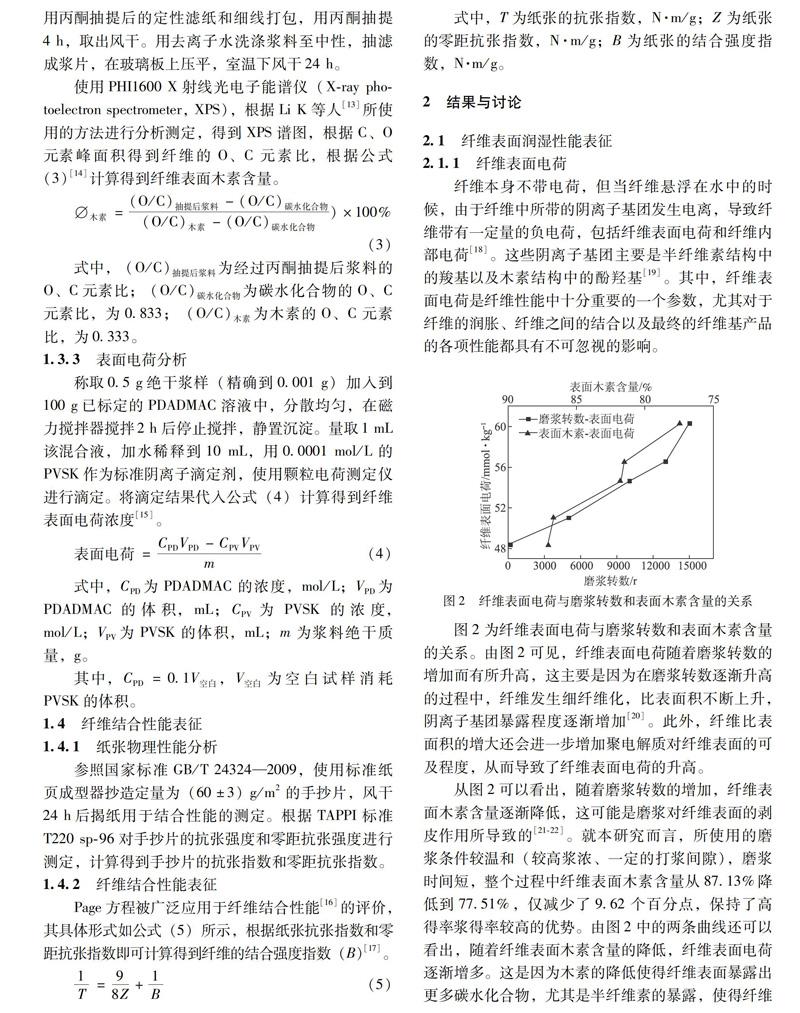
摘要:對南方松熱磨機械漿纖維進行PFI磨漿處理,通過“液橋法”分析纖維接觸角,進而計算表面能用于表征纖維表面潤濕性能,最終建立纖維表面潤濕性能與纖維結合性能之間的響應關系。結果表明,隨著機械處理程度的加深,纖維表面木素含量從87.13%降低到77.51%,纖維表面潤濕性能得到改善(表面能從46.63 mJ/m2上升到54.45 mJ/m2,表面電荷從48.382 mmol/kg上升到60.382 mmol/kg),結合強度指數從4.63 N·m/g提升到10.9 N·m/g。實驗發現,纖維表面潤濕性能與結合強度指數以及紙張的松厚度之間存在二次函數關系,且相關系數均大于0.9。從表面潤濕性能與松厚度之間的關系方程可知,紙張松厚度隨纖維表面潤濕性能降低而降低的較小,在整個機械處理過程中從4.95 cm3/g下降到3.57 cm.3/g,這表明可通過改善纖維表面潤濕性能來達到在不顯著影響紙張松厚度的前提下提高纖維結合性能的目的。
關鍵詞:木質纖維;潤濕性;表面能;表面木素;結合性能
中圖分類號:TS71.2
文獻標識碼:A
DOI:10.11980/j.issn.0254 508X.2018.12.001
木質纖維具有可生物降解、可回收利用等優點,在多個領域有著廣泛的應用,如纖維復合材料領域[12]和制漿造紙領域[3]等。決定纖維應用的關鍵因素是纖維本身的性能,包括纖維表面性能和內部性能兩部分。其中,纖維表面潤濕性能是纖維表面性能的重要指標之一,在纖維表面化學組成中,碳水化合物是親水性物質,而木素是疏水性物質,二者的比例是決定纖維應用的基礎,在從植物纖維原料中分離出單根纖維的過程中,傳統的制漿過程可以理解為是在此分離過程中努力平衡纖維表面親水性物質和疏水性物質間的比例。可見纖維表面潤濕性能發揮著重要的作用。
纖維表面潤濕性能指的是液滴在纖維表面進行鋪展和潤濕的能力,通過纖維對某種液體的接觸角和纖維的表面能來反映。纖維表面潤濕性能所涵蓋的內容很廣,包括纖維表面化學組成、表面電荷、表面能以及與纖維表面潤濕過程相關的其他物化性能[4]。當纖維與液滴接觸的時候,對于制漿造紙而言,纖維表面的潤濕能力會影響纖維的潤脹,纖維之間的結合面積發生相應變化[5];此外,纖維表面潤濕性能還會對纖維表面的化學組成和基團產生影響,從而影響纖維之間的結合強度。然而至今為止,關于纖維表面潤濕性能與纖維結合性能的關系卻很少有報道。
纖維之間的結合強度是紙張強度的主要來源,由纖維間氫鍵結合力和范德華力兩部分構成[6]。纖維表面的化學組成、表面電荷以及表面能等都會對纖維之間的結合產生影響,尤其是纖維表面的化學組成及分布在纖維表面的基團,會直接影響纖維之間形成氫鍵的多少[7]。相關研究表明[89],分布在纖維表面的木素不利于纖維之間的結合,這是因為木素本身是疏水的,無法在纖維之間形成氫鍵結合。對于高得率漿纖維,人們嘗試通過多種預處理方式來達到在不大量脫除木素的前提下改善纖維之間的結合性能,因此纖維表面潤濕性能發揮著十分重要的作用。然而,文獻報道中很少有關于高得率漿纖維表面潤濕性能的相關研究。
本研究通過對南方松熱磨機械漿(Thermo mechanical pulp,TMP)進行機械處理,分析纖維表面潤濕性能(包括纖維表面木素、表面電荷和表面能),建立纖維表面潤濕性能與纖維之間結合性能的響應關系。本研究的主要目的在于通過改善纖維表面潤濕性能,在對成紙松厚度影響較小的前提下努力改善高得率漿纖維結合性能,為進一步擴大高得率漿的應用范圍和提高使用比例起到一定指導作用。
3結論
南方松熱磨機械漿(TMP)纖維經過不同程度的機械處理后,纖維表面木素含量降低,纖維表面電荷增多,纖維表面接觸角降低,纖維表面能從46.63 mJ/m2提高到54.45 mJ/m2,纖維表面潤濕性能提高。纖維表面潤濕性能與纖維結合強度指數和紙張松厚度之間分別存在二次函數關系,纖維表面潤濕性能提高,纖維結合強度指數從4.63 N·m/g 提高至10.9 N·m/g,紙張松厚度略有降低。但紙張松厚度隨纖維表面潤濕性能降低而降低的較小,從4.95 cm3/g下降至3.57 cm3/g,這表明可以通過改善纖維表面潤濕性能在松厚度下降幅度不大的前提下提高高得率漿纖維的結合強度。
參考文獻
[1] Li X, Strieder W. Emissivity of hightemperature fiber composites[J]. Industrial & Engineering Chemistry Research, 2009, 48(4): 2236.
[2] Ma C, Ma M G, Li Z W, et al. Nanocellulose composites—Properties and applications [J]. Paper and Biomaterials, 2018, 3(2): 51.
[3] Gaudreault R, Cesare N D, Ven T G M V D, et al. Structure and strength of flocs of precipitated calcium carbonate induced by various polymers used in papermaking [J]. Industrial & Engineering Chemistry Research, 2015, 54(24): 6234.
[4] Yu R, Wang C, Qiu Y. Influence of aramid fiber moisture regain during atmospheric plasma treatment on aging of treatment effects on surface wettability and bonding strength to epoxy[J]. Applied Surface Science, 2007, 253(23): 9283.
[19] hman L O, Wgberg L, Malmgren K, et al. Adsorption of aluminum(III) on cellulosic fibres in neutral to alkaline solutionsInfluence of charge and size of the particles formed [J]. Journal of Pulp & Paper Science, 1997, 23(10): J467.
[20] Fardim P, Durn N. Modification of fibre surfaces during pulping and refining as analysed by SEM, XPS and ToFSIMS [J]. Colloids & Surfaces A Physicochemical & Engineering Aspects, 2003, 223(1/3): 263.
[21] Wang B, Li R, He B, et al. The impacts of lignin coverage, relative bonded area, and fiber properties on sheet strength [J]. Bioresources, 2011, 6(4): 4356.
[22] Skowronski J, Bichard W. Fibretofibre bonds in paper. I: Measurement of bond strength and specific bond strength [J]. Journal of pulp and paper science, 1987, 13(5): 165.
[23] Arianie L. Potention of lignin, lignin sulfonate and lignin acetate from palm empty bunch as an additive substance in urea fertilizer as an effort to reduce the solubility of urea nitrogen[J]. Advanced Materials Research, 2010, 9394: 409.
[24] Banavath H N, Bhardwaj N K, Ray A K. A comparative study of the effect of refining on charge of various pulps [J]. Bioresource Technology, 2011, 102(6): 4544.
[25] GAO Guilin, LIN Benping, SHEN Kuizhong, et al. The Effect of Lignin Content on Pulp Fiber Surface on the Sheet Strength [J]. Transactions of China Pulp & Paper, 2012, 27(1): 9.
高桂林, 林本平, 沈葵忠, 等. 紙漿物理強度與纖維表面木素含量關系的探討 [J]. 中國造紙學報, 2012, 27(1): 9.
[26]Chen H, Wang G, Cheng H T, et al. Effects of different chemical maceration methods on the surface wetting properties and section shapes of single bamboo fibers[J]. Journal of Beijing Forestry University, 2011, 33(1): 115.
陳紅, 王戈, 程海濤, 等. 不同化學離析方法對單根竹纖維表面潤濕性能及斷面形態的影響[J]. 北京林業大學學報, 2011, 33(1): 115.
[27] WANG Xin, LI Zhiqiang, ZHANG Hongjie, et al. Study on the Characterization of Deformation Behavior of Lignocellulosic Fibers and Its Effect on Interfiberbonding Properties[J]. China Pulp & Paper, 2017, 36(12): 14.
王欣, 李志強, 張紅杰, 等. 機械木漿纖維形變性表征及其對纖維間結合性能的影響[J]. 中國造紙, 2017, 36(12): 14.
[28] Ishiguro M, Endo T. Addition of alkali to the hydrothermalmechanochemical treatment of eucalyptus enhances its enzymatic saccharification [J]. Bioresour Technol, 2014, 153(153C): 322.
[29] Gharehkhani S, Sadeghinezhad E, Kazi S N, et al. Basic effects of pulp refining on fiber properties—a review [J]. Carbohydrate Polymers, 2015, 115: 785.
[30]ZHAO Huifang, ZHANG Meiyun, LU Jinbei. Configuration of PmiaPulp and Its Effect on Aramid Paper [J]. China Pulp & Paper, 2010, 29(02): 1.
趙會芳, 張美云, 路金杯. 芳綸1313漿粕結構形態及其對成紙性能的影響[J]. 中國造紙, 2010, 29(2): 1.
[31]PENG Jinyong, LIU Hongbin, LI Ganlin, et al. The Main Factors Affecting Bulk of Paper and Board [J]. China Pulp & Paper, 2014, 33(06): 64.
彭金勇, 劉洪斌, 李甘霖, 等. 影響紙和紙板松厚度的主要因素[J]. 中國造紙, 2014, 33(06): 64.
[32] Li H, Zhang H, Legere S, et al. Estimating the interfiber bonding capacities of highyield pulp(HYP) fibers by analyzing the fiber surface lignin and surface charge[J]. Bioresources, 2017, 13(1): 1122.
[33] Yan D, Li K. Measurement of wet fibre flexibility of mechanical pulp fibres by confocal laser scanning microscopy [J]. Journal of Materials Science, 2008, 43(8): 2869.CPP
(責任編輯:馬忻)
