不同生長期多花木蘭根系抗拉拔特性及其根系邊坡的穩定性
2018-10-18 12:25:46鄭明新
農業工程學報 2018年20期
鄭明新,黃 鋼,,彭 晶
?
不同生長期多花木蘭根系抗拉拔特性及其根系邊坡的穩定性
鄭明新1,黃 鋼1,2※,彭 晶2
(1. 華東交通大學土木建筑學院,南昌 330013; 2. 黃岡師范學院建筑工程學院,黃岡 438000)
為研究不同生長期灌木植物根系抗拉拔特性,并分析其對護坡效應的影響,對生長期分別為3個月、6個月、9個月、12個月、15個月和18個月的典型護坡灌木植物多花木蘭根系進行室內抗拉試驗和現場抗拔試驗,并采用二維有限元法模擬試驗區不同生長期多花木蘭根系邊坡穩定性的增強作用。結果表明:受不同生長期的影響,多花木蘭單根的抗拉力隨著根徑的增加呈冪函數增大,抗拉強度隨著根徑的增加呈冪函數減小,單根直徑一定時,抗拉力和抗拉強度隨著生長期的增長而增大;受不同生長期的影響,多花木蘭植物根系的抗拔力隨著地徑、地下生物量和側根數的增加呈指數函數增大,多花木蘭根系的平均生物指標和平均抗拔力的增大幅度隨著生長期的增長而減小,其中平均抗拔力增大幅度由102.78%減小到31.55%;邊坡的安全系數隨著植物生長期的增長而增大,等效塑性應變和最大位移隨著植物生長期的增長而減小,其中最大等效塑性應變較裸坡減小了24%~72%,最大水平位移的減少程度約為最大豎向位移的一半。
邊坡穩定性;數值模擬;植物;根系;生長期;抗拉強度;抗拔力;生物指標
0 引 言
隨著生態護坡技術的不斷發展,植物根系固土護坡效果已引起了國內外學者的高度重視[1-2]。根系的護坡效果與植物根系抗拉拔特性緊密相關,根系的抗拉強度與土-根粘結強度是研究植被護坡力學機理的重要力學指標。國內外學者對植物根系抗拉拔方面試驗進行了大量研究[3]。在抗拉特性方面,李可等[4-9]開展單根抗拉試驗,對草本和灌木植物不同根徑根系的抗拉力、抗拉強度進行了研究,得出單根抗拉力隨根徑增大而減小的結論;李光瑩等[10]、Yan等[11]通過分析認為,根系受土體運動而產生的抗拉力是植物根系的主要固土力學效應,故反映根系受力潛能的單根抗拉強度,可作為評判根系固土能力的一個有效指標;Roering等[12]分析了根系化學成分的差異對根系抗拉強度的影響;Vergani等[13]發現植物根系的抗拉強度與環境因素有關;馮國建等[14]研究了根系抗拉強度和根系分布特征研究;萬娟等[15]探討了不同坡度邊坡灌木根系的抗拉強度與邊坡穩定性。在抗拔特性方面,李紹才等[16]通過抗拉試驗對巖石邊坡植被護坡工程坡面巖體根系互作的力學特性進行了初步探討,研究了抗拉強度與復合體含根量等因子間的關系;Hu等[17]研究了根系纖維含量對抗拉力的影響;陳麗華等[18]通過對邊坡單株木本進行拉拔試驗,研究了根系的分布形態對抗拔能力影響;劉旭菲等[19-22]通過對根系的室內外試驗,研究了根-土摩擦力的影響因素;劉小光[23]研究了根系與土壤之間的錨固性能的影響因素;曹云生等[24]研究了根-土摩擦力的影響因素,根的抗拔力隨著根系根徑和埋深的增加而增大。這些研究成果中有關不同生長期的灌木植物根系的抗拉拔特性及護坡效果的研究較少。然而植物護坡是一個長期的、復雜的、動態的過程,根系護坡坡效果與植物的生長有很大關系[25-27]。為了探討生態護坡的可持續能力,需要對生態護坡中植物生長期對邊坡穩定性影響進行研究。
本文依據對試驗區內的灌木植物多花木蘭()進行室外現場抗拔試驗和室內抗拉試驗,探討灌木植物多花木蘭根系抗拉力、抗拉強度和抗拔力與不同生長期關系,分析不同生長期的多花木蘭根系抗拉拔能力強弱變化。并采用二維有限元法,模擬和對比試驗區黏土裸坡與不同生長期多花木蘭根系邊坡的安全系數和等效塑性區應變、最大位移,從而評價試驗區不同生長期多花木蘭根系護坡貢獻。這對于采用多花木蘭類護坡,實現基礎設施建設與生態環境保護之間的協調發展具有重要的學術價值和現實意義。
1 試驗材料與方法
為保證護坡植物的生長適應能力和水土保持能力,在黃岡師范學院周邊邊坡上建立試驗區,選取優良的護坡物種多花木蘭,種植在坡比為1∶1.5邊坡上。在該邊坡上,自植物發芽開始,每隔3個月(3個月、6個月、9個月、12個月、15個月和18個月)分別選取多花木蘭根系做現場抗拔試驗和室內抗拉試驗。
抗拉試驗方法:在試驗區邊坡上隨機選取10株多花木蘭根系用水清洗掉根系上的泥土和側根,從主根上選取較直的10 cm段作為抗拉試驗材料。為了保證單根新鮮、完整,把剪好單根放入保鮮袋里面儲存,并在24 h內采用電子拉力儀進行室內抗拉試驗,拉伸加載速度控制為0.02 mm/s,測得最大拉力,用游標卡尺測量根斷裂處的平均根徑。
2 結果及分析
2.1 不同生長期多花木蘭根系抗拉特性分析
2.1.1 不同生長期多花木蘭根系抗拉特性分析
多花木蘭根系生長期、單根根徑與抗拉力和抗拉強度與的關系見圖1。
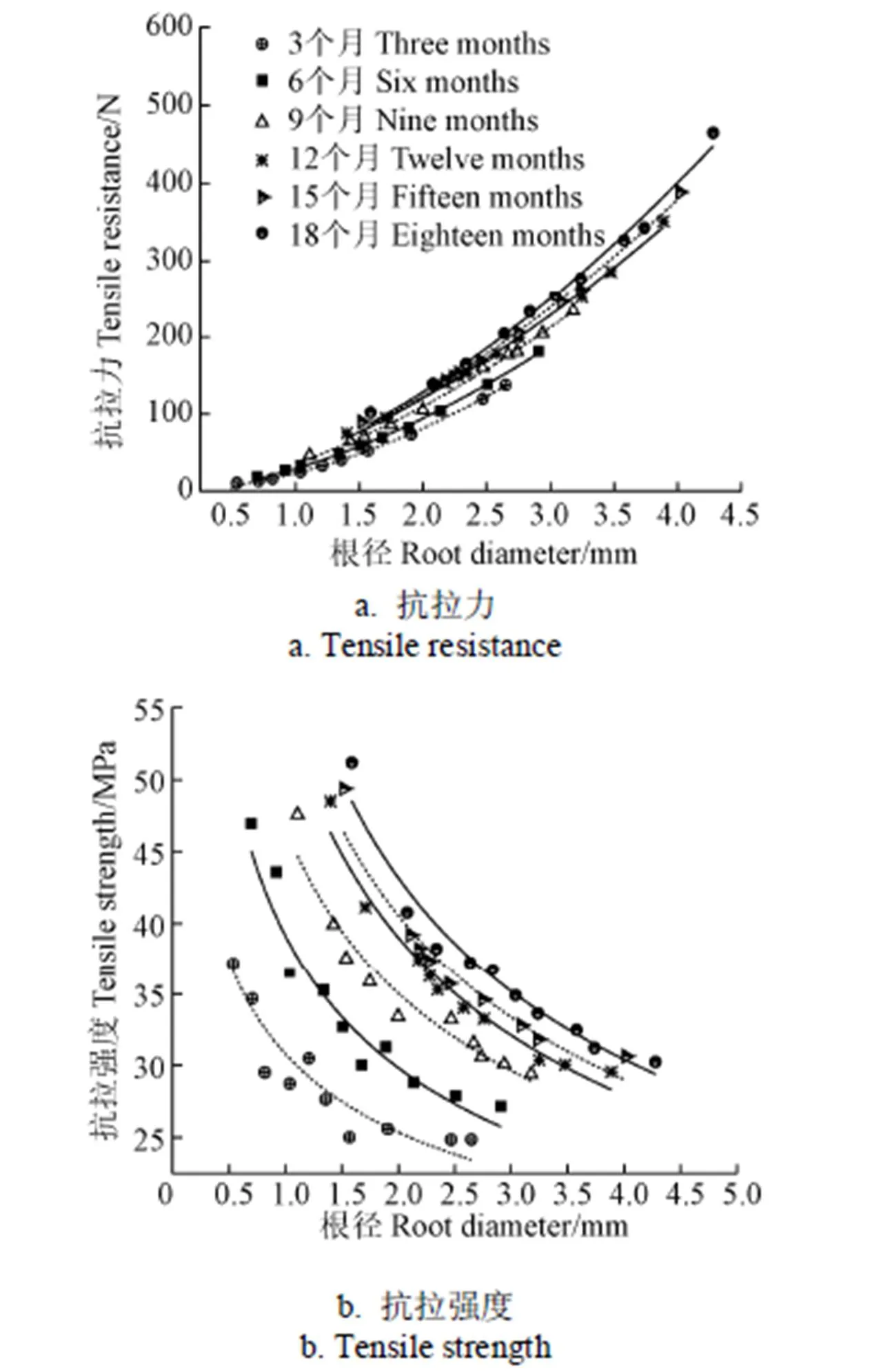
圖1 不同生長期根系的抗拉力、抗拉強度與根徑關系
由圖1可以看出,在單根生長期相同的情況下,單根抗拉力隨著根徑的增大而增加,兩者存在明顯的正向關系;單根抗拉強度隨著根徑的增大而減小,兩者存在明顯的負向關系。
相同生長期的單根根徑與抗拉力、抗拉強度之間具有較好的冪函數關系:
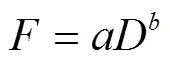
式中為抗拉力或抗拉強度,為單根根徑;,為擬合參數。不同生長時間根系擬合結果及相關系數見表1,相關系數均較高。
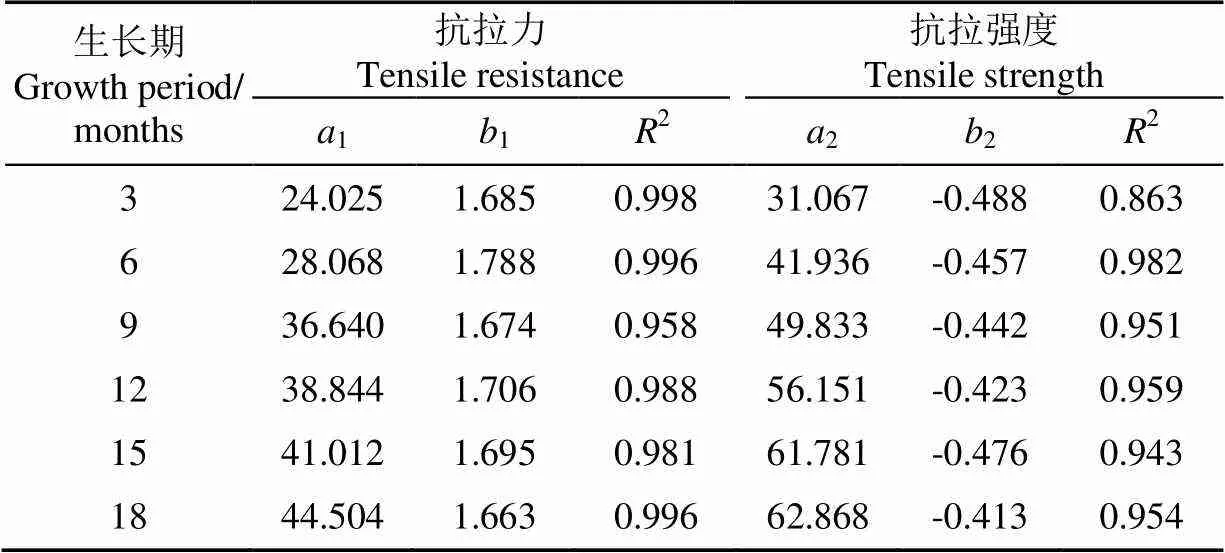
表1 不同生長期抗拉力、抗拉強度與根徑的擬合參數及相關系數
由表1分析可知,抗拉力與根徑擬合參數1在1.7左右變化,1隨著生長時間的增加而增大,從而同一根徑的根系抗拉力隨著生長時間的增加而增大;抗拉強度與根徑的擬合參數2在?0.45左右變化,2隨著生長期的增加而增大,從而可知,同一根徑一定時,根系抗拉強度隨著生長期的增加而增大,說明隨著植物的生長發育,根系的抗拉能力越來越強,這是因為隨著植物生長發育,植物根系內部的纖維含量逐漸增多,木質化程度增加,提高根系的抗拉斷裂極限能力,這與劉治興[28]通過對不同邊坡防護根系的研究發現,隨著植物生長期的增長其根系平均抗拉力逐漸增加的結論一致。
2.1.2 根系抗拔特性
蔡曉松解釋說,有些客戶接到品牌訂單,覺得難以達到要求,公司就把其小樣拿過來,在實驗室里試樣,得到工廠認可后,再將配方和工藝交給客戶,并派技術人員前往指導。如果在售后中碰到問題,品牌商可以將產品拿到實驗室,進行分析,尋找解決方案,再到工廠實地解決。
根系抗拔力的大小反映了根-土相互作用的強度,因此抗拔力愈大,其根系愈有利于邊坡土體的穩定性。根系的抗拔力與地徑、地下生物量、側根數等生物指標有關[19]。
不同生長期多花木蘭抗拔力與根系生物指標的關系見圖2。由圖2可以看出,隨著生長期的增長,地徑、地下生物量、側根數都增大,抗拔力增大。生長期3~6個月內的生物指標和抗拔力增幅度最大,之后生長期每增加3個月平均地徑增大幅度由102.78%減小到9.80%,平均地下生物量增大幅度由117.55%減小到19.70%,平均側根數增加幅度由104.35%減小到6.67%,平均抗拔力增大幅度由102.78%減小到31.55%。根系生物指標的增加幅度隨著生長期的增長而減小。說明根系的生長發育程度與抗拔力之間存在明顯的正向關系,多花木蘭根系和土壤的粘結作用隨著生長不斷加強,但是生長半年后發育增快幅度有變緩趨勢。這是由于隨著根系的生長發育,根系中側根的數量、根系的根徑和延伸的深度隨之增加,根系對四周土體產生膨壓作用,使根和土之間的接觸更加緊密,增大了根和土之間的接觸面積,增強了根系和土壤之間的粘液、有機膠質和摩擦等產生的粘結強度,從而根系的固持土壤的能力在不斷增強。
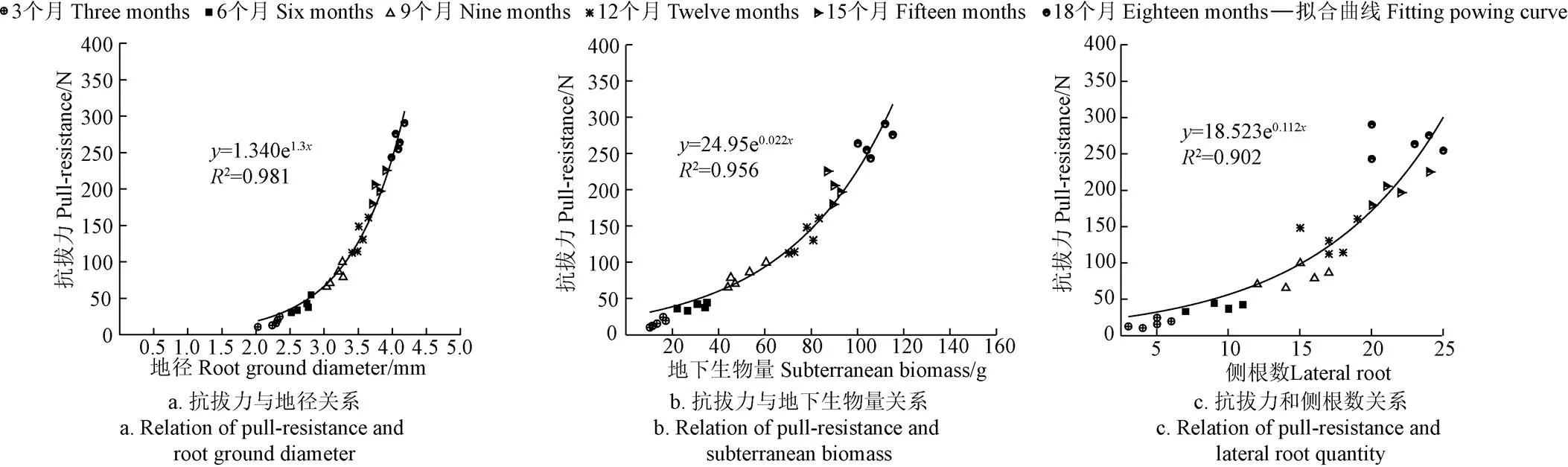
圖2 不同生長期根系的抗拔力與地徑、地下生物量和側根數的關系
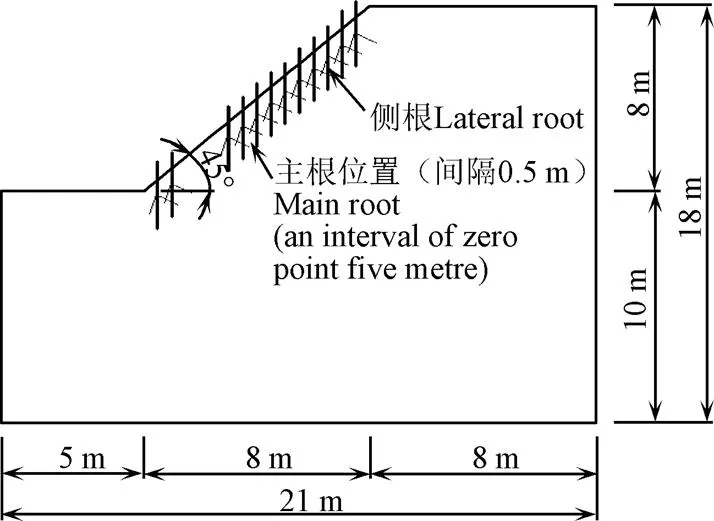
圖3 邊坡幾何模型圖
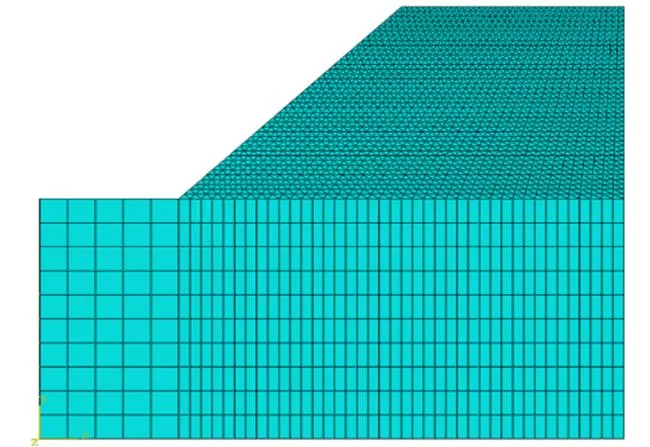
圖4 邊坡網格劃分
2.2 多花木蘭根系邊坡穩定性數值分析
目前,邊坡穩定性的分析方法主要分為極限平衡法和有限元法兩大類。極限平衡法是基于摩爾-庫倫強度準則,必需事先假定滑動面,計算式不考慮土體應力應變的關系,通過引入若干假定而轉化為靜定問題進行計算。而強度折減有限元法可求解非線性問題,對巖土工程有較好的適用性,分析折減之后抗剪強度參數來計算邊坡安全系數,從而使得計算更加方便快捷[29-30]。以下使用ABAQUS軟件來模擬不同生長期多花木蘭根系邊坡的穩定性。
2.2.1 數值模型建立
1)邊坡幾何模型與邊界條件
采用二維平面應變模型來分析多花木蘭根系對邊坡土體穩定作用。結合種植多花木蘭植物的試驗區邊坡地形條件和根系密度(間隔0.5 m),建立簡化試驗區邊坡平面幾何模型如圖3所示,模型左右邊界施加水平方向的位移約束,底部邊界施加水平和豎向約束。邊坡計算模型網格如圖4所示,劃分3 650個單元,2 146個節點,土體采用Mohr-Coulomb破壞準則。
2)多花木蘭根系模型
多花木蘭根系屬于直根型灌木,垂直主根優勢不明顯,斜向側根較為發達,與垂直主根之間的,角度在20°~65°之間。真實狀態下的多花木蘭根系在土體里面盤根錯節,數值分析時把每個多花木蘭根系全簡化成直線段,垂直主根和斜向側根均按等徑處理,側根的直徑簡化成主根地徑的一半,垂直主根和斜向側根之間的角度為45°,側根間距取0.1 m,對稱布置,最上面的側根與邊坡距離0.1 m。模擬計算時假定不考慮土體和多花木蘭根系界面發生錯動,把垂直主根和斜向側根使用約束命令嵌固土體里[31],根系和土體能自動實現位移協調。多花木蘭根系為受拉強度遠大于受壓強度柔性材料,采用桁架單元模擬多花木蘭根系。
2.2.2 數值模型工況及計算參數
本次模擬試驗采用的飽和黏土裸坡以及植物生長期分別為3個月、6個月、9個月、12個月、15個月、18個月的飽和黏土邊坡的7個工況的模型,模擬工況如表2所示。
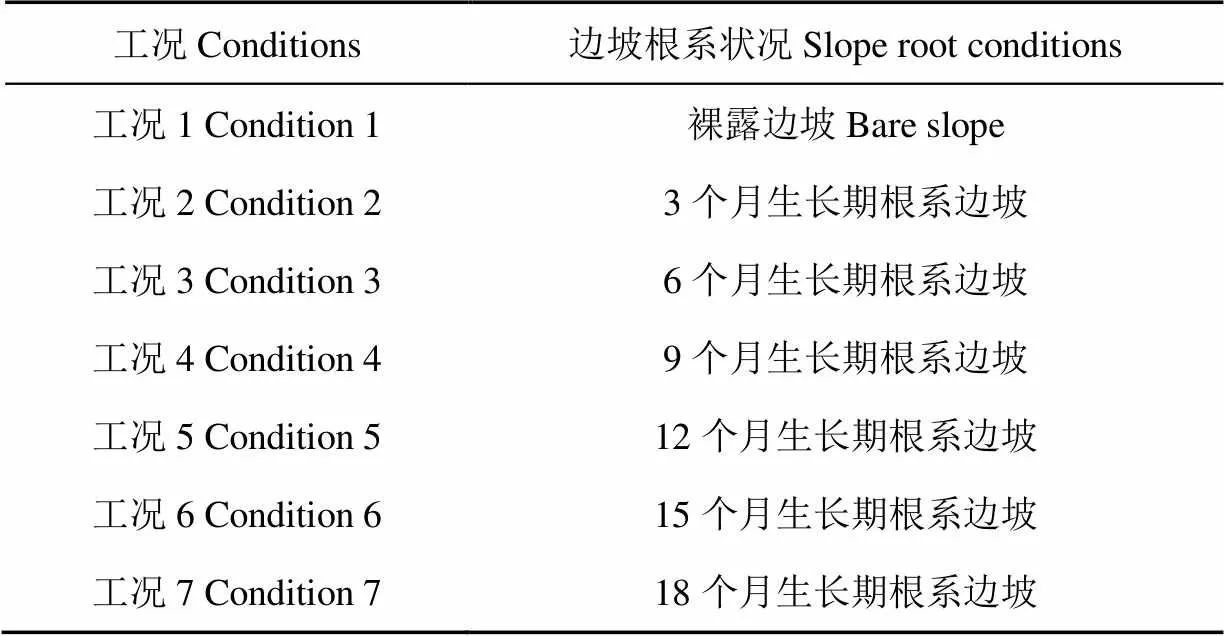
表2 模擬工況
飽和黏土邊坡土體的參數由土工試驗測得,含水率為16.90%,彈性模量為11.23 MPa,黏聚力為12.68 kPa,內摩擦角為21.35°,干密度為1.85 kg/m3,模型中根系的物理參數由試驗測得,具體數據見表3。
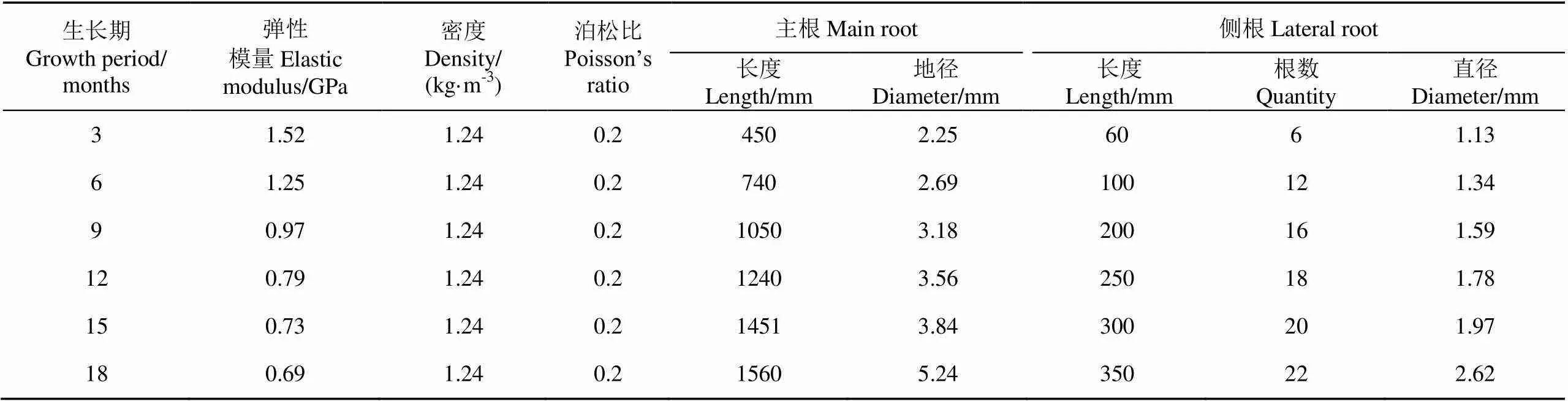
表3 不同生長期根系參數表
2.2.3 計算結果及分析
1)邊坡安全系數分析
通過有限元計算得到各工況下邊坡安全系數分別為1.190、1.203、1.221、1.246、1.345、1.405和1.468。
由圖5可知,6種不同生長期多花木蘭的植物邊坡的安全系數大于裸坡,并隨著多花木蘭植物生長期增加,其安全系數逐漸增大。工況2~7的安全系數分別較工況1增幅1.09%、2.61%、4.71%、13.03%、18.07%和23.36%,環比增幅1.09%、1.50%、2.05%、7.95%、4.46%和4.48%。說明多花木蘭根的存在能過提高邊坡的穩定性能,且隨著根系的生長發育,主根越長,側根越多,根系越發達,根系護坡能力越強,邊坡的安全系數越高。
2)邊坡塑性應變
基于試驗所測多花木蘭根系的增強邊坡穩定性分析,各工況邊坡失穩時的等效塑性應變云圖和最大等效性應變分別如圖6、表4所示。由此可知:
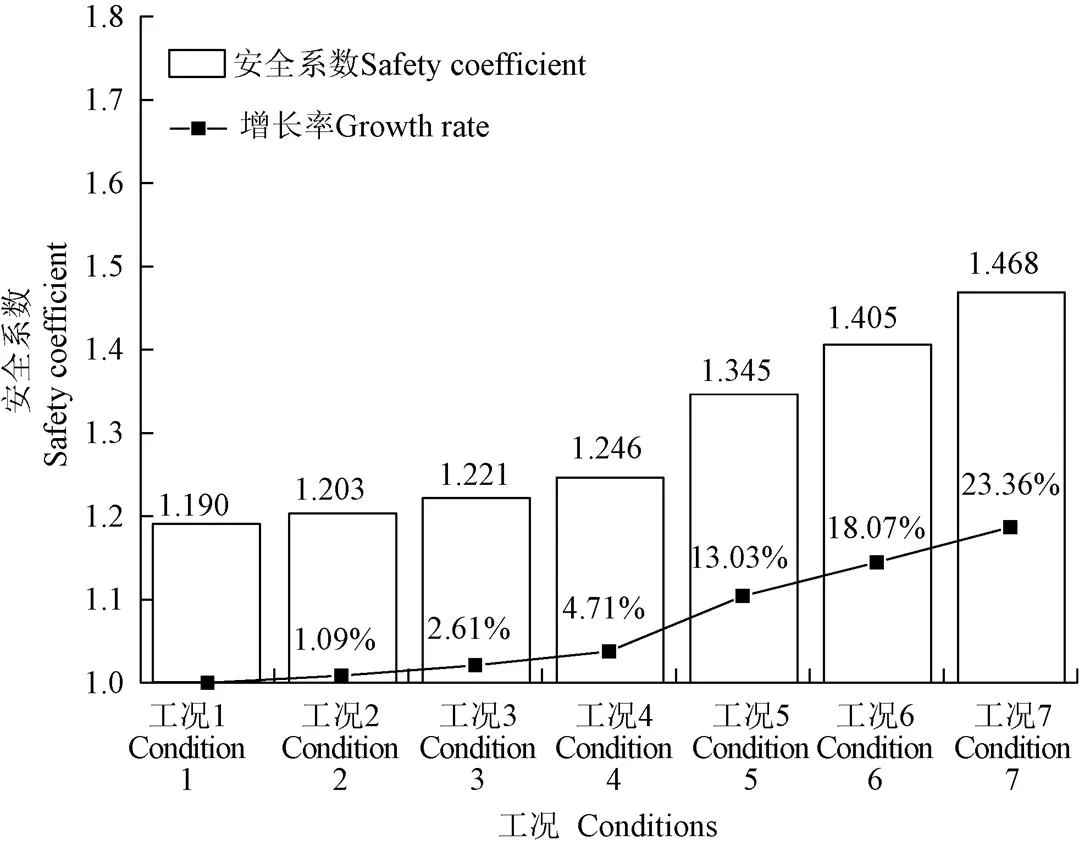
圖5 邊坡的安全系數
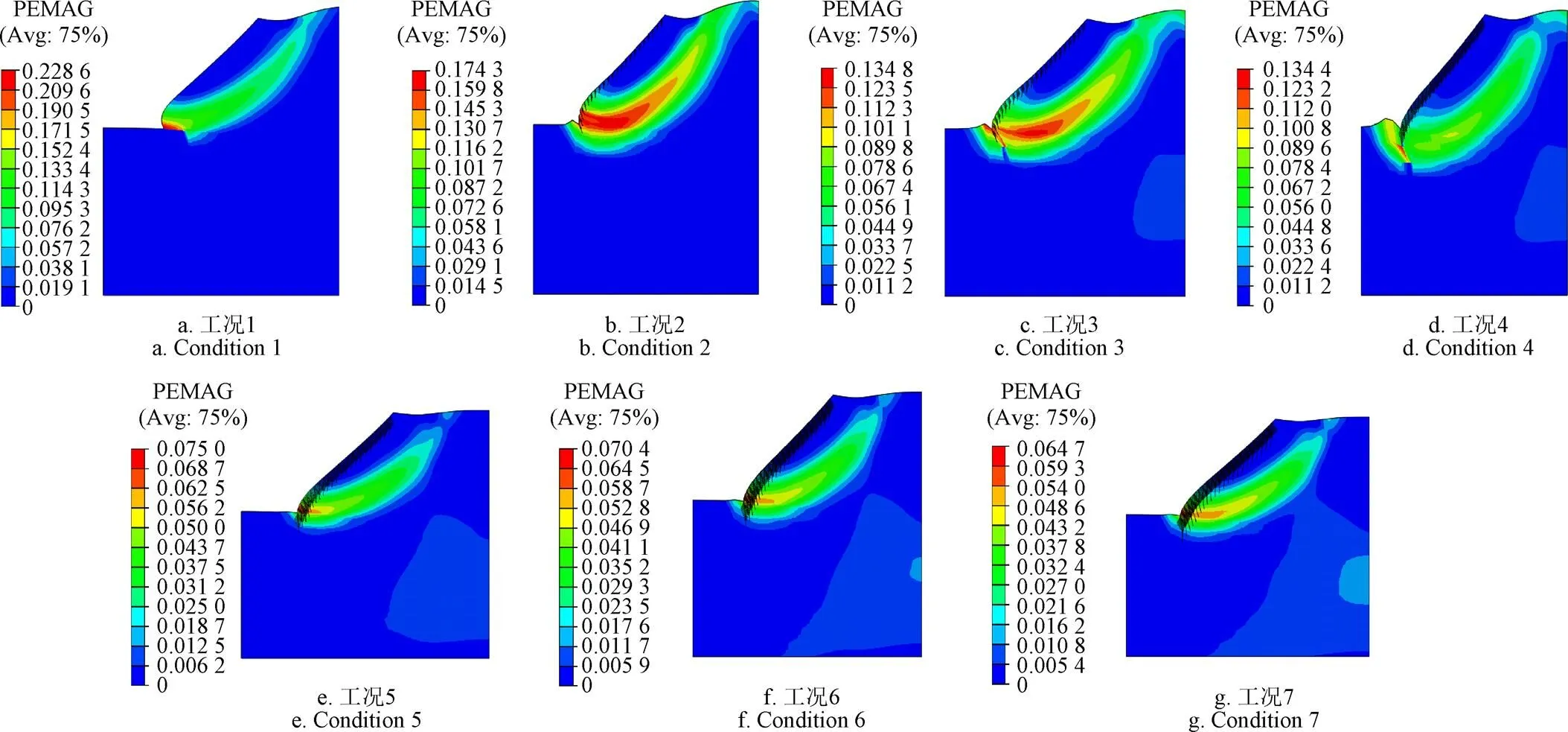
圖6 各工況下邊坡失穩時等效塑性應變云圖

表4 各工況下邊坡失穩時最大等效塑性應變
裸坡失穩時最大等效塑性應變出現在坡腳,為0.228 6,且主要集中坡面以下4 m之內,其破壞屬于淺層滑坡。不同生長期的根系邊坡,最大等效塑性應變比裸坡減少了24%~72%,并且隨著根系生長期的增加而減小,表明多花木蘭根系的存在能有效減少邊坡等效塑性應變。
通過對裸坡與多花木蘭根系邊坡的滑動面對比發現,隨著邊坡根系生長期的增加,塑性區逐漸向邊坡的深層移動,塑性變形集中區域逐漸遠離坡腳,并出現范圍越來越大隆起“延性”破壞。說明灌木多花木蘭植物根系能加固土體,控制邊坡淺層土體的變形,使土體變形區域向深層移動,增加淺層土體的穩定性。
3)最大水平和豎向位移
基于試驗所測多花木蘭根系的增強邊坡穩定性分析,1~7工況的最大水平位移和豎向位移如表5所示。由表5可知,6種不同生長期多花木蘭根系均能有效減少邊坡的最大水平位移和豎向位移,并且隨著生長期的增大,最大水平位移和豎向位移的減少程度越來越高,最大水平位移的減少程度是最大豎向位移的一半左右,表明根系的生長發育減小邊坡的變形。這是由于剛度較大的多花木蘭根系與邊坡周邊土體的共同作用,增大邊坡整體剛度,約束了邊坡的水平位移和豎向位移,約束效應并隨著根系的生長發育而增強,因根系剛度主要對水平向應力起作用,所以植入根系后的邊坡水平位移減小幅度要大于豎向位移減小幅度。
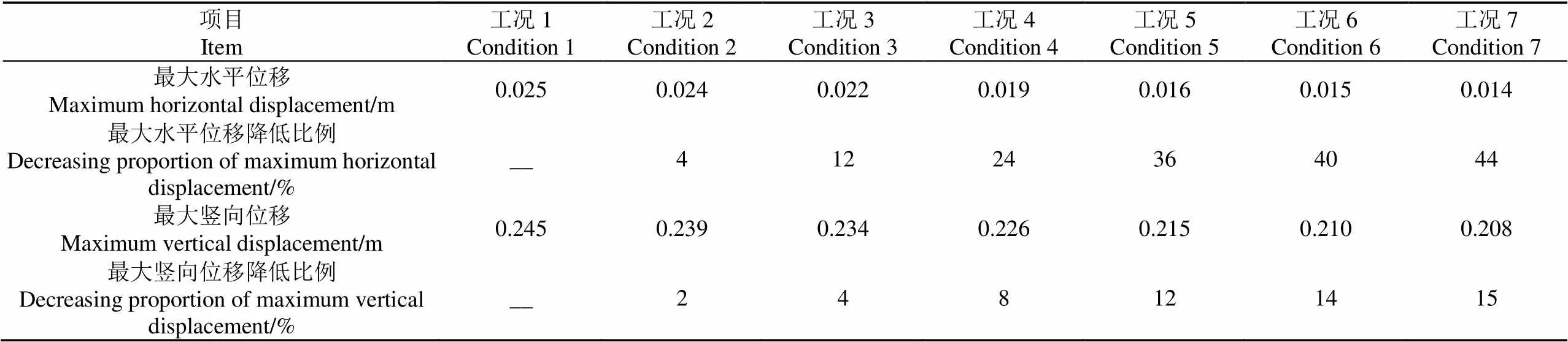
表5 各工況下最大水平位移和豎向位移
3 討 論
本文研究發現多花木蘭植物的單根抗拉力隨著根徑的增大呈增大趨勢,抗拉強度隨著根徑的增大呈減小趨勢。這一研究結論與大多數研究者有關單根抗拉特性與根徑的關系的研究結果一致[4-6,9-10,15];不同之處在于,不同生長期條件下植物單根的抗拉力增加、抗拉強度減少的函數不同,在直徑一定的情況下,生長期越長的根系抗拉力和抗拉強度越高。該結論需要結合植物根系在不同生長期的微觀結構和纖維素含量進行進一步分析研究。由圖1可知多花木蘭植物的單根抗拉力和抗拉強度增大隨著生長期的增長而增大,這一結論與苑淑娟[31]關于2種生長期灌木檸條單根抗拉力和抗拉強度的研究結論一致,與劉艷琦等[7]關于灌木檸條、沙棘、沙柳的研究結論不一致。分析原因,可能與植物的種類、生長的立地條件不同有關,這些影響因素需要更進一步的研究。
已有研究得到植物根系的抗拔力受到植物生物指標的影響[22-24]。本文研究發現多花木蘭植物根系抗拔力在不同生長期條件下隨著生物指標的增加呈增大趨勢,多花木蘭根系的平均生物指標和平均抗拔力的增大幅度隨著生長期的增長而減小。這與李紹才等[16]研究發現巖石風化條件一定時灌木抗拔力隨生物指標的增加而增大的結論一致。但是,本文關于多花木蘭根系抗拔力與側根數呈冪函數關系的結論與李國榮等[32]研究寒旱地區灌木根系得出抗拔力呈線性相關結論不一致。分析原因,可能與植物的種類、土壤含水等水文條件不同有關,因為張興玲等[22]研究發現根系抗拔力隨著土壤含水量有關,關于這些需要更進一步的研究。
本文采用數值分析的研究發現結果與萬娟等[15]植物根系理論分析結果和瞿文斌等[20]、陳潮[30]有限元分析結果相一致。本文采用數值模擬中根系簡化模型反映了根系的特征和根土的相互作用,比瞿文斌等[20]更接近實際情況,但與實際還有一定差距,因根系在土中的分布特征、根系與土的相互作用非常復雜,這些將在以后做進一步的研究。
4 結 論
1)相同生長期多花木蘭植物單根的抗拔力隨著直徑的增大而增大,抗拉強度隨著根徑的增大而減小,抗拉力、抗拉強度與根徑之間存在顯著冪函數關系;單根直徑一定時,抗拉力和抗拉強度增大隨著生長期的增長而增大,反映出根系的生長發育能提高根系的抗拉斷裂極限能力。
不同生長期多花木蘭植物根系的抗拔力隨著生物指標的增大而增大,抗拔力與地徑、地下生物量和側根數三者之間存在顯著的指數函數關系。多花木蘭根系的平均生物指標和平均抗拔力的增大幅度隨著生長期的增長而減小,其中平均抗拔力增大幅度由102.78%減小到31.55%,反映出根系的生長發育能提高根-土的粘結作用。
2)植物根系的存在能增強邊坡的穩定性。邊坡的安全系數隨著植物生長期的增長而增大,等效塑性應變和最大位移隨著植物生長期的增長而減小,其中最大等效塑性應變較裸坡減小了24%~72%,最大水平位移的減少程度約為最大豎向位移的一半。
[1] 夏振堯,張倫,陳毅,等. 香根草根系與土壤接觸特性及抗拔模型研究[J]. 水生態學雜志,2016,37(4):36-41.
Xia Zhenyao, Zhang Lun, Chen Yi, et al. Vetiver root-soil contact characteristics and pull-out model[J]. Journal of Hydroecology, 2016, 37(4): 36-41. (in Chinese with English abstract)
[2] 譚儒蛟,楊旭朝,胡瑞林. 反傾巖體邊坡變形機制與穩定性評價研究綜述[J]. 巖土力學,2009,30(增刊2):479-484.
Tan Rujiao, Yang Xuzhao, Hu Ruilin. Review of deformation mechanism and stability analysis of anti-dipped rock slopes[J]. Rock Mechanics, 2009, 30(Supp.2): 479-484. (in Chinese with English abstract)
[3] 楊旸,字淑慧,余建新,等. 植物根系固土機理及模型研究進展[J].云南農業大學學報,2014,29(5):759-765.
Yang Yang, Zi Shuhui, Yu Jianxin, et al.Advances in research on mechanism and models of plant roots reinforcement[J]. Journal of Yunnan Agricultural University, 2014, 29(5): 759-765.(in Chinese with English abstract)
[4] 李可,朱海麗,宋路,等. 青藏高原兩種典型植物根系抗拉特性與其微觀結構上的關系[J]. 水土保持研究,2018,25(2):240-249.
Li Ke, Zhu Haili, Song Lu, et al. Relationship between tensile properties and microstructure of two typical plant roots in the qinghai-tibei plateau[J]. Soil and Water Conservation Research, 2018, 25(2): 240-249. (in Chinese with English abstract)
[5] 朱海麗,胡夏嵩,毛小青,等. 青藏高原黃土區護坡灌木植物根系力學特性研究[J]. 巖石力學與工程學報,2008(增刊2):3445-3452.
Zhu Haili, Hu Xiasong, Mao Xiaoqing, et al. Study on mechanical characteristcs of shrub roots for slope protection in loess area of tibetan plateau[J].Chinese Journal of Rock Mechanics and Engineering, 2008(Supp.2): 3445-3452. (in Chinese with English abstract)
[6] 陸桂紅,歐國強,楊順. 泥石流源區典型草本植物根系抗拉試驗[J]. 山地學報,2014,32(6):725-731.
Lu Guihong, Ou Guoqiang, Yang Shun. Root tensile test of typical grass in debris flow triggering area[J]. Mount Ain Research, 2014, 32(6): 725-731. (in Chinese with English abstract)
[7] 劉艷琦,格日樂,阿如旱,等. 2個生長時期5種植物單根抗拉力學特性比較[J]. 內蒙古農業大學學報:自然科學版,2017,38(6):25-30.
Liu Yanqi, Gerile, Aruhan, et al.Comparison of single root tensile resistance characteristics of five plants in two growth periods[J]. Journal of Inner Mongolia Agricultural University: Natural Science Edition, 2017, 38(6): 25-30. (in Chinese with English abstract)
[8] 嵇曉雷. 基于植被根系分布形態的生態邊坡穩定性研究[D]. 南京:南京林業大學,2013.
Ji Xiaolei. A Roots Distribution-based Study on the Stability of Ecological Slope[D]. Nanjing: Nanjing Forestry University, 2013. (in Chinese with English abstract)
[9] 嵇曉雷,楊平,王磊. 狗牙根根系抗拉強度試驗[J].湖北農業科學,2015,54(23):5941-5948.
Ji Xiaolei, Yang Ping, Wang Lei. Experiments on root tensile strengths of bermuda grass[J].Hubei Agricultural Sciences, 2015, 54(23): 5941-5948. (in Chinese with English abstract)
[10] 李光瑩,杜江濤,余冬梅,等. 堿脅迫條件下草本植物根系力學強度試驗研究[J]. 工程地質學報,2016,24(4):585-595.
Li Guangying, Fu Jiangtao, Yu Dongmei, et al.Mechanical strength characteristics of herbaceous plant roots under alkali stressing[J]. Journal of Engineering Geology, 2016, 24(4): 585-595. (in Chinese with English abstract)
[11] Yan Z, Song Y, Jiang P, et al. Mechanical analysis of interaction between plant roots and rock and soil mass in slope vegetation[J]. Applied Mathematics and Mechanics, 2010, 31(5): 617-622.
[12] Roering J J, Schmidt K M, Stock J D, et al. Shallow landsliding, root reinforcement, and the spatial distribution[J]. Canadian Geotechnical Journal, 2003, 40(2): 237-253.
[13] Vergani C, Chiaradia E, Bischetti G. Variability in the tensile resistance of roots in Alpine forest tree species[J]. Ecological Enginerring, 2012, 46(9): 43-56.
[14] 馮國建,王世通. 護坡植物根系分布特征及抗拉強度研究[J]. 重慶師范大學學報:自然科學版,2013,30(2):115-118.
Feng Guojian, Wang Shitong. Study on distributiaon characteristic and tensile strength of slope eco-engineering plant root[J]. Journal of Chongqing Normal University: Natural Science, 2013, 30(2): 115-118. (in Chinese with English abstract)
[15] 萬娟,肖衡林,何俊. 多花木蘭根系抗拉特性及邊坡穩定性分析[J]. 華中科技大學學報:自然科學版,2014(8):110-116.
Wan Juan, Xiao Henglin, He Jun. Tensile Properties of magnolia multiflora’s roots and slope stability analysis[J]. Journal of Huazhong University of Science and Technology: Natural Science Edition, 2014(8): 110-116. (in Chinese with English abstract)
[16] 李紹才,孫海龍,楊志榮,等. 護坡植物根系與巖體相互作用的力學特性[J]. 巖石力學與工程學報,2006,25(10):2051-2057.
Li Shaocai, Sun Hailong, Yang Zhirong, et al. Mechanical characteristics of interaction between root system of plants and rock for slope protection[J]. Chinese Journal of Rock and Engineering, 2006, 25(10): 2051-2057. (in Chinese with English abstract)
[17] Hu X, Brierley G, Zhu H, et al. An exploratory analysis of vegetation strategies to reduce shallow landslide activity on loess hillslopes, Northeast qinghai-tibet plateau[J]. Journal of Mountain Science, 2013, 10(4): 668-686.
[18] 陳麗華,余新曉,張東升,等. 整株林木垂向抗拉試驗研究[J]. 資源科學,2004,26(增刊):39-41.
Chen Linhua, Yu Xinxiao, Zhang Dongsheng, et al.Experimental study on vertically tensile strength of whole tree[J]. Resources Science, 2004, 26(Supp.): 39-41. (in Chinese with English abstract)
[19] 劉旭菲. 多因素作用植被對岸坡穩定影響的試驗及數值模擬研究[D]. 天津:天津大學,2015.
Liu Xufei. Experimental and numerical investigation of slope stability with multiple factors based on vegetation Protection[D]. Tianjin: Tianjin University, 2015. (in Chinese with English abstract)
[20] 瞿文斌,及金楠,陳麗華,等. 黃土高原植物根系增強土體抗剪強度的模型與試驗研究[J]. 北京林業大學學報,2017,39(12):79-86.
Qu Wenbin, Ji Jinnan, Chen Lihua, et al.Research on model and test of reinforcing shear strength by vegetation roots in the Loess Plateau of northern China[J]. Journal of Beijing Forestry University, 2017, 39(12): 79-87. (in Chinese with English abstract)
[21] 蔣坤云,陳麗華,蓋小剛,等. 華北護坡闊葉樹種根系抗拉性能與其微觀結構的關系[J]. 農業工程學報,2013,29(3):115-123.
Jiang Kunyun, Chen Lihua, Gai Xiaogang, et al. Relationship be-tween tensile properties and microstruc-tures of three different broad-leaf tree roots in North China[J]. Transactions of the Chinese Society of Agricultural Engineering (Transactions of the CSAE), 2013, 29(3): 115-123. (in Chinese with English abstract)
[22] 張興玲,胡夏嵩,毛小青,等. 青藏高原東北部黃土區護坡灌木檸條錦雞兒根系拉拔摩擦試驗研究[J].巖石力學與工程學報,2011(增刊2):3739-3745.
Zhang Xingling, Hu Xiasong, Mao Xiaoqing, et al. Research on pull-out friction test of shrub caraganak or shinskii roots for slope protection in loess area of noetheast qinghai-tibetan plateau[J]. Journal of Rock Mechanics and Engineering, 2011(Supp.2): 3739-3745. (in Chinese with English abstract)
[23] 劉小光. 林木根系與土壤摩擦錨固性能研究[D]. 北京:北京林業大學,2013.
Liu Xiaoguang. Study on Firction and Anchorage Characteristics Between Root System and Soil[D]. Beijing: Beijing Forestry University, 2013. (in Chinese with English abstract)
[24] 曹云生,陳麗華,劉小光. 植物根土界面摩擦力的影響因素研究[J]. 摩擦學學報,2014(5):482-488.
Cao Yunsheng, Chen Lihua, Liu Xiaoguang.The lnfluence factors of plant root-soil interface friction[J]. Tribology, 2014(5): 482-488. (in Chinese with English abstract)
[25] 吳宏偉. 大氣–植被–土體相互作用:理論與機理[J]. 巖土工程學報,2017(1):1-40.
Charles Wangwai. Atmosphere-plant-soil interactions: theories and mechanisms[J]. Chinese Journal of Geotechnical Engineering, 2017(1): 1-40. (in Chinese with English abstract)
[26] Mao Z, Bourrier F, Stokes A, et al. Three dimensional modelling of slope stability in heterogeneous montane forest ecosystems[J]. Engineering Division, 2014, 273: 11-22.
[27] Fan C C, Laiy F. Influence of the spatial layout of vegetation on the stability of slopes[J]. Plant and Soil, 2014, 377(1/2): 83-95.
[28] 劉治興. 高速公路邊坡植物不同生長期防護效果[D]. 北京:北京林業大學,2016.
Liu Zhixing. Study on the Protective Effect of Highway Slope Plant in Different Growth Stages[D]. Beijing: Beijing Forestry University, 2016. (in Chinese with English abstract)
[29] 閆俊維,王曙光,陳靜瑜. ABAQUS強度折減法在邊坡穩定性分析中的應用[J]. 西部交通科技,2015(8):21-24.
Yan Junwei, Wang Shuguang, Chen Jun. Applications of ABAQUS strength reduction method in slope stability analysis[J]. Western China Communications Science & Technology, 2015(8): 21-24. (in Chinese with English abstract)
[30] 陳潮. 護坡灌木根-土力學作用時間尺度效應研究[D]. 成都:西南交通大學,2017:1-54.
Chen Chao. Study on the Effect of Shrub Roots-soil in Bio-slope[D]. Chengdu: South Jiaotong University, 2017: 1-54. (in Chinese with English abstract)
[31] 苑淑娟. 4種植物單根抗拉力學特性的研究[D]. 呼和浩特:內蒙古農業大學,2010.
Yuan Shujuan. Study on Mechanical Properties of Single Root Tensions of Four Plants[D]. Hohhot: Inner Mongolia Agricultural University, 2010. (in Chinese with English abstract)
[32] 李國榮,胡夏嵩,毛小青,等. 寒旱環境黃土區灌木根系護坡力學效應研究[J]. 水文地質工程地質,2008(1):94-97.
Li Guorong, Hu Xiasong, Mao Xiaoqing, et al. A study of the mechanical effects of shrub roots for slope protection in frigid and arid-semiarid loes area[J]. Hydrogeology and Engineering Geology, 2008(1): 94-97. (in Chinese with English abstract)
Tensile-pullout properties of roots ofin different growth stages and stability of slope with its root
Zheng Mingxin1, Huang Gang1,2※, Peng Jing2
(1.,330013,; 2.438000,)
To study the root tensile-pullout characteristics of shrubs in different growth periods and analyze their effects on slope protection. A indoor tensile test and a field pull-out test using the roots ofwhich is a typical slope-protection shrubs with a growth period of three months, six months, nine months, twelve months, fifteen months and eighteen months were carried out, respectively. The indoor tensile test and field pull-out test of’s roots were conducted at a constant displacement rate of 0.02 mm/s and 10 mm/min, respectively. Under the different growth periods, root mechanical effect indexes and physiological indexes were determined, respectively. Root mechanical effect indexes include the single root tensile resistance, single root tensile strength and root pull-resistance. The physiological indexes include the ground diameter, subterranean biomass and lateral root quality. The two-dimensional finite element method was used to simulate the enhancement of the slope stability in terms of the’s roots at different growth stages. The results are as follows: Under different growth periods, the tensile resistance of the’s single root increases with the increasing of root diameter according to a good power function, and the tensile strength decreases with the increasing of root diameter according to a good power function, when the single root diameter is constant, both the tensile resistance and the tensile strength increase with the growth period. Under the influence of different growth periods, the pull-resistance increases with the increasing of ground diameter, subterranean biomass and lateral root quantity according to a significant exponential function, the increase rate of the average biological index and the average pull-resistance of the’s roots are the largest in the growth period of three to six months. After six months, the average biological index and the average pull-resistance of the’s roots decrease with the growth period increasing, the increase rates of the ground diameter decrease from 102.78% to 9.8%, the increase rates of subterranean biomass decrease from 117.55% to 19.70% and the increase rates of lateral root quantity decrease from 104.35% to 6.67%, the increase rates of pull-resistance decrease from 102.78% to 31.55%.The safety factor of’s roots slope is greater than that of the bare slope, the increase rates of the safety factor are from 1.09% to 23.36% and the safety factor of the slope increases with the’s growth period increasing, which indicates that Magnolia magnolia’s roots can improve the stability of slope. The equivalent plastic strain and the maximum displacement decreases with the’s growth period increasing, among them, the maximum equivalent plastic strain is reduced by 24% to 72% compared with that of the bare slope. The’s roots can effectively reduce the slope’s maximum horizontal displacement and vertical displacement at different growth stages, the decreasing proportions of maximum horizontal displacement and maximum vertical displacement is increase with the growth period increasing and the reduction of the maximum horizontal displacement are about half of the maximum vertical displacement, it indicates that the growth and development of roots can effectively reduce the displacement of slopes. This research has important research value and practical significance for the coordinated development of infrastructure construction and ecological environment protection using shrub slopes such as.
slope stability; numerical simulation; vegetation; roots; growth period; tensile resistance; pull-resistance; biological indicator
10.11975/j.issn.1002-6819.2018.20.022
TU411.3
A
1002-6819(2018)-20-0175-08
2018-03-29
2018-06-05
國家自然科學基金項目(51568022);江西省自然科學基金項目(20171BAB206056)
鄭明新,博士,博士生導師,長期從事道路邊坡穩定與路基病害防治、環境巖土保護的教學和研究。Email:492001473@qq.com
黃 鋼,講師,博士生,主要從事環境巖土保護的研究。Email:627823405@qq.com
鄭明新,黃 鋼,彭 晶. 不同生長期多花木蘭根系抗拉拔特性及其根系邊坡的穩定性[J]. 農業工程學報,2018,34(20):175-182. doi:10.11975/j.issn.1002-6819.2018.20.022 http://www.tcsae.org
Zheng Mingxin, Huang Gang, Peng Jing.Tensile-pullout properties of roots ofin different growth stages and stability of slope with its root[J]. Transactions of the Chinese Society of Agricultural Engineering (Transactions of the CSAE), 2018, 34(20): 175-182. (in Chinese with English abstract) doi:10.11975/j.issn.1002-6819.2018.20.022 http://www.tcsae.org
猜你喜歡
新長征(2022年4期)2022-05-19 16:16:57
黃河之聲(2021年3期)2021-05-15 01:17:52
閱讀(低年級)(2019年10期)2019-12-14 14:11:54
電影(2018年8期)2018-09-21 07:59:58
下一代英才(酷炫少年)(2017年10期)2017-11-22 02:16:15
少兒科學周刊·兒童版(2017年5期)2017-06-29 22:24:28
少兒科學周刊·兒童版(2017年5期)2017-06-29 16:46:33
紅領巾·萌芽(2017年5期)2017-06-23 10:35:59
爆笑show(2016年7期)2017-02-09 09:36:13
少兒科學周刊·兒童版(2015年10期)2015-11-07 03:42:03