
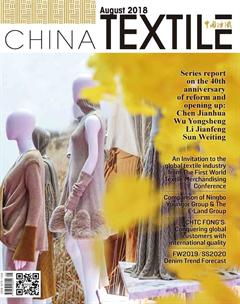
Wu Yongsheng:An on-the-spot report on rapid development of textile machinery industry
2018-10-11 06:11:44
China Textile 2018年8期

Historic social reform Astonishing brilliant achievements
The historical development has been promoted within the short forty years. The national people have facilitated development of the productive force through ideological emancipation with continuous and high-speed economic development. Economic aggregate has ranked the second place in the world and the striking achievements have promoted the social reform.
Enormous changes have happened to China within the forty years. At the beginning of 2018, Chinas foreign exchange reserved reached USD 3,140 billion, and 115 enterprises entered the world top 500. 286 million peasants migrated out for work with greatly improved living environment and elevated living standard. Over 600 million people surfed the internet through smartphones so that their visual field was widely opened.
Chinas textile industry has enjoyed flying development in the forty years, and annual processing aggregate of textile industrial fibers has been kept at 50 million tonnes. Yields of many textile products like chemical fibers, yarns, cloths and clothes have reached the top list in the world. In 2017, Chinas chemical fiber yield reached 49.19 million tonnes, being 109 times of that (450,300 tonnes) in 1980. Yarn yield reached 40.49 million tonnes, being 13.8 times of that (2.936 million tonnes) in 1980. Cloth yield reached 49.55 billion meters, being 5.8 times of that(13.48 billion meters) in 1980. Wool textiles, linen textiles and silk products have realized synchronous development. Since the beginning of the reform and opening-up policy, uniformed management of textile and clothing industrial chains has been realized and development has been achieved. In 2017, textile and clothing yield reached 28.7 billion pieces, being 30 times of that (950 million pieces) in 1980, and per capita yield was 4 pieces in the world. In 2017, annual foreign exchange through textile output reached USD 263.39 billion, being 78.3 times of that (USD 3.59 billion) in 1980, and net foreign exchange earning was kept at the top of the industries.
Textile machinery industry which provides technical equipment for textile industrial development has obtained rapid development. There were only dozens of enterprises producing textile machines in 1980, the figure was 1,100 in 2017 and the realized gross output value reached RMB 115.0 billion which was over 30 times of that in 1980. There were only China-aid foreign projects but no export for textile machines in the past. Chinas textile machines were imported from and exported to 181 countries and regions in 2017, import and export volume reached nearly USD 7 billion and export volume was USD 3.5 billion. Its gratifying that through the development over the several decades, Chinas textile machinery industry has formed a complete industrial system with its own R&D;, education and production bases. There are mainly four categories of textile machines in the production process in China: fiber manufacturing machine, fiber processing machine, dyeing & printing and finishing machine and special basic parts for textile machinery. There are now over 3,000 kinds of main machines and tens of thousands of dedicated basic parts of textile machines. These machines and parts have served, equipped and covered 51 textile industries, and a textile machinery industry system with Chinese characteristics has been formed.
These packaged technical equipment also covers all kinds of special basic parts of main machines, control systems of technological lines and complete engineering sets as well as quality control and detection instruments for online and terminal products. Engineering projects in multiple industries can be fused into the whole flow of the solutions through technological lines and engineering sets.
Thus it can be said that Chinas textile machinery industry has steadily ranked the first place in the world in aspects of industries, product varieties and specifications and yields. Now China has become the largest textile machine manufacturing power and the largest textile machine use power in the world.
Differences can be distinguished through the comparison. Everyone can feel about the brilliant achievements and can have the sense of acquiring them, and this is more convincing than the comparison of real objects. This is more concretely embodied in basic necessities of life, namely from the past shortage of clothes and food to todays ample food and clothes. The current eating stresses nutrition, dressing fashion, housing spaciousness and traveling comfort, rich people have top-grade cars and poor people take buses equipped with air conditioners. Multiple aspects have proved glorious achievements since the reform and opening-up policy, and Chinas social economy has experienced enormous changes.
Historical orientation, social positioning and special status of textile machinery
Textile machinery industry belongs to special equipment manufacturing industry in the whole manufacturing industry. Its name has determined its historical orientation, social positioning and special status. It has been decided that it is about to serve textile industry and has mutual dependent “skin and hair” relationship with textile industry, where can hair stand if stripped off the skin? Thus service property of textile machinery industry is definite.
Textile machinery industry is equipment department and technical rear of textile industry. The national leadership has definitely pointed out that the textile machinery industry should be rejuvenated firstly to rejuvenate textile industry. Closely adhering to this guideline, textile machinery industry has obtained sustainable and steady development.
The guideline “capture the two ends, promote the middle and lay the foundation” has been carried out in the development process of textile industry over the years. So-called “capture the two ends” refers to capture raw material production and development of production means with our own means of producing technical equipment. “Promote the middle” refers to promoting continuous improvement of technological level in the textile industry. “Lay the foundation”refers to two foundations: education and scientific research, which closely cooperate with each other but not restricting each other.
Rightly because textile machinery industry is under this social positioning, its task is to produce textile machines and serve downstream development with “benefit maintained and cost cleared”. Therefore, prices of many textile mechanical products are pressed at very low levels and equivalent to prices of “pork head meat” in the market. Development of textile machinery industry has drawn much concern from leaders at all levels in the ministry of textile industry for many years, and the leaders manage it elaborately and concretely. Its unforgettable that Jianxiu Hao who acted as candidate secretary of secretariat of the central committee worked in Yizheng Chemical Fiber Co., Ltd. and Tianjin Petrochemical Corporation to understand the situation and summarize development experience of chemical fiber machines. We were called by her to the South China Sea. It took half a day to report textile machinery situation to her, analyze causes, define development ideas and give important introductions to development of textile machinery industry.
Rightly because of this, China has supported textile machinery industry from multiple aspects like policy, capital and foreign exchange. It has given support from complete set of vinylon manufacturing equipment to “four major chemical fibers” project until the subsequent national “12 dragons” project consisting of multiple professional projects, among which textile machinery industry is. Domestication of rapier looms and airflow spinning machines is taken as one of special domestication projects to introduce, digest and absorb technologies. “Technological introduction and domestication of automatic winders and shuttleless looms” of textile machinery is listed as one special project in the two national projects, followed by the special projects “coordinated development of dyeing and printing technological equipment”, composite fiber weaving, etc.
With the national support and local capital and enterprise capital input, textile machinery industry has obtained effective development and become the real technical rear of textile industry. During this period, textile machinery enterprises equipment themselves, add educational and scientific research power and improve manufacturing means. At the initial stage of the reform and opening-up, textile machinery enterprises cooperated with German Universitat Hannover in producing the first FMS flexible processing production line in China. Machine tool processing equipment was developed from digital display to CNC machine tools until flexible production line. Automatic production line was created from sand distribution, transporta- tion, moulding, continuous pouring until technological production line of casting sand removal and finishing. The “Molders and blacksmiths have black nostrils”history became the history. Metal plate manufacturing technology also experienced profound changes, and a technological production line from standalone machine of laser cutting (including underground cutting) to CNC punching machine and from sheet storage to CNC punching machine, cutting and moulding and deburring was formed. The pet phrase “nine among ten metal plate apprentices are deaf, and the last one, who is not deaf, doesnt learn” became a history. With this foundation, a new industrial manufacturing system was formed soon.
Driven by the reform and opening up and under the attention paid by and support given by leaders at all levels, this textile machinery industry in which“large mechanical industries cant make it while small industries cant do very well” has obtained sustainable, rapid and healthy development during the process of carrying out and implementing guidelines and policies of the Communist Party. Now Chinas textile machinery industry has formed a relatively independent manufacturing system which is worldwide recognized. The practice has proved that China can equip itself to develop industries only with an independent equipment manufacturing industry.
Center on demands for raw textile materials Develop mechanical fiber production
One cannot accomplish intentions lacking the necessary materials. Textile industry belongs to a processing industry, and raw materials are needed to develop this industry. Raw materials in this industry are natural fibers and chemical fibers, both of which should be developed simultaneously. Natural fibers derive from the nature while chemical fibers come from synthesis of petroleum and natural gas. Textile machinery industry serves textile industry, so it must center on development of chemical fiber industry. Chemical fibers are subdivided into man-made fibers and synthesized fibers. The former is also called cellulosic fiber which is produced through chemical reactions based on cellulose. The latter is generated through fission and polymerization of petroleum and natural gas. There must be a whole set of technological equipment combing physical and chemical aspects to produce these products. What textile machinery industry needs to undertake are these fiber production machines, including the whole set of technological equipment of polymerization, spinning and post-finishing.
Chinas man-made fibers - jointly called viscose--include filaments and fibers, and their process technologies were introduced from Eastern European countries in the 1960s when uniline production capacity was limited and the industry was basically under a stagnant status in the Great Cultural Revolution and introverted ten years. After the reform and opening up, Europe was developing, uniline production capacity of viscose staple fibers reached over 30,000 tonnes, viscose filaments developed from semi-continuous spinning to full-automatic continuous spinning, and the production field concept could be said as being largely identical with the polyester spinning environment. We were astonished by this, we could do nothing but catch up with it, actively develop continuous pulp charging, box-type maturing, large-scale yellowing and large-scale metering pumps and combined type spinning components so as to improve uniline production capacity. The former annual production capacity was elevated to 10,000 tonnes and then to 30,000 tonnes and 60,000 tonnes, and now uniline production capacity can reach 100,000 tonnes. Implementing the same production flow, various parties have witnessed actual effects in improvement and innovation of process technologies.
The complete set of equipment of continuous spinning process of viscose filaments has integrated spinning, moulding, drafting, oil pumping, drying and winding so that filament spinning process is completed with several minutes from the former over 70 hours. The production field has put an end to the phenomenon “water dripping from the sky and water leakage on the ground”. Synthetic fiber industry has continuously innovated, gradually expanded the production and realized domestication based on introducing “four major chemical fibers”. The complete set of process technologies of cellulose acetate fibers has also realized domestication.
The main production body of synthetic fibers is polyester fiber production. Before the reform and opening up, China was basically in a phase from learning, R&D;, groundwork to practice. After that, rapid development was achieved through technological introduction, digestion and absorption for autonomous innovation. Polyester devices came into being and were gradually improved and realized domestication through studies of process technological equipment based on importing equipment with annual output being 60,000 tonnes. Now uniline production capacity has developed to 200,000 tonnes, 300,000 tonnes and even above 400,000 tonnes. There are not only fiberclass polyesters but also bottle-class polyesters. The gap with foreign advanced technologies is greatly narrowed.
Polyester filament spinning and fiber spinning adopted slice redissolving indirect spinning technology which featured small output and high cost. Now direct spinning technology of filaments and fibers is realized, they directly enter spinning box through melt pipeline for spinning, drafting, moulding to packing of finished products, which is continuous and automatic. Spinning cakes can be detected and packaged so as to enter automation of the steroscopic warehouse. Annual output of fiber production line reaches over 60,000 tonnes.
Equipment can be configured according to technological requirements while civil yarns are developed, including domestication of the complete set of process technological equipment from polymerization, spinning, original twisting and re-twisting (direct twisting machines are now used) of cord threads to gum dipping.
Its noteworthy that drafting, moulding and twisting equipment can be equipped as required after moulding of these filaments. The multifilament can be divided into six or weight thinner monofilaments using a filament splitting machine for selected use in downstream production.
Acrylic fibers are divided into fibers and filaments with wet process and dry process. They are mostly used to spin wool fabrics. After the reform and opening up, wet process line had mature traditional processes, so technological transformation was the emphasis to elevate the production capacity. But dry spinning technology needed a new starting. Domestication of the “annual output of 300,000 tonnes of ethylene”project drove domestication of dry acrylic fiber equipment. Within a short term, 5 projects were completed in succession from polymerization, spinning and drafting of acrylonitrile to moulding and packaging of filaments and fibers, and annual capacity reached 165,000 tonnes. With this foundation, they could not only be used in civil products but also laid a foundation for carbon fiber production.
The complete set of process technologies of spandex fibers and fibers were all imported in the past with high prices, and spandex fibers were several hundred thousand yuan per tonne. Now single and uniline annual production capacities can reach 10,000 tonnes or 20,000 tonnes or so by digesting and absorbing process technological equipment to realize domestication and re-innovation. After the domestication of process technological equipment, spandex price declines by a large margin, and people are benefited from the reform and development. As China enters the new era, new processes and new technologies are emerging in endlessly, followed by emergence of new-type fibers, including aramid fiber 1313, aramid fiber 1414 and carbon fibers. We should not only learn from and keep up with the foreign industry, but also should transcend it. Process technological equipment of these new materials and new fibers should basically be rooted in domestic production at present. Scale production of carbon fibers and glass fibers contributes to development of composite materials through high and new technologies. Many projects relating to process technological equipment from warping, weaving, thermal moulding, thermosetting, material dipping to finished carbon fiber products have been at international advanced levels.
Fiber manufacturing machines not only need main machines but also auxiliary machines together with corresponding dedicated basic parts like spinning pump, oiling agent pump and spinneret plate. The spinneret process has been comparable to Germany and Japan. Spinning nozzle made of au-pt alloy in the past is now made of tantalum alloy, which greatly reduces production cost.
Online detection and quality control systems matched for process production line and engineering project have been all in readiness. Thus it can be said that categories, varies and specifications of machines producing fibers in China have already been complete, which can not be domestically supplied but also can be exported. In the review of production development history of fiber machines, we have to review some of the tortuous paths we have taken. During strict control of “production capacity”, large polyester device construction projects should be reported for approval at all levels, so “small projects” came into being in local regions, then small polyester projects with annual output being 10,000 tonnes were blooming everywhere and then were gradually knocked out, so capital and resources were wasted. A notice of criticism from “official documents” was circulated to one province due to unplanned construction of a polyester filament project. “Official documents” exerted effect of promoting development on the contrary, and then the polyester filament yarns of the whole province obtained highspeed development. After the project with annual output being 15,000 tonnes was introduced for polyester fiber, foreign countries were continuing to develop large-capacity technical equipment while we changed large-capacity processes into semi-piece of spinning machines and complete post-finishing equipment for the sake of “relational” development, thus forming a “a large horse is pulling a small trolley” pattern, followed by technological transformation, and this lesson was profound.
- China Textile的其它文章
- 2018. 07
- Yarn strength measurement–and protection against quality claims
- Safe and simpler iwarm clothing solution leads a new intelligent dressing fashion
- Beyond Millennials:Understanding always-on Gen Z consumers
- Rieter: Sales increase in the first half of 2018
- CHTC FONG’S:Conquering global customers with international quality