
Controlled Synthesis of Au36(SR)24 (SR = SPh, SC6H4CH3, SCH(CH3)Ph,and SC10H7) Nanoclusters
2018-09-10 01:40:08ZHOUYangLIZhiminZHENGKaiLIGao
物理化學學報 2018年7期
ZHOU Yang, LI Zhimin, ZHENG Kai, LI Gao
1 State Key Laboratory of Catalysis, Dalian Institute of Chemical Physics, Chinese Academy of Sciences, Dalian 116023, Liaoning Province, P. R. China.
2 University of Chinese Academy of Sciences, Beijing 100049, P. R. China.
Abstract: In the past decade, gold nanoclusters of atomic precision have been demonstrated as novel and promising materials for potential applications in catalysis and biotechnology because of their optical properties and photovoltaics. The Au36(SR)24 nanocluster is one of the most well-known clusters, which is directly converted from the Au38(SR)24 cluster through a “ligand-exchange” process. It consists of an Au28 kernel with a truncated face-centered cubic (FCC)framework exposing the (111) and (100) facets. Here we report a simple protocol to prepare Au36(SR)24 nanoclusters, ligated by aliphatic and aromatic thiolate ligands (SR = SPh, SC6H4CH3,SCH(CH3)Ph, and SC10H7) via a “size-focusing” process. First,polydisperse Au nanoparticles were synthesized and isolated, and then reacted under harsh conditions in the presence of excess thiol ligands at relatively high etching temperatures (80 °C). The as-synthesized Au36(SR)24 nanoclusters were characterized and analyzed by UV-Vis absorption spectroscopy, electrospray ionization (ESI), and matrix-assisted laser desorption ionization (MALDI) mass spectrometry, as well as thermogravimetric analysis (TGA). All the Au36(SR)24 nanoclusters showed two step-like optical absorption peaks at ~370 and 580 nm in the UV-vis spectra. Only one strong set of nanocluster-ion peaks centered at an m/z of 10517.0 was observed in the ESI mass spectrum of the Au36(SCH(CH3)Ph)24 nanocluster. This could be assigned to the [Au36(SCH(CH3)Ph)24Cs]+ species, and was a strong indicator of the high purity of the as-obtained Au36 cluster samples produced on a small scale. The TGA profile showed 31.67% organic weight loss of the nanocluster, matching well with the expected theoretical value of 31.71%. The Au-SR bond in the gold nanoclusters was broken at ~180 °C in a normal air atmosphere. Fragments of the Au36(SR)24 clusters capped with different thiolate ligands, which were mainly caused by the strong laser intensity during the analysis, were detected in the MALDI mass spectra. This interesting phenomenon was also observed in the case of Au25(SR)18, and could be due to the inherent properties of the Au-SR bond on the surface of the gold nanoclusters. Finally, the optical properties of the Au36(SR)24 nanoclusters were found to be influenced by the capping thiolate ligands. Compared to the UV-Vis spectrum of the Au36(SCH(CH3)Ph)24 cluster, the optical spectra of the other three Au36 clusters were red-shifted(~3 nm for Au36(SPh)24, 5 nm for Au36(SC6H4CH3)24, and 13 nm for the (Au36(SNap)24 clusters). This shift could be explained by the electron transfer occurring from the electron-rich aromatic ligands to the Au kernel. The electron transfer capacity followed the order ―SNap > ―SC6H4CH3 > ―SPh > ―SCH(CH3)Ph. Overall, this study demonstrates the effectiveness and promising application of ligand engineering for tailoring the electronic properties of Au nanoclusters.
Key Words: Gold cluster; Au36(SR)24; Control synthesis; Size-focusing; Ligand effect
1 Introduction
Gold nanoclusters of atomic precision have emerged as one of the most important types of nanogold materials, being extensively investigated in nanoscience and nanotechnology research1–5. These thiolate capped gold nanoclusters,formulated as Aun(SR)m(SR represent the thiolate ligand,hereafter), are composed of exact number of gold atoms (n,ranging from ten to a few hundred) and protecting thiolate ligands (m). The core size of the particle typically ranges from 0.7 to ~2 nm. Gold nanoclusters possess unique physical and chemical properties, mainly due to quantum size effects of this extremely small size regime. Thus, it makes this type of nanomaterial very promising in optical properties and photovoltaics, as well as applications in fields such as catalysis and biology6–13.
With the development of the synthesis protocol, two methods are widely applied in the wet chemical synthesis of the atomically precise gold nanoclusters, i.e., “size-focusing” and ligand-exchange1,14–16. Regarding to the “size-focusing”protocol, the most important point is to obtain a proper distribution of polydispersed gold nanoclusters as the precursor,which is made by kinetically controlling the reduction of gold(I) complexes or polymers with NaBH4reducing agent under mild conditions. And then, the as-prepared polydispersed gold nanoclusters are subjected to the “size-focusing” process under relatively harsh conditions (e.g., at 80 °C and in the presence of excess thiol). In the presence of harsh conditions,the unstable gold nanoclusters would decompose/convert to the thermostable gold nanoclusters during the “size-focusing”. And it eventually gives rise to the most thermostable gold nanoclusters14.
On the other hand, the synthesis of the atomically precise gold nanoclusters also is effected by pH, solvent, thiolate ligand, etc.17–19. For example, the aliphatic thiolate protected Au38 (SC2H4Ph)24 nanoclusters can convert to the aromatic thiolate capped Au36(SPhtBu)24nanoclusters in the presence of excess HSPhtBu ligand under a thermal condition20,21. And in our recent work, we found that the Au102(SPh)44nanoclusters also can convert to Au99(SPh)42with equivalent thiophenol ligands at 80 °C etching reactions22. It is worthy to note that these conversion processes are not reversible.
Herein, we report a simply method to prepare Au36(SR)24nanoclusters (where, SR = SPh, SC6H4CH3, SCH(CH3)Ph, and SC10H7) via a “size-focusing” process. The Au36(SR)24can be ligated with both the aliphatic and aromatic thiolate ligands.Finally, the optical property of the Au36(SR)24nanoclusters is explored.
2 Experimental
2.1 Chemicals
Tetrachloroauric(III) acid (HAuCl4?3H2O, 99.99% metal basis, Aldrich), tetraoctylammonium bromide (TOAB, 98%,Fluka), sodium borohydride (99.99% metals basis, Aldrich),1-phenylethanol (99%, Admas), thiourea (99%, Sigma-Aldrich). thiophenol (99%, Adamas), p-toluenethiol (98%+,Adamas), 2-naphthalenethiol (98%+, Adamas), toluene (HPLC grade, 99.9%, Aldrich), methanol (absolute, 200 proof,Pharmco), methylene chloride (HPLC grade, 99.9%, Sigma-Aldrich), acetone (HPLC grade, 99.9%, Sigma-Aldrich). All chemicals were used as received.
Nanopure water (resistance 18.2 MΩ·cm) was purified with a Barnstead NANOpure Diwater TM system. All glassware was thoroughly cleaned with aqua regia (V(HCl) : V(HNO3) =3 : 1), rinsed with copious Nanopure water, and then dried in an oven prior to use.
2.2 Synthesis of 1-phenylethanethiol (H-SCH(CH3)Ph)
The synthesis protocol follows a previously reported method by Adachi et al.23. The reaction was under N2 atmosphere.1-phenylethanol (10.0 g, 80.0 mmol) was dissolved in concentrated hydrochloric acid (30 mL), thiourea (8.8 g, 115.8 mmol) was then added and the reaction mixture was refluxed for one day. After cooling to room temperature, 10 mol·L-1sodium hydroxide solution was added up to pH 10 in an ice-water bath, and the reaction mixture heated to a gentle reflux for 6 h. After the resulting suspension was acidified with concentrated hydrochloric acid to pH ca. 7, the crude reaction mixture extracted with diethyl ether and then dried over anhydrous magnesium sulfate. The colorless 1-phenylethanethiol was accomplished by silica gel column chromatography(eluent: V(CH2Cl2) : V(hexane) = 1 : 20).
2.3 Synthesis of Au36(SR)24 nanoclusters
The control synthesis of Au36(SCH(CH3)Ph)24was applied as an example to introduce the synthesis process. It contains two main steps. In the first step: HAuCl4·3H2O (0.827 g, 0.21 mmol, dissolved in 10 mL Nanopure water) and tetraoctylammoniun bromide (TOAB, 0.137 g, 0.25 mmol,dissolved in 10 mL toluene) were combined in a 25 mL tri-neck round bottom flask. The solution was vigorously stirred (~800 r?min-1) with a magnetic stir bar to facilitate phase transfer of Au(III) salt into the toluene phase. After 10 min, phase transfer was completed, leaving a clear aqueous phase at the bottom of the flask; the aqueous layer was then removed using a syringe.The toluene solution of Au(III) was cooled to 0 °C in an ice bath over a period of 15 min under magnetic stirring. After that,magnetic stirring was reduced to a very low speed (50 r·min-1),Ph(CH3)CHS-H (87 μL, 3 equivalents of the moles of gold)was added. The solution color slowly changed from deep red to clear over a ~2 h period. After the solution turns to clear, 1 ml of aqueous solution of NaBH4(9.6 mg, 1.2 equivalents of the moles of gold, freshly made with ice-cold Nanopure water) was slowly added to the solution in a dropwise fashion within 15 min. After NaBH4addition, and the reaction was allowed to proceed 2 days. The organic phase was removed by rotary evaporation at room temperature. Methanol was used to separate the Au nanoparticles from TOAB and other side products.
Second step: to obtain truly monodisperse Au36nanoclusters,excess Ph(CH3)CHS-H was used to react the as-prepared Au nanoparticles from the first step. Typically, 20 mg Au nanoparticles was dissolved in 5 mL DCM and 0.5 mL Ph(CH3)CHS-H was then added to the Au nanoparticles solution. The solution was heated to 70 °C and maintained at 70 °C for about 24 h under constant magnetic stirring. After that, the DCM was removed by rotary evaporation, 20 mL methanol was added to the solution to precipitate Au nanoparticles. Only Au36 nanoparticles and Au(I)-SCH(CH3)Ph exist in the black precipitation. Au36(SR)24nanoclusters were extracted with acetone and Au(I)-SCH(CH3)Ph residuals(poorly soluble in most solvents) were discarded. The yield of the Au36(SR)24nanoclusters was ca. 5% based on the consumption of HAuCl4.
2.4 Characterization
The UV-Vis spectra of the MxAu25-x(SR)18nanoclusters(dissolved in CH2Cl2) were recorded on a Hewlett-Packard(HP) Agilent 8453 diode array spectrophotometer. MALDI mass spectrometry was performed with a PerSeptive Biosystems Voyager DE super-STR time-of-flight (TOF) mass spectrometer. Trans-2-[3-(4-tert-butylphenyl)-2-methyl-2-propenyldidene] malononitrile was used as the matrix in MALDI-MS analysis. Typically, 0.1 mg matrix and 10 μL analyte stock solution were mixed in 10 μL CH2Cl2. 10 μL solution was applied to the steel plate and then dried under vacuum (at room temperature) prior to MALDI mass spectrometry analysis. Electrospray ionization (ESI) mass spectrum was recorded on a Waters Q-TOF mass spectrometer equipped with a Z-spray source. The sample was dissolved in toluene (1 mg?mL-1) and then mixed with a dry methanolic solution of cesium acetate (CsOAc, 50 mmol?L-1) with a volume ratio of 1/1. Thermogravimetric analysis (TGA) (ca.1.5 mg sample was used) was conducted under a N2atmosphere (flow rate: ca. 50 mL?min-1) on a TG/DAT 6300 analyzer (Seiko Instruments Inc.); the heating rate was 10 °C?min-1.
3 Results and Discussion
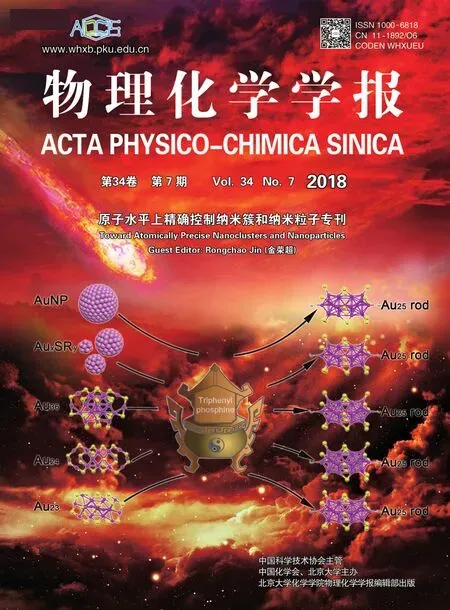
The synthesis protocol in this study involves two steps: the polydisperse Au nanoparticles were firstly prepared in two phase (water/toluene) using HAuCl4as the precursor and by controlled reduction with NaBH4(dissolved in cold water) in the presence of three equivalent thiol ligands at room temperature. and then, these polydisperse Au nanoparticles were simply isolated and used as precursor for “size-focusing”process following one-phase thiol etching, Scheme 1. And it found that only the Au36(SR)24nanoclusters was survived under the harsh conditions in the etching reactions. The fresh Au36(SCH(CH3)Ph)24nanoclusters are further identified and characterized by UV-Vis spectroscopy, electrospray ionization mass spectrometry (ESI-MS), and thermogravimetric analysis(TGA).
The Au36(SCH(CH3)Ph)24nanoclusters show two step-like optical absorption peaks at ~370 and 580 nm (Fig. 1, red line),which is similar with the reported Au36(SR)24nanoclusters24–26.To check the exact molecular mass of the Au36(SCH(CH3)Ph)24nanoclusters, the ESI mass spectrometry analysis has been performed, which is a soft ionization technique. As the Au36(SCH(CH3)Ph)24nanoclusters are neutral, CsOAc(dissolved in ethanol) was added to the cluster solution(toluene) to promote the nanocluster ionization via formation of[Au nanocluster-Cs] adducts27. In the ESI process, the Cs+ions can ads orb on the surface of the gold nanocluster to give[MCsx]x+adducts (M and x represent the gold nanoclusters and the charge of the cluster, respectively). As shown in Fig. 2, only one strong set of nanocluster-ion peak centered at m/z 10517.0 was observed in the ESI mass spectrum of the gold nanocluster.After detailed calculation, the mass peak, at m/z 10517.0,corresponding to the mass of [Au36(SCH(CH3)Ph)24Cs]+species (Au36S24C192H216Cs).

Scheme 1 The control synthetic process of the Au36(SR)24 nanoclusters (SR = SPh, SC6H4CH3, SCH(CH3)Ph, and SC10H7) in this work.Color code: Au, blue and green; SR group, yellow; color online. The structure of Au36(SR)24 nanoclusters adopts ball-stick mode, and it is redrawn from the Ref. 20.

Fig. 1 UV-Vis spectra of Au36(SCH(CH3)Ph)24 and Au36(SPh-tBu)24 nanoclusters (dissolved in dichloromethane).The spectrum is up-shifted for easy comparison.
Thermal gravimetric analysis (TGA) was applied to deduce the ratio of gold atoms and thiolate ligands of the Au36(SCH(CH3)Ph)24 nanocluster and recheck the formula of the gold nanoclusters. TGA curves (in an air atmosphere) reveal that the clean weight loss step occurring at ca. 180 °C and the organic weight loss of the nanocluster to be 31.67% (Fig. 3),which well agrees with the expected value (i.e., [(137.22 ×24)/(137.22 × 24 + 196.97 × 36)] = 31.71%).

Fig. 2 ESI mass spectrum of the Au36(SCH(CH3)Ph)24 nanocluster in positive mode.The strongest MS peak at m/z (z = 1) 10517.0 belongs to the[Au36(SCH(CH3)Ph)24Cs]+ species (Au36S24C192H216Cs, m/z 10517.02 (z = 1)).

Fig. 3 TGA of the free Au36(SCH(CH3)Ph)24 nanoclusters under an air atmosphere.
For completeness, we choose other aromatic thiol ligands(i.e., thiophenol (H–SPh), p-toluenethiol (H–SC6H4CH3),2-naphthalen ethiol (H–SNap)) for the “size-focusing” under the identical condition (70 °C for 24 h). These prepared nanoclusters are analyzed by matrix-assisted laser desorption ionization (MALDI) mass spectrometry, Fig. 4b–d. As shown in Fig. 4b, two MS peaks, i.e., 9602.0 and 8485.8 Da, are found in the range from 2 × 10³to 30 × 103Da, assigned to the Au36(SC6H5)23(one thiolate loss) and Au32(SC6H5)20(losing a Au4(SC6H5)4unit) fragments, which is caused by the strong laser intensity during the MALDI-MS analysis20. Similar phenomenon is observed in the case of Au36(SC6H4CH3)24and Au36(SNap)24 nanoclusters. It is interesting that three MS peaks are found; the 9921.7, 9678.9, and 8650.3 Da belongs to the Au36(SC6H4CH3)23(one thiolate loss), Au36(SC6H4CH3)21,(three thiolate ligand loss) and Au32(SC6H4CH3)20species (Fig.4c). More intriguingly, four peaks at 10752.2 Da (for Au36(SC10H7)23), 10435.9 Da (Au36(SC10H7)21), 9488.4 Da(Au32(SC10H7)20), and 9327.5 Da (Au32 (SC10H7)19) in the analysis of the Au36(SNap)24 nanoclusters (Fig. 4d). Of note,the fragments of the Au36(SR)24clusters capped with different thiolate ligands is total different. The interesting phenomenon is also observed in the Au25(SR)18case28, and it is mainly due to the property of the Au-SR bond on the surface of the gold nanoclusters.
The Au36(SR)24nanoclusters show similar UV-Vis spectra with Au36(SCH(CH3)Ph)24(Fig. 4a). However, the UV-Vis spectra are all red-shifted compared with that of the Au36(SCH(CH3)Ph)24clusters: ca. 3 nm for Au36(SPh)24, 5 nm(for Au36(SC6H4CH3)24), and 13 nm (Au36(SNap)24clusters).This observation has been reported in the case of Au25(SR)18nanoclusters (―SC6H13and –SCH2CH2Ph vs ―SPh and ―SNap), and it is mainly due to the electron transfer from the electron-rich aromatic ligand to the Au25kernel27. The electron transfer capacity follows the order: ―SNap >―SC6H4CH3> ―SPh > ―SCH(CH3)Ph.

Fig. 4 (a) UV-Vis spectra of Au36(SCH(CH3)Ph)24, Au36(SPh)24, Au36(SC6H4CH3)24, and Au36(SNap)24 nanoclusters.
4 Summary
In conclusion, we synthesized aliphatic and aromatic thiolate ligand protected Au36(SR)24nanoclusters (where, SR = SPh,SC6H4CH3, SCH(CH3)Ph, and SC10H7) via a “size-focusing”process. The purity of these as-obtained Au36(SR)24nanoclusters are analyzed by UV-Vis spectroscopy,electrospray ionization and matrix-assisted laser desorption ionization mass spectrometry, and thermogravimetric analysis.Finally, it is found that the electronic property of the protecting thiolate ligands largely affects the optical property of Au36(SR)24nanoclusters.
- 物理化學學報的其它文章
- Electronic Stability of Eight-electron Tetrahedral Pd4 Clusters
- Synthesis of High Yield Au21(SR)15 Nanoclusters
- Luminescence Emission of Copper Nanoclusters by Ethanol-induced Aggregation and Aluminum Ion-induced Aggregation
- Construction and NIR Luminescence Properties of Zn-Ln Rectangular Nanoclusters
- Ag7(MBISA)6 Nanoclusters Conjugated with Quinacrine for FRETEnhanced Photodynamic Activity under Visible Light Irradiation
- Synthesis and Structure Determination of Ag-Ni Alloy Nanocluster Ag4Ni2(SPhMe2)8 (SPhMe2 = 2,4-dimethylbenzenethiol)