Why is “Sulphur Limit” so tricky?
2018-09-03 09:21:36ReporterZhaoBo
中國船檢 2018年8期
Reporter Zhao Bo
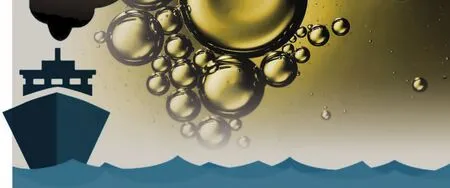
As the IMO’s 2020 “sulphur limit order” edges closer, shipping companies are continually looking for the optimal solution that can limit sulphur oxides emission to meet IMO’s new regulations.However, the underlying problem warns us of a rough road filled with obstacles, and it is something not just shipping companies should think about.
The industry may face a serious problem of short supply of low-sulphur marine oil. According to a foreign institute’s research, refineries basically are not well prepared to supply low-sulphur marine oil by 2020.Jiang Wencheng, senior engineer of China Institute of Maritime Technology & Economy, also warned that it remained a question whether low-sulphur marine oil can be used worldwide and there may be insufficient supply at that time. As the marine bunker fuel consumption has switched to MGO, it will lead to a 5%-10% or even close to 20% increase in MGO consumption, which undoubtedly will cause a tighter supply of medium distillates worldwide.
It is noteworthy that there may be some safety problems about the supply and utilization of low-sulphur marine bunker fuel. As various low-sulphur oil with different components from the conventional marine fuel are currently sold in the international marine fuel markets, it will to some extent result in marine engines breakdown during the operation due to unstable burning. On the other hand, apart from the different proportion of sulphur contained in low-sulphur oil sold in different regions,there are big differences among them in other technical parameters as well, which will increase the possibility of engine failure due to frequent switch of fuels. Statistics show that after the establishment of costal emission control areas in European and North American waters,about 30% of accidents where ships get out of control may be related to fuel switch. Therefore, the influence of the use of low-sulphur oil shall not be neglected.
Because of its low content of impurity, low-sulphur oil has better fluidity compared to conventional marine fuel, but it is not good news for ship safety. Bunker fuels with higher viscosity can be helpful to seal some of the tiny leaking parts. Those leaks are barely detectable during navigation and they pose higher chances of fire.According to the internal statistics of a shipping company,85% of its fleet had apparent oil leaking accidents in the process of low-sulphur oil transformation. In this case,the use of low-sulphur oil requires shipping companies to improve the overall management of their fleet.
Installing scrubbers on ships can indeed reduce CO2emission, but the point is that it still has a lot of uncertainties. According to sources, there are no factual practical results of either scrubbers or the emission reduction effect after desulphurization, which means that shipping companies may have invested a large amount of capital without meeting the expected result. Meanwhile,no decisions have been made as to how the supervision will be done.
Considering all these factors comprehensively,alternative fuels and power may be better options,and LNG as an alternative fuel at the initial stage has received most recognition from the industry. However,Jiang Wencheng, senior engineer in China Institute of Maritime Technology & Economy, warned that the cost–performance ratio of LNG might be a major obstacle for it to become marine power. What’s more, the use of LNG as marine fuel can cause methane leakage and methane is more detrimental to the environment than CO2. Besides,burning LNG will discharge higher proportion of CO2,although it can avoid sulphur emission completely. As we can see, safety and CO2 emission reduction are the problems remaining to be solved for LNG as marine fuel.
Since the “sulphur limit” will cause more cost for the shipping industry, governments’ encouragement is therefore indispensable to shipping emission reduction.The European Union will reportedly discuss “Climate Finance Plan” in the near future, which refers to multiple areas of the shipping industry and will fund relevant businesses with respect to environment protection.“We hope more dedicated funding can be spent on maritime field, including providing financial support for the development of new technologies and new fuels,supporting shipping companies to adopt existing green technologies and constructing necessary infrastructure in both ports and inland areas.
As for similar actions, Peng Chuansheng, the deputy chief engineer of China Waterborne Transport Research Institute, suggested that our government shall consider to promote the implementation of environmental policy through proper subsidies at early stage, and then gradually make it commercialized. Hong Kong is carrying out such incentive schemes to advance the use of low-sulphur oil. Some shipping companies in North Europe are going to install scrubbers also because of the governments’ dedicated subsidies. We can really learn from this experience.”