重型柴油機顆粒物分布規律的試驗研究
2018-08-10 07:11:50周小波胡清華蘇萬華
農業工程學報 2018年13期
關鍵詞:顆粒物
周小波,胡清華,閆 峰,蘇萬華
?
重型柴油機顆粒物分布規律的試驗研究
周小波1,2,胡清華1※,閆 峰3,蘇萬華2
(1. 天津大學計算機科學與技術學院,天津 300350; 2. 天津大學內燃機燃燒學國家重點實驗室,天津 300072;3. 中國汽車技術研究中心有限公司,天津 300300)
為了同時控制車用重型柴油機的顆粒物排放質量和數目,該文對穩態工況及瞬態工況下柴油機排放顆粒物分布規律進行了試驗研究。試驗結果表明:在穩態工況下,隨著負荷的增加或者轉速的提高,積聚態及核態顆粒物數目濃度、中位直徑(count median diameter,CMD)、表面積和質量均呈現增大趨勢,且峰值向大粒徑方向偏移。在本研究中,穩態工況全工況總顆粒物數目濃度為1.5×10⁶~4.5×10⁶個/cm3,積聚態顆粒物數目濃度為2×106~1×107個/cm3,而核態顆粒物數目濃度為1×107~3×107個/cm3,在總顆粒物數目濃度中占比為65%~96%。全工況當量比均小于0.7,在中低轉速,當量比對顆粒物分布影響較為明顯,在高轉速尤其是大負荷條件下,當量比的影響減弱。在瞬態工況下,顆粒物數目濃度出現了與顆粒物質量類似的排放尖峰現象,濃度峰值達到2×108~7×108個/cm3,比其對應的穩態工況出現的濃度峰值高出1個數量級。而且排放尖峰現象中,積聚態顆粒物數目濃度占主要部分,其峰值濃度比穩態工況要高出2個數量級,此時排放尖峰現象中核態顆粒物數目濃度也出現明顯增長。排放尖峰現象對應的粒徑主要集中在積聚態顆粒物的50~200 nm范圍和核態顆粒物的6~8 nm及20~50 nm范圍。這主要是因為當量比在瞬態過程出現了超過臨界當量比0.8的情況。研究結果對重型柴油機顆粒物排放控制以及生成機理有重要指導意義,并可為排放后處理器的匹配計算提供數據支持。
柴油機;排氣;顆粒;穩態工況;瞬態工況;分布規律;核態和積聚態顆粒
0 引 言
近年來,中國各主要城市均出現了不同程度的霧霾現象。流行病學和毒理學研究表明[1-7],大氣中的超細顆粒物(顆粒物粒徑D<100 nm)附著大量有毒物質,通過呼吸道進入人體后會對人體呼吸道和心血管等器官造成嚴重危害,有數據證明其與人類發病率和死亡率有明顯關聯。中國約有30%的國土面積以及超過8億人口受到霧霾的影響[8]。同時,顆粒物的輻射效應僅次于二氧化碳(CO2),是造成溫室效應的重要原因之一[9]。柴油機排放的微粒直徑一般為3 nm~1m,其數目濃度高達10×107~10×109個/cm3,是城市大氣中超細顆粒的重要來源。通常,排放微粒按粒徑分為核態顆粒物(5 nm<D<50 nm)和積聚態顆粒物(50 nm<D<0.15m),其中積聚態顆粒物主要由不完全燃燒產生的一次碳粒(D為2 nm左右)發生團聚作用并凝結有部分HC和硫酸鹽等揮發和半揮發組分形成;核態顆粒物的成因比較復雜,通常認為核態顆粒物是由燃燒室內形成的一次碳粒以及H2SO4或HC等氣態前體物成核形成的二次顆粒物,并且其數濃度和粒徑分布特征受稀釋系統參數(如顆粒在通道內的停留時間、稀釋比例、稀釋空氣的溫度和濕度等)影響較大[10-11]。
從2000年開始,隨著DPF的推廣使用,研究者發現稱重式的PM檢測方法已經不足以準確反映內燃機顆粒排放水平。因此2001年歐盟組織排放顆粒物測量計劃PMP(particle measurement program)開始研究更靈敏和準確的內燃機排放顆粒物檢測手段。Giechaskiel等[12-13]于2007年和2010年分別提交輕型車和重型車顆粒數檢測方法的最終報告并被PMP采用,這種去除顆粒物中揮發成分后進行顆粒物數量統計的檢測顆粒物數量排放的新方法得到了廣泛的認可并被列入法規考察范圍。自此,顆粒物排放數目和粒徑分布成為研究內燃機顆粒物排放特性的新熱點。
目前,國內外針對柴油機顆粒物數目和粒徑分布的研究主要集中在穩態工況下[14-19]。1998年Kittelson等[20]提出典型柴油機穩態工況顆粒物粒徑分布、數目、表面積和質量。顆粒物數量和質量濃度基本呈現對數正態分布規律,核態顆粒物占總數量的90%以上,積聚態顆粒物占總質量的比例最大,粗態顆粒物數量較少,其質量約占總質量的5~20%。但是近十幾年來隨著燃燒理論的發展以及后處理器的使用,粗態顆粒物明顯減少,研究者把研究目標主要集中在核態和積聚態顆粒物上。Kazakov等[21]提出碳煙顆粒碰撞理論,認為燃燒溫度是決定顆粒物尺寸和分布的主要因素。Desantes等[22]的試驗結果顯示,積聚態顆粒物與核態顆粒物之間是此消彼長的關系。即積聚態顆粒物如同“海綿體”一樣來吸收HC和硫酸鹽等揮發和半揮發組分。當積聚態顆粒大幅度增加后,用以促進核態顆粒物生長的組分減少,導致其濃度較低。Shi等[23-24]在穩態工況下系統地研究了顆粒物的物理、化學和形態學特征。
在瞬態工況下,Tan等[25]在輕型柴油機上研究了生物柴油和普通柴油的不同摻混比例在穩態和瞬態工況下對顆粒物數目排放的影響。試驗結果表明在穩態工況下,隨著生物柴油比例的提高,積聚態顆粒物數目排放減少,核態顆粒物數目增加。在瞬態工況下,扭矩瞬變率增大,總顆粒物數目明顯提高;使用生物柴油時,顆粒物數目排放明顯高于普通柴油。Wang等[26]研究了在美國瞬態測試循環中轉速變化率及扭矩變化率對柴油機顆粒物數目的影響。研究表明在從怠速開始的急加速工況中顆粒物數目會大幅增加。在瞬態工況下,柴油機顆粒物數目及粒徑分布特性的研究還比較少,因此,對比分析穩態工況和瞬態工況下柴油機排放顆粒物的生成規律和影響因素具有重大的現實意義和科研價值。
1 試驗裝置與方法
本文試驗臺架是無后處理器、滿足歐IV法規的試驗樣機,并通過了中國汽車技術研究中心的認證,主體部分包括某12 L重型柴油機和電力測功機[27],如圖1所示。

1.數據采集系統 2. 柴油機 3.IVCT系統 4.高壓共軌燃油噴射系統 5.電力測功系統 6.中冷器 7.EGR系統 8.兩級渦輪增壓系統 9.VGT系統 10.智能控制器 11.瞬時流量計
發動機進氣系統部分包括高壓級為可變幾何截面渦輪(variable geometry turbocharger ,VGT)的兩級增壓系統、高壓廢氣再循環 (exhaust gas recirculation,EGR)系統和課題組自主研發的進氣門晚關系統(IVCT系統)[28]。測試儀器包括高響應的進排放壓力傳感器、進氣流量計、油耗儀、排放采集儀等。試驗中使用Cambustion公司的DMS500快速顆粒光譜儀研究分析柴油機瞬態工況顆粒物粒徑分布規律,其測量范圍是5~1 000 nm,響應時間是100 ms。試驗方法參照GB17691中ETC試驗規范執行。
2 結果與分析
2.1 穩態工況下顆粒物粒徑分布規律
為了研究顆粒物粒徑分布規律,穩態試驗選取歐洲穩態測試循環(european steady-state cycle,ESC)十三工況作為主要研究工況,并在穩態工況平面內另選了54個工況點以完成全工況顆粒物排放數目脈譜。54個工況點按照轉速和扭矩均勻選取,兼顧了轉速分布和扭矩分布。
中位直徑(count median diameter,CMD)是累積百分比為50%時所對應的粒子直徑,直接關系到粒譜特征的判斷和表征,是表達顆粒物粒徑的重要參數之一。研究表明柴油機排放微粒的粒徑分布近似于對數正態分布,CMD用式(1)計算[29]:

式中d是各分級的切割直徑,N是分級對應的粒子直徑。
2.1.1 負荷對穩態工況顆粒物粒徑分布的影響
圖2為穩態工況下該發動機為轉速1 600 r/min時負荷變化對顆粒物粒徑分布、數目濃度、表面積、質量和CMD的影響。圖2a為負荷對積聚態顆粒物數目濃度和粒徑分布的影響,隨著負荷的增大,積聚態顆粒物數目濃度和粒徑分布的峰值隨之增大,范圍處于4×106~8×106個/cm3之間,此時CMD也隨之增大,范圍在40~50 nm之間。由碳煙顆粒碰撞理論[21]可知,隨著負荷的增大,缸內燃燒溫度增加,碳煙顆粒之間碰撞的頻率提高,顆粒粒徑增大,CMD增大。圖2b為負荷對核態顆粒物數目濃度和粒徑分布的影響。隨著負荷的增大,核態顆粒物數目濃度和粒徑分布的峰值總體呈現增大趨勢,范圍處于1×10⁷~2×10⁷個/cm3之間,同時CMD也隨之增大,范圍在5~9 nm之間,如圖2c所示。核態顆粒物的數目濃度相比積聚態顆粒物要高1個量級,如圖2d所示,核態顆粒數目濃度在總顆粒數濃度中占比59%~80%,排放顆粒物主要為核態顆粒物。隨著負荷的增加,積聚態顆粒物數目濃度呈現增大趨勢,其對應的CMD也呈現增大趨勢;核態顆粒物數目濃度總體呈現增大趨勢,其對應的CMD也呈現增大趨勢。
顆粒物毒性與顆粒物表面積密切相關[30-31]。假設顆粒物均為球形規則體,根據顆粒物數目濃度和粒徑分布,可以得到顆粒物表面積分布,如圖2e與圖2f所示。隨著負荷的增加,積聚態顆粒物表面積增加,對應峰值在5×10¹⁰~18×1010nm2/cm3之間,核態顆粒物表面積隨負荷增加整體呈現增大趨勢,其對應峰值在1×109~7×109nm2/cm3之間,比積聚態顆粒物表面積峰值低1~2個量級。而且,相比顆粒物數目濃度,顆粒物表面積和粒徑分布對應的峰值無論是積聚態還是核態均往大粒徑方向偏離。由于顆粒物密度無法測量且形狀不規則,此處假設顆粒物密度均勻,核態與積聚態密度一致,且均為球形規則體。圖2g與圖2h為負荷對積聚態和核態顆粒物質量和粒徑分布的影響。顆粒物質量和粒徑的分布規律與顆粒物數目濃度和粒徑的分布規律有明顯區別,隨著負荷的增加,積聚態顆粒物質量呈明顯增加趨勢,對應峰值在1×104~4×104ng/m3之間,核態顆粒物質量與粒徑分布隨負荷增加整體呈現增大趨勢,其對應峰值在20~80 ng/m3之間,比積聚態顆粒物質量低2~3個數量級。相比顆粒物數目濃度和表面積分布,顆粒物質量和粒徑分布的對應峰值無論是積聚態還是核態均往大粒徑方向偏離。
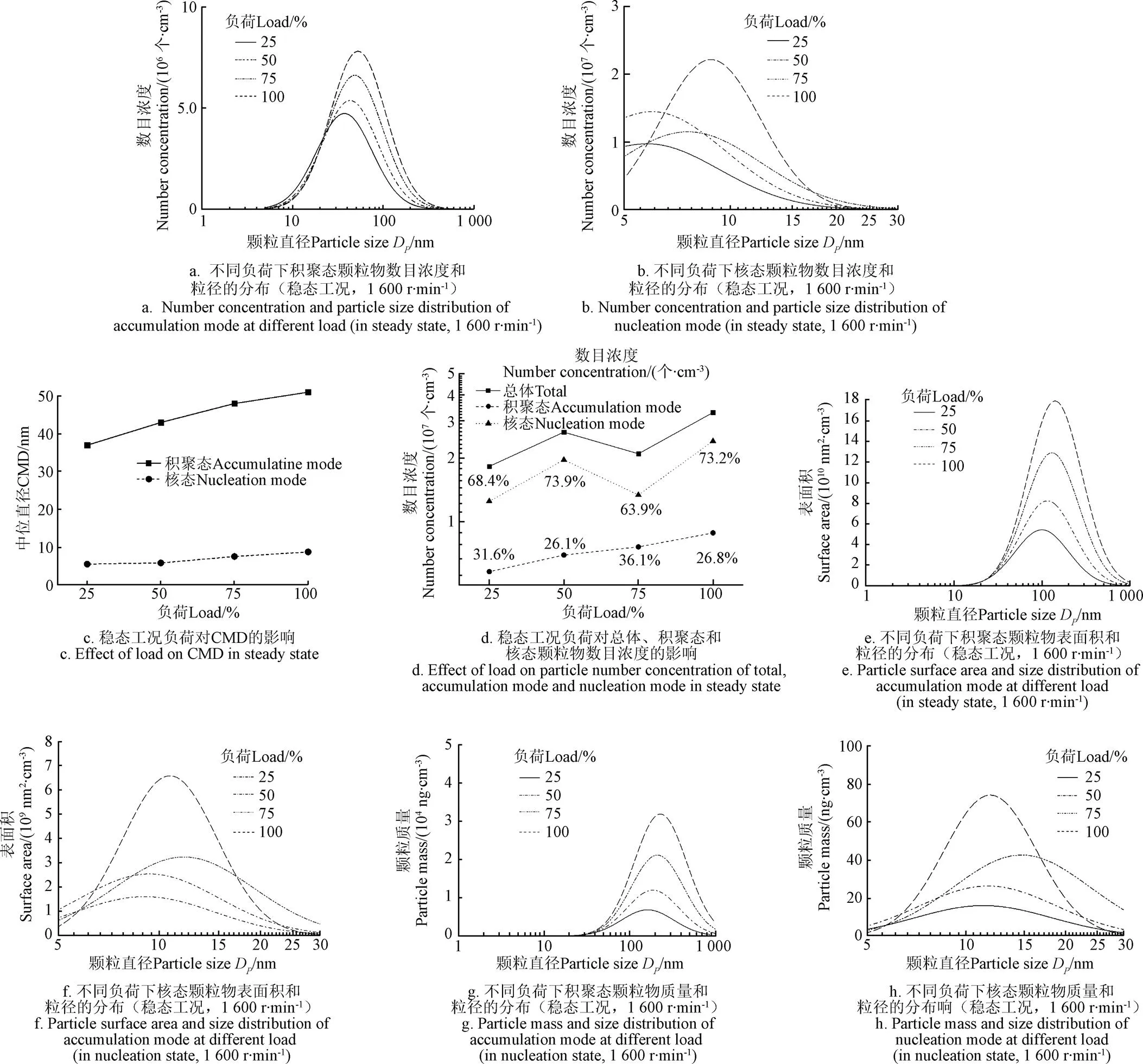
圖2 穩態工況下負荷對顆粒物分布的影響
2.1.2 轉速對穩態工況下顆粒物粒徑分布的影響
圖3為穩態工況下50%負荷時轉速變化(1 300、1 600和1 900 r/min)對顆粒物粒徑與數目濃度分布、表面積、質量和CMD的影響。圖3a為轉速對積聚態顆粒物數目濃度和粒徑分布的影響,隨著轉速的提高,積聚態顆粒物數目濃度和粒徑分布的峰值隨之增大,范圍處于5×106~8×106個/cm3之間,此時CMD也隨之增大,范圍在37~47 nm之間。圖3b為轉速對核態顆粒物數目濃度和粒徑分布的影響,隨著轉速的提高,核態顆粒物數目濃度和粒徑分布的峰值隨之增大,范圍處于1×10⁷~2×10⁷個/cm3之間,同時CMD也隨之增大,范圍在6~8.5 nm之間,如圖3c所示。核態顆粒物的數目濃度相比積聚態顆粒物要高1個量級,如圖3d所示,在總顆粒物數目中,核態顆粒物占比在64%~75%之間。這主要是由于隨著轉速的上升,燃燒過程中的實際混合時間減少,在缸內局部缺氧條件下,更易導致碳煙顆粒生成量的增加,這些顆粒以積聚態為主;而核態顆粒物其成核作用受排放溫度影響較大,隨著轉速的提高,排放溫度從670 K增大到780 K,核態顆粒物數目濃度隨著轉速的提高而增大,且CMD也隨之增大。因此隨著轉速的提高,積聚態顆粒物數目濃度上升,其對應的CMD也增大;核態顆粒物數目濃度呈現增大趨勢,其對應的CMD也呈現增大趨勢,排放顆粒物主要為核態顆粒物,且隨轉速提高而增加。
顆粒物表面積分布如圖3e與圖3f所示。顆粒物表面積和粒徑分布規律與顆粒物數目和粒徑分布規律一致,隨著轉速的提高,積聚態顆粒物表面積明顯增加,對應峰值在6×10¹⁰~16×1010nm2/cm3之間,跨度較大;核態顆粒物表面積隨轉速增加而增大,其對應峰值在2×109~6×109nm2/cm3之間,比積聚態顆粒物表面積峰值低1~2個量級。而且,相比顆粒物數目濃度,顆粒物表面積和粒徑分布對應峰值無論是積聚態還是核態均往大粒徑方向偏離。
圖3g與圖3h為轉速對積聚態和核態顆粒物質量與粒徑分布的影響。隨著轉速的增加,積聚態顆粒物質量呈明顯增加趨勢,對應峰值在7×10⁶~30×106ng/cm3之間,核態顆粒物質量隨轉速增加而增大,其對應峰值在2×104~9×104ng/cm3之間,比積聚態顆粒物質量峰值低2個量級以上。相比顆粒物數目濃度和表面積分布,顆粒物質量分布對應峰值無論是積聚態還是核態均往大粒徑方向偏離。因此,大粒徑顆粒物是顆粒物質量的主要來源,且積聚態顆粒物遠大于核態顆粒物。
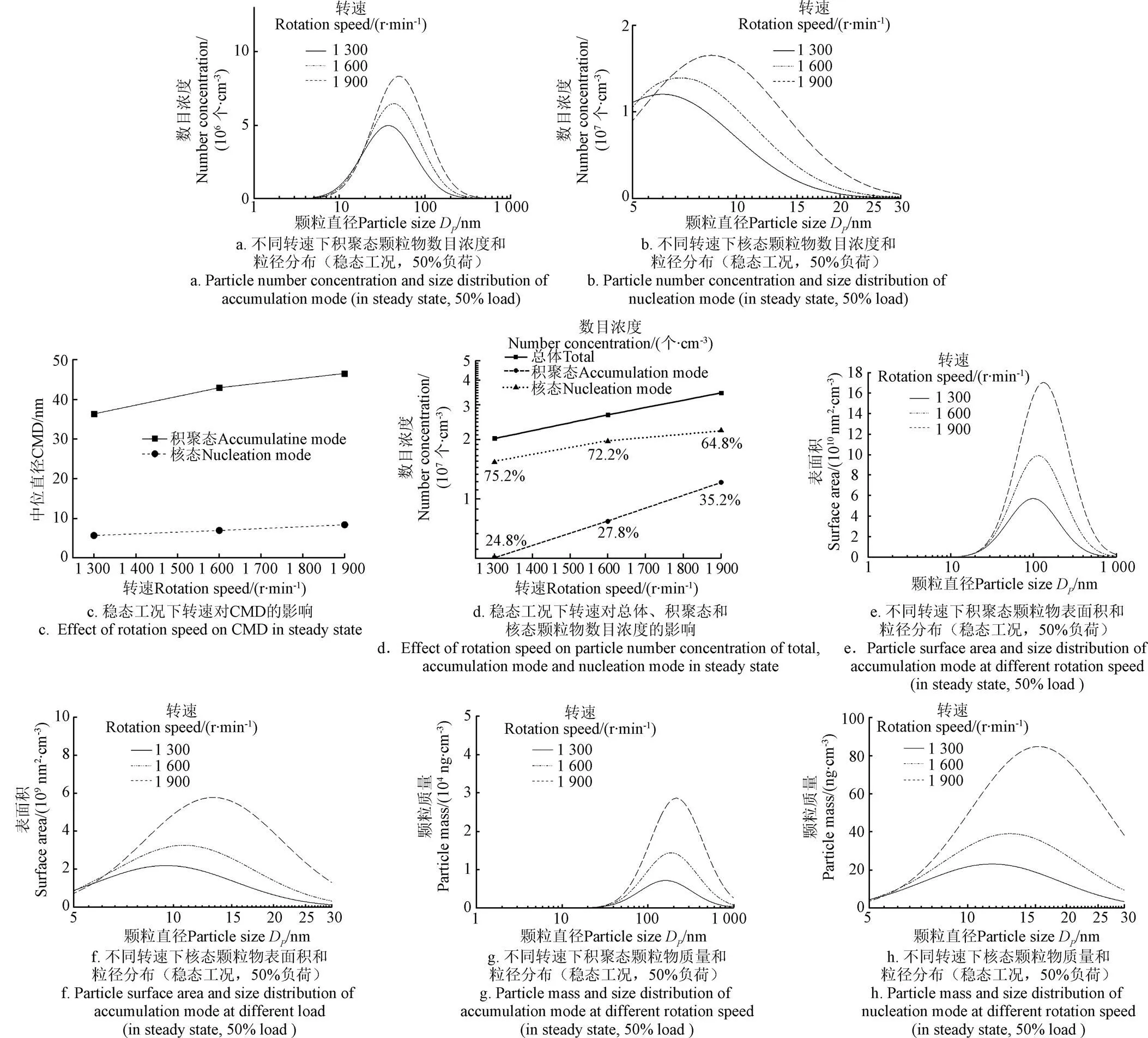
圖3 穩態工況下轉速對顆粒物分布的影響
2.1.3 穩態工況顆粒物分布
為完成全工況顆粒物排放數目脈譜,穩態試驗包括十三工況及其他54個工況。圖4為穩態工況下全工況平面內總顆粒物數目濃度(圖4a)、核態顆粒物數目濃度(圖4b)、積聚態顆粒物數目濃度(圖4c)及當量比分布規律(圖4d)。其中總顆粒物數目濃度在1.5×10⁷~4.5×10⁷個/cm3,積聚態顆粒物數目濃度為2×106~1×107個/cm3,核態顆粒物數目濃度為1×107~3×107個/cm3,在總顆粒物數目濃度中占比65%~96%。從整個穩態工況平面可以看出,全工況當量比均小于0.7,在中低轉速,當量比對顆粒物分布影響較為明顯,而在高轉速尤其是大負荷條件下,當量比的影響減弱。
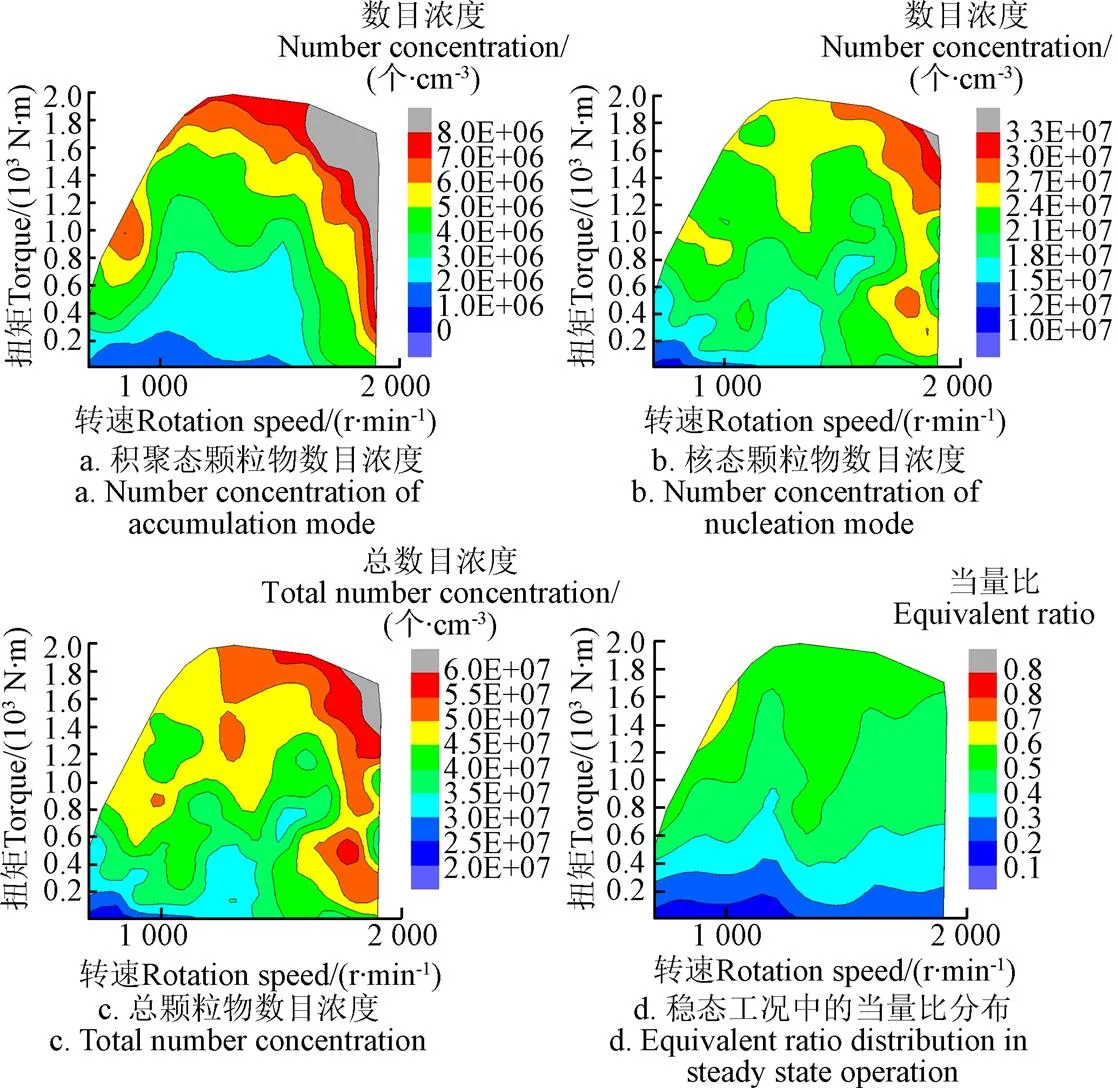
圖4 穩態工況下顆粒物數目濃度及對應的當量比分布
2.2 瞬態測試循環的顆粒物分布
本文按照歐洲瞬態測試循環(ETC)完成,瞬態控制策略參考文獻[27]。圖5為在ETC瞬態測試循環中轉速和扭矩、當量比變化趨勢和顆粒物分布規律,包括總顆粒物數目濃度、核態顆粒物數目濃度和積聚態顆粒物數目濃度。從顆粒物數目濃度來看,瞬態工況下出現了與顆粒物質量類似的排放尖峰現象,數目濃度峰值甚至達到了2×10⁸~7×10⁸個/cm3,比其對應的穩態工況出現的濃度峰值高出1個數量級。而且排放尖峰現象中,積聚態顆粒物占主要部分,這與穩態工況有很大不同,其數目濃度峰值比穩態工況要高出2個數量級,從穩態工況的2×106~1×107個/cm3跨越式增長到1×108~8×108個/cm3;此時排放尖峰現象中核態顆粒物數目濃度也出現明顯的增長,其數目濃度峰值從穩態工況的1×107~3×107個/cm3增長到3×107~3×108個/cm3。排放尖峰現象主要是因為當量比在瞬態過程出現了對應的峰值,穩態工況下當量比沒有超過0.7,但是排放尖峰對應的工況出現了超過臨界當量比0.8的情況[27]。

圖5 瞬態工況下顆粒物分布
在城市道路工況中,排放尖峰出現12次,總顆粒物數目濃度峰值為2×10⁸~8×10⁸個/cm3,積聚態顆粒物數目濃度峰值為1×108~5×108個/cm3,核聚態顆粒物數目濃度峰值為3×107~3×108個/cm3;在鄉村道路工況中,排放尖峰出現8次,總顆粒物數目濃度峰值明顯低于城市道路工況,為1×108~3×108個/cm3,積聚態顆粒物數目濃度峰值為1×108~2×108個/cm3,核聚態顆粒物數目濃度峰值為3×107~1×108個/cm3;在高速道路工況中,排放尖峰沒有出現,總顆粒物數目濃度、積聚態顆粒物數目濃度、核聚態顆粒物數目濃度與穩態工況顆粒物粒徑分布規律相當。圖6為在ETC瞬態測試循環中顆粒物粒徑分布的頻譜圖,更準確地反應了各個顆粒物粒徑對應的顆粒物數目濃度。
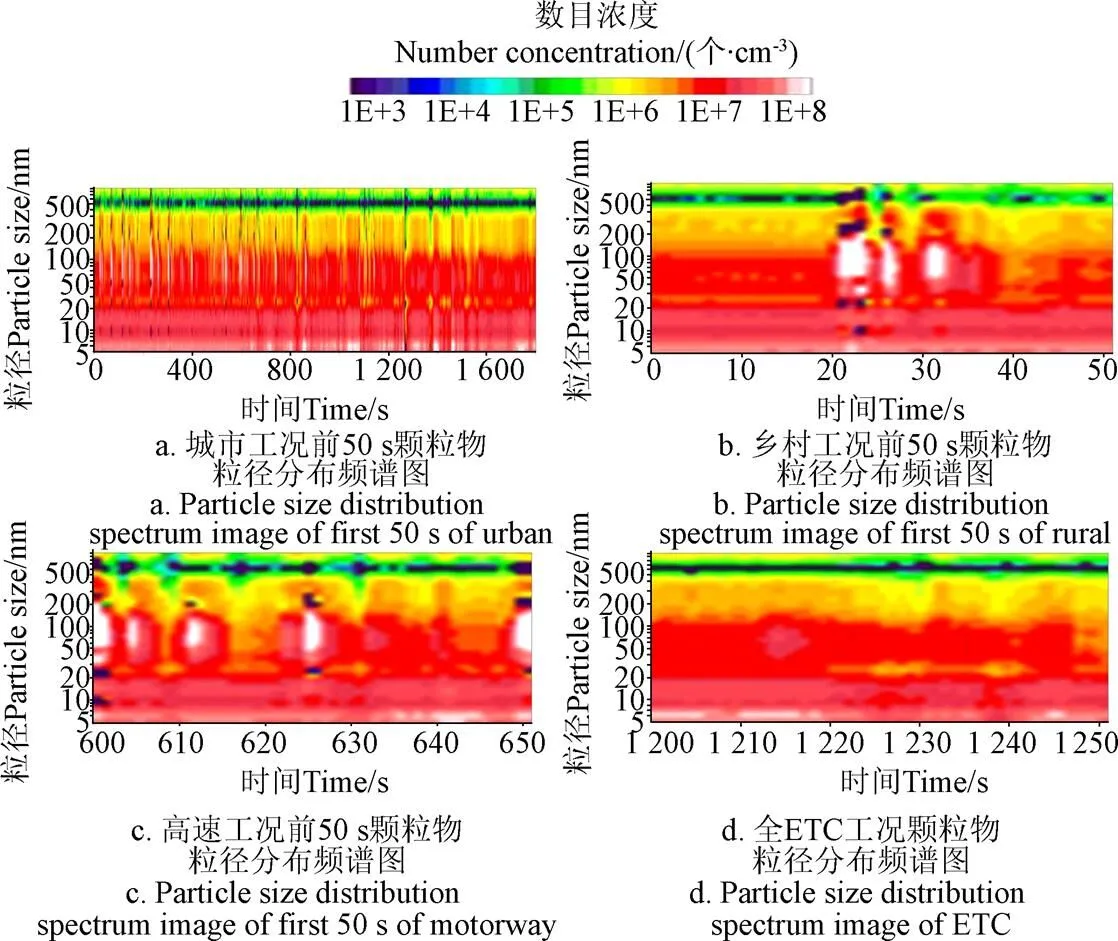
圖6 瞬態工況顆粒物粒徑分布頻譜圖
為了方便分析,把城市道路工況、鄉村道路工況和高速道路工況的前50 s對應的顆粒物粒徑分布頻譜圖放大,與整個測試循環并列展示。
從整個測試循環可以發現,在顆粒物粒徑大于200 nm時,3個道路工況并沒有明顯區別。在顆粒物粒徑50~200 nm內,數目濃度峰值達到1×10⁸個/cm3以上的情況(即圖中白色區域)主要集中在城市道路工況(12次)和鄉村道路工況(8次),高速道路工況沒有,這也就是前面討論的瞬態排放尖峰中的積聚態顆粒物。城市道路工況對應的數目濃度峰值達到1×108個/cm3以上的情況(即圖中白色區域)持續時間長,大多超過10 s,而鄉村道路工況對應的數目濃度峰值達到1×10⁸個/cm3以上的情況(即圖中白色區域)持續時間較短,大多在5 s以內。顆粒物粒徑在20~50 nm時,城市道路工況和鄉村道路工況出現排放尖峰的時刻,該粒徑段也出現了數目濃度峰值達到1×10⁸個/cm3以上的情況(即圖中白色區域)。顆粒物粒徑小于20 nm時,城市道路工況中數目濃度峰值達到1×10⁸個/cm3以上的情況(即圖中白色區域)很少,而鄉村道路工況和高速道路工況較多,且數目濃度峰值均出現在顆粒物粒徑為6~8 nm時。因此,在瞬態工況下排放尖峰現象對應的粒徑主要集中在積聚態顆粒物的50~200 nm范圍和核態顆粒物的6~8 nm及20~50 nm范圍。
3 結 論
本文對穩態工況及瞬態工況下柴油機排放顆粒物粒徑分布規律分別進行了分析,結果如下:
1)在穩態工況下,隨著負荷的增加,積聚態顆粒物數目濃度呈現上升趨勢,其對應的CMD也呈現增大趨勢,積聚態顆粒物表面積和質量均呈現增大趨勢且峰值向大粒徑方向偏移;核態顆粒物數目濃度總體呈現增大趨勢,其對應的CMD也呈現增大趨勢,核態顆粒物表面積和質量均呈現增大趨勢且峰值向大粒徑方向偏移。
2)隨著轉速的提高,積聚態顆粒物數目濃度上升,其對應的CMD呈現增大趨勢,積聚態顆粒物表面積和質量均呈現增大趨勢且峰值向大粒徑方向偏移;核態顆粒物數目濃度呈現增大趨勢,其對應的CMD呈現增大趨勢,核態顆粒物表面積和質量均呈現增大趨勢且峰值向大粒徑方向偏移。
3)穩態工況全工況平面內總顆粒物數目濃度為1.5×10⁷~4.5×10⁷個/cm3,積聚態顆粒物數目濃度為2×106~1×107個/cm3,核態顆粒物數目濃度為1×107~3×107個/cm3,且在總顆粒物數目濃度中占比65%~96%之間,因此在穩態工況下,核態顆粒物數目是總顆粒物數目的主要來源。全工況當量比均小于0.7,在中低轉速當量比對顆粒物分布影響較為明顯,而在高轉速尤其是大負荷條件下,當量比的影響減弱。
4)在瞬態工況下,顆粒物數目濃度出現了與顆粒物質量類似的排放尖峰現象,濃度峰值達到2×10⁸~7×10⁸個/cm3,比其對應的穩態工況出現的濃度峰值高出1個數量級。而且排放尖峰現象中,積聚態顆粒物數目濃度占主要部分,其峰值濃度比穩態工況要高出2個數量級,從穩態工況的2×106~1×107個/cm3跨越式增長到1×108~8×108個/cm3;排放尖峰現象中核態顆粒物數目濃度也出現明顯的增長,其峰值濃度從穩態工況的1×107~3×107個/cm3增長到3×107~3×108個/cm3。排放尖峰現象對應的粒徑主要集中在積聚態顆粒物的50~200 nm范圍和核態顆粒物的6~8 nm及20~50 nm范圍。
[1] Lamarche B, Moorjani S, Cantin B, et al. Small, dense low-density lipoprotein particles as a predictor of the risk of ischemic heart disease in men: prospective results from the Qué bec Cardiovascular Study[J]. Circulation, 1997, 95(1): 69-75.
[2] Wasko M K, Goodman S B. Emperor’s new clothes: Is particle disease really infected particle disease?[J]. Journal of Orthopaedic Research, 2016, 34(9): 1497-1504.
[3] 馮仲科,毛海穎,李虹. 環首都圈植被分布與可吸入顆粒物的空間相關性[J]. 農業工程學報,2015,31(1):220-227.
Feng Zhongke, Mao Haiying, Li Hong. Spatial correlation between vegetation distribution and respirable particulate matter around capital region[J]. Transactions of the Chinese Society of Agricultural Engineering (Transactions of the CSAE), 2015, 31(1): 220-227. (in Chinese with English abstract)
[4] Suzuki S, Nishikawa A, Kuwana M, et al. Inflammatory myopathy with anti-signal recognition particle antibodies: case series of 100 patients[J]. Orphanet journal of rare diseases, 2015, 10(1): 61.
[5] 張延峰,宋崇林,成存玉,等. 車用柴油機排放顆粒物中有機組分和無機組分的分析[J]. 燃燒科學與技術,2004,10(3):197-201.
Zhang Yanfeng, Song Zonglin, Cheng Cuiyu, et al. Analysis of the organic and inorganic components in the emission particulates from diesel engine[J]. Journal of Combustion Science & Technology, 2004, 10(3): 197-201. (in Chinese with English abstract)
[6] Stewart Goldman M D, Turner C D, Jr D P, et al. Katsouyanni K, Touloumi G, Spix C. Short-term effects of ambient sulphur dioxide and particulate matter on mortality in 12 European cities: results from times series data from the APHEA project[J]. British Medical Journal, 1997, 314(7095): 1658-1653.
[7] 李林,周啟星. 不同粒徑大氣顆粒物與死亡終點關系的流行病學研究回顧[J]. 環境與職業醫學,2015,32(2):168-174.
Li Lin, Zhou Qixing. Size-fractionated atmospheric particulate matters and mortality: An epidemiological review[J]. Journal of Environmental & Occupational Medicine, 2015, 32(2): 168-174. (in Chinese with English abstract)
[8] 郝斌. 不同燃料對柴油機排放顆粒物的影響研究[D]. 天津:天津大學,2014.
Hao Bin. Effect of Fuel Identity on the Exhaust Particles from Diesel Engine[D]. Tianjin: Tianjin University, 2014. (in Chinese with English abstract)
[9] 梅德清,趙翔,王書龍,等. 柴油機排放顆粒物的熱重特性分析[J]. 農業工程學報,2013,29(16):50-56.
Mei Deqing, Zhao Xiang, Wang Shulong, et al. Thermogravimetric characteristics analysis of particulate matter of emission of divided diesel[J]. Transactions of the Chinese Society of Agricultural Engineering (Transactions of the CSAE), 2013, 29(16): 50-56. (in Chinese with English abstract)
[10] 王強. 乙烯預混火焰中碳煙微觀形貌、納觀結構及氧化特性研究[D]. 天津:天津大學,2015.
Wang Qiang. Studies on the Morphology, Nanostructure and Oxidation Reactivity of Soot in a C2H4/O2/Ar Premixed Flame[D]. Tianjin: Tianjin University, 2015. (in Chinese with English abstract)
[11] 于文斌. 基于混合與化學反應協同作用的混合燃燒控制策略的研究[D]. 天津:天津大學,2012.
Yu Wenbin. Research on Hybrid Combustion Control Strategy Based on Interaction of Mixing and Chemical Factors[D]. Tianjin: Tianjin University, 2012. (in Chinese with English abstract)
[12] Giechaskiel B, Carriero M, Martini G, et al. Heavy Duty Particle Measurement Programme (PMP): Exploratory Work for the Definition of the Test Protocol[J]. Sae International Journal of Engines, 2009, 2(1): 1528-1546.
[13] Giechaskiel B, Dilara P, Sandbach E, et al. Particle measurement programme (PMP) light-duty inter-laboratory exercise: comparison of different particle number measurement systems[J]. Measurement Science & Technology, 2008, 19(9): 44-46.
[14] Benajes J, García A, Monsalve-Serrano J, et al. Gaseous emissions and particle size distribution of dual-mode dual-fuel diesel-gasoline concept from low to full load[J]. Applied Thermal Engineering, 2017, 120: 138-149.
[15] Barrios C C, Domínguez-Sáez A, Martín C, et al. Effects of animal fat based biodiesel on a TDI diesel engine performance, combustion characteristics and particle number and size distribution emissions[J]. Fuel, 2014, 117: 618-623.
[16] Barrios C C, Martin C, Dominguez-Saez A, et al. Effects of the addition of oxygenated fuels as additives on combustion characteristics and particle number and size distribution emissions of a TDI diesel engine[J]. Fuel, 2014, 132: 93-100.
[17] 王忠,孫波,趙洋,等. 小型非道路柴油機排氣管內顆粒的粒徑分布與氧化特性[J]. 農業工程學報,2016,32(10):41-46.
Wang Zhong, Sun Bo, Zhao Yang, et al. Characteristics of particle coagulation and oxidation in exhaust pipe of diesel engine[J]. Transactions of the Chinese Society of Agricultural Engineering (Transactions of the CSAE), 2016. (in Chinese with English abstract)
[18] 李新令,黃震,王嘉松,等. 柴油機排氣顆粒濃度和粒徑分布特征試驗研究[J]. 內燃機學報,2007,25(2):113-117.
Li Xinling, Huang Zhen, Wang Jiasong, et al. Investigation on concentrations and size distribution characteristic of particles from diesel engine[J]. Transactions of Csice, 2007, 25(2): 113-117. (in Chinese with English abstract)
[19] 孟建,劉軍恒,孫平,等. 雙極荷電凝并降低柴油機顆粒排放數量的試驗研究[J]. 農業工程學報,2017,33(14):78-84.
Meng Jian, Liu Junheng, Sun Ping, et al. Experimental research on decreasing particles emission number of diesel engine by bipolar charged coagulation[J]. Transactions of the Chinese Society of Agricultural Engineering (Transactions of the CSAE), 2017, 33(14): 78-84. (in Chinese with English abstract)
[20] Kittelson D B. Engines and nanoparticles: a review[J]. Journal of Aerosol Science, 1998, 29(5/6): 575-588.
[21] Kazakov A, Foster D E. Modeling of soot formation during di diesel combustion using a multi-step phenomenological model[J]. Sae Technical Papers, 1998.
[22] Desantes J M, Bermúdez V, García J M, et al. Effects of current engine strategies on the exhaust aerosol particle size distribution from a Heavy-Duty Diesel Engine[J]. Journal of Aerosol Science, 2005, 36(10): 1251-1276.
[23] Shi J P, Khan A A, Harrison R M. Measurements of ultrafine particle concentration and size distribution in the urban atmosphere[J]. Science of the Total Environment, 1999, 235(1/2/3): 51-64.
[24] Shi J P, Evans D E, Khan A A, et al. Sources and concentrationof nanoparticles (<10 nm diameter) in the urban atmosphere[J]. Atmospheric Environment, 2001, 35(7): 1193-1202.
[25] Tan P Q, Ruan S S, Hu Z Y, et al. Particle number emissions from a light-duty diesel engine with biodiesel fuels under transient-state operating conditions[J]. Applied Energy, 2014, 113(113): 22-31.
[26] Wang Jian, John Storey, Norberto Domingo, et al. Studies of diesel engine particle emissions during transient operations using an engine exhaust particle sizer[J]. Aerosol Science and Technology, 2006, 40(11): 1002-1015.
[27] Xiaobo Zhou, Erxi Liu, Dezeng Sun, Wanhua Su, Study on transient emission spikes reduction of a heavy-duty diesel engine equipped with a variable intake valve closing timing mechanism and a two-stage turbocharger[J]. International Journal of Engine Research, 2018(13): 146808741774883.
[28] 戰強. 重型柴油機可變氣門系統的開發及實驗研究[D]. 天津:天津大學,2013.
Zhan Qiang. Design of The Variable Valve Timing System for Heavy Duty Diesel Engine and Its Experimental Study [D]. Tianjin: Tianjin University, 2013. (in Chinese with English abstract)
[29] 劉志華,葛蘊珊,丁艷,等. 柴油機和 LNG 發動機排放顆粒物粒徑分布特性研究[J]. 內燃機學報,2009,27(6):518-522.
Liu Zhihua, Ge Yunshan, Ding Yan, et al. The size distribution characteristic of PM emitted from diesel engine and LNG engine[J]. Transactions of Csice, 2009. (in Chinese with English abstract)
[30] Ibald-Mulli A, Wichmann H E, Kreyling W, et al. Epidemiological evidence on health effects of ultrafine particles. J Aerosol Med, 2002, 15: 189-201
[31] Oberd?ster G, Utell M J. Ultrafine particles in the urban air: To the respiratory track and beyond. Environ Health Perspec, 2002, 110 A: 440-441.
Experimental study on particle distribution of exhaust emission of heavy-duty diesel engine
Zhou Xiaobo1,2, Hu Qinghua1※, Yan Feng3, Su Wanhua2
(1.300350,; 2.300072,; 3.,300300,)
In recent years, smog has emerged in most of major cities in China. Epidemiological and toxicological studies showed that the ultrafine particles in the atmosphere adhere to a large number of toxic substances, which can cause serious harm to human respiratory and cardiovascular and other organs after they enter the human body through the respiratory tract. and the data indicated that it had a significant correlation with human morbidity and mortality. Particulate emissions from diesel engines are an important source of ultrafine particles in urban atmosphere. The researchers found that the weighing method of particulate matter detection cannot accurately reflect the emission levels of internal combustion engines. This new method for measuring the number of particulate matter emissions after removing volatile matter from the method has been widely recognized and included in the scope of regulatory investigation. However, there are few studies on the number and size distribution of particles in the transient process of diesel engine. In order to simultaneously control the quality and quantity of particulate matter emitted from heavy duty diesel engines, the particle distribution of exhaust particulates from diesel engines under steady and transient conditions was studied. The test bench is a 12 L heavy duty diesel engine and an electric dynamometer. The test bench is a prototype with no post-processor and meets the Euro IV regulations. It has been certified by China Automotive Technology Research Center (CATRC). The engine intake system consists of a two-stage turbocharging system with variable geometry section turbine (VGT), a high-pressure EGR system and an intake valve late closing system (IVCT system, which is developed by the research group independently). Cambustion DMS500 fast particle spectrometer was used to analyze the particle size distribution of diesel engine under transient conditions. The experimental results showed that, in the steady state, with the increase of load or speed, the concentration of accumulated particles showed an upward trend, corresponding to the increase of count median diameter (CMD), the surface area and mass of accumulated particles showed an increasing trend, and the peak value shifted to the direction of large particle size. In this study, the total number concentration of particles during the steady state is 1.5×10⁶-4.5×10⁶/cm3, and accumulation mode particle was 2×10⁶-1×10⁷/cm3, nucleation mode particle was 1×10⁷-3×10⁷/cm3which account for 65%-96%. In the steady state, the number of nucleation mode particles is the main source of the total number of particles. The equivalent ratio of all steady state conditions is less than 0.7. The effect of equivalent ratio on particle distribution is obvious at middle and low rotational speed, but weakens at high rotational speed, especially at high load. The European Transient Cycle (ETC) was used for the transient test. In transient condition, the spikes also appear in the number concentration of particles which similar to that of quality of particulate matter, and the number concentration peak even reaches 2×10⁸-7×10⁸/cm3, which is 2 orders of magnitude higher than that of the corresponding steady state operation. The number concentration of nucleation mode particle increases significantly in the spikes, but the proportion of the number concentration of nucleation mode particle in the total particles is reduced. The number concentration of accumulation mode particle is the main part of the spikes which is different from the steady state condition. The particle size peak is mainly concentrated in the 50-200 nm range at accumulation mode, the 6-8 nm and 20-50 nm at nucleation mode, this mainly because that the equivalent ratio in the transient process appears to exceed the critical equivalent ratio of 0.8 working conditions. The equivalent ratio does not exceed 0.7 in steady state operation, but the condition corresponding to the emission peak appears to exceed the critical equivalent ratio 0.8. The results are of great significance for particulate emission control and generation mechanism of heavy-duty diesel engine, and can provide data support for matching calculation of post-exhaust processor.
diesel engineers; exhaust gas; particulate matter; steady state condition; transient condition; distribution function; nucleation and accumulation mode
周小波,胡清華,閆 峰,蘇萬華. 重型柴油機顆粒物分布規律的試驗研究[J]. 農業工程學報,2018,34(13):62-69.doi:10.11975/j.issn.1002-6819.2018.13.008 http://www.tcsae.org
Zhou Xiaobo, Hu Qinghua, Yan Feng, Su Wanhua. Experimental study on particle distribution of exhaust emission of heavy-duty diesel engine[J]. Transactions of the Chinese Society of Agricultural Engineering (Transactions of the CSAE), 2018, 34(13): 62-69. (in Chinese with English abstract) doi:10.11975/j.issn.1002-6819.2018.13.008 http://www.tcsae.org
2018-03-26
2018-06-06

周小波,博士后,主要研究柴油機排放控制及自動駕駛。 Email:xiaobo_zhou@tju.edu.cn
胡清華,教授,博士生導師。主要研究不確定性建模和多模態學習等。Email:huqinghua@tju.edu.cn
10.11975/j.issn.1002-6819.2018.13.008
TK421+.5
A
1002-6819(2018)-13-0062-08
猜你喜歡
環境保護與循環經濟(2021年7期)2021-11-02 08:10:50
潔凈煤技術(2021年2期)2021-04-08 12:15:36
傳感器與微系統(2018年7期)2018-08-29 00:44:16
建筑熱能通風空調(2018年5期)2018-07-09 03:16:38
環境保護與循環經濟(2017年2期)2017-09-26 11:52:22
環境科技(2016年5期)2016-11-10 02:42:14
環境科技(2016年1期)2016-11-08 12:17:48
河北工業大學學報(2016年6期)2016-04-16 02:54:23
化工進展(2015年3期)2015-11-11 09:18:15
浙江大學學報(工學版)(2015年1期)2015-03-01 01:17:28