
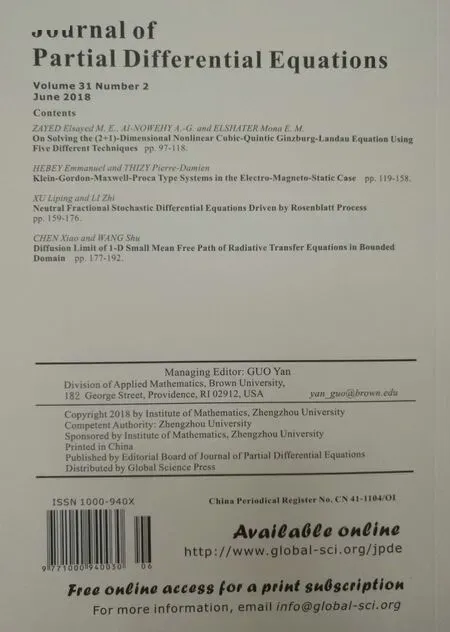
Neutral Fractional Stochastic Differential Equations Driven by Rosenblatt Process
2018-08-06 02:05:58XULipingandLIZhi
XU Liping and LI Zhi
SchoolofInformationandMathematics,YangtzeUniversity,Jingzhou434023,China.
Abstract.In this paper,we are concerned with a class of neutral fractional stochastic partial differentialequations driven by a Rosenblatt process.By the stochastic analysis technique,the propertiesofoperator semigroup andcombining the Banach fixed-point theorem,we prove the existence and uniqueness of the mild solutions to this kind of equations drivenbyRosenblatt process.Intheend,anexampleis giventodemonstrate the theory of our work.
Key Words:Fractional neutral SDEs;Rosenblatt process;existence and uniqueness.
1 Introduction
The long-memory and long range-dependence property of fractional Brownian motion(fBm)BH,with Hurst parameter H∈(1/2,1)make the fBm as a potential candidate to model noise in biology[1];in mathematical finance[2];in the analysis of global temperature anomaly[3];in electricity markets[4]and communication networks[5]etc.
However,the fBm belongs to the family of Hermite processes which admit the following representation,for all d≥1:

where{Bx:x∈R}is a two-sided Brownian motion,c(H0)is a normalizing constant such thatandwithWhen d=1,Hermite process is the fractional Brownian motion with Hurst parameter H∈(1/2,1).
When d=2,the Hermite process is called the Rosenblatt process by Taqqu[6].The Rosenblatt process share many properties with fBm.For example,they are self-similar processes with Hurst parameter H and have stationary increments[7].They exhibit long range-dependence and their sample paths are almost-surely H¨older continuous of order strictly less than H.In addition,Albin[8],Veillette and Taqqu[9]and Maejima and Tudor[10]have studied the distributional properties of Rosenblatt process.Geometric properties the Rosenblatt process have been considered in[11].But,as far as we know,in contrast to the extensive studies on fractional Brownian motion,there has been little systematic investigation on other Hermite processes.The main reasons for this,in our opinion,are the complexity of the dependence structures and the property of non-Gaussianity.Therefore,it seems interesting to study the Rosenblatt process.
On the other hand,fractional calculus and fractional differential equations have attracted the attention of many researchers due to their important applications to problems in mathematical physics,chemistry,biology and engineering.Many results on existence and stability of solutions to various type of fractional differential equations has been obtained.For more details on this topic,one can refer to[12–14].The deterministic models often fl uctuate due to noise.Systems are often subjected to random perturbations.With the help of semigroup theory and fractional calculus technique,some authors have also considered fractional(neutral)stochastic differential equations.Ones can refer to the literatures[15–18].
To the best of our knowledge,there are no paper which studied the fractional stochastic differential equations driven by Rosenblatt process.To close the gap,we will make the first attempt to study the following fractional stochastic differential equations driven by Rosenblatt processes in this paper.

where the fractional derivativeCDq,q∈(1/2,1),is understoodin the Caputo sense,is a Rosenblatt process with parameterin a real and separable Hilbert space(K,k·kK,〈·,·〉K),τ > 0 and A generates a strongly continuous semigroupin a Hilpert space U with inner product 〈·,·〉and normk·k.Here C([?τ,0];U)denote the family of all continuous U-valued functions ξ from[?τ,0]to U with the normkξkC=are continuous functions,are two given measurable mappings and σ is a given function to be speci fied later.The main aim of this paper is to investigate the existence and uniqueness of the mild solution to(1.1)by using the stochastic analysis techniques,the properties of operator semigroup and combining the fixed point theorem.
The rest of this paper is organized as follows.In Section 2,we introduce some necessary notations and preliminaries.In Section 3,we devote to investigate the existence and uniqueness of the mild solutions to(1.1).In Section 4,we give an example to illustrate the ef ficiency of the obtained result.
2 Preliminary
Let(?,F,{Ft}t≥0,P)be a filtered complete probability space satisfying the usual condition,which means that the filtration is a right continuous increasing family andF0contains all P-null sets.Now we aim at introducing the Wiener integral with respect to the one-dimensional fBm BH.Consider a time interval[0,T]with arbitrary fixed horizon T and let{ZH(t),t∈[0,T]}be a one-dimensional Rosenblatt process with parameterThis means{ZH(t)}has the following Wiener integral representation:

where{B(t),t∈[0,T]}is a Brownian motion,and KH(t,s)is the kernel given by


Now we aim at introducing the Wiener integral with respect to Rosenblatt process{ZH(t)}(see Maejima and Tudor[20]).
Consider the operator I de fined on the set of functions f:[0,T]→R,which takes its values in the set of functions g:[0,T]×[0,T]→R×R and is given by

Then,we can rewrite(2.1)as

where 1[0,t]is the indicator function on the set[0,t].
Let f be an element of the set E of step functions on[0,T]of the form

Then,it is natural to de fine its Wiener integral with respect to ZHas

LetHbe the set of functions f such that

It follows that(see[19])

It has been proved in Maejima and Tudor[20]that the mapping

de fines an isometry from E to L2(?)and it can be extended continuously to an isometry fromHto L2(?)because E is dense inH.We call this extension as the Wiener integral of f∈Hwith respect to ZH.
Notice that the spaceHcontains not only functions but its elements could be also distributions.Therefore it is suitable to know subspaces|H|ofH:

The space|H|is not complete with respect to the normk·kHbut it is a Banach space with respect to the norm

As a consequence,we have

For any f∈L2([0,T]),we have

for some constant C(H)>0.For simplicity throughout this paper we let C(H)>0 stand for a positive constant depending only on H and its value may be different in different appearances.
Consider the linear operatorfrom E to L2([0,T])de fined by

whereKis the kernel of Rosenblatt process in representation(2.1).


Moreover,for f∈H,we have


Then ξ is called a Q-Hilbert-Schmidt operator from K to U.

where{en}n∈Nis a complete orthonormal basis in K.Moreover,if Q is a non-negative self-adjoint trace class operator,then this series converges in the space K,that is,it holds thatThen,we say that the aboveis a K-valued Q-Rosenblatt process with covariance operator Q.For example,if{σn}n∈Nis a bounded sequence of non-negative real numbers such thatassuming that Q is a nuclear operator in K,then the stochastic process

is well-de fined as a K-valued Q-Rosenblatt process.
De finition 2.1.Let ?such thatThen,its stochastic integral with respect to the Rosenblatt processis de fined,for t≥0,as follows:

Lemma 2.1.([21])Forsuch thatholds and for any a,b∈[0,T]with b>a,we have

If,in addition,

then,it holds that

Now,we recall some notations and preliminary results about fractional calculus and some special functions.
De finition 2.2.The Riemann-Liouville fractional integral of the order q>0 of f:[0,T]→H is de fined by

where Γ(·)is the standard Gamma function.
De finition 2.3.The Riemann-Liouville fractional derivative of the order q∈(0,1]of f:[0,T]→H is de fined by

De finition 2.4.The Caputo fractional derivative of the order q∈(0,1]of f:[0,T]→H is de fined by

The Laplace transform of Caputo fractional derivative is given by


where ?λ stands for the real part of the complex number λ.
De finition 2.5.The Mittag-Lef fl er function is de fined by

When p=1,set Eq(z)=Eq,1(z).
De finition 2.6.The Mainardi’s function is de fined by

The Laplace transform of Mainardi’s function Mq(r)is(see[22]):

By(2.8)and(2.10),it is clear that

On the other hand,Mq(z)satis fies the following equality(see[22])

and the equality(see[22])

Throughout this paper we impose the following assumptions:
(H1)A is the in finitesimal generator of a analytic continuous semigroup{S(t)}t≥0on U,that is,for t≥0,it holds

(H2)There exists a positive constant K1such that for all x,y∈U and t≥0,

(H3)There exists k∈(0,1)and a positive constant K2such that for all x,y∈U and t≥0,

(H4)The function(?A)kg is continuous in the quadratic mean sense:for all x∈C([0,T];L2(?,U)),


3 Existence and uniqueness
In this section,we shall prove the existence and uniqueness of the mild solution to equation(1.1).For 0<q<1,setandt≥0,x∈X.It is known thatand is the mild solution to the deterministic fractional equation

see,for example,[23,24].Motivated by this result and note the De finition 2.3 and De finition 2.4,we present the following de finition of mild solutions to(1.1).
De finition 3.1.A continuous stochastic process X:[?r,T]→U is said to be a mild solution of(1.1)if
(i)X(t)∈ C([?τ,T];L2(?,U))(the Banach space of all continuous functions from[?τ,T]into L2(?,U)equipped with the supermum norm);
(ii)X(t)=ξ(t)∈C([?τ,0];U),?r≤t≤0;
(iii)for each t∈[0,T],X(t)satis fies the following integral equation

The following properties of Tq(t)and Sq(t)appeared in[14]are useful.
Lemma 3.1.Under the assumption(H1),

(ii)Tq(t)and Sq(t)are strongly continuous;
(iii)for any x∈U,β∈(0,1)and k∈(0,1],we have

Theorem 3.1.Assume that(H1)-(H5)hold.Then for every ξ∈C([?τ,0];U),(1.1)has a unique mild solution on[?τ,T].
Proof.First of all,we check that the well-de fined stochastic integral possesses the repaired regularity.To this end,let us consider δ>0 small enough.We have

For J1,by Lemma 2.1,we have


Note that q∈(1/2,1],using Ho¨lder’s inequality we have for

Similarly,we have

Applying the dominated convergence theorem on(3.2),it follows that

For J2,we have

Then,by(3.3)we have


Then it is clear that to prove the existence of mild solutions to(1.1)is equivalent to find a fixed point for the operator Ψ.Next we will show by using Banach fixed point theorem that Ψ has a unique fixed point.We divide the subsequent proof into two steps.
Step 1.We show that Ψ(x)(t)?STfor t∈[?τ,T].It is trivial for the case t∈[?τ,0].For arbitrary x∈ST,we will prove that t→Ψ(x)(t)is continuous on the interval[0,T]in the L2(?,U)-sense.Let 0≤t≤T and|h|be suf ficiently small.Then,for any fixed x∈ST,we have

For the first term I1(h),by the strong continuity of Tq(t)and(H1),we have

and

Hence,by the Lebesgue dominated theorem,we obtain

For the second term I2(h),by(H4)and the boundedness of the operator(?A)?kwe have

For the third term I3(h),we consider only the case that h>0(for h<0 we have the similar estimates hold).

For the term I31(h),by(H3),Lemma 3.1 and H¨older’s inequality we have

Hence,by the Lebesgue dominated theorem and strongly continuity of Sq,we have

For I32(h),by(H3),Lemma 3.1 and H¨older’s inequality we have

Hence,

Similarly to I3,we can easily obtain

Last,by(3.2)and(3.3)we have

Now,we show that Ψ(x)(t)?STfor t∈[?τ,T].Let x∈ST,and from(3.4),we have

It follows from(H1),(H3)and Lemma 3.1 that

For the second term,I2,using the assumption(H3)again,we have

From(H3),the H¨older’s inequality and Lemma 3.1,we can obtain

By using Lemma 3.1,(H2)and the H¨older’s inequality,we have

By Lemma 2.1,we know that

Thus,we derive from(3.5)to(3.10)that,for some constants c1,c2and c3,

Hence,Ψ(x)(t)?ST.
Step 2.We shall show that the mapping Ψ is contractive.Let x,y∈ST.For any fixed t∈[0,T],we have

By the assumptions(H2),(H3)and H¨older’s inequality,we obtain

Then,

where x(t)=y(t)on[?τ,0],and C1>0,C2>0 are two bounded constant.Hence,by the conditionchoosing suf ficiently small T1such that

we can conclude that Ψ is a contraction mapping on ST1and therefore has a unique fixed point,which is a mild solution of(1.1)on[0,T1].This procedure can be repeated in order to extend the solution to the entire interval[0,T]in finitely many steps.This completes the proof.
4An Example
In this section,an example is provided to illustrate the theory obtained.
Example 4.1.We consider the following neutral fractional stochastic partial functional differential equation driven by α-stable process:

with the Dirichlet boundary condition

and the initial condition

Furthermore,let φ:R→R be Lipschitzian.Assume further that ?:[?τ,0]×[0,π]×[0,π]→R is measurable such that ?(·,·,0)= ?(·,·,π)=0 and

Let H=L2(0,π)and A be given by

where Hk(0,π),k=1,2,represents the classical Sobolev spaces,andis the subspace of H1(0,π)of all functions vanishing at 0 and π.Note that A is a self-adjoint negative operator in H and Aek=?k2ekwith ek(ξ)=(2/π)1/2sinmξ for m∈N and ξ∈[0,π].
For t∈[0,T]and x∈[0,π],let

Then(4.1)canbe rewrittenintheform(1.1).Wecaneasily knowthat A is thein finitesimal generator of an analytic semigroup S(t),t≥0,in H and

Thus(H1)holds andkS(t)k≤e?t.Furthermore,we know that


5 Conclusion
In this paper,by the stochastic analysis technique,the properties of operator semigroup and combining the Banach fixed-point theorem,the existence and uniqueness of the mild solutions to a class of fractional neutral stochastic partial differential equations driven by a Rosenblatt process with parameter H∈(1/2,1)are obtained.In our next paper,we will explore the existence and uniqueness of the mild solutions to a class of fractional neutral stochastic partial differential equations driven by a Rosenblatt process with parameter H∈(0,1/2)and a class offractional neutralstochasticpartial differential equations driven by multi-Rosenblatt process.
Authors’contributions
All authors contributed equally to this work.All authors read and approved the final manuscript.
Acknowledgement
This research is partially supported by the NNSF of China(No.11271093)and Natural Science Foundation of Hubei Province(No.2016CFB479).
 Journal of Partial Differential Equations2018年2期
- Journal of Partial Differential Equations的其它文章
- Diffusion Limit of 1-D Small Mean Free Path of Radiative Transfer Equations in Bounded Domain
- Klein-Gordon-Maxwell-Proca Type Systems in the Electro-Magneto-Static Case
- On Solving the(2+1)-Dimensional Nonlinear Cubic-Quintic Ginzburg-Landau Equation Using Five Different Techniques