基于輸出采樣數據的非線性切換系統網絡化同步
2018-07-10 07:20:04潘睿周磊
現代電子技術 2018年13期
潘睿 周磊

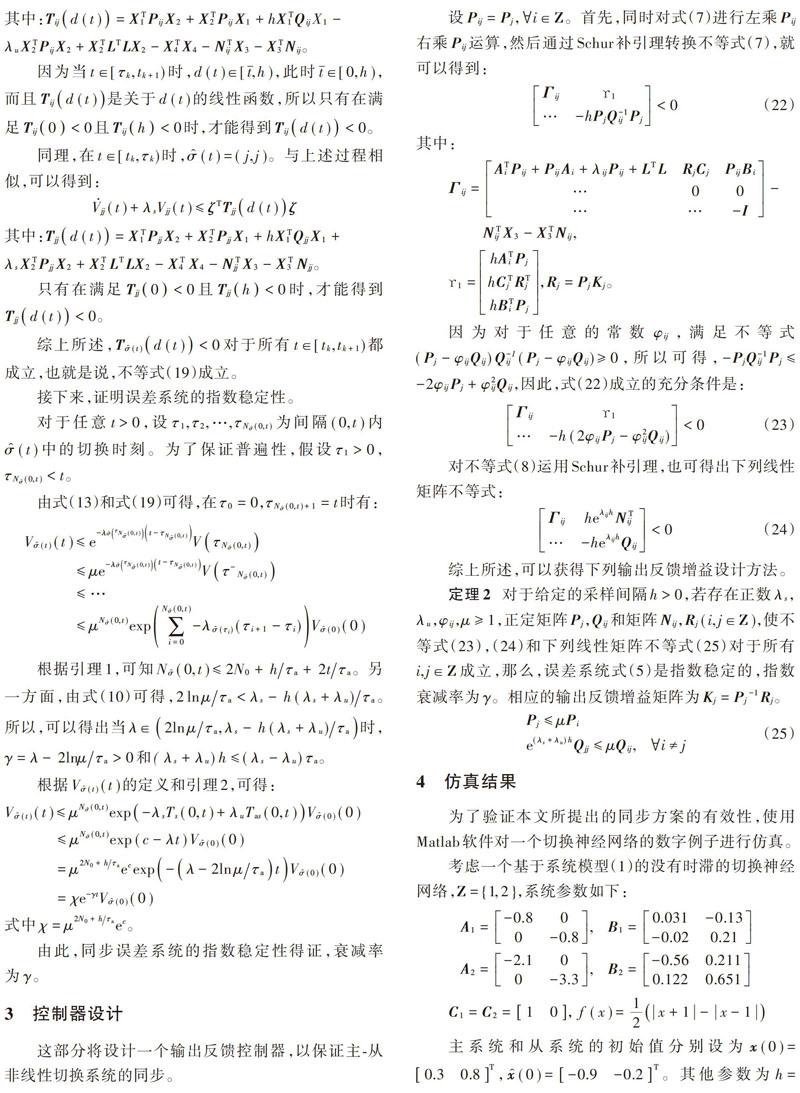
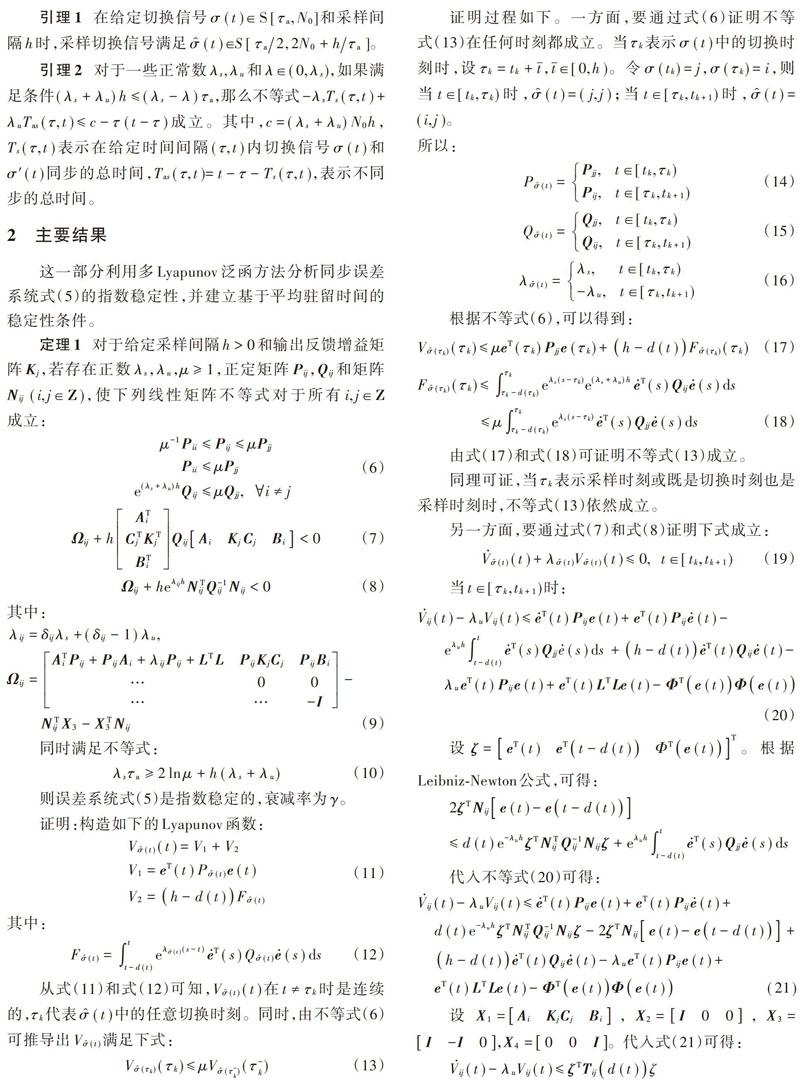
摘 要: 針對連續Lipschitz非線性切換系統,設計了基于輸出采樣數據反饋的主從同步控制器,以實現主從非線性切換系統在網絡環境中狀態同步的目的。首先,通過基于采樣數據的輸入時滯方法,將同步誤差系統建模成具有狀態時滯的非線性切換系統,解決了因考慮對輸出信號采樣而帶來的系統模態與控制器模態的不同步切換問題。然后,利用多Lyapunov泛函和平均駐留時間方法建立同步誤差系統指數漸近穩定的充分條件,并通過求解一組線性矩陣不等式給出輸出反饋控制器的設計方法。最后,通過一個切換神經網絡的數值例子驗證了所提同步方案的有效性。
關鍵詞: 非線性切換系統; 網絡化同步; 采樣控制; 輸入時滯方法; 同步誤差; 平均駐留時間
中圖分類號: TN914.53?34 文獻標識碼: A 文章編號: 1004?373X(2018)13?0014?05
Abstract: A master?slave synchronous controller based on output sampling data feedback was designed for the continuous Lipschitz nonlinear switched system to realize the state synchronization of the master?slave nonlinear switched system in the network environment. The input delay approach based on sampling data is used to model the synchronization error system as a nonlinear switched system with state delay to solve the non?synchronous switching between the system mode and controller mode caused by output signal sampling. The multi?Lyapunov functional theory and average dwell time method are used to get a sufficient exponential approximate stability condition for the synchronization error system. The design approach of the output feedback controller is given by solving a set of linear matrix inequalities. The effectiveness of the proposed synchronization scheme was verified with numerical example of a switching neural network.
Keywords: nonlinear switched system; networked synchronization; sampling control; input delay approach; synchronization error; average dwell time
0 引 言
切換系統和網絡化控制系統一直是研究者們研究的熱點。切換系統是由多個動態子系統以及離散切換信號構成的一類特殊的混雜系統。子系統之間的切換都是由切換信號決定的,所以切換系統呈現出了更為復雜的動態行為,這也使其在控制理論及工程實踐上有了廣泛的應用[1?2]。另一方面,網絡化控制系統是由通信網絡將執行器、傳感器和控制器等系統單元進行連接而形成的空間分布式控制系統,在實現系統的遠程控制與檢測、增加控制系統的靈活性和可靠性等方面具有傳統控制系統無法超越的優越性[3?4]。近年來,網絡化控制與同步和切換系統分別取得了很大的研究進展,但將兩者融合的研究還處于起步階段,因此,本文提出的非線性切換系統的網絡化同步方案對于進一步發展切換系統和網絡化系統理論和方法具有十分重要的理論意義。
文獻[4]分析了離散線性切換控制系統在異步切換條件下的有限時間[H∞]狀態估計問題,采用龍伯格觀測器技術設計了同步觀測器;在具有網絡時延和數據丟失限制的網絡環境下,文獻[5]研究了線性切換系統的有限時間采樣數據觀測器設計問題,通過時鐘驅動方法進行輸出采樣和模態監測,分析了系統的有限時間[H∞]性能;在異步切換條件下,文獻[6]采用多Lyapunov泛函方法和平均駐留時間方法研究了線性時滯反饋切換系統的指數穩定性。上述研究成果雖然考慮了異步切換或者采用采樣數據反饋控制方法,但其研究對象都是線性切換系統。在非線性切換系統研究方面,文獻[7]研究了最小駐留時間約束條件下的同步切換觀測器設計問題;文獻[8]采用非線性反饋方法研究了具有時變時滯的切換神經系統的同步問題;文獻[9]研究了一類非線性切換系統在任意切換下的全局有限時間鎮定問題,設計了連續非光滑的狀態反饋控制器和共同Lyapunov函數,實現了系統的有限時間鎮定。但以上研究都是在采用連續的系統狀態或輸出的基礎上進行的,而沒有考慮網絡環境下系統狀態或者輸出信號的數據采樣問題。因此,所得的研究結果無法應用于本文所研究的非線性切換系統網絡化同步問題中。
基于以上分析,本文考慮對切換系統輸出進行采樣,研究將采樣數據應用于非線性切換系統的網絡化同步方法,以減少不必要的信道帶寬和計算資源的浪費。本文假設在采樣時刻,控制器只能獲得系統輸出的采樣數據和切換信號,通過融合原始切換信號和采樣時刻的切換信號,獲得一個采樣切換信號作為新的切換信號。但在考慮信號采樣時,很難保證控制器與原系統的同步切換,造成控制器與原系統在各采樣周期內會存在不同步的區間。基于此,采用基于采樣數據的輸入時滯方法,建立具有時滯的同步誤差系統模型。然后通過多Lyapunov泛函方法分析同步誤差系統的指數穩定性,建立基于平均駐留時間條件的穩定性條件,并給出同步控制器的設計方法。
圖2顯示了主系統和從系統的狀態軌跡逐漸趨于一致;從圖3可知同步誤差系統軌跡也逐漸趨于零;圖4給出了原始切換信號[σ(t)]和采樣切換信號[σ(t)]的對比關系。這都顯示了本文提出的基于采樣數據的非線性切換系統同步方案的有效性。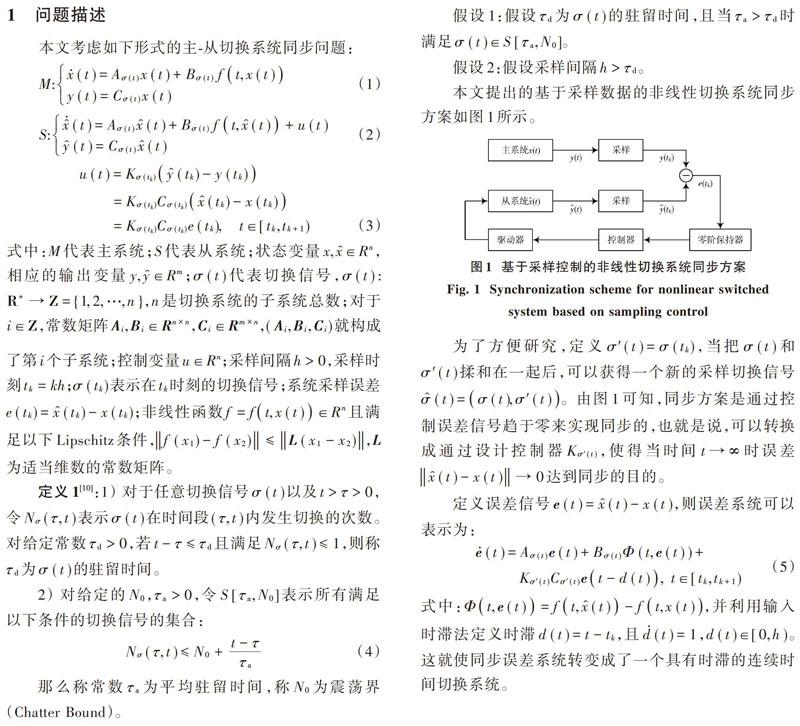
5 結 語
本文提出基于采樣數據的非線性切換系統的網絡化同步方案。首先,采用輸入時滯方法處理因考慮對系統輸出進行采樣而導致的異步切換問題,建立具有時滯的同步誤差系統模型和新的采樣切換信號;其次,通過多Lyapunov泛函方法分析同步誤差系統的指數穩定性,建立了基于平均駐留時間條件的穩定性條件;接著,提出一種輸出反饋控制器的設計方案,通過數值例子驗證了所提同步方案的有效性。
參考文獻
[1] ZHONG G, YANG G. Robust control and fault detection for continuous?time switched systems subject to a dwell time constraint [J]. International journal of robust & nonlinear control, 2015, 25(18): 3799?3817.
[2] CORONA D, GIUA A, SEATZU C. Stabilization of switched systems via optimal control [J]. Nonlinear analysis hybrid systems, 2014, 11(1): 1?10.
[3] 鄭英,方華京,謝林柏,等.具有隨機時延的網絡化控制系統基于等價空間的故障診斷[J].信息與控制,2003,32(2):155?159.
ZHENG Ying, FANG Huajing, XIE Linbo, et al. Fault diagnosis based on equivalent space for networked control systems with random delay [J]. Information and control, 2003, 32(2): 155?159.
[4] IQBAL M N, XIAO J, XIANG W. Finite?time [H∞] state estimation for discrete?time switched control systems under asynchronous switching [J]. Asian journal of control, 2014, 16(4): 1112?1121.
[5] WANG S, ZHANG L, JASRA A, et al. Network?based finite?time sampled?data observer design for switched linear systems [J]. IFAC, 2015, 48(28): 590?595.
[6] ZHAI S, YANG X S. Exponential stability of time?delay feedback switched systems in the presence of asynchronous switching [J]. Journal of the Franklin Institute, 2013, 350(1): 34?49.
[7] YANG J, CHEN Y, ZHU F. Synchronous switching observer for nonlinear switched systems with minimum dwell time constraint [J]. Journal of the Franklin Institute, 2015, 352(11): 4665?4681.
[8] WANG L, SHEN Y, ZHANG G. Synchronization of a class of switched neural networks with time?varying delays via nonlinear feedback control [J]. IEEE transactions on cybernetics, 2016, 46(10): 2300?2310.
[9] 梁迎久.一類切換非線性系統的全局有限時間鎮定[J].重慶工商大學學報(自然科學版),2014,31(1):8?13.
LIANG Yingjiu. Global finite time stabilization for a class of nonlinear switched systems [J]. Journal of Industrial and Commercial University of Chongqing (natural science edition), 2014, 31(1): 8?13.
[10] FRIDMAN E. A refined input delay approach to sampled?data control [J]. Automatica, 2010, 46(2): 421?424.
[11] ZAMANI I, SHAFIEE M. On the stability issues of switched singular time?delay systems with slow switching based on average dwell?time [J]. International journal of robust & nonlinear control, 2014, 24(4): 595?624.
[12] 姜培剛,姜偕富,李春文,等.基于LMI方法的網絡化控制系統的[H∞]魯棒控制[J].控制與決策,2004,19(1):17?21.
JIANG Peigang, JIANG Xiefu, LI Chunwen, et al. [H∞] robust control of networked control system based on LMI method [J]. Control and decision, 2004, 19(1): 17?21.
[13] VU L, MORGANSEN K A. Stability of time?delay feedback switched linear systems [J]. IEEE transactions on automatic control, 2010, 55(10): 2385?2390.