
Multilingual Mix in Women Fashion Industry Advertising A Comparison between Hong Kong and China
2018-06-12 08:50:12王騰飛
校園英語·中旬 2018年4期
關鍵詞:海洋大學


【Abstract】This paper is aimed to compare the linguistic practice in advertisements of women fashion industry in Mainland China and Hong Kong, in terms of the patterns, forms and functions of language mixing.
【Key words】Multilingual Mix; Women Fashion Industry Advertising; Hong Kong; China
【作者簡介】王騰飛,中國海洋大學。
Nowadays, a lot of researches pay their attention to language mixing on western media. But they hardly ever focus on the ads of English mixed with Chinese in mainland China. There are actually seldom authoritative descriptions about the situation of ads with code-mixing in the context of Mainland China. While, Hong Kong, as an international area of Asian, a great variety of multilingual mixing ads has been researched by scholars from the national functionalist perspective, the local and global point of views (Wu & Chan, 2007) and so on. This paper is aimed to compare the linguistic practice in advertisements of women fashion industry in Mainland China and Hong Kong, attempting to apply a comparative study of the two regions and to exam the up-to-date multi-linguistic phenomena.
The language features in advertisements
The language in advertisements, have its particular features, except for borrowings and loanwords, multiple codes are prevalent connected to the trend of globalization. Multilingualism has started to become a major phenomenon in the language of advertising and will undoubtedly continue to expand (Piller, 2003). One important reason is that English has become a non-national language and has been applied in many non-English-speaking countries to indicate a social stereotype.
Piller (2003) summarized, no matter whether the target customer can grasp the meaning of a foreign form or not, people will be able to identify the form as belonging to a particular language, and they can transfer the ethno-cultural stereotype about the group most frequently associated with that language onto the product.
Methodology
Framework of Analysis
A content analysis is conducted to study the language mix features in advertisements in fashion magazines based on both Hong Kong and mainland China. The study aims to research the patterns of language mix, the form or level of mixture and the function of each language or variety when mixing with others in both regions.
The method of language function classification from Wu and Chan (2007) is borrowed in this study. The function of language is classified into “informational” function and “involvement” function. According to Wu and Chan (2007), “‘informational function refers to the function of language in providing or presenting information.” Language used for generally product introduction or ingredient statement may be included in applying“informational” function. And “‘Involvement function refers to the affective function of language which is beyond providing or presenting information”. Language used for arousing emotional effects or asking for actions may apply the “involvement” function. Although the design of advertising text or typeface and product package may also affect peoples minds, we only focus on the meaning of language and exam the function of language context in this study.
Sampling
The study focuses on advertisements in fashion magazines and selects the Hong Kong version and mainland China version of Cosmopolitan magazine as the sample base. Cosmopolitan is a famous international fashion magazine for women. With the audited circulation of 42,100 in Hong Kong and 1670,000 in mainland China, Cosmopolitan magazine is regarded as the industry leader and one of the most influential women magazine in both regions.
In order to exam the up-to-date situation, the Nov. issue of Hong Kong version and mainland China version of Cosmopolitan magazine were selected. A total of 47 ads were collected from the mainland China version while a total of 72 ads were collected in the Hong Kong version.
Results
Sample origins
Table1 below shows the brand origins of our samples. Almost all the samples are from foreign brands in both mainland China and Hong Kong version. There are only 3 local brands from mainland China and only 1 local brand from Hong Kong invest their ads in the selected magazines. And all these brands of our samples are related to fashion industry, such as brands of cosmetics, bags, clothing, watches and accessories.
Language usage, language mixed patterns and forms
From Table 2, we could see that SWC appeared in 89.4% of ads in mainland China samples and only 48.6% of ads in Hong Kong samples. English appeared in most samples (93.6%) of mainland China and all the samples of Hong Kong. And Other languages (almost all are French) appeared in about 20% samples in both regions. In the samples of China, we found a higher proportion of appearance in English than SWC, but this can not indicate that English usage is more common than SWC usage in fashion ads. Because most of the English appeared as the product names and in the form of words. SWC is still the base language in ads in Chinese samples. And in SWC shows a relatively low proportion of appearance in Hong Kong because a lot of samples are in pure English. Therefore, from Table 3 we could find that the “English only” ads occupy the highest proportion (41.7%) among all ads patterns in Hong Kong, followed by the pattern of SWC mixed with English (38.9%).
As for the form of language mixing, English could be embedded in the form of a word, a phrase, and/or clause in both regions. Most of the embedded elements is a word or a phrase (mainland China: word=80.5%, phrase=68.3; Hong Kong: word=50.0%, phrase=59.5%). Only a few clauses form is found in mainland China (7.31%) while there is a much higher proportion of clause form (21.4%) in Hong Kong samples.
Functions of Language mixed in Ads
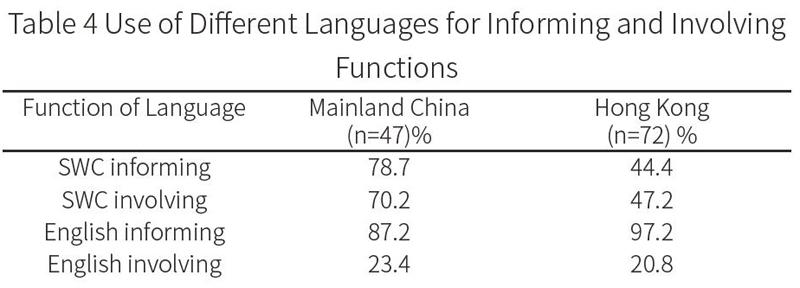
In the samples of both regions, both English and SWC could serve informing and/or involving functions. In both regions, SWC, as the base language, serves informing and involving functions together in most of the language mixed ads, therefore we could find a corresponding statistics of the informing function and involving function for SWC. And the smaller proportions of SWC functions in Hong Kong is resulted from the big number of pure English ads. And we need to notice that all the English in pure English ads of both regions serve only informing function. And we could conclude from Table 4 that most English are using for informing functions while a few proportion serve the involving function. When comparing the English involving function between the two regions, mainland China (23.4%) even hold the slightly higher proportion than Hong Kong (20.8). And that is mainly because all the pure English ads serve only informing functions in Hong Kong. If we only look at those ads with language mixing, the proportion of English involving function in Hong Kong (35%) would be higher than that in mainland China (27%).
Discussion and conclusion
Based on our research in China samples, English hold the highest appearance rate and the pattern of “SWC-English” hold the highest proportion can indicate that English has become a regular language in ads of fashion magazine in mainland China. According to Wu & Chan (2007), the use of language for“involving” function and for“informing” function at the same time provides indicates a higher degree of cultural acceptability related to the language used by people. So when we take the levels of language mix and functions of language into consideration, we find that most English are embedded in simple words, such as product names, and they are serving only informing function. This may prove that English are mainly used as identity representations of foreign brands and to provide basic information. And most consumers in mainland China have not culturally accept the usage of English. But we can still conclude that English language has already been accepted as the informational tool by the advertiser and consumers in mainland China and at most times English would embedded in SWC as supplement. The possible reasons for this might including the development of public education and local economy in mainland China as well as the development of global economy.
References:
[1]Piller,I.(2003).10.ADVERTISING AS A SITE OF LANGUAGE CONTACT.APL,23.
[2]Wu,D.and Chan,K.(2007).Multilingual Mix in Hong Kong Advertising,Pre- and Post-1997. Asian Journal of Communication, 17(3),pp.301-317.
猜你喜歡
編輯之友(2023年8期)2023-11-02 05:10:44
科技進步與對策(2021年3期)2021-03-11 00:57:34
當代水產(2019年10期)2019-12-18 05:29:14
校園英語·月末(2019年7期)2019-10-21 19:51:43
意林·全彩Color(2019年7期)2019-08-13 00:53:50
校園英語·上旬(2018年9期)2018-10-16 01:22:58
——MTA教育中心
中國海洋大學學報(社會科學版)(2017年2期)2017-04-25 02:05:00
韓國語教學與研究(2017年2期)2017-03-07 17:48:24
法語學習(2015年2期)2015-04-17 09:05:31
法語學習(2013年3期)2013-04-18 11:03:58
