
Light-responsive adsorbents with tunable adsorbent-adsorbate interactions for selective CO2 capture
2022-04-01 05:46:34PengTanYaoJiangQiurongWuChenGuShichaoQiQiangZhangXiaoqinLiuLinbingSun
Peng Tan,Yao Jiang,Qiurong Wu,Chen Gu,Shichao Qi,Qiang Zhang,Xiaoqin Liu,Linbing Sun,*
1 State Key Laboratory of Materials-Oriented Chemical Engineering,Jiangsu National Synergetic Innovation Center for Advanced Materials (SICAM),College of Chemical Engineering,Nanjing Tech University,Nanjing 211816,China
2 Department of Chemistry,Washington State University,Pullman,WA 99163,United States
Keywords:Adsorbents CO2 capture Selectivity Light responsiveness Azobenzene
ABSTRACT Amines in porous materials have been employed as active species for the selective CO2 adsorption from natural gas because of their target-specific interactions.Nevertheless,it is difficult to modulate such strong interactions to reach a high efficiency in the adsorption processes.Herein,we fabricated lightresponsive adsorbents with tunable adsorbent-adsorbate interactions for CO2 capture.The adsorbents were synthesized by introducing primary and secondary amines into a mesoporous silica that had been grafted with azobenzene groups on the surfaces.The target-specific amine sites render the adsorbents significantly selective in the uptake of CO2 over CH4,and the azobenzene groups were used as lightresponsive switches to influence the adsorbent-adsorbate interactions.The adsorbents can freely adsorb CO2 when the azobenzene groups are in the trans state.Ultraviolet-light irradiation makes the azobenzene groups transform to the cis configuration,which greatly hinders amines in the uptake of CO2.The caused difference of adsorption capacity can reach 34.9%.The alternative irradiation by ultravioletand visible-light can lead to a recyclable regulation on adsorption performance.The changes of the electrostatic potentials of amines are responsible for the light-induced regulation on adsorption.
1.Introduction
With the explosive usage of global energy and the associated environmental problems,widespread access to green fuels is imperative[1].Natural gas is considered as a feasible and efficient alternative energy to fossil fuels because of its rich reserves,clean burning properties,and good transport safety[2].Methane(CH4)is the main component in natural gas,but the complex impurities decrease the safety and quality of CH4.Particularly,the acid gases like carbon dioxide (CO2) in natural gas may reduce the calorific value of CH4and cause the equipment corrosion as well [3,4].As such,selective removal of CO2is favored to upgrade natural gas in various practical applications.In the past decades,amine scrubbing by using organic amine solutions has been employed to selectively absorb CO2in industry [5-7].Albeit effective,high energy penalty in regeneration and corrosion on equipment limits the development of this technique [8].In order to improve separation efficiency and decrease energy consumption,porous solids with target-specific pore structures and surface chemistry have been developed as adsorbents to selectively capture CO2,such as activated carbons [9-11],zeolites [12-14],and porous polymers[15-17].These adsorbents were designed based on the anticipated size sieving and host-gust interactions,and their properties are unable to change once synthesized.As a result,the adsorption/desorption cycles of these adsorbents can only be achieved by pressure and temperature swings.This causes adsorbents to undergo some harsh environments,which may short their lifetime.In addition,pressure and temperature swings are the most energyconsuming section in adsorption processes,which is contrary to the original intention of replacing amine scrubbing with adsorption.It is still a challenge to develop an energy-efficient adsorption process to address all the issues.
The critical problem derives from the opposite requirements of desorption over adsorption.Current works have focused on constructing small pores or enhancing host-guest interactions to achieve the desired selectivity [18-20],but ignoring the increased difficulty in desorption which prefers to large pore channels and weak interactions [21-23].The unchangeable properties of adsorbents lead to the irreconcilable differences between adsorption and desorption.Endowing adsorbents with tunable properties is considered as an efficient solution [24-28].Inspired by nature,smart materials with responsiveness have been developed to efficiently addressed various complicated medical,mechanical,and engineering issues [29-34].These smart materials can respond to different stimuli such as temperature,redox potential,pH,and light [35-39].Light is paid particular attention to because of its rapid and remote controllability with high precision [40-42].The inspiring progress of lightresponsive materials offers a precious opportunity to produce smart adsorbents with tunable properties,challenging the predominant status of pressure-and temperature-swing adsorptions via low energy penalties and convenience.Some efforts have been made to tune the textural properties of adsorbents for regulating CO2adsorption.A ligand with azobenzene groups were used to construct the metal-organic framework (MOFs) with pending light-responsive motifs [43].Light irradiation induced the configuration change of azobenzene groups,resulting in the different CO2uptake of the adsorbent.Steric hindrance is responsible for this adsorption behavior.In another case,an azobenzene derivative was used as the building block to construct a Zn-based MOF [44].This building block can isomerize in limited space under light irradiation,which leads to the structural variation of the MOF.CO2molecule is more difficult to accommodate in the twisted pore structures.These recent reports have demonstrated successful cases in changing adsorption behavior through physical regulation.It is urgently desired to tune chemical adsorption out of the importance of selective CO2capture in industry,but scarce approaches have been developed to achieve this goal because of the difficulty in interrupting chemical interactions during adsorption/desorption cycles.
In this paper,we report the fabrication of alight-responsive adsorbent with tunable chemical interactions for CO2capture.An azobenzene derivative,N-[4-[2-(4-aminophenyl)diazenyl]phe nyl]-N′-[3-(triethoxysilyl)propyl]urea (PDA-TPI),was incorporated into mesoporous silica (MS) as the light-responsive switches.Primary and secondary amines were introduced as the targetspecific active sites for CO2over CH4.The results show that CO2can be unimpededly captured by amines when azobenzene groups are in the initialtransstate.Irradiation with ultraviolet (UV) light can make azobenzene groups isomerize to thecisstate,which hinders the chemical interaction between amines and CO2molecules and subsequently decreases the uptake of CO2(Fig.1).The maximum difference of the adsorption capacity can reach 34.9%.Irradiation with visible (Vis) light recovers azobenzene groups to thetransstate,and the light-responsive adsorbents can be fully regenerated.The calculation results by the density function theory(DFT)demonstrate that the surface electrostatic potentials of amines are limitedly affected by thetransazobenzene groups but significantly influenced by thecisazobenzene groups,which responds for the modulation of chemical interactions by light.
2.Experimental
2.1.Materials
Tetraethyl orthosilicate (TEOS),hydrochloric acid (HCl,37% (mass)),cetyltrimethylammonium bromide (CTAB),[3-(2-aminoethylamino)propyl]trimethoxysilane (AEATS),p-diaminoazobenzene (PDA),sodium hydroxide (NaOH),and 3-(triethoxysilyl)propyl isocyanate (TPI) were purchased from Adamas (China).Tetrahydrofuran (THF),n-hexane,ethanol,and toluene were purchased from Sinopharm (China) and dehydrated before use.
2.2.Preparation of light-responsive adsorbents
MCM-41 was prepared by the sol-gel method and used as the support.NaOH (1.75 ml,2 mol·L-1) and CTAB (0.5 g,1.37 mmol)were mixed in water (240 ml) with vigorous stirring.When the temperature elevated to 80 °C,TEOS (2.5 ml,11.5 mmol) was added to the mixture within 5 min.After reaction for 2 h,the white solids were collected and refluxed in ethanol (80 ml) with HCl(1 ml,1 mol·L-1)to remove the template CTAB.The obtained powder was denoted as MS.
The light-responsive adsorbents were synthesized by grafting PDA-TPI and AEATS on MS.PDA (0.98 g,4.6 mmol) and TPI(1.15 g,4.6 mmol) were mixed in 10 ml of THF,and refluxed in the N2atmosphere for 12 h.The obtained PDA-TPI were washed withn-hexane and dried in vacuum.MS (0.50 g),APTES (0.10 g),and PDA-TPI(0.07,0.10,or 0.20 g)(Fig.S1 in Supplementary Material)were dissolved in toluene(80 ml)and stirred at 80°C for 12 h under the N2atmosphere.The obtained solids were washed with ethanol and denoted as DAL(x)@MS,wherexvaries from 1 to 3 corresponding to the different contents of light-responsive switches.
2.3.Materials characterization

Fig.1.Light-induced modulation on CO2 capture.(a) CO2 molecules are captured by active sites when light-responsive switches in the trans state;(b) The active sites are sheltered when light-responsive switches in the cis state.
X-ray diffraction(XRD)analysis was performed on a D/MAX-γA diffractometer (Smartlab 9KW,Rigaku,Japan).The morphology of different samples was analyzed by a scanning electron microscopy(SEM,S-4800,Hitachi,Japan) and a transmission electron microscopy (TEM,JEM-2010 UHR,JEOL,Japan),respectively.N2adsorption-desorption isotherms were tested on a surface area and porosity analyzer (ASAP 2020,Micromeritics,USA).Fourier transform infrared(FT-IR)spectra were measured by a Nexus 470 spectrometer (Nicolet,USA).UV-Vis spectra were collected on the Lambda 35 (PerkinElmer,USA).The Vario Micro Cube elemental analyzer was used to perform elemental analysis (Elementar,Germany).
2.4.Adsorption experiments
ASAP 2020 was used to test the adsorption isotherms of CO2and CH4.Before tests,a xenon lamp (CEL-HXUV300,Zhongjiaojinyuan,China) was used to generate UV or Vis light to transform the configurations of the light-responsive switches.The virial equation(Eq.(1)) was used to fit the adsorption data,wherePis pressure,Tis temperature,Nis amount adsorbed,aiandbiare temperature independent empirical parameters,andmandnare the number of terms.The isosteric heats (Qst) of CO2was estimated by Eq.(2),whereRrefers to the universal gas constant.

The selectivity for CO2over CH4is defined asS=(x1/y1)/(x2/y2),wherexandyrefer to the composition of the adsorbed and bulk phases,respectively.The ideal adsorption solution theory (IAST)is applied to analyze the adsorption of binary gas mixture in porous materials,and the dual-site Langmuir model was selected to fit the adsorption isotherms.
3.Results and Discussion
3.1.Textural and surface characteristics
The textural properties of the adsorbents were studied based on the XRD,TEM,and N2adsorption results.The low-angle XRD patterns (Fig.1(a)) show that MS has a strong peak and two weak peaks,which can be indexed to the (100),(110),and (200) reflections,suggesting its hexagonal pore structure(p6mm).After introducing amines and light-responsive switches into MS,the strong peak can be clearly observed for DAL(x)@MS,indicating that the post-modification process of the silane coupling agent used had little negative effects on MS’s pore structure.The wide-angle XRD patterns(Fig.S2)show that all the samples have a broad diffraction peak centered at about 23°,which is attributed to the amorphous framework of MS.Amines and light-responsive switches are highly dispersed in the pore channels because of the fact that no other peaks are observed for these adsorbents.The particles of MS and DAL(2)@MS are spherical as shown in SEM and TEM (Fig.2(b),(c),and Fig.S3)images,and the uniform and straight pore channels can be clearly observed.The highly open pores provide a compelling platform to accommodate CO2molecules.The shape and pore structures DAL(2)@MS are the same as that of MS,which is consistent with the XRD results.The element mapping results(Fig.2(d)) confirm the existence of the elements C and N in DAL(2)@MS,which derive from the introduction of amines and lightresponsive switches.Further,elemental analysis reveals that the adsorbents have higher C and N contents than MS as shown in Table 1,and follow the order of DAL(1)@MS <DAL(2)@MS <DAL(3)@MS.This implicates that amines and light-responsive switches were introduced into MS as expected,and the introduced amount is controllable.The N2adsorption-desorption isotherm of MS(Fig.2(e))shows a rapid increase in the relative pressures less than 0.4,corresponding to the shape of the type-IV adsorption isotherm.This provides additional evidence of the developed mesoporous structures of the MS particles.The N2amounts adsorbed of the other samples are not as high as that of MS,and the grafting process caused a nearly half drop of the BET surface area (SBET) of MS (Table 1).It can be deduced that most of amines and lightresponsive switches were grafted on the pore walls rather than the outside surfaces of the MS particles.The isotherms of the adsorbents can still be ascribed to the type-IV,suggesting that mesopores of MS are not blocked by the introduce species.In addition,the lowest BET surface area for the sample DAL(3)@MS can reach 512 m2·g-1.The pore size distributions (Vp) (Fig.2(f)) calculated from the adsorption branches show that DAL(1)@MS have a smaller pore diameter (Dp) than MS,supporting the conclusion that amines and light-responsive switches were grafted on the pore walls.The more amounts introduced,the smaller pore size and pore volume the adsorbents have.

Table 1Physicochemical parameters and elemental compositions of different samples
The surface chemistry of the adsorbents was studied by the IR results (Fig.S4).MS has two characteristic bands at 960 and 800 cm-1that are ascribed to the symmetrical stretching vibrations of -SiOH and -SiO-,respectively.The emerging bands of 1560 and 1600 cm-1for DAL(1)@MS can be attributed to the stretching vibrations of -NH2and -NH-,respectively,indicating the successful introduction of AEAPS.With more AEAPS introduced in the samples DAL(2)@MS and DAL(3)@MS,the relative intensities of the two peaks obviously increase.The characteristic band at 1546 cm-1that corresponds to the stretching vibration of-CONH-is also observed for all the adsorbents,certifying the successful incorporation of light-responsive switches.IR results give the evidence of the critical organic groups in the entire samples,while the element mapping results proof the presence and uniform distribution of amines and light-responsive switches in some scattered particles.
3.2.Light-responsive properties
UV-Vis spectrometer was used to analyze the light-responsive properties of PDA-TPI.In the initial state,most PDA-TPI molecules are in the stabletransconfiguration,thus the characteristic bands of PDA-TPI at 395 and 500 nm (Fig.S5a) are detected.Irradiating PDA-TPI with UV light for 3 min results in a remarkable decrease of the band intensity at 395 nm,suggesting the decrease of π-π*transition of thetransisomer.Meanwhile,an increase of the band intensity at 500 nm is observed,suggesting the increase of n-π*transition of thecisisomer.This indicates that PDA-TPI can rapidly transform from thetranstocisconfigurations under the external UV-light irradiation.The intensity of the two characteristic bands do not show any further significant change with prolonging time for UV-light irradiation,meaning that most of thetransisomers have transformed into thecisisomers in 3 min.Vis light was used to restore the PDA-TPI molecules.After Vis-light irradiation for 3 min,the bands at 395 and 500 nm can fully restore to their initial states,which not only demonstrates the reversible alternation of PDA-TPI but shows its high transformation efficiency fromcistotransconfigurations.It is worth noting that the band intensity at 395 nm even surpass its initial state.This can be explained by the fact that there is a fraction ofcis-isomers in the initial PDATPI.The light-responsive transformation of PDA-TPI is repeatable as shown in Fig.S5(b).

Fig.2.Characterization of light-responsive adsorbents.(a) Low-angle XRD patterns of different samples.TEM images of (b) MS and (c) DAL(2)@MS as well as (d) EDXmapping images of DAL(2)@MS.(e) N2 adsorption-desorption isotherms and (f) pore size distributions of different samples.
After PDA-TPI was introduced into the pores of MS as the lightresponsive switch,its light-responsive properties were studied by UV-Vis spectrometer as well.The intensity of the band at 405 nm that is ascribed to the π-π*transition of thetransisomers obviously decrease after UV-light irradiation for 5 min (Fig.3(a)).The light-responsive switches can receive the energy of light in the confined pore channels and freely undergo isomerization because of sufficient space.Similar to the case of the dissolved PDA-TPI,the light-responsive switches can transform to thetransconfiguration after Vis-light irradiation for 5 min as the band intensity at 405 nm restore to the initial state.The isomerization of the light-responsive switches is completely reversible (Fig.3(b)) without any decay,indicating that the adsorbents are able to achieve adsorption/desorption cycles.
3.3.Adsorption behavior

Fig.3.Light-responsive properties of the adsorbents.(a)Alteration in the UV-Vis spectra of DAL(2)@MS upon UV/Vis light irradiation.(b)Reversible changes in absorbance at 395 nm as a function of cycles for DAL(2)@MS.
The adsorption performances of the obtained light-responsive adsorbents were systematically studied.One-component adsorption experiments were first conducted.As DAL(2)@MS have primary and secondary amines,CO2can be preferentially adsorbed with the uptake of 50 cm3·g-1at 100 kPa while that less than 1 cm3·g-1of CH4can be adsorbed at the same pressure (Fig.4(a)).In consideration that MS has the type-I isotherm of CO2because of lacking active sites,it can rest assured that amines work on improving the adsorbent-adsorbate interactions during CO2adsorption.After UV-light irradiation,DAL(2)@MS remains a low CH4uptake,and negligible light-induced adsorption swing is observed.When the light-responsive switches transform to thecisconfiguration,only 33 cm3·g-1of CO2can be adsorbed on DAL(2)@MS,indicating that the ability of amines to capture CO2is negatively influenced by thecisazobenzene groups.Fig.4(b)gives the change amounts of different samples in capacity.MS has little change as physical interactions dominate the adsorption.The steric hindrance caused by the light-induced isomerization exerts negligible impact on the entrance of CO2molecules into pores.For DAL(1)@MS (Fig.S6),its capacity can be modulated by 27.9%.With more amines introduced,DAL(2)@MS shows the optimized change amount of 34.9%.When a excessive amount of amines were introduced,the controllability of light on the adsorbent decreases by half as demonstrated by DAL(3)@MS (Fig.S7).The optimal change amount (17.5 cm3·g-1) is higher than that of some previous reports,such as 13.0 cm3·g-1of AP2@MS [28] and 13.8 cm3·g-1of AL(2)/MS [45].The adsorption/desorption cycles were carried out as well (Fig.4(c)),and the results show that DAL(2)@MS can be fully regenerated after 6 cycles.It is proposed that the adsorbents should maintain the adsorption performance if more cycles were conducted.Firstly,the light-responsive switches and active sites are chemically anchored on porous materials,thus the mild operation and regeneration conditions (e.g.light irradiation and degasification) have little effects on their amounts and activity.Secondly,the light-responsive behaviors are completely reversible,and light-responsive switches only influence the activity of amines rather than forming chemical bonds,so the light-induced modulation in the 6th cycle is comparable to the fresh one.Thirdly,CO2molecules are captured on the pore walls instead of into the framework of adsorbents.The pore structures of the adsorbents are intact during adsorption/desorption cycles.
The IAST model was used to study the light-induced modulation on the selectivity of DAL(2)@MS (Fig.4(d)).When the lightresponsive switches are in thetransconfiguration,the selectivity of amines can reach 801 at 0 °C and 10 kPa.The selectivity decreases to 220 as the light-responsive switches transformed to thecisconfiguration.The change of the selectivity follows the same trend at the higher pressures.The affinity of DAL(2)@MS for CO2was further studied by isosteric heat(Fig.S8).The calculated value of DAL(2)@MS at the CO2uptake of 0.1 mmol·g-1is 63.6 kJ·mol-1,which is higher than that of massive physical interactions.This suggests the strong interactions between amines and the CO2molecules.When the CO2uptake increases,the isosteric heat of DAL(2)@MS gradually decreases because of the multilayer adsorption.Light-induced modulation can directly decrease the isosteric heat of DAL(2)@MS to 48.2 kJ·mol-1,indicating that the strong adsorbent-adsorbate interactions can be modulated by light.
3.4.Proposed mechanism for light-induced adsorption swing
In industry,primary and secondary amines in the organic solvents were used to chemically capture CO2.Such strong chemical interactions result in difficult regenerations.The adsorbents in this work employed the strong interactions of primary and secondary amines,but the capacities of the adsorbents can be efficiently modulated by light irradiation.This phenomenon can not be well explained by the traditional theories,but light-induced adsorption swing should still follow the laws of mass transfer in pores and surface interactions around active sites.Steric hindrance is first taken into consideration as a contributor to adsorption swing.The pore sizes of the adsorbents are around 2 nm,and no matter thetransorcislight-responsive switches can freely swing in the pores.Even after grafting PDA-TPI,there is sufficient space of pores for the small gas molecules to pass through[46].Since size screen is not the reason for the light-induced adsorption swing,another possibility is that CO2molecules can not approach the active sites upon the light-responsive switches being in thecisstate.But if one active site were sheltered in three-dimension space,the lightresponsive switches around should happen to isomerize to the direction of the site with suitable distances,blocking all the paths for approaching the sites.Unfortunately,PDA-TPI and amines were randomly dispersed over the surfaces,and the dimensional change of azobenzene group is estimated only to be 0.34 nm[41].It is not convinced to ascribe the 34.9% of change amount in capacity to such relatively small steric change,let alone meeting some harsh prerequisites at the same time.
The above signs,especially the change of isosteric heat,suggest that the adsorbent-adsorbate interactions may be distinctively influenced by the light-responsive switches.DFT is employed to reveal the possible reasons.The simulated geometries and surface electrostatic potentials of light-responsive switches and amines are shown in Fig.5.The surface electrostatic potentials of primary amine and secondary amine are-0.0857 and -0.0749 eV,respectively (Fig.5(a)).The pointed regions are the most active sites to interplay with CO2.When azobenzene groups around amines are in thetransstate,the free energies of primary amine and secondary amine are -0.0820 and -0.0807 eV,respectively (Fig.5(b)).This means that thetransazobenzene groups have little effects on the activities of both the amines.Interestingly,thecisazobenzene groups lead to remarkable increases of surface electrostatic potentials for the two amines,especially the primary amine whose value reaches 0.001 eV.This reflects that the adsorbent-adsorbate interactions derived from the primary amines are greatly weakened.In addition,the activity of secondary amine is also impaired by half.The DFT calculations well explain the reasons for the adsorption difference induced by light irradiation.

Fig.4.Adsorptive performance of the adsorbents.(a)Adsorption isotherms of CO2 and CH4 on DAL(2)@MS possessing PDA-TPI in trans or cis configuration at 25°C.(b)Lightinduced change amount of CO2 adsorption on different samples.(c) Adsorption cycles of CO2 on AP2@MS by alternative UV-and Vis-light irradiation.(d) IAST selectivity of CO2/CH4 for DAL(2)@MS.

Fig.5.Proposed mechanism for light-induced adsorption swing.The simulated geometry and surface electrostatic potential of (a) amines,(b) the trans azobenzene group interacting with amines,and (c) the cis azobenzene group interacting with amines.
It is proposed that the azo group transformation influences the affinity of the active amine sites by modulating their electrostatic potentials rather than steric hindrance.Thetrans-state azobenzene groups have little effects on active sites,and amines can freely capture CO2molecules;After UV-light irradiation,thecis-state azobenzene groups are closer to active sites from the simulated geometries,which increases the surface electrostatic potentials of amines.This leads to a drop of affinity in CO2capture.The change of isosteric heat well supports the calculation results.As azobenzene group is irreversible in configuration change,the optimal adsorbent shows little decrease in capacity after regeneration.
4.Conclusions
Light-responsive adsorbents with tunable adsorbent-adsorbate interactions have been successfully fabricated by introducing amines and azobenzene groups into MS.The adsorbents show high selectivity in the uptake of CO2over CH4because of the targetspecific active sites.UV-light irradiation makes the azobenzene groups transform from thetransstate to thecisconfiguration in the pores,which remarkably decreases the adsorption capacity.Vis-light irradiation can recover the adsorption capacity,and the alternative irradiation of the two kinds of light leads to a recyclable regulation on adsorption performance.DFT calculations reveal the effects of azobenzene groups on adsorption.Thetrans-state azobenzene groups have little influence on both primary and secondary amines,and these active sites can freely adsorb CO2molecules.Thecis-state azobenzene groups significantly increase the electrostatic potentials of amines,especially the primary amine,resulting in weakening the adsorbent-adsorbate interactions.The present study may open up an avenue for regulating chemical interactions of adsorption under mild conditions.It should be stated that the change amounts in capacity by light-induced modulation still cannot satisfy industrial applications,and it is desired to improve the difference through increasing the adsorption capacities or the effects of light-induced modulation.
Declaration of Competing Interest
The authors declare that they have no known competing financial interests or personal relationships that could have appeared to influence the work reported in this paper.
Acknowledgements
This work was supported by the National Natural Science Foundation of China (22078155,21808110,21878149,and 21676138),and China Postdoctoral Science Foundation (2020M681567).We are also grateful to the High Performance Computing Center of Nanjing Tech University for supporting the computational resources.
Supplementary Material
Supplementary data to this article can be found online at https://doi.org/10.1016/j.cjche.2021.07.010.
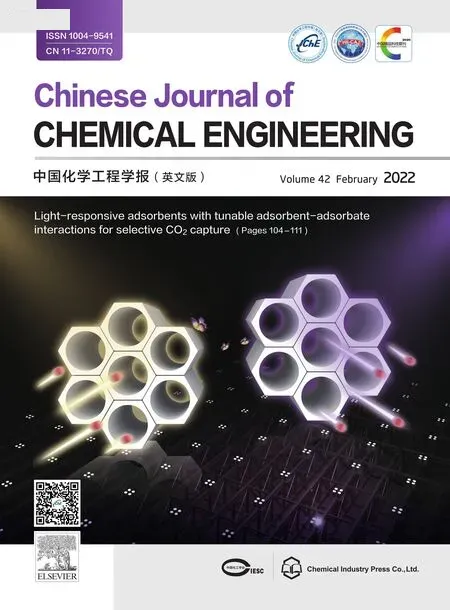 Chinese Journal of Chemical Engineering2022年2期
- Chinese Journal of Chemical Engineering的其它文章
- Thermal performance and entropy generation for nanofluid jet injection on a ribbed microchannel with oscillating heat flux:Investigation of the first and second laws of thermodynamics
- Chlorinated butyl rubber/two-step modified montmorillonite nanocomposites:Mechanical and damping properties
- A core-shell amidoxime electrospun nanofiber affinity membrane for rapid recovery Au (III) from water
- Influence of coke rate on thermal treatment of waste selective catalytic reduction (SCR) catalyst during iron ore sintering
- Effects of formaldehyde on fermentable sugars production in the low-cost pretreatment of corn stalk based on ionic liquids
- Evaluation of phenanthrene removal from soil washing effluent by activated carbon adsorption using response surface methodology