
Toward Atomically Precise Nanoclusters and Nanoparticles
2018-03-05 22:47:40JINRongchao
物理化學學報 2018年7期
JIN Rongchao
Department of Chemistry, Carnegie Mellon University, Pittsburgh, PA15213, USA.
Inorganic nanoparticles (NPs) are being intensely pursued in current nanoscience research. However, fundamental research is hampered by the imprecisions of nanoparticles. Some of the major issues are as follows.
(1) Polydispersity: Even highly monodisperse NPs still have a standard deviation of 5% and they vary from one to another on the atomic scale, which precludes the attainment of precise size dependences of physical and chemical properties;
(2) Structural heterogeneity: The same sized nanoparticles may have different structures, such as isomers, which precludes obtaining precise structure-property relationships;
(3) Elusive surface and interface of nanoparticles: While TEM can map out the inorganic core, the surface species (e.g., the protecting ligands) cannot be mapped out, nor the structure of the interface between the core and surface ligands. This precludes fundamental studies on many surface/interface related issues such as the stability of NPs, chirality, isomerism, surface catalytic mechanism, fluorescence blinking in quantum dots,charge transfer in photovoltaics and photocatalysis, spin canting in magnetic nanoparticles, and many others.
To achieve precise structure-property relationships and understand many remaining fundamental issues of nanoparticles in nanoscience research, atomically precise nanoparticles must be pursued. A recent milestone is the attainment of atomically precise 2.2 nm Au246(SR)80nanoparticles with the total structure(i.e., core plus surface) successfully solved by single crystal X-ray diffraction1. Such perfect nanoparticles serve as critical models for nanoscience research and leverage the fundamental studies of nanoscale phenomena1.
The current Special Issue is intended to promote the “atomic precision” concept in nanoscience research. The goal of atomic precision has been partially fulfilled with gold and silver nanoparticles in the ultrasmall size regime (e.g., 1-3 nm diameter, often called nanoclusters, NCs). Among the fourteen articles published in this Special Issue, researchers have presented their recent advances in the synthesis, structural characterization, studies of properties and developments of applications, as well as theoretical simulations on nanoclusters.
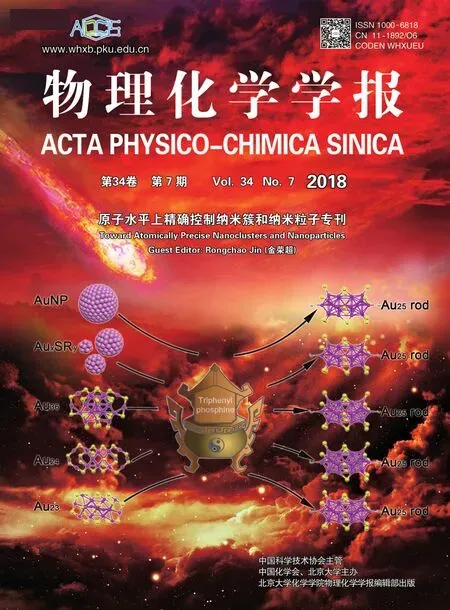
With respect to chemical synthesis, Ren et al.2reported a high-yield method for synthesizing Au21(S-Adam)15 via ligandexchange induced conversion of Au23(S-Adam)16to Au21(SAdam)15(where S-Adm stands for adamantanethiolate). Toward ligand engineering of nanoclusters, Zhou et al.3devised a “sizefocusing” method for the preparation of Au36(SR)24 nanoclusters with various aliphatic and aromatic thiolate ligands (SR = SPh,SPhCH3, SCH(CH3)Ph, and SC10H7). Other than nanoclusters with all thiolate ligands, Zhu et al.4demonstrated a general method of triphenylphosphine (PPh3) induced conversion of thiolated [Au23(SC6H11)16]-, Au24(SC2H4Ph)20, Au36(TBBT)28(where TBBT stands for 4-(tert-butyl) benzene-1-thiolate),Au38(SC2H4Ph)20, as well as size-mixed nanoclusters and 3 nm Au nanoparticles into an exclusive product,[Au25(PPh3)10(SR)5Cl2]2+protected by both thiolate and PPh3.Interestingly, this process occurred via a common[Au11(PPh3)8Cl2]+intermediate. This so-called reverse ligand exchange5(i.e., from thiol to phosphine) is interesting in that Au-S bonds are typically stronger than Au―P bonds and thus would not be attacked by PPh3. It will be worthy of theoretical studies on the Au―S and Au―P bonds in future work. Toward mechanistic understanding of nanocluster growth, Yang et al.6studied the formation process of Au13(L3)2(SR)4Cl4(where L3is a diphosphine) by in-situ X-ray absorption and UV-Vis spectroscopies in combination with time-dependent mass spectrometry. Details on the conversion of polydisperse NCs to monodisperse Au13were mapped out6, which are highly valuable for controlled synthesis of nanoclusters. The optical absorption properties of NCs were also studied in the above reports, including the core size effects2,4,6and ligand influences3.
Compared to the intense research on gold nanoclusters, silver and copper have only gained progress recently. In this Special Issue, Tominaga et al.7prepared a water-soluble Ag7(MBISA)6nanocluster (MBISA = 2-mercapto-5-benzimidazolesulfonic acid sodium salt). This Ag7 cluster was found to be highly efficient in singlet oxygen (1O2) generation even under white light (as opposed to typical laser excitation)7. The Ag7NC holds promise in photodynamic therapy, catalysis and sensing applications7. By introducing nickel, a bimetal Ag4Ni2(SPhMe2)8(SPhMe2= 2,4-dimethylbenzenethiol) cluster was obtained by Sun et al.8, and the structure was found to be a cubic Ag4Ni2S8framework with S atoms at the eight corners8. Xie et al.9reported an Ag25 nanocluster ligated by both thiolate and phosphine, with a formula of [Ag25(SC6H4Pri)18(dppp)6](CF3SO3)7·CH3CN (HSC6H4Pri = 4-t-isopropylthiophenol). The crystal structure of Ag25was solved, which exhibits a sandwichlike structure, namely, two structurally similar cylinders sharing a metal-cluster plane. This nanocluster was found to emit green luminescence at λ = 505 nm and room temperature9. To exploit the photoluminescence of metal nanoclusters, Guo et al.10prepared glutathione (GSH)-protected copper nanoclusters(GS@CuNCs) and observed a ~30-fold enhancement of luminescence after ethanol-induced aggregation of NCs. By extension to cation-induced aggregation of NCs, Guo et al.designed a highly selective and sensitive fluorescence turn-on sensor for the detection of Al3+ions10.
Heterometallic d-4f nanoclusters are another interesting type of nanoclusters that exhibit tunable luminescence. Such NCs are typically obtained via metal/ligand coordination-induced selfassembly of metal ions and ligands into nanosized species. Jiang et al.11prepared two Zn-Ln nanoclusters [Ln2Zn2L2(OAc)6] (Ln= Yb (1) and Er (2)) using a new long Schiff base ligand with a Ph(CH2)Ph backbone. The crystal structures were solved by X-ray crystallography and both NCs exhibited near infrared (NIR)luminescence of Yb3+or Er3+via excitation energy transfer from the ZnII/L centers to respective Ln3+ions11.
Metal-oxo nanoclusters are of particular interest for catalysis,photovoltaics, ceramics, etc. Narayanam et al.12reported a deep eutectic-solvothermal (DES) synthesis and obtained two nanoclusters, Zr-oxo (PTC-65, Zr6core) and Zr/Ti-oxo (PTC-66, Ti11Zr4core), both having surface-bound 1,10-phenanthroline (1,10-phn) and phenol ligands. The X-ray structures of these two NCs were solved12. The two NCs exhibited a drastic difference of catalytic activity in photocatalytic hydrogen evolution from water, with PTC-66 being ~13 times more active owing to its higher dispersion while PTC-65 was aggregated12.
This Special Issue also includes two review articles. Zheng et al.13provided a thorough review of the important strategies for precise syntheses of alloy metal NCs, including the one-pot synthesis, ligand exchange, chemical etching, metal exchange,intercluster reactions, surface motif exchange reaction, etc.Higaki et al.14summarized the evolution patterns of facecentered cubic Aun(SR)mnanoclusters, including i) the 1D growth series of Au28(TBBT)20, Au36(TBBT)24,Au44(TBBT)28, Au52(TBBT)32(TBBT: 4-tertbutylbenzenethiolate) and theoretical works15,16on the extension of this series to Au60(SCH3)36, Au68(SCH3)40, and Au76(SCH3)44; ii) the 2D growth pattern from Au44(TBBT)28to Au68(SCH3)36(theory only17) to Au92(TBBT)44; and iii) quasiisomerism from Au52(TBBT)32 to Au52(SCH2CH2Ph)32 caused by surface ligands18.
Well-defined nanoclusters are ideal subjects for theoretical studies, including the electronic structure and stability of geometrical structures as well as many other issues. In this Special Issue, Shen et al.19performed density functional theory(DFT) calculations on a tetrahedral [Pd4(μ3-SbH3)4(SbH3)4]cluster and revealed valuable insights into the structure, stability and bonding characteristics, and they further predicted a series of analogues. Xue and Gao extended the recently established“grand unified model”20of Aun(SR)mNCs to predict an Au60(SR)20nanocluster with a hollow-caged structure resembling that of C20fullerene with each C atom replaced by an Au4tetrahedron, as well as larger NCs such as Au140(SH)60(Au4bilayered cage structure) and Au180(SR)60(resembling C60)21.
In summary, future progress in atomically precise nanoclusters and nanoparticles will bring nanoscience research to the ultimate level-“atomic precision”22, much like the organic chemistry in controlling large molecules such as DNA and proteins. Precise structure-property relationships will be established. Based upon such progress, new materials with specific functionalities will be created and tailored at atomic levels. We expect that research toward atomic precision will open up new horizons for nanoscience.
- 物理化學學報的其它文章
- Electronic Stability of Eight-electron Tetrahedral Pd4 Clusters
- Synthesis of High Yield Au21(SR)15 Nanoclusters
- Luminescence Emission of Copper Nanoclusters by Ethanol-induced Aggregation and Aluminum Ion-induced Aggregation
- Construction and NIR Luminescence Properties of Zn-Ln Rectangular Nanoclusters
- Ag7(MBISA)6 Nanoclusters Conjugated with Quinacrine for FRETEnhanced Photodynamic Activity under Visible Light Irradiation
- Synthesis and Structure Determination of Ag-Ni Alloy Nanocluster Ag4Ni2(SPhMe2)8 (SPhMe2 = 2,4-dimethylbenzenethiol)