
The First Satellite of Hongyun Project Launched Atop LM-11
2018-02-21 01:57:38SUNZhe
Aerospace China 2018年4期
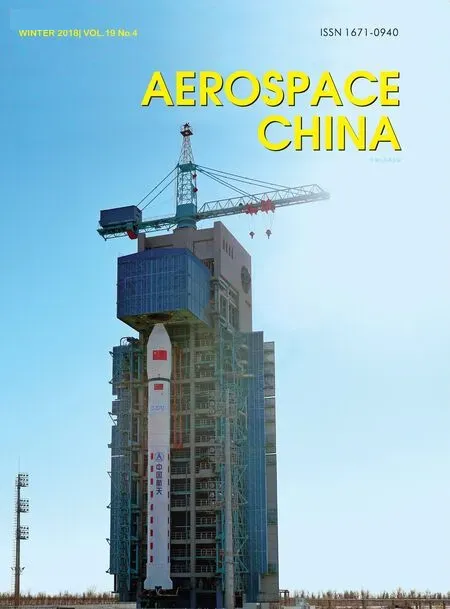
At 07:51 Beijing time on December 22, a LM-11 launch vehicle soared up from the Jiuquan Satellite Launch Center, placing the first satellite of the Hongyun Project into orbit.
Developed by the China Academy of Launch Vehicle Technology, LM-11 is the first solid launch vehicle among the LM launch vehicle family, as well as the only solid carrier rocket of China's new-generation launch vehicles. It features flexible use, continuous and multiple launches with high-density.
Since its maiden flight in September 2015, LM-11 has achieved 5 consecutive successful flights, demonstrating its excellent performance and high reliability.This launch was thefirst time that LM-11 sent payloads into a sun-synchronous orbit of 1000 km.
The preparation period for the LM-11 which carried out this mission was only half a year, greatly enhancing the market response ability and task adaptability,which benefited from measures taken by the LM-11 development team including generalization of flight-control software,a parallel and integrated design of the interface between the spacecraft and the launch vehicle and payload adapter.
In addition, the innovative use of the project contract management mode enabled the complete rocket assembly within one month by only 7 persons and factory acceptance test in 10 days, which demonstrates improved AIT efficiency.
The first satellite of the Hongyun Project, which was developed by China Aerospace Science and Industry Corporation, is thefirst broadband communications technology test satellite for low Earth orbit launched by China.
This mission was the 295th flight of LM launch vehicle family, also the 35th mission of a LM series launch vehicle in 2018. (SUN Zhe/China Space News)

A LM-11 launch vehicle is putting thefirst satellite of the Hongyun Project into orbit Photo: LIU Yu
- Aerospace China的其它文章
- BeiDou System Begins to Serve the World
- A LM-3C Successfully Launches a Communications Technology Test Satellite 3
- LM-3B/Yuanzheng 1 Launches Three BeiDou Satellites into Space
- LM-2D Launched SaudiSat 5A & SaudiSat 5B Successfully
- China Launches 5 Satellites into Orbit Atop A LM-2D
- Long March Rockets Complete 2018 Missions with 37 Record-Setting Launches