
Cap and trade to solve environmental problems
——an analysis of approach in the EU
2018-01-05 03:58:35LiJingjingShanghaiUniversityofInternationalBusinessandEconomics
大陸橋視野 2017年24期
Li Jingjing/ Shanghai University of International Business and Economics
Cap and trade to solve environmental problems
——an analysis of approach in the EU
Li Jingjing/ Shanghai University of International Business and Economics
Environmental problem is a global problem, which has been emphasized by many countries all over the world.To handle the climate change, international community has tried many means.This paper will focus on the approach called “cap and trade”, and analyze its application in the EU—the EU Emissions Trading System (EU ETS).The effectiveness of the EU ETS in different phases will be analyzed in detail, as well as the benefits of the EU ETS comparing with other means of reducing greenhouse gas.It can be found that “cap and trade” is a successful mechanism to reduce the greenhouse gas s and other countries are supposed to learn from the experience of the EU ETS.
Cap and Trade; the EU ETS; Green House Gas
1.Introduction
Environmental problem is a global problem, which has absorbed the attention of countries all over the world.When it comes to environmental problems, the first thing to be mentioned is global warming.The global temperature has risen by about 0.8 degrees centigrade over the past 150 years, and is expected to increase further.The climate change which is mostly caused by the emission of the greenhouse gas (GHG) has become a big challenge for human beings.To handle the climate change,international community has tried various approaches, for example the EU has initiated some policies to cut GHG emissions like improving the energy efficiency, mandating increased use of renewable energy sources and so on.This paper will focus on another approach called “cap and trade”, and study the application of this mechanism in the EU—the EU Emissions Trading System (EU ETS).
So what is “cap and trade”? What is the EU ETS? How did it form and develop? Is it cost-efficient? In this paper, first the definitions of the“cap and trade” and the EU ETS are explained.The second part will analyze the history and development of the EU ETS and the performance of the EU ETS to see whether it is effective.At last the benefits of“cap and trade” will be listed, in comparison with other two means of reducing GHG emissions.
2.The basic concepts
“Cap and trade” mechanism is the foundation of the Kyoto Protocol, which controls greenhouse gas emissions using both macroeconomic policies and market mechanism.It is widely accepted by international community that “cap and trade” plays an important role in reducing GHG emissions.
In the “cap and trade” mechanism, a cap is set on the total amount of certain greenhouse gases that can be emitted by installations.The cap is reduced over time so that total emissions fall.Companies will receive or buy emission allowances within the cap.Companies are supposed to surrender a number of allowances each year to make up for their emissions, or they would be fined heavily.However, if the company emits less and has spare allowances, it can either keep them or to sell them to those who are in need.
The EU Emissions Trading System is a system based on the “cap and trade” mechanism.It is a cornerstone of the EU’s policy to mitigate the climate change and meet the requirements of emissions reductions targets.The EU ETS is the world’s first major carbon market and remains the biggest one, covering more than 11,000 power stations and industrial plants in 31 countries and flights between airports of participating countries.
3.Three phases of the EU ETS and the performances
The EU ETS was first introduced in 2005, and has undergone several changes since then.The implementation of this system has been divided up into three distinct phases over time.
3.1 The first phase
The first phase of the EU ETS ran from 2005 to 2007 and was seen as a pilot phase.This phase was aimed at testing price in the carbon market, establishing the necessary infrastructure for monitoring, reporting and investigating emissions
As for the setting of the cap, in the first phase it was done “from bottom to top” to gain more support from member states.Members set the allowance on their own according to their situation and report it to the EU via National Allocation Plans, and then the plans would be checked and approved by the European Commission.However, because the cap was largely based on estimates as there was no reliable emission data available, the “bottom to up” mechanism will lead to an inevitable problem: many companies set a loose cap for themselves to gain more profits, and finally the number of allowances turns out to be excessive (as a matter of fact, the total amount of allowances distributed exceeded the verified emissions by 2.3 percent), consequently the cap is useless and the price of first-period allowances falls to zero in 2007.
3.2 The second phase
The second phase of the EU ETS ran from 2008 to 2012, the same period as the first commitment period under the Kyoto Protocol.In the second phase, the amount of allowances distributed was reduced by about 6.5%, with the result of 2 percent decline in verified emissions.The verified emissions exceeded the allocated allowances by 2.9 percent so companies were on average short of allowances.Price can reflect the demand for the allowances, as is showed in Illustration 1, the carbon prices become €20 per EUA in 2008.In 2009, due to the crisisinduced demand reduction for allowances, the carbon price fell to about€15.
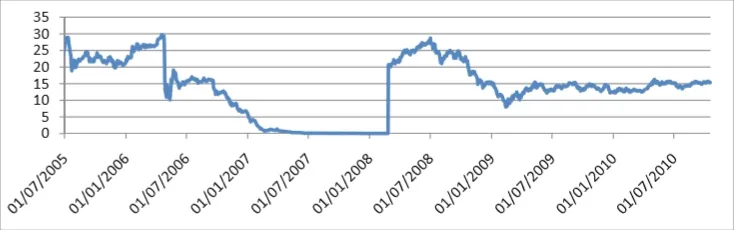
Daily Closing Price EUA spot
3.3 The third phase
The third phase of the EU ETS runs from 2013 to 2020 and was formed by the lessons learnt from the previous two phases.It coincides with the Kyoto Protocol second commitment period.The third phase is significantly different from the first two phases in that a single, EU-wide cap on emissions is implemented instead of national caps.Contrary to the first phase, this is an “up to the bottom” method.
While the EU ETS is not perfect, researches show it does contribute a lot to the reduction in European emissions.Independent analyses have concluded that Phases 1 and 2 of the EU ETS have reduced Europe’s carbon emissions, even as gross domestic product (GDP) has grown.In the phase 3, Emissions from installations in the scheme are falling as intended – by around 5% compared to the beginning of phase 3.
4.Benefits of the “cap and trade”
The EU chose a “cap-and-trade” mechanism as the best approach to achieve the GHG emissions reduction target and developed successfully with a low cost.In comparison with traditional commandand-control approach and carbon tax, the“cap and trade” has its own benefits and features.
Regarding to traditional command-and-control approach, it may set a limited standard per installation, but gives little flexibility to companies as to where or how to reduce emissions.In terms of carbon tax, it does not guarantee that the GHG emissions reduction target will be achieved.Besides, in a multi-national system, an agreement should be reached across all countries on the right price for carbon, which is very difficult to determine.
The benefits of the “cap and trade” consist in its certainty about quantity, cost-effectiveness and stimulation to low-carbon investment.Firstly the cap and trade system directly limits GHG emissions by setting a cap so that it is certain what the maximum quantity of GHG emissions for the period of time is, and this helps to achieve the EU’s environmental objectives.Secondly, the EU ETS has contributed to great reductions in European emissions while the cost has been low —by some estimates, just 0.01% of the EU’s GDP.Thirdly, by capping overall GHG emissions from major sectors of the economy, the EU ETS creates an incentive for companies to invest in technologies that can cut emissions.
5.Conclusion
This paper analyzes the “cap and trade” from different angles and shows clearly how EU uses this approach to solve the environmental problems.“Cap and trade” is a mechanism that controls GHG emissions using both macroeconomic policies and market mechanism,while EU ETS is a system based on “cap and trade” mechanism and is the world’s first and biggest carbon market.Looking back at the history of the EU ETS, there are three distinctive phases: 2005-2007, 2008-2012 and 2013-2020.The first phase is for the purpose of trying, and the second phase is the same period as the first commitment period under the Kyoto Protocol, the third phase learns from the first two phases and has a satisfactory effect.As for the performance of the EU ETS, phase one was judged unsuccessful for the over-allocation of carbon permits, which sent the carbon price plummeting.Phase two reduced emissions successfully for about 2 percent.Phase three is on the right track and its further performance worth to be studying in the future.Last but not least, the “cap and trade” has many distinctive benefits like certainty about quantity,cost- effectiveness and stimulation to low-carbon investment.
It can be concluded that “cap and trade” is a successful mechanism to reduce the GHG emissions and there are lots of things can be learned from the EU ETS.To protect the environment and to mitigate the global warming is everyone’s responsibility.Other countries are supposed to learn from the experience of the EU ETS and contribute to the reduction of GHG emissions in the future.
Bibliography:
[1]European Commission (n.d.): EU ETS Handbook.In:http://ec.europa.eu/clima/publications/docs/ets_handbook_en.pdf
[2]European Commission (n.d.): EU ETS Factsheet.In:http://ec.europa.eu/clima/publications/docs/factsheet_ets_en.pdf
[3]European Environment Agency (2016): Climate change.In:http://www.eea.europa.eu/themes/climate/intro
[4]Hanafi, A.and others (n.d.): The EU Emissions -- Trading System Results and Lessons Learned
[5]Hao H.& Mao J.(2015): The Reform and Inspirations of the EU Carbon Emissions Trading Legal System In: Hao H.et al [eds.]: Journal of ocean university of China.pp.82-87
[6]Hu, N.(2015): Discussion on the Improvement of China’s Legal System of Carbon Emission Trading from the Research on Legal System of EUETS
[7]Lan, H.& Lan, H.(2013): Firm’s Order Strategy Model and Simulation Under Cap-and-Trade System.In: Lan, H.et al.[eds.]:Proceedings of International Conference on Asia Conference on Management Science and Engineering (ACMSE).pp.281-284
[8]Tce the Chemical Engineer (2008): EU reveals phase three ETS details
About the author:Jingjing Li (1996-), female, senior student in Shanghai University of International Business and Economics, majoring in International event management.
