
基于非貴金屬鎳的金屬有機(jī)大環(huán)的光解水放氫性能
2018-01-04 21:15:36李和川李明鳳段春迎
無(wú)機(jī)化學(xué)學(xué)報(bào) 2018年1期
李和川 李明鳳 何 成 段春迎
(大連理工大學(xué)精細(xì)化工重點(diǎn)實(shí)驗(yàn)室,大連 116024)
基于非貴金屬鎳的金屬有機(jī)大環(huán)的光解水放氫性能
李和川 李明鳳 何 成*段春迎
(大連理工大學(xué)精細(xì)化工重點(diǎn)實(shí)驗(yàn)室,大連 116024)
將具有NN(氮氮)雙齒配位點(diǎn)的席夫堿配體L2(L2=1,4-苯二-2′-吡啶腙)與鎳構(gòu)筑得到一例[2+2]型金屬有機(jī)大環(huán)[Ni2(L2)2(CH3CN)4](ClO4)4·4CH3CN(2),并將其用于可見(jiàn)光條件下的光解水產(chǎn)氫研究。該非貴金屬光催化體系由催化劑、光敏劑(熒光素,F(xiàn)l)和電子犧牲劑(三乙胺)三部分組成。相比于具有相同配位環(huán)境的單核配合物[Ni(L1)2(CH3CN)2](ClO4)2(1,L1=3-甲酰基苯-2′-吡啶腙),金屬有機(jī)大環(huán)2作為催化劑具有較高的光催化活性,其產(chǎn)氫TON值可以達(dá)到3 100 molH2·歸因于熒光素分子可能與金屬有機(jī)大環(huán)2形成超分子配合物,提高了光致電子轉(zhuǎn)移效率。
金屬有機(jī)大環(huán);鎳;光催化產(chǎn)氫;超分子
0 Introduction
The splitting of water through artificial photosynthesis (AP)is a key transformation towards the conversion of solar energy into stored chemical potential in the form of fuel[1-2].For water splitting,the reductive side of the reaction involves the light-driven conversion of aqueous protons into H2.Currently,themost prevalent strategy for proton reduction consists of a three component system[3].These systems typically consist of a catalyst,photosensitizer (PS),and a sacrificial electron donor[4-5].Recent studies on noblemetal-based[6-13]and noble-metal-free[14-16]homogeneous systems for light-driven hydrogen production have shown high activity.However,significant problems in the noble-metal-free molecular systems include relatively low catalyst turnover numbers for hydrogen formation.Besides,most of the systems based on organic dyes suffer from a reduction quenching step which produces unstable PS-which reduces the stability of the system[3].With precise organization of the catalytic centers and organic ligands into a metalorganic macrocycle, remarkable performance in hydrogen formation can be realized.In addition,the cavities of macrocycles have a special physical and chemical environment, such as hydrophilic/hydrophobic properties, hydrogen bonding, π-π stacking interaction,electrostatic interaction and so on,which can interact with the photosensitizer forming a supramolecular complex to enhance the electron and energy transfer efficiency[17].
In 1922,Paul Sabatier reviewed the state of the art of catalysis in organic chemistry and highlighted the specific behavior of nickel catalysts[18].Nickel,as an earth-abundant and relatively low-cost material,may be a worthwhile basis for proton reduction catalysts.DuBois and co-workers have also shown that mononuclear nickelギ-bis(diphosphine)complexes are effective catalysts for electrochemical hydrogen generation.While photocatalytic hydrogen generation from the nickel-phosphine complexes is long-lived,the activity of the photocatalytic system with the nickel phosphine catalyst is low,with a turnover frequency(TOF)of approximately 20 equivalents of H2per hour[19-21].

Scheme 1 Structures of ligands L1 and L2
1 Experimental
1.1 Materials and physical measurements
All chemicals were of reagent grade quality obtained from commercial sources and used without further purification.The elemental analyses of C,H and N were performed on a Vario ELⅢelemental analyzer.1H NMR spectra were measured on a Varian INOVA 400M spectrometer.ESI mass spectra were carried out on a HPLC-Q-Tof MS spectrometer.The fluorescent spectra were measured on a JASCO FP-6500.
Cyclic voltammetry measurements:Electrochemical measurements of catalysts 1 and 2 were performed in CH3OH solutions with 0.1 mol·L-1TBAPF6working on ZAHNER ENNIUM Electrochemical Workstation with a homemade Ag/AgCl electrode as a reference electrode,a platinum silk with 0.5 mm diameter as a counter electrode,and glassy carbon electrode as a working electrode.The addition of p-toluenesulfonic acid (0.1 mol·L-1in CH3OH)was carried out with syringe.
Fluorescence quenching experiments:A solution(2.0 mL)of Fl at 10 μmol·L-1concentration in a CH3OH/H2O solution (1∶1,V/V,pH=11.5)was prepared in a quartz cuvette fitted with a septum cap,and the solution was degassed under N2for 15 min.Aliquots of 20 μL of the catalysts were added,and the intensity of the fluorescence was monitored by steady state fluorescence exciting at 460 nm on a Spex fluoromax-P fluorimeter with a photomultiplier tube detector.
Photocatalytic proton reduction experiments:Photoinduced hydrogen evolution was made in a 15 mL flask.Varying amounts of the catalysts 1 and 2,Fl and NEt3in CH3OH/H2O (1∶1,V/V)were added to obtain a total volume of 5.0 mL.The flask was sealed with a septum and degassed by bubbling argon for 15 min.The pH of this solution was adjusted to a specific pH by adding HCl or NaOH and measured with a pH meter.After that,the samples were irradiated by a 500 W Xenon lamp with the 400nm light filter,and the reaction temperature was maintained at 293 K by using a thermostat water bath.The generated photoproduct of H2was characterized by GC 7890T instrument analysis using a 5A molecular sieve column(0.6 m×3 mm),thermal conductivity detector,and argon used as carrier gas.The amount of hydrogen generated was determined by the external standard method.
1.2 Syntheses of L1 and L2
The ligand L1 was synthesized by refluxing a methanol solution (40 mL)containing of m-phthalaldehyde(6 mmol,0.8 g)and 2-hydrazinopyridine(6 mmol,0.65 g)for 8 h.Yield:72%.Anal.Calcd.for C13H11N3O(%):H,4.92;C,69.32;N,18.66.Found(%):H,4.96;C,69.10;N,18.74.1H NMR(DMSO-d6,400 MHz):δ 10.93(s,1H),10.02(s,1H),8.03(d,2H),8.01(s,1H),7.90(s,1H),7.62(t,2H),7.39(t,1H),7.23(d,1H),6.73(t,1H).
The synthesis of L2 was similar to that described for L1 with the corresponding terephthalaldehyde(3 mmol,0.4 g).Yield:70%.Anal.Calcd.for C18H16N6(%):H,5.10;C,68.34;N,26.56.Found(%):H,5.16;C,68.44;N,26.71.1H NMR (DMSO-d6,400 MHz):δ 10.93(s,2H),8.12(d,2H),8.03(s,2H),7.68(s,4H),7.65(t,2H),7.27(d,2H),6.78(t,2H).
1.3 Syntheses of complexes 1 and 2
The ligand L1(0.2 mmol,0.045 g)and Ni(ClO4)2·6H2O (0.1 mmol,0.037 g)were dissolved in 20 mL acetonitrile.The solution was refluxed for 4 h,and then slowly evaporated at room temperature.The brown block crystals (complex 1)were obtained in several days.Yield:45%.ESI-MS m/z:[2L1+Ni]2+,254.060 7;[2L1+Ni+ClO4]+,607.072 5.Anal.Calcd.for NiC30H28Cl2N8O10(%):H,3.57;C,45.60;N,14.18.Found(%):H,3.60;C,45.56;N,14.24.
The synthesis of complex 2 was similar to that described for 1 with the ligand L2(0.1 mmol,0.032 g)and Ni(ClO4)2·6H2O(0.1 mmol,0.037 g).After several days,yellow block crystals were obtained.Yield:55%.ESI-MS m/z:[2L2+2Ni+ClO4-H]2+,423.839 4;[2L2+2Ni+2ClO4]2+,473.800 4;[2L2+2Ni+2ClO4-H]+,946.611 5;[2L2+2Ni+3ClO4]+,1 046.495 1.Anal.Calcd.for Ni2C52H56Cl4N20O16(%):H,3.82;C,42.31;N,18.98.Found(%):H,3.87;C,42.26;N,19.02.
1.4 X-ray crystallography
The data were collected on a Bruker Smart APEXⅡX-diffractometer equipped with graphite monochromated Mo Kα radiation(λ=0.071 073 nm)using the SMART and SAINT[22]programs at 296 K for complexes 1 and 2.Final unit cell parameters were based on all observed reflections from integration of all frame data.The structures were solved in the space group by direct method and refined by the fullmatrix least-squares using SHELXTL-97 fitting on F2[23].The crystal data and details of the structure refinement of complexes 1 and 2 are summarized in Table 1.
CCDC:1576598,1;1576599,2.
2 Results and discussion
2.1 Crystal structural description
Single-crystal structure representations for the complexes 1 and 2 are shown in Fig.1.In the crystal structure of complex 1,the nickel coordination sphere is a distorted octahedron,consisting of two N atoms from 2-pyridinylhydrazone group of one Schiff base ligand L1,two N atoms from another ligand L1 and two N atoms from two acetonitrile molecules coordinated to the nickel.Similar to the complex 1,in the crystal of complex 2,each of the two metal centers was octahedrally coordinated by two N atoms from two acetonitrile molecules and four N atoms that equally originated from one arm of the two ligands L2,respectively.As a result,the metal-organic macrocycle 2 was constructed by two ligands and two Niギ.In addition,these Niギcenters feature an octahedral configuration thatallowsthe production offree coordination sitesby release ofthe acetonitrile molecules oriented outside of the metal-organic macrocycle.Moreover,the coordinated acetonitrile molecules were easily removed based on the configuration of 2,producing the open sites of nickel for photosensitizer molecules.As a result,the photogenerated electron would be migrated from the photosensitizer to the catalyst during the photoreduction process,which was beneficial to achieving high activity in the catalytic system[24].

Table1 Crystal data and structure refinements for complexes 1 and 2

Fig.1 Single-crystal structures of 1(a)and 2(b)
2.2 Cyclic voltammetry of the complexes
The cyclic voltammetry shows that the reduction potentials of Niギ/Niガ and Niガ/Ni occur at-0.586 and-1.08 V (vs Ag/AgCl)respectively for 1(Fig.2a).And the complex 2 exhibits the reduction processes of Niギ/Niガ and Niガ/Ni at-0.595 and-1.28 V(vs Ag/AgCl),respectively(Fig.2b).In addtion,both the Niギ/Niガ potential for complexes 1 and 2 fall well within the range of that of proton reduction in aqueous media[25].To investigate the role of the Ni complex as a proton reduction catalyst,cyclic voltammetry was performed in the presence of increasing amounts of ptoluenesulfonic acid.Addition of enough p-toluenesulfonic acid triggers the appearance of a new irreversible cathodic wave near the Niギ/Niガ response[26-27].Increasing the concentration of p-toluenesulfonic acid raises the height of the new wave and shifts it to more negative potentials,indicating that complexes 1 and 2 are able to reduce protons through a catalysis process.
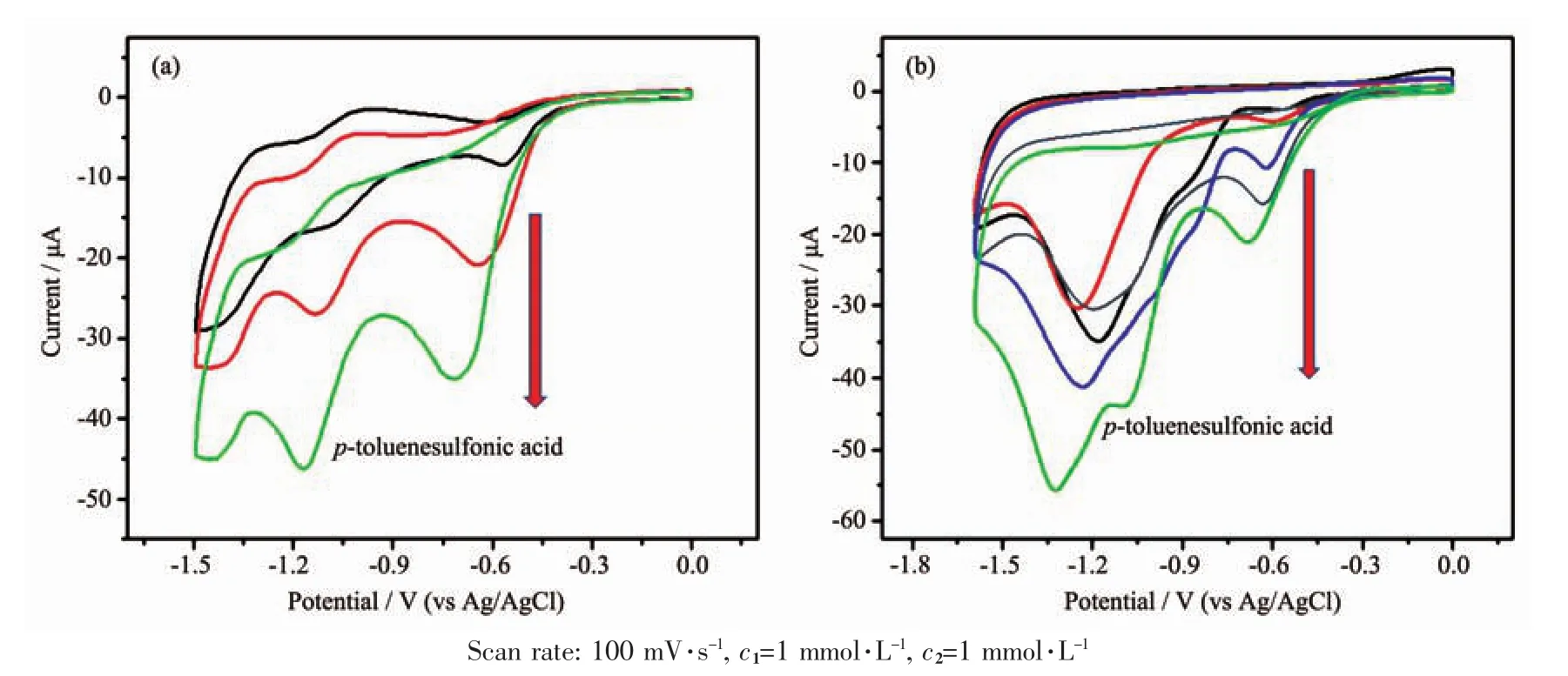
Fig.2 Cyclic Voltammogram of 1(a)and 2(b)in CH3OH with 0.1 mol·L-1TBAPF6upon addition of p-toluenesulfonic acid with different concentrations

Fig.3 Emission spectra of fluorescein solutionin CH3OH/H2O solution upon addition of catalysts 1(a)and 2(b)with various concentration
2.3 Complexes 1 and 2 as quenchers for the photosensitizer Fl
Complexes 1 and 2 can also serve as efficient quenchers for the photosensitizer fluorescein.The Stern-Volmer quenching constant Ksv1in this system was calculated as 3.217×10³L·mol-1upon the addition of 1 into Fl solution in CH3OH/H2O (1∶1,V/V)as shown in Fig.3a.The quenching behavior can be considered as a photoinduced electron transfer process from excited state of Fl to 1,providing possibilities for Fl to activate complex 1 for the production of H2in solution.The Ksv1for the catalyst 1 was higher than the Ksv3reported for NEt3(0.44 L·mol-1).When the concentration of NEt3was 0.576 mol·L-1(8%,V/V,the same below)and the concentration of catalyst 1 was 20 μmol·L-1in the actual photocatalytic reactions,the Ksv3cNEt3(0.25)is much higher than the Ksv1c1(0.06).Hence,a photoinduced electron transfer from the NEt3to Fl*,with the unstable Fl-is produced(reductive quenching),dominated the homogeneous photolysis of the reaction mixture instead of direct quenching by 1.The Stern-Volmer quenching constant Ksv2of 2(1.592×10⁵L·mol-1)is almost 50 times that of complex 1(Fig.3b).When the concentration of NEt3was 0.576 mol·L-1(8%)and the concentration of catalyst 2 was 20 μmol·L-1under photocatalytic conditions,the Ksv1c2(3.2)is much higher than the Ksv3cNEt3(0.25).Hence,the quenching of the excited state of Fl by the catalyst 2 is largely dominated by the oxidative quenching.The initial photochemical step is the formation of Fl+through oxidative quenching by complex 2[28-29].It indicates that the metal-organic macrocycle 2 with a specific electronic transport pathway may be in favor of stabilizing the photosensitizer Fl compared with the mononuclear complex 1.

Fig.4 ESI-MS spectra of 2 in the absence(a)and presence(b)of Fl(1 equiv.)in CH3OH
2.4 Supramolecular complex formation between Fl and the macrocycle 2
Despite the cavity size of metal-organic macrocycle 2 being too small to encapsulate fluorescein molecules,the coordinated acetonitrile molecules were easily removed based on the configuration of 2,which might produce open sites of nickel for photosensitizer molecules.To explore this hypothesis further,the1H NMR spectrum and ESI-MS spectrum of metal-organic macrocycle 2 in the presence of fluorescein were analyzed.The ESI-MS spectrum of 2 in CH3OH exhibits a series of peaks at m/z=423.839 4,473.800 4,946.611 5 and 1 046.495 1 which are assigned to the[2L2+2Ni+ClO4-H]2+,[2L2+2Ni+2ClO4]2+,[2L2+2Ni+2ClO4-H]+,[2L2+2Ni+3ClO4]+respectively,suggesting the formation and stability ofthe metal-organic macrocycle 2 in solution(Fig.4a).When an equimolar amount of Fl was added into the solution of 2,two new intense peaks at m/z=590.192 1,706.262 9 were observed (Fig.4b).A simple comparison with the simulation results based on natural isotopic abundances suggests that the peaks can be assigned to[2L2+2Ni+ClO4+Fl-H]2+and [2L2+2Ni+ClO4+2Fl-H]2+,respectively.This result implies the formation of a 2∶1 supramolecular adduct 2Fl·2 in solution[30-31].The1H NMR spectrum of 2 in the presence of Fl shows significant downfield shifts of the signals associated with protons H1,H1′nearby the Niギ (δ=0.15)which suggested that the coordinated acetonitrile molecules were easily released for metal-organic macrocycle 2,producing the free coordination sites of Niギcenters for fluorescein molecules (Fig.5).Fl molecules are capable of coordinating to the Niギof macrocycle 2 and the Niギof mononuclear complex 1 is hardly coordinated with Flon accountoflarge steric hindrance,which well explains that the Stern-Volmer quenching constant of 2(Ksv2=1.592×10⁵L·mol-1)is almost 50 times that of complex 1(Ksv1=3.217×10³L·mol-1).Hence,macrocycle 2 could potentially be used for the construction of photocatalytic systems.

Fig.5 1H NMR spectra of 2(a),Fl(b)and 2 in the presence of Fl(c)
2.5 Catalytic behavior of the complex 2 in H2 evolution
Proton reduction catalytic activity of complex 2 was evaluated with Fl as a photosensitizer (PS)and irradiation with visible light(λ>400 nm)in a CH3OH/H2O solvent mixture (1∶1,V/V)containing NEt3at 25℃.The volume of H2was quantified at the end of the photolysis by gas chromatographic analysis[32-33].The optimum pH valueofthereaction mixturewas maintained at 11.5,decreasing or increasing the pH value both resulted in a lower initial rate and shorter system lifetime for hydrogen evolution (Fig.6a).The decrease of the efficiency at higher pH values is likely due to the lower concentration of proton in solution[34].It was found out that the optimal concentration of NEt3is 8% when fixing the pH of the system at the optimum value of 11.5 (Fig.6b).Furthermore,control experiments of the system with the absence of any one species of catalyst 2,Fl or NEt3hardly yielded any observable amount of hydrogen,demonstrating that all ofthree speciesare essentialforthe hydrogen generation.This artificial photosynthetic system does not work well in the absence of the light either.
When the concentrations of Fl(3 mmol·L-1)and NEt3(8%)were fixed,the volume of the hydrogen produced exhibited a linear relationship with the concentration of catalyst 2 in the range from 5 to 20 μmol·L-1(Fig.6c).When the concentration of catalyst 2 was at 5 μmol·L-1,the system exhibited a high activity for a noble-metal-free system[14-16,19-21,35],achieving a turnover number of 3 100 molH2·even after 30 h.At higher catalyst concentrations,even though a larger amount of H2is evolved,the TON does not scale linearly with catalyst concentration because of the limited lifetime of the system.In addition,when catalyst 2(20 μmol·L-1)was replaced by the mononuclear complex 1(40 μmol·L-1)which contains the same concentration of nickel ions in the same system consisting of Fl(3 mmol·L-1),NEt3(8%),approximately only one third of hydrogen quantity of catalyst 2 was acquired (Fig.6d).The enhanced efficiency of the catalyst 2 is likely ascribed to the formation of supramolecular complex between fluorescein and the macrocycle which is beneficial to transfer electrons from the excited state of Fl to 2.
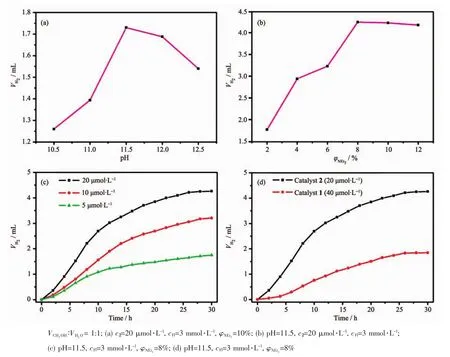
Fig.6 Initial rates of H2production in CH3OH/H2O of systems containing 2,Fl and NEt3with different pH values(a)and systems containing 2,Fl at pH 11.5 with different concentrations of NEt3(b);Photocatalytic hydrogen evolution of the systems containing Fl,NEt3with the concentration of 2(c)and systems containing NEt3,Fl in CH3OH/H2O upon addition with catalyst 1 or 2(d)
3 Conclusions
In summary,a new strategy for constructing artificial photocatalytic systems to generate hydrogen from water by combining an organic photosensitizer with a redox active metal-organic macrocycle 2 was reported.Because fluorescein molecules are able to coordinate to the Niギof complex 2,the photosensitizer and catalyst were forced close together,promoting the oxidative quenching of Fl by 2 when compared to the mononuclear complex 1.This work may contribute toabrightfutureofsupramolecularsystemsin hydrogen evolution.
[1]Lewis N S,Nocera D G.Proc.Natl.Acad.Sci.USA,2006,103:15729-15735
[2]Eisenberg R.Science,2009,324:44-45
[3]Han Z J,McNamara W R,Eum M S,et al.Angew.Chem.,Int.Ed.,2012,51:1667-1670
[4]Bard A J,Fox M A.Acc.Chem.Res.,1995,28:141-145
[5]Esswein A J,Nocera D G.Chem.Rev.,2007,107:4022-4047
[6]Cline E D,Adamson S E,Bernhard S.Inorg.Chem.,2008,47:10378-10388
[7]Fihri A,Artero V,Razavet M.Angew.Chem.,Int.Ed.,2008,47:564-567
[8]Du P W,Knowles K,Eisenberg R.J.Am.Chem.Soc.,2008,130:12576-12577
[9]Curtin P N,Tinker L L,Burgess C M,et al.Inorg.Chem.,2009,48:10498-10506
[10]Probst B,Rodenberg A,Guttentag M,et al.Inorg.Chem.,2010,49:6453-6460
[11]Streich D,Astuti Y,Orlandi M,et al.Chem.Eur.J.,2010,16:60-63
[12]White T A,Whitaker B N,Brewer K J.J.Am.Chem.Soc.,2011,133:15332-15334
[13]McNamara W R,Han Z J,Alperin P J,et al.J.Am.Chem.Soc.,2011,133:15368-15371
[14]Lazarides T,McCormick T,Du P W,et al.J.Am.Chem.Soc.,2009,131:9192-9194
[15]McCormick T M,Calitree B D,Orchard A,et al.J.Am.Chem.Soc.,2010,132:15480-15483
[16]Zhang P,Wang M,Dong J F,et al.J.Phys.Chem.C,2010,114:15868-15874
[17]Jing X,He C,Yang L L,et al.J.Am.Chem.Soc.,2015,137:3967-3974
[18]Ananikov V P.ACS Catal.,2015,5:1964-1971
[19]DuBois M R,DuBois D L.Chem.Soc.Rev.,2009,38:62-72
[20]DuBois M R,DuBois D L.Acc.Chem.Res.,2009,42:1974-1982
[21]Helm M L,Stewart M P,Bullock R M,et al.Science,2011,333:863-866
[22]SMART,SAINT and XPREP,Bruker Analytical Instruments Inc.,Madison,WI,1995.
[23]Sheldrick G M.SHELXS-97,Program for X-ray Crystal Structure Solution and Refinement,University of G?ttingen,Germany,1997.
[24]Stewart M P,Ho M H,Wiese S,et al.J.Am.Chem.Soc.,2013,135:6033-6046
[25]Artero V,Chavarot-Kerlidou M,Fontecave M.Angew.Chem.,Int.Ed.,2011,50:7238-7266
[26]Razavet M,Artero V,Fontecave M.Inorg.Chem.,2005,44:4786-4795
[27]Kasunadasa H I,Chang C J,Long J R.Nature,2010,464:1329-1333
[28]Zhang P,Wang M,Dong J,et al.J.Phys.Chem.C,2010,114:15868-15874
[29]Li L,Duan L L,Wen F Y,et al.Chem.Commun.,2012,48:988-990
[30]Yu H,He C,Jing X,et al.Inorg.Chem.Front.,2016,3:1256-1263
[31]Yang L L,Jing X,He C,et al.Chem.Eur.J.,2016,22:18107-18114
[32]Lazarides T,McCormick T,Du P W,et al.J.Am.Chem.Soc.,2009,131:9192-9194
[33]Zhang P,Wang M,Na Y,et al.Dalton Trans.,2010,39:1204-1206
[34]McNamara W R,Han Z,Alperin P J,et al.J.Am.Chem.Soc.,2011,133:15368-15371
[35]YANG Lin-Lin(楊 林 林), JING Xu(景旭),HE Cheng(何成),et al.Chinese J.Inorg.Chem.(無(wú)機(jī)化學(xué)學(xué)報(bào)),2017,33(6):913-922
Construction of a Noble-Metal-Free Nickel Metal-Organic Macrocycle for Photocatalytic Hydrogen Production
LI He-Chuan LI Ming-Feng HE Cheng*DUAN Chun-Ying
(State Key Laboratory of Fine Chemicals,Dalian University of Technology,Dalian,Liaoning 116024,China)
A nickel based metal-organic macrocycle[Ni2(L2)2(CH3CN)4](ClO4)4·4CH3CN(2)constructed from bidentate Schiff base ligand L2(L2=1,4-benzenedicarboxaldehyde-bis(2′-pyridinylhydrazone))with multiple N atoms was utilized to produce hydrogen through splitting of water by visible light(λ>400 nm).This noble-metalfree photocatalytic system consists of a catalyst,photosensitizer (fluorescein,Fl)and sacrificial electron donor(Triethylamine,NEt3).Using the metal-organic macrocycle 2 as a proton reduction catalyst,the activity of the photocatalytic system is high,with a turnover number(TON)of approximately 3 100 molH2·molcat-1.In contrast to the metal-organic macrocycle 2,a mononuclear complex[Ni(L1)2(CH3CN)2](ClO4)2(1,L1=3-formyl benzaldehyde-2′-pyridylhydrazone)with similar coordination environment has a low efficiency on producing hydrogen.The enhanced efficiency of the catalyst 2 is likely ascribed to the formation of supramolecular complex between fluorescein and the macrocycle which enhances the efficiency of photoinduced electron transfer.CCDC:1576598,1;1576599,2.
metal-organic macrocycle;nickel;light driven H2production;supramolecular
considerable attention as chelating ligands for transition metal catalysts.In this article,a new metal-organic macrocycle[Ni2(L2)2(CH3CN)4](ClO4)4·4CH3CN(2)was constructed using the ligand L2(L2=1,4-benzenedicarboxaldehyde-bis(2′-pyridinylhydrazone))consisting of multiple N atoms and nickel ions(Scheme 1).Because the Niギof macrocycle 2 can be coordinated with the fluorescein (Fl)molecules to form supramolecular complex,the photocatalytic activity of catalyst 2 was higher than that of[Ni(L1)2(CH3CN)2](ClO4)2(1,L1=3-formylbenzaldehyde-2′-pyridylhydrazone)under similar reaction conditions.And the metal-organic macrocycle 2 significantly improves the stability of the catalytic system.
O614.81+3
A
1001-4861(2018)01-0011-09
10.11862/CJIC.2018.017
2017-09-28。收修改稿日期:2017-10-18。國(guó)家自然科學(xué)基金(No.21531001)資助項(xiàng)目。
*通信聯(lián)系人。 E-mail:hecheng@dlut.edu.cn
 無(wú)機(jī)化學(xué)學(xué)報(bào)2018年1期
- 無(wú)機(jī)化學(xué)學(xué)報(bào)的其它文章
- SnS2/GCP(石墨烯復(fù)合粉末)微米復(fù)合材料作為鋰離子電池負(fù)極材料的電化學(xué)性能
- Bi2 WO6量子點(diǎn)(QDs)修飾Bi2MoO6-xF2x異質(zhì)結(jié)的構(gòu)筑及其催化活性增強(qiáng)機(jī)理
- 手性化合物[Co(L/D-thr)3]·4.5H2O的合成、結(jié)構(gòu)以及圓二色性
- 基于半剛性二羧酸配體的兩個(gè)三維鎘ギ配位聚合物
- 表面化學(xué)侵蝕改性富鋰層狀正極材料Li[Li0.2Mn0.54Ni0.13Co0.13]O2
- 異構(gòu)多羧酸配體的兩種Znギ配位聚合物的水熱合成和表征