
Buddhas with Double Faces (I)
2018-01-04 16:53:32By
英語世界 2017年10期
關鍵詞:印度
By
Buddhas with Double Faces (I)
ByWilliam Empson1
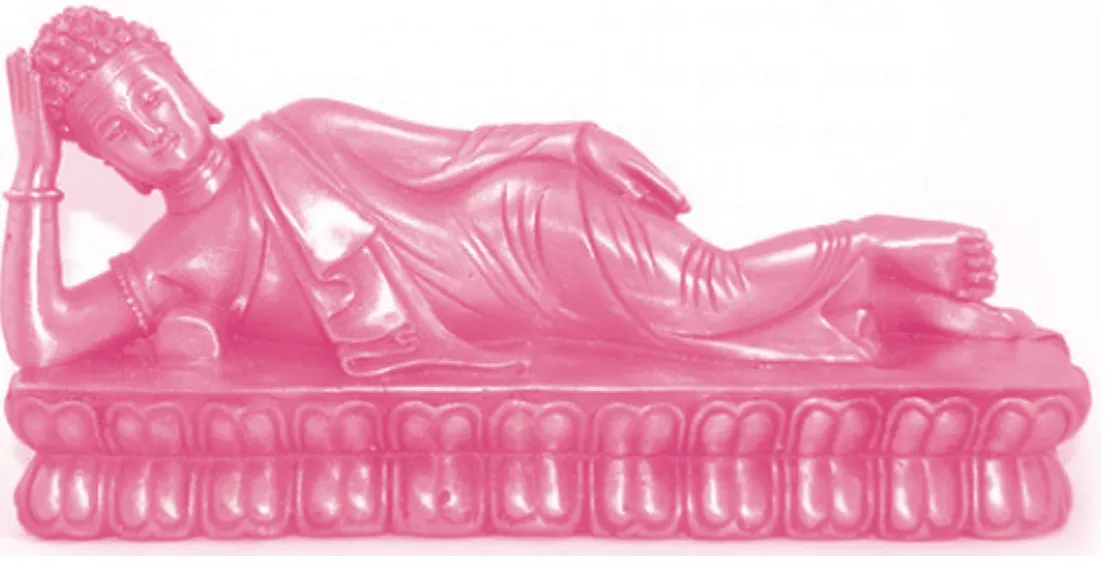
People tend to think of ‘a Buddha’as a standard object, to think of the heads as all alike and practically without expression. This is roughly true about the work of later periods in all countries which adopted Buddhism, but the earlier ones vary a great deal. I want in this article to describe an asymmetrical technique, a rule for making the two sides of the faces different, which I think was used in the Far East from about the fifth to the tenth centuries AD. However, before enlarging on the variety of these heads one should of course recognise that there is a Buddha type, in its way a rigid one, and that the different heads are keeping the rules.
[2] It is perhaps the simplest expression of high divinity that the human race has devised. In a way, Europe has agreed on the face of Christ, but you have to be a trained artist to draw it.The Lotus Sutra,written probably in the fi rst century AD,says that even boys in their play who draw the Blessed One with their fingernails are acquiring merit and becoming pitiful in heart. The boys would really be able to draw a Buddha with their fingernails;even the crudest use of the formula gives him his effect of eternity. It is done by the high eyebrow, soaring outwards; by the long slit eye, almost shut in meditation,which would be a frighteningly large eye if opened; and by a suggestion of the calm of childhood in the smooth lines of the mature face—a certain puppy quality in the long ear often helps to bring this out. If you get these they carry the main thought of the religion; for one thing the face is at once blind and all-seeing (‘He knows no more than a Buddha’ they say of a deceived husband in the Far East) so at once suf fi cient to itself and of universal charity.
[3] Representations of the Buddha himself seem to have been forbidden in India till the first century AD, and the earliest ones were probably made by foreign converts in Gandhara, part of the modern Afghanistan, along the trade route to Europe and China. These draw on Greek conventions for the face and drapery, but give the Buddha his distinctively Indian marks such as the spot between the brows(over the pineal gland; perhaps originally a caste-mark) and the cross-legged position with the soles of both feet lying upwards. He has already the nob on the top of his head, which may have been the formalisation of a hairdressing fashion,but is listed early as a sacred deformity.He has wavy but not tightly curled hair,and a half-closed eye, but the early examples have not got the high eyebrow.
[4] At almost the same date, statues of the Buddha appear at Mathura in India,drawing not on the Greek tradition but on an Indian tradition for local pagan deities (the fi rst statues of the main Hindu deities seem to have been made about the same time). These give him much more of the vigour of an evangelist; he has a wide open eye and a high eyebrow, as if beaming out his radiance to the world. As a rule only the hairline is marked on an apparently bald head (monks shaved their heads) but he sometimes has a sort of twisted cap. The earth-god tradition gives him a strong physique and a swelling chest. In fact, the ‘mysticism of the East’ as shown by the slim body and the halfshut eyes, seems to have been put in by the Greek artisans not by the Indians.
[5] Then by the Gupta period in India, from the fourth century, these two traditions have been fully combined, and the Buddha has the high eyebrow and the slit eye. They combine so perfectly that it is hard to believe they developed apart.All the details are now firmly stylised;for instance the ear has become longer.The idea that the Buddha when a prince wore very grand jewels in his ears which dragged down the lobe, but since his renunciation there is only the long ear to show it. In the same way the Greek wavy hair has become tight curls which look like snail-shells and are actually said to be snailshells. As a monk he should have shaved his hair, but he was partly thought of as a prince; it was settled therefore that the shade of the sacred Bo-tree moved away from him while he was plunged in meditation, and a crowd of devout snails came clustering onto his head to keep him from sunstroke.The Gupta Buddhas are magnificent creatures but withdrawn from the world to the point of deadness, except for some youthful ones which are touching but rather feminine.
人們傾向于認為“佛像”是一種標準件,認為所有的佛首都是一個模樣,基本沒有什么表情。在所有接受佛教的國家中,后期的佛像大體如此,但是早期的佛像變化很大,不能一概而論。在本文中,我打算描述一種佛造像的非對稱技術,也就是一種讓佛像左右兩邊的面容有所不同的做法。在遠東,這種技術運用于公元5至10世紀。不過,在詳細說明這些佛首的不同樣式之前,我們當然應該知道,佛像是具有一定樣式的,而且是嚴格的樣式,那些形態不同的佛首也是有法可依的。
[2]佛像也許是人類對于高超神性的至簡表達。歐洲人對于基督的面容已經達成了某種程度的一致認識,但是如果要描畫基督的面容,非得是訓練有素的藝術家不可。大約成書于公元1世紀的《妙法蓮華經》這么寫道:“乃至童子戲,若草木及筆,或以指爪甲,而畫作佛像,如是諸人等,漸漸積功德,具足大悲心,皆已成佛道。”佛的臉上,眉彎高聳,向外舒展;因處禪定之中,修長的雙目幾乎完全合上,這樣的眼睛如果睜開,一定大得嚇人;佛臉成熟而輪廓柔滑,略帶孩童似的寧靜,柔長的耳廓線常使這種寧靜更顯突出。如果你描繪的佛像有這些特征,就可以說具備了佛教的本旨;比如,佛眼既無所見,也無所不見(在遠東,如果丈夫遭到妻子的背叛,人們就說他“所知超不過佛”),因此既圓滿具足,也無限慈悲。
[3]在印度,直到公元1世紀以前,為佛造像似乎都是被禁止的。最早的佛像大概出自遠在犍陀羅(今阿富汗境內絲綢之路沿線)的異國皈依者。這些佛像在臉型和衣褶處理方面體現出希臘藝術的特點,但是仍然保留著鮮明的印度特色,比如眉間的點(在松果腺之上,原先也許是種姓的標志)、雙腳腳心向上盤腿而坐的姿勢。佛的頭頂已經出現發髻,也許當時的流行發型就固定為這個樣子,但被視為早期化凡為圣的一種變形。佛的頭發如波浪起伏,但還沒有形成緊密的卷狀,眼睛半睜半閉,還沒有高聳的眉彎。
[4]幾乎在同一時期,印度的馬圖拉也出現了佛像,不是希臘傳統的樣式,而是印度本土異教神祇的樣式(印度教主要神祇的早期造像也大約出現于同一時期)。此時的佛像具有福音傳道士般的活力,雙眼睜開,眉彎高聳,似乎在向大千世界放射他的光芒。一般來說,明顯光禿的佛頂上只有發際線(出家人要剃光頭發),不過有時也戴一頂翹邊的帽子。依照印度土地神的形象,佛像體格壯碩,胸膛隆起。實際上,以苗條的體形和半閉的眼睛為特征的所謂“東方神秘造像”,似乎出自希臘工匠之手,而非印度人。
[5]到公元4世紀開始的笈多王朝時期,兩種造像傳統已完全融合,佛像于是有了高聳的眉彎和半閉成縫的眼睛。這種融合如此完美,幾乎讓人難以相信這些特征來自不同的源頭。到這時,佛像的所有細節都形成了確定的樣式,比如說,耳朵變得更長了。傳說佛陀在當王子的時候,耳朵上綴著奇珍異寶,以至于拉長了耳垂,但既然出家了,就只能用長長的耳朵來表現這一點了。同樣,希臘人波浪狀的頭發在佛首上成為緊密的卷發,好似一個個蝸牛殼,而被稱為“蝸髻”。作為出家人,佛陀應該剃光頭發,不過人們在某種程度上仍然把他當作王子。比較肯定的說法是,他在菩提樹下深入禪定的時候,有時樹蔭移走,沒有了遮蔽,一群虔誠的蝸牛爬上他的頭頂,聚集在那里為他遮擋毒辣的陽光。笈多時期的佛像看起來富貴堂皇,不過消極遁世,形同死寂;只有幾座看似年輕的佛像面容動人但頗顯陰柔
雙面佛像(上)
文/燕卜蓀譯/彭發勝
1(1906—1984),英國著名文論家,詩人。在劍橋大學讀書期間寫出《朦朧的七種類型》而一舉成名。曾在日本教授英國文學。1937年來到中國,先后在北京大學和昆明西南聯大任教,講授英國文學,對于當時中國文學的現代主義運動影響深遠。1939年返英,在英國廣播公司任職。1947年重來北京大學任教,至1952年回國。此后在謝菲爾德大學任教,直至去世。燕卜蓀在遠東期間,對佛教造像藝術產生濃厚興趣,不斷收集資料并拍攝大量照片,回國后寫成書稿《佛的面容》(The Face of the Buddha),后因種種變故,書稿遺失,令他抱憾終生。2005年,此書手稿在大英圖書館奇跡般重現,經整理后于2016年由牛津大學出版。
猜你喜歡
中外文摘(2021年23期)2021-12-29 03:54:04
英語文摘(2021年7期)2021-08-14 02:36:28
幼兒100(2021年8期)2021-04-10 05:39:44
數學大王·趣味邏輯(2020年10期)2020-10-20 06:20:01
中國化肥信息(2018年4期)2018-08-23 09:11:18
中外文摘(2017年21期)2017-11-02 01:50:04
華人時刊(2017年19期)2017-02-03 02:51:37
青年文學(2015年1期)2015-10-24 03:27:18
海峽姐妹(2015年5期)2015-02-27 15:11:02
環球時報(2015-01-21)2015-01-21 01:38:52
