
甲殼類年齡鑒定方法研究進展
2017-09-04 01:28:58劉必林陳新軍倪震宇林靜遠
海洋漁業 2017年4期
蔣 瑞,劉必林,2,3,4,張 健,2,3,4,陳新軍,2,3,4,倪震宇,林靜遠
·綜述·
甲殼類年齡鑒定方法研究進展
蔣 瑞1,劉必林1,2,3,4,張 健1,2,3,4,陳新軍1,2,3,4,倪震宇1,林靜遠1
(1.上海海洋大學海洋科學學院,上海 201306;2.國家遠洋漁業工程技術研究中心,上海 201306;3.大洋漁業資源可持續開發省部共建教育部重點實驗室,上海 201306;4.遠洋漁業協同創新中心,上海 201306)
甲殼類特有的蛻殼現象,使其能夠記錄年齡信息的外骨骼周期性消失,因此甲殼類的年齡鑒定一直未得到較好的解決。年齡鑒定是評估甲殼類漁業資源的基礎,鑒定甲殼類年齡的方法主要有飼養法、標記重捕法、體長頻度法、脂褐素分析法、放射性同位素分析法和硬組織生長紋分析法。飼養法、標記重捕法和放射性同位素分析法較準確,然而由飼養法得到的數據不適用于實際野生環境,放射性同位素分析法花費較高,因此,這兩種方法都存在較大的局限性。應用最廣泛的標記重捕法和體長頻度法也存在不足之處。相對于體長頻度鑒齡技術而言,脂褐素分析法優勢明顯,但是對勞動強度和技術要求高。硬組織生長紋分析法是最近幾年出現的鑒齡技術,也存在人為主觀性較強等不足。本文對甲殼類年齡鑒定的方法進行了總結回顧,將不同鑒定方法進行比較,分析優缺點,以期為開展甲殼類資源評估與管理提供基礎。
甲殼類;年齡與生長;年齡鑒定方法
甲殼類動物種類多、數量大,是漁業資源的重要組成部分[1],廣泛分布于世界各大洋和南、北極等海域。年齡是研究水生動物生活史的必要組成部分[2],也是漁業種群動態模型及漁業資源評估中非常重要的參數之一。大多數水生動物能夠通過計數硬組織中的生長紋來鑒定年齡,例如魚類耳石[3-5]、鰭條[6-8]和脊椎骨[9-10],頭足類耳石[11-12]、角質顎[13-14]和內殼[15-16]等。然而,甲殼類動物是脫殼式生長,每次脫殼時原先的硬殼被新殼替代,使其鈣化結構周期性消失。因此,甲殼類的年齡鑒定一直未得到較好的解決[17],直到2012年KILADA等[18]首次發現甲殼類動物體內存在能夠用來鑒定年齡的硬組織。本文歸納了現有甲殼類年齡鑒定的方法,并且對各方法進行了比較,以期為開展甲殼類年齡與生長的研究提供基礎。
1 材料與方法
1.1 飼養法
實驗室飼養法是甲殼類年齡鑒定最精確可靠的方法。WICKINS等[19]采用此方法對甲殼類的年齡進行了研究,并將結果記錄于書中。LUKHAUP等[20]和NEW等[21]也運用此方法分別對養殖的克氏原螯蝦(Procambarus clarkii)和淡水蝦類的年齡進行了鑒定(表1)。
1.2 標記重捕法
標記重捕法是甲殼類另一個直接有效的鑒齡方法,作為研究動物生活史(如棲息地、死亡率、生長率、年齡等)和評價漁業資源并對其進行管理的重要工作內容,已經被廣泛地應用在漁業資源研究中。采用標記重捕法,可以通過對標記生物個體或種群放流和重捕的時間、空間來分析和推測該生物移動的方向、速度、路線以及范圍,并可以依據標記生物體長、重量和年齡的變化推測其在放流場所的生長率,進而為評估漁業資源現狀提供資料和依據。為了確保標記的保留時間,標記通常被放置在甲殼類甲殼之下。常用的標記有被動整合雷達標記(passive integraded transpoder,PIT)、微編碼線標記(code wire tag,CWT)、可視植入字母數字標記和可視植入彈性體等。
可視植入字母數字標記和可視植入彈性體要求從外部可以直接讀取信息,所以通常需要放置在透明的甲殼類甲殼之下。然而,當甲殼類的外殼鈣化加厚之后,可讀性通常會變差[22],所以,相比之下,CWT和PIT更適合于標記重捕法的甲殼類年齡鑒定中。
WEINGARTNER[23]于1981年第一次將標記重捕法運用于克氏原螯蝦的年齡鑒定中,隨后BUBB等[24]、GHERARDI等[25]、HURYN等[26]在研究克氏原螯蝦時同樣用了該方法。眾多實驗中表明,標記重捕法同樣適用于利莫斯螯蝦(Orconectes limosus)[27]、挪威海螯蝦(Nephrops norvegicus)[28]、紅斑青蟹(Callinectes sapidus)[22]、蜘蛛蟹類(Majidae)[29]、歐洲鰲龍蝦(Homarus gammarus)[30-31]、遠海梭子蟹(Portunus pelagicus)[32]、白圓鉗螯蝦(Austropotamobius pallipes)[33]、眼斑龍蝦(Panulirus argus)[34]、巴爾曼螯蝦(Ibacus peronii)[35]和紅色原螯蝦(Procambarus erythrops)[36]。
1.3 體長頻度法
體長頻度法是早期學者鑒定甲殼類年齡的最常采用方法[37-41]。對于那些不能通過硬組織生長紋鑒定年齡的水生生物,該方法是另外一個最佳選擇[42-43]。體長頻度法首先將體長數據分成不同的體長組,然后用Von Bertalanffy生長方程或其他模型將其轉換成年齡組[43]。ANDRADE等[44]已經開發了一些軟件包(ELEPHANT、MULTIFAN),用于從長度頻率數據估算生長參數和年齡組成。
早前,MALIK等[45]于1995使用體長頻度法對伊拉克巴士拉河流中伊拉克薄板蟹(Elamenopsis kempi)的種群動力學進行研究,隨后,RELINI等[37]發現成年雌性觸須蝦(Aristeus antennatus)的年齡能達到17歲。1999年,OH等[38]同樣使用體長頻度法研究褐蝦(Crangon crangon)的種群動力,SHEEHY等[46]認為在鑒定歐洲鰲龍蝦壽命和生長時使用體長頻度法是一種新的趨勢。體長頻度法在研究加萊螯蝦(Aegla jarai)[47]、小長臂蝦(Palaemonetes pugio)[40]、突尼斯境內的淡水蝦類[41]和土耳其螯蝦(Astacus leptodactylus)[39]時都取得了較好的結果。
1.4 脂褐素分析法
脂褐素是細胞內與衰老相關的色素顆粒,最初由HANNOVER[48]于1842年發現并報道,如今已被認為是細胞中最明顯的年齡標記[49]。現在已有的研究證明,部分甲殼類生物其脂褐素濃度會隨著年齡的增長而增加(表1),如日本囊對蝦(Marsupenaeus japonicus)[50]、南極背褐蝦(Notocrangon antarcticus)[51]、淡水螯蝦(Pacifastacus leniusculus)[52]、歐洲鰲龍蝦[46]、紅斑青蟹[53]、眼斑龍蝦[54]。在無法建立形態特征與年齡之間的關系時,脂褐素分析法可以作為許多無脊椎動物鑒齡研究中的年齡生長標記[51,54-57]。相對于體長或體重法鑒齡技術而言,該方法優勢明顯[52,58]。
1.5 放射性同位素分析法
放射性同位素分析法適用于確定甲殼類外殼年齡,進而反映自上一次蛻殼后經過的時間。在蛻殼后,同位素228Ra進入外殼,經過一定的時間衰變成為228Th。每個元素的半衰期是已知的,因此可以通過這兩種元素的比率來確定所經歷的時間[59-60]。
1.6 硬組織生長紋分析法
硬組織生長紋分析法是近幾年興起、用于甲殼類鑒定年齡的新方法,之前最常用于魚類(鱗片[61-62]、鰭條[6-8]、脊椎骨[9-10]和耳石[3-5])和頭足類(角質顎[13-14]、內殼[15-16]和耳石[11-12])。2012年,KILADA等[18]首次對美國螯龍蝦(Homarus americanus),雪蟹(Chionoecetes opilio),粗糙硬褐蝦(Sclerocrangon boreas)和北極蝦(Pandalus borealis)眼柄或胃磨中的生長紋進行研究,研究首先將眼柄或胃磨制成切片,然后在顯微鏡計數生長紋的數目,并與實際年齡做比較,結果發現生長紋個數與樣品實際壽命基本相符,因此該方法為甲殼類提供了一種直接準確的年齡鑒定方法。隨后,2015年KILADA等[63]使用胃磨對智利的蹲龍蝦(Pleuroncodesmonodon)、東方黃扁蝦(Cervimunida johni)和里德異腕蝦(Heterocarpus reedi)三種重要商業價值的甲殼類進行鑒齡。目前,我們在此基礎上對中華絨螯蟹(Eriocheir sinensis)、三疣梭子蟹(Portunus trituberculatus)和中國明對蝦(Penaeus orientalis)眼柄的生長紋進行了觀察與分析(圖1)。從圖1中,可以清楚地看到眼柄中的生長紋。
2 年齡鑒定方法的比較分析
與野外環境不同,實驗室飼養法只是在適宜物種生存的環境中得到數據,因此,飼養法得到的數據只能用于水產養殖或者構建實驗室模型中,不能用于野生環境中生存生長物種的年齡鑒定。相比于飼養法,標記重捕法將樣品標記后放流,更貼合實際情況,但是該方法實驗周期長,耗費的時間、精力和金錢較多,且對于定期蛻殼的甲殼類物種來說,標記容易破損、丟失,且個體重捕率低。所以,飼養法和標記重捕法雖然得到的結果比較直接,但在甲殼類鑒齡中不常用。
體長頻度法是甲殼類年齡鑒定中最常見的方法,其數據收集起來較簡單迅速。然而,當研究的物種年齡越大時,體長頻度法得到的結果偏差越大,年齡逐漸增大,體長增長率變小,年齡大的、生長緩慢的樣品可能會與年齡小的、生長迅速的樣品分為一組,導致最后得到的結果不準確。因此,體長頻度法不適宜于壽命長的甲殼類[46,64]。此外,基于長度-頻度模型要求附加的數據或假設的輸入,因此,可能會出現不同的輸出結果[64]。體長頻度法依賴于確定樣本的體長模態,理想情況下,模態可以清楚地予以定義,體長頻度分布也呈正態分布,分析相對簡單直接。然而,實際情況并非如此,體長分布數據的解釋通常易受人為錯誤干擾[64]。
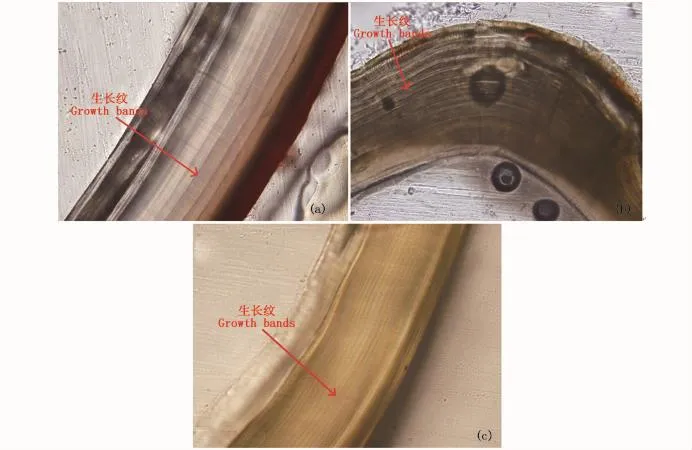
圖1 (a)三疣梭子蟹眼柄中的生長紋;(b)中華絨螯蟹眼柄中的生長紋;(c)中國明對蝦眼柄中的生長紋Fig.1 The grow th bands of eyestalk of(a)Portunus trituberculatus,(b)Eriocheir sinensis and(c)Penaeus orientalis

表1 甲殼類年齡鑒定方法Tab.1 M ethods for the crustaceans age identification
脂褐素分析法不易受到人為因素的影響,但是脂褐素每年的平均累積速率不同,這取決于該物種的代謝速率。例如,紅螯螯蝦(Cherax quadricarinatus)、淡水螯蝦、歐洲鰲龍蝦和南極背褐蝦的每年的脂褐素含量百分比分別為2.0%、0.20%、0.07%和0.02%[51,65]。脂褐素含量是物種生理年齡的標記而不是實際年齡的標記,這需要利用已知年齡的樣品對物種和環境進行校準[54,58]。脂褐素分析法的缺點是對勞動強度和技術要求高,在應用于野生種群之前需要構建物種特異性數據庫。脂褐素鑒齡研究因量化和校準技術存在的困難和不確定性而發展緩慢[18]。因此,這種方法不適合在漁業管理中使用。
放射性同位素分析法得到的結果也比較準確,由于元素的半衰期一般較長,所以該方法一般適用于壽命較長的物種,花費較高,測量元素半衰期時要求特殊的實驗設備。所以,該方法在甲殼類年齡鑒定的中的應用相對較少。
硬組織生長紋分析法利用甲殼類眼柄或胃磨等硬組織在生長過程中產生的生長紋來鑒定年齡,利用生長紋鑒定甲殼類年齡是最為精確的方法,硬組織也易于提取。硬組織生長紋分析法對于甲殼類鑒齡研究來說,為直接鑒定甲殼類年齡提供了一個新方法,應用前景廣泛。
3 分析與展望
到目前為止還沒有確定哪一種方法是最有效的獨立鑒定甲殼類年齡的方法,對于不同種類的甲殼類或者同一種類的不同年齡階段,最佳鑒齡方法也可能不一致,要對比多種鑒齡方法予以確定。對同一種甲殼類進行年齡鑒定的時候,可以采取多種年齡鑒定方法相結合,相互交叉比較,既可以比較得出此類甲殼類各年齡最適合的年齡鑒定方法,也能相互驗證不同方法,進而比較得出各年齡段最適宜的年齡鑒定方法,最終精確鑒定出年齡。
在實際的生產實踐中,飼養法得到的數據適用于水產養殖或者構建實驗室模型中,標記重捕法適合對洄游區域小的甲殼類鑒齡,體長頻度法在分析生長迅速的甲殼類時比較理想,在有校準技術保證的前提下比較適合使用脂褐素分析法對甲殼類進行鑒齡,對壽命長的甲殼類鑒齡時,放射性同位素分析法比較適宜。
硬組織生長紋分析法通過直接讀取甲殼類硬組織中的生長紋數目來鑒定其年齡,該方法的出現很好地解決了缺乏直接有效甲殼類鑒齡方法的問題,進而為甲殼類漁業資源評估與管理提供理論基礎。在今后對甲殼類年齡生長的研究中,硬組織生長紋分析法的精確性和廣泛的應用前景使該方法成為主流的甲殼類鑒齡方法。應當注意的是,在使用時需要改進以下幾點:(1)選取合適的實驗材料(眼柄或者胃磨)、正確的截面,以及掌握熟練的切面研磨技術;(2)多次多人對生長紋進行讀取,各研究者之間加強相互交流;(3)利用微結構對年齡進行進一步研究;(4)使用其他方法進行交叉驗證;(5)建立以甲殼類年齡與生長為基礎的數據庫,包括甲長、甲寬、體重的范圍、性別和性腺等級的數據參考標準,利用數據庫為甲殼類年齡鑒定提供參考。硬組織生長紋分析法雖然是最近幾年才出現的新方法,但相比其他方法來說相對精確,如果能夠避免該方法的缺點,該方法的發展潛力比較大,能更好地對甲殼類年齡生長進行研究。
[1] 劉瑞玉.南海對蝦類[M].北京:農業出版社,1988.LIU R Y.Economic shrimp and crab in North of China[M].Beijing:Science Press,1988.
[2] CASSIDY K M.Use of extractable lipofuscin as an age biomarker to determine age structure of ghost shrimp(Neotrypaea californiensis)populations in west coast estuaries[J].Explorer Site-North Coast Explorer,2008.
[3] 張治國,王衛民.魚類耳石研究綜述[J].湛江海洋大學學報,2001,21(4):77-83.DOI:10:13140/RG.2.1.3453.7681.
ZHANG Z G,WANG W M.A Review of Fish Otolith Research[J].Journal of Zhanjiang Ocean University,2001,21(4):77-83.DOI:10:13140/RG.2.1.3453.7681.
[4] 裘海雅,徐東坡,施煒綱.魚類耳石與年齡關系的研究進展[J].浙江海洋學院學報(自然科學版),2009,28(3):331-337.
QIU H Y,XU D P,SHIW G.A review of the relationship between fish otolish and age[J].Journal of Zhejiang Ocean University(Natural Science),2009,28(3):331-337.
[5] KALISH JM.Otolith microchemistry:Validation of the effects of physiology,age and environment on otolith composition[J].Journal of Experimental Marine Biology&Ecology,1989,132(3):151-178.
[6] 熊 飛,陳大慶,劉紹平,等.青海湖裸鯉不同年齡鑒定材料的年輪特征[J].水生生物學報,2006,30(2):185-191.
XIONG F,CHEN D Q,LIU S P,et al.Annuli characteristics of the different ageingmaterials of Gymnocypris przewalskii przewalskii(kessler)[J].Acta Hydrobiologica Sinica,2006,30(2):185-191.
[7] 陳焜慈,鄔國民,李恒頌.珠江斑鳠年齡和生長的研究[J].中國水產科學,1999,6(4):63-67.
CHEN K C,WU G M,LIH S.Studies on the age and growth of Mystusguttatus[J].Journal of Fishery Sciences of China,1999,6(4):63-67.
[8] KOCH JD,QUISTM C.A technique for preparingfin rays and spines for age and growth analysis[J].North American Journal of Fisheries Management,2007,27(3):782-784.
[9] 謝小軍.嘉陵江南方大口鯰的年齡和生長的初步研究[J].生態學報,1987,7(4):73-81.
XIE X J.A study on the age and growth of silurus soldatovimeridionalis in the jialing river[J].Acta Ecologica Sinica,1987,7(4):73-81.
[10] 江建軍,許柳雄,朱國平,等.北太平洋長鰭金槍魚年齡與生長初步研究[J].海洋漁業,2016,38(1):1-8.
JIANG JJ,XU L X,ZHU G P,et al.Preliminary study on age and growth of north Pacific albacore Thunnus alalunga[J].Marine Fisheries,2016,38(1):1-8.
[11] 馬 金,劉必林,陳新軍,等.利用耳石鑒定頭足類年齡與生長研究進展[J].海洋漁業,2009,31(3):316-324.
MA J,LIU B L,CHEN X J,et al.Advances on using sta tolith to study age and growth of cephalopod[J].Marine Fisheries,2009,31(3):316-324.
[12] 劉必林.利用耳石微結構研究印度洋西北海域鳶烏賊的年齡和生長[D].上海:上海水產大學,2006.
LIU B L.Studying age and growth of purple back flying squid(Sthenoeuthis oualaniensis)in northwest India Ocean based on statolith microstructure[D].Shanghai Ocean University,2006.
[13] 劉必林,陳新軍,方 舟,等.利用角質顎研究頭足類的年齡與生長[J].上海海洋大學學報,2014,23(6):930-936.
LIU B L,CHEN X J,FANG Z,et al.Study of age and growth of cephalopod using their beaks[J].Journal of Shanghai Ocean University,2014,23(6):930-936.
[14] 胡貫宇,陳新軍,劉必林,等.莖柔魚耳石和角質顎微結構及輪紋判讀[J].水產學報,2015,39(3):361-370.
HU G Y,CHEN X J,LIU B L,et al.Microstructure of statolith and beak for Dosidicus gigas and its determination of growth increments[J].Journal of Fisheries of China,2015,39(3):361-370.
[15] 劉必林,陳新軍,李建華.內殼在頭足類年齡與生長研究中的應用進展[J].海洋漁業,2015,37(1):68-76.
LIU B L,CHEN X J,LIJH.Advances on age and growth of cephalopods by using gladius,stylets and cuttlebone[J].Marine Fisheries,2015,37(1):68-76.
[16] 劉必林,陳新軍.頭足類貝殼研究進展[J].海洋漁業,2010,32(3):332-339.
LIU B L,CHEN X J.Research progress on shells in Cephalopods[J].Marine Fisheries,2010,32(3):332-339.
[17] 朱國平,宋 旗.運用脂褐素鑒定甲殼類年齡的研究進展[J].生態學雜志,2016,35(8):2225-2233.
ZHU G P,SONG Q.Aging crustacean based on the lipofuscin analysis:A review[J].Chinese Journal of Ecology,2016,35(8):2225-2233.
[18] KILADA R,SAINTE-MARIE B,ROCHETTE R,et al.Direct determination of age in shrimps,crabs,and lobsters[J].Canadian Journal of Fisheries&Aquatic Sciences,2012,69(11):1728-1733.
[19] WICKINS J F,LEE D O.Crustacean farming:Ranching and culture,second edition[M].2007.
[20] LUKHAUP C,LUKHAUP C.Süβwasserkrebse aus aller welt[M].Daehne Verlag,2008.
[21] NEW M B,VALENTIW C,TIDWELL JH,et al.Freshwater Prawns:Biology and Farming[M].2009.
[22] DAVIS J L D,YOUNG-WILLIAMS A C,HINES A H,et al.Comparing two types of internal tags in juvenile blue crabs[J].Fisheries Research,2004,67(3):265-274.
[23] WEINGARTNER D L.A field-tested internal tag for crayfish(decapoda,astacidea)[J].Crustaceana,1981,43(2):181-188.
[24] BUBB D H,LUCASM C,THOM T J,et al.The potential use of pit telemetry for identifying and tracking crayfish in their natural environment[J].Hydrobiologia,2002,483(1):225-230.
[25] GHERARDI F,BARBARESIS,SALVIG.Spatial and temporal patterns in the movement of Procambarus clarkii,an invasive crayfish[J].Aquatic Sciences,2000,62(2):179-193.
[26] HURYN A D,VENARSKY M P,KUHJADA B J,et al.Assessment of population size,age structure and growth rates for cave inhabiting crayfish in alabama[R].Montgomery,Departmentof Conservation and Natural Resources,2008.
[27] BU RˇICˇM,KOZáK P,VíCH P.Evaluation of different marking methods for spiny-cheek crayfish(Orconectes limosus)[J].Knowledge&Management of Aquatic Ecosystems,2008,389(389):198-201.
[28] CHAPMAN C J,SHELTON P M J,SHANKSA M,et al.Survival and growth of the norway lobster nephrops norvegicus in relation to light-induced eye damage[J].Marine Biology,2000,136(2):233-241.
[29] FREIRE J,GONZáLEZ-GURRIARáN E.New approaches to the behavioural ecology of decapod crustaceans using telemetry and electronic tags[J].Hydrobiologia,1998(371-372):123-132.
[30] LINNANE A,MERCER JP.A comparison ofmethods for tagging juvenile lobsters(Homarus gammarus L.)reared for stock enhancement[J].Aquaculture,1998,163(3-4):195-202.
[31] SCHMALENBACH I,MEHRTENSF,JANKEM,et al.A mark-recapture study of hatchery-reared juvenile european lobsters,Homarus gammarus,released at the rocky island of helgoland(german bight,north sea)from 2000 to 2009[J].Fisheries Research,2011,108(1):22-30.
[32] MCPHERSON R.Assessmentof t bar anchor tags for marking the blue swimmer crab portunus pelagicus(L.)[J].Fisheries Research,2002,54(54):209-216.
[33] ROBINSON CA,THOM T J,LUCASM C.Ranging behaviour of a large freshwater invertebrate,the white-clawed crayfish austropotamobius pallipes[J].Freshwater Biology,2000,44(3):509-521.
[34] SHARPW C,LELLISW A,BUTLER M J,et al.The use of coded microwire tags in mark-recapture studies of juvenile caribbean spiny lobster,Panulirus argus[J].Journal of Crustacean Biology,2000,20(3):510-521.
[35] STEWART J.Long-term recaptures of tagged scyllarid lobsters(Ibacus peronii)from the east coast of australia[J].Fisheries Research,2003,63(2):261-264.
[36] STREEVER W J.Energy economy hypothesis and the troglobitic crayfish[J].American Midland Naturalist,1996,135(2):357-366.
[37] RELINI L O,RELINIG.Seventeen instars of adult life in female Aristeus antennatus(crustacea:Decapoda:Aristeidae).A new interpretation of life span and growth[J].Journal of Natural History,1998,32(10-11):1719-1734.
[38] OH C W,HARTNOLL R G,NASH R D M.Population dynamics of the common shrimp, Crangon crangon(L.),in port erin bay,isle of man,irish sea[J].ICESJournal ofMarine Science,1999,56(5):718-733.
[39] DEVALM C,TOSUNOGˇLU Z.Length-based estimates of growth parameters,mortality rates,and recruitment of Astacus leptodactylus(eschscholtz,1823)(decapoda,astacidae)in unexploited inland waters of the northern marmara region,european turkey[J].Crustaceana,2007,80(6):655-665.
[40] CHáZAROOLVERA S.Growth,mortality,and fecundity of palaemonetes pugio from a lagoon system inlet in the southwestern gulf of Mexico[J].Journal of Crustacean Biology,2009,29(2):201-207.
[41] DHAOUADI-HASSEN S,BOUMA?ZA M.Reproduction and population dynamics of Atyaephyra desmarestii(decapoda,caridea)from the sidi salem dam lake(northern tunisia)[J].Crustaceana,2009,82(2):129-139.
[42] PAULY D,MORGAN G R.Length-based methods in fisheries research[J].ICLARM Conference Proceedings,1987(13):468.
[43] JENNINGS S,KAISER M J,REYNOLDS J D.Marine Fisheries Ecology[M].Blackwell Publishing,2001.
[44] ANDRADE H A,KINASPG.Estimation of birthdates and catch-at-age using length frequency analysis(lfa),with application for skipjack tuna(Katsuwonus pelamis)caught in the southwest atlantic[J].ICESJournal ofMarine Science,2004,61(5):798-811.
[45] MALIK H A,SALMAN M D,AL-ADHUB A Y.Population dynamics of the hymenosomatid crab elamnopsis kempi in a brackish subtidal region of Basrah,Iraq[J].Scientia Marina,1995(59):1-13.
[46] SHEEHY M,BANNISTER R,WICKINS JF,et al.New perspectives on the growth and longevity of the european lobster[J].Canadian Journal of Fisheries&Aquatic Sciences,1999,56(56):1904-1915.
[47] BOOS JH,SILVA-CASTIGLIONID,SCHACHT K,et al.Crescimento de aegla jarai bond-buckup&buckup(crustacea,anomura,aeglidae)[J].Revista Brasileira De Zoologia,2006,23(2):490-496.
[48] HANNOVER A.Mikroskopiske unders?gelser af neresysteme[J].Kgl Danbske Videsk Kabernes Selkobs naturv Math Aft Copenhagen,1842(10):1-112.
[49] HALLIWELL B,GUTTERIDGE JM.Oxygen toxicity,oxygen radicals,transition metals and disease[J].Biochemical Journal,1984,219(1):1-14.
[50] MEDINA A,VILA Y,MEGINA C,et al.A histological study of the age-pigment,lipofuscin,in dendrobranchiate shrimp brains[J].Journal of Crustacean Biology,2000,20(3):423-430.
[51] BLUHM B A,BREY T.Age determination in the antarctic shrimp notocrangon antarcticus(crustacea:Decapoda),using the autofluorescent pigment lipofuscin[J].Marine Biology,2001,138(2):247-257.
[52] BELCHIER M,EDSMAN L,SHEEHY M R J,et al.Estimating age and growth in long-lived temperate freshwater crayfish using lipofuscin[J].Freshwater Biology,1998,39(3):439-446.
[53] PEREIRA C R,D’INCAO F,FONSECA D B.Bilateral comparison of in situ neurolipofuscin accumulation in Callinectes sapidus caught in thewild[J].Journal of the Marine Biological Association of the United Kingdom,2010,90(3):563-567.
[54] MAXWELL K E,MATTHEWS T R,SHEEHY M R,et al.Neurolipofuscin is a measure of age in Panulirus argus,the caribbean spiny lobster,in florida[J].Biological Bulletin,2007,213(1):55-66.
[55] ETTERSHANK G,MACDONNELL I,CROFT R.The accumulation of age pigment by the fleshfly,sarcophaga bullata parker(diptera:Sarcophagidae)[J].Australian Journal of Zoology,1983,31(2):131-138.
[56] SHEEHY M,CAPUTIN,CHUBB C,et al.Use of lipofuscin for resolving cohorts ofwestern rock lobster panul[J].Canadian Journal of Fisheries&Aquatic Sciences,2011,55(4):925-936.
[57] KODAMA K,SHIRAISHIH,MORITA M,et al.Verification of lipofuscin-based crustacean ageing:Seasonality of lipofuscin accumulation in the stomatopod Oratosquilla oratoria in relation to water temperature[J].Marine Biology,2006,150(1):131-140.
[58] SHEEHY M R J,GREENWOOD JG,FIELDER D R.More accurate chronological age determination of crustaceans from field situations using the physiological age marker,lipofuscin[J].Marine Biology,1994,121(2):237-245.
[59] GARDNERC,JENKINSONA,HEIJNISH.Estimating intermoult duration in giant crabs Pseudocarcinus gigas[J].Agricultural&Veterinary Sciences,2002:17-28.
[60] ERNST B,ORENSANZ JM,ARMSTRONG D A.Spatial dynamics of female snow crab(Chionoecetes opilio)in the eastern bering sea[J].Canadian Journal of Fisheries&Aquatic Sciences,2005,62(62):250-268.
[61] 吳萬榮.布氏哲羅鮭年齡與生長的初步研究[J].水產學報,1987,11(1):37-44.
WUW R.On the age and growth of Hucho bleekeri kimura[J].Journal of Fisheries of China,1987,11(1):37-44.
[62] 王繼隆,唐富江,劉 偉.大麻哈魚的年齡與生長[J].水生生物學報,2012,36(6):1149-1155.
WANG JL,TANG F J,LIUW.Age and growth of chum salmon[J].Acta Hydrobiologica Sinica,2012,36(6):1149-1155.
[63] KILADA R,ACU?A E.Direct age determination by growth band counts of three commercially important crustacean species in chile[J].Fisheries Research,2015(170):134-143.
[64] HARTNOLL R G.Growth in crustacea—twenty years on[M].Netherlands:Springer,2001.
[65] SHEEHY M R.Role of environmental temperature in aging and longevity:Insights from neurolipofuscin[J].Archives of Gerontology&Geriatrics,2002,34(3):287-310.
Advance on methods for the age identification of crustaceans
JIANG Rui1,LIU Bi-lin1,2,3,4,ZHANG Jian1,2,3,4,CHEN Xin-jun1,2,3,4,NIZhen-Yu1,LIN Jing-yuan1
(1.College of Marine Sciences,Shanghai Ocean University,Shanghai201306,China;2.National Distant-water Fisheries Engineering Research Center,ShanghaiOcean University,Shanghai 201306,China;3.The Key Laboratory of Sustainable Exploitation of Oceanic Fisheries Resources,Ministry of Education,ShanghaiOcean University,Shanghai 201306,China;4.Collaborative Innovation Center for Distant-water Fisheries,Shanghai 201306)
Crustaceans are widely distributed in the oceans worldwide including the polar region.Their high species diversity and large quantity make them become an important part of fishery resources.Age is the essential part of the aquatic animal life history study,as well as one of themost important parameters in the fish population dynamicsmodels and fishery resources evaluation.Mostaquatic animals’age can be identified by counting the growth bands in the hard tissue.However,crustaceans grow up through molt,leading to the original shells replaced by the new ones,which causes the periodic record of their calcified structures disappearing.Therefore,the age identification of crustaceans has never been perfectly accomplished.Main existingmethods for the crustaceans’age identification are rearing in captivity,tagging and recapture,sizefrequency analysis,lipofuscin-based ageing,radioisotope analysis and calcified structures analysis.Rearing in captivity is the most accurate and reliable method for the crustaceans’age identification.Tagging and recapturemethod ismore directand effective.Size-frequency analysismethod ismost commonly used by early scholars.In thismethod,crustaceans’body length data are firstly classified into different body length groups,and then converted into age groups by Von Bertalanffy growth equation or other equation models.For the relationship between the morphological characteristics of crustaceans and their ages can not be established,lipofuscin-based ageingmethod is applied for the age identification ofmany invertebrates.Lipofuscin is related with cells aging,which is one of themost obvious age tags in cells.Radiometric ageingmethod is applicable to determine the crustaceans’shell age and the results are also comparatively accurate.This method is generally used for long-lived species based on the long elementhalf-life,but the elementhalf-lifemeasuremeat requires special equipment so the cost for thismethod is very high.So it is less used.Calcified structures analysis is a kind ofmethod to count the growth bands that generate in the crustaceans’eye stalk or gastric when they grow.Calcified structures analysis is themost accuratemethod,and the needed hard tissue is easy to extract.The calcified structure analysis method provides a new way for the direct age identification of crustaceans,and its application prospect is extensive.Rearing in captivity method,tagging and recapture method and radiometric ageing method all are comparatively accurate.However,the data obtained from the rearing in captivity method is not applicable in the natural environment,and the radiometric ageingmethod is very expensive.So both methods have limitations in practice.The tagging and recapture method and sizefrequency analysis method which are most widely used also have their disadvantages.Compared to sizefrequency analysismethod,lipofuscin-based ageing method has obvious advantages,but the labor intensity and technical requirements are high.Calcified structures analysismethod is the age identification technology that has appeared in recent years,and the age is identified by directly counting the number of growth bands in crustaceans’hard tissue.Thismethod is a good solution to the lack of direct and effective crustaceans’age identification,and provides the theoretical basis for the assessment and management of crustacean fishery resources,but there are also some disadvantages like strong man-made subjectivity.In this paper,themethods of crustaceans’age identification are reviewed and summarized,the differentmethods are compared and analyzed to get the advantages and disadvantages,so as to provide the basis for the assessment and management of crustacean fishery resources.
crustaceans;age and growth;age determination methods
S 931
A
1004-2490(2017)04-0471-10
2016-12-21
國家自然科學基金(NFSC41306127,NSFC41276156);上海市自然科學基金(13ZR1419700);教育部博士點基金(20133104120001)
蔣 瑞(1994-),女,碩士研究生,主要從事漁業資源學研究。
劉必林,副教授。E-mail:bl-liu@shou.edu.cn
猜你喜歡
小讀者(2021年2期)2021-03-29 05:03:48
瘋狂英語·新悅讀(2019年11期)2019-12-18 05:14:16
華人時刊(2019年13期)2019-11-17 14:59:54
兒童故事畫報(2019年5期)2019-05-26 14:26:14
NBA特刊(2018年21期)2018-11-24 02:48:04
文苑(2018年22期)2018-11-19 02:54:14
紅領巾·萌芽(2016年1期)2016-09-10 07:22:44
Coco薇(2016年2期)2016-03-22 02:42:52
Coco薇(2015年1期)2015-08-13 02:47:34
小雪花·成長指南(2015年7期)2015-08-11 15:03:12
