
RED ALL ABOUT IT
2017-07-31 19:06:59BYHATTYLIU
漢語世界 2017年4期
BY HATTY LIU
RED ALL ABOUT IT
BY HATTY LIU

The enduring cult appeal of an 18th-century literary classic
半部《紅樓夢》凝結了曹雪芹畢生心血,兩百多年后仍有無數中國人為之夢縈魂牽
The appeal, half-desperate and halfdefiant, appeared at the start of the 2008 fall semester at Nanchang Aviation University. “Do you think it’s possible to start aDream of the Red Chamberassociation at a school like ours?” a student posted online. “I think if a university doesn’t even have a ‘Red Chamber Association,’ then it cannot be called a university.”
Published posthumously (and unfinished) in 1791, Cao Xueqin’sDream of the Red Chamberhas been declared a masterpiece and “the book of the millennium” in translation, yetremains almost unknown in the West. In China, though, the book—a vast, allegorical portrait of Qing household life, sometimes known asThe Story of the Stone—is so beloved, it has spawned its own field of scholarship, known as redology. For professional redologists, there are mysteries to solve and manuscripts to authenticate; while for regular fans, there’s period costumes, themed parties, and endless WeChat articles to share.
The aviation student’s plea in this case fell on largely deaf ears: The author updated the thread just two months later to say that he’d given up due to lack of interest, though he logged on five years later to urge new students to keep trying. But whatever stymied his efforts, it wasn’t because he underestimated the popularity of the literary classic in campuses and beyond.
Founded in 2005, the Renmin University Red Chamber Association (“Renda Hongxie”) is the kind of club likely envisioned at Nanchang. Following similar organizations at Peking University and Tsinghua University, a group of students set out to create a space on campus where they could host literary lectures, throw potlucks, and socialize with others who shared their love of a 200-yearold book. Former Renda Hongxie president Wang Junyan says that, while the club followed its illustrious forerunners in inviting literature professors and scholars to give talks, over time, it has come to emphasize social aspects over the academic.
FOR PROFESSIONAL REDOLOGISTS, THERE ARE MYSTERIES TO SOLVE AND MANUSCRIPTS TO AUTHENTICATE
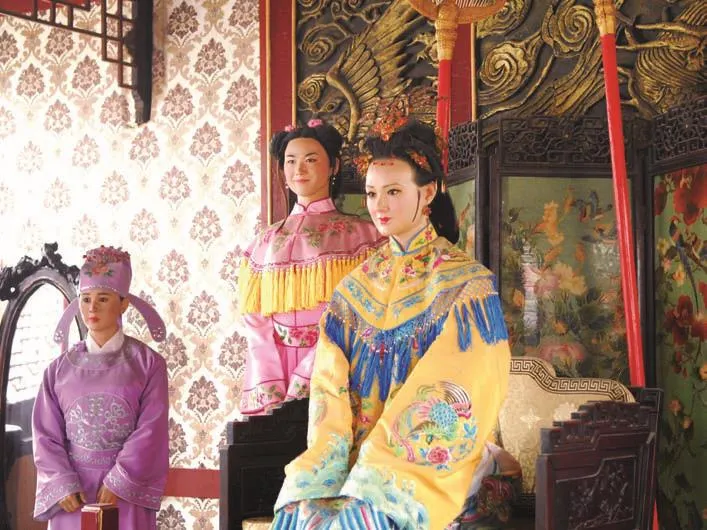
Zhengding county, Hebei, is home to the Rongguo Mansion, which was built to showcase scenes from the novel and was used in a TV adaption in 1987. This scene shows royal consort Jia Yuanchun during an imperial visit home
Wang says she first readDream of the Red Chamberin middle school, but never full appreciated it until she picked it up again in high school. The novel closely mirrors the experiences of the author’s grandfather, Cao Yin (曹寅), once a prominent southern official for the Kangxi Emperor (康熙帝). When Kangxi died and Emperor Yongzheng (雍正帝) took over, the family fell out of favour and was purged; ruined, the Caos exiled themselves to a hutong in Beijing––far from the grandeur of their original mansion. Amid the dull, utilitarian texts she was cramming for hergaokao, the novel stood out to Wang for how well it was written.
“There was so much beautiful poetry…the characters are so realistically drawn and nuanced; it’s a very moving story, handed down through history,” she told TWOC.“I’d read it every night after myhomework. In my first year of university…[Renda Hongxie] was the only student club I joined.”
New members typically meet at a fall introductory session where, they went around the room stating their name, major, and year. But their icebreakers had a twist; members might be asked to name their favorite character from the novel and why they identify with them, or share their favorite chapter or poem. Activities include themed games or handicrafts, an annual pilgrimage to the author’s old home at the Beijing Botanical Gardens, and biweekly meetings where members discussRed Chamber-related articles—but also chat about mundane topics over free snacks, with the assurance of having found a niche on campus.
“We don’t do those icebreakers much these days; people can just join the WeChat group and come to the meetings, and we might chat about anything,” Wang admits. “It’s more the idea that you get to talk to other people who’ve felt an interest and a connection…and, say, if you use an allusion [or] an old-fashioned figure of speech, you know everyone in the room will get it; or, if something happens to make you reflect on the novel, inspires you to write a poem, it can get published on our WeChat account.”
Plenty of other clubs take a more rigorous approach, though. The Red Chamber Cultural Society at Xi’an’s Chang’an University hosts regular talks on the novel, prepared by the student themselves. In March, Zhongshan University’s Red Chamber Study Society in Guangzhou held a workshop on the orchid-shaped hairpins worn in the novel’s hugely popular 1987 TV adaptation (just one of the reasons for the book’s enduring popularity). On a national level, the Red Chamber Fan Club has chapters in all major Chinese cities to help high school and university students start their own clubs. They also hold weekly public readings at their Beijing headquarters, and celebrate most lunar calendar holidays with traditional activities like kite-making or flower-watching, both described in lavish detail in the novel.
Though ostensibly a family drama about 18th-century aristocracy,Dream of the Red Chamberhas long enjoyed an eclectic fan base. In the mid-1700s, when hand-copied manuscripts of Cao’s original chapters began to circulate, the text’s rich examples of foreshadowing, poetic verse, and literary allusion inspired scholars to add their own annotations as they transcribed the work. This interest only grew after Cao died sometime in the 1760s, leaving behind only 80 finished chapters of the 120 found in most modern editions of the work.
GRAY-BEARDED GOVERNORS WROTE POEMS AND TREATISES ON THE TRAGEDY OF THE NOVEL’S CENTRAL LOVE TRIANGLE
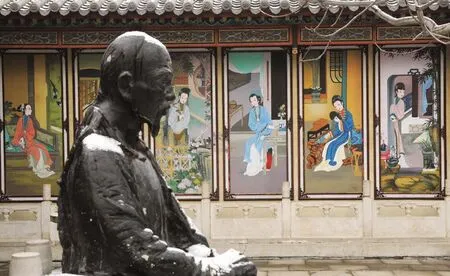
Cao Xueqin’s statue in the court yard of Cao’s Memorial Hall in Rongguo Mansion
In the centuries that followed, scholarly commentary, speculation, and attempts to definitively conclude the saga grew into the discipline of redology, with a diverse body of adherents. Gray-bearded governors wrote poems and treatises on the tragedy of the novel’s central love triangle; prominent political scientists Hu Shi (胡適) and Cai Yuanpei (蔡元培) fought over the best way to infer the author’s intended ending. Writer Eileen Chang reused sentence structures and themes from the novel in her short stories, while Mao Zedong claimed to have read the novel five times, praising its critique of class relations: “To not read [the novel] is to not understand China’s feudal society…anyone who has not read it three times had no power to discourse.”
Mao’s endorsement ensured the novel was one of the few ancient works not banned during the Cultural Revolution, though China’s leading redologist, Zhou Ruchang (周汝昌), was imprisoned in a cowshed then dispatched to Hubei. To Liu Xiaolei, professor of Chinese literature at the Beijing Institute of Technology, this survival gave the novel a particularly strong cultural imprint. “It contains all elements of Chinese culture, traditional practices that are described in detail,” she says. “Also, the author wrote about very ‘soft’ subjects, such as love, the life of the aristocracy, young women—it’s very beautiful and poetic…These things made it easy to access.”
It’s also a work that’s adept at moving with the times, with multiple adaptations to TV, film, theatre and opera. The book’s wide embrace of culture ensures its appeal across many interests. At Renda Hongxie, Wang says,“We’ll perform at the annual student showcase with thehanfu(traditional costume) society or theguqin(seven-string zither) society, and introduce the show with a line from the novel, or act out a scene…we’re just one of many clubs on campus catering to those with an interest in traditional culture.”
As interest in the novel moves away from what Liu calls the “niche study” of redologists and their habit of “delving into hidden political meanings,” Weibo and public WeChat accounts have sprung up for and by the “grassroots,” rather than academic experts. These analyze and adapt the novel’s pertinence to issues as diverse as parenting or modern relationships. The Red Chamber Fan Club now streams its weekly public readings on WeChat, and a few accounts, like Shanghai-based “A Dream in the Red Chamber,” host events where fans around the country will read a chapter or related essay, then discuss afterwards in a WeChat group.
“Modern fans are definitely not like mainstream redologists, as their interests are much more varied,” says Liu, who runs her ownRed ChamberWeChat account.“Some are fanatics, who never really ‘left’ the novel and actually imagine themselves to be the characters, but I think most people who follow me just love the novel and are looking for something deeper.”
MANSION OF MYSTERIES FIVE UNANSWERED QUESTIONS
The Red Chamber Study Association at Henan Normal University is a studentrun group that hosts lectures, plays, and discussion groups based on the classic novel. TWOC asked the club to provide their favorite unanswered questions from the book.
Mystery of the Lin Family Inheritance—How did the female protagonist, Lin Daiyu, go from being the only daughter of an affluent official to a powerless dependent of her Jia relatives?
The Fate of Baoyu—What fate did the original author intend for the protagonist? Or, if we accept Gao E’s ending as canon, what happens to Baoyu after his mysterious disappearance in Chapter 119?
The Fate of Jia Yuanchun—What caused Baoyu’s elder sister, the imperial concubine, to lose the emperor’s favor and die (foreshadowing the entire Jia clan’s fall from grace)?
The Death of Qin Keqin—Qin Keqin, Baoyu’s childhood crush, mysteriously dies in Chapter 13. Did she die from disease or, as some redologists have suggested, did she hang herself because it was discovered she had an affair with her fatherin-law? The behavior of her two maidservants after her death—one publicly kills herself, the other offers to guard Qin’s body as her “honorary daughter”—make the circumstances more mysterious.
The Conspiracy of the “Fate of Gold and Jade”—There are symbols throughout the novel that prophecy marriage between Baoyu (born with a jade piece in his mouth) and his cousin Xue Baochai (gifted a gold locket by monks as a toddler). Are these objects actually planted by his mother and aunt, who wished to elevate their own family’s prestige through intermarriage with the Jias?
