黑土稻田連續深耕改善土壤理化性質提高水稻產量大田試驗
2017-06-27 01:31:07王秋菊高中超張勁松常本超郭中原賈會彬
農業工程學報 2017年9期
王秋菊,高中超,張勁松,常本超,姜 輝,孫 兵,郭中原,賈會彬,焦 峰,劉 峰
?
黑土稻田連續深耕改善土壤理化性質提高水稻產量大田試驗
王秋菊1,高中超1,張勁松1,常本超1,姜 輝2,孫 兵3,郭中原4,賈會彬5,焦 峰6,劉 峰2※
(1. 黑龍江省農業科學院土壤肥料與環境資源研究所,哈爾濱 150086; 2. 黑龍江省農業科學院科研處,哈爾濱 150086;3. 黑龍江省農業科學院耕作栽培研究所,哈爾濱 150086; 4. 黑龍江省慶安水利實驗站,慶安 152400;5. 黑龍江省農業科學院佳木斯分院,佳木斯 154000; 6. 黑龍江八一農墾大學,大慶163319)
為了明確深耕對水田土壤理化性質及水稻產量影響,該文在黑土型水稻土上開展深耕研究,應用自主研發的水田深翻犁,開展深翻、淺翻與旋耕大區對比研究。結果表明:淺翻和深翻可以降低土壤固相比率和容重,與旋耕相比,土壤固相比率降低幅度分別為0.74%~4.80%和1.86%~3.90%;>10~20 cm土層土壤容重分別下降0.09 g/cm3和0.08 g/cm3,>20~30 cm土層深翻處理土壤容重比旋耕下降0.03 g/cm3;>10~20 cm土層土壤的通氣系數和飽和透水系數淺翻處理比旋耕分別提高4.04倍和2.71倍,深翻提高4.42倍和2.14倍;>20~30 cm深翻比旋耕提高1.86倍和2.87倍,2年趨勢一致;深翻可使土壤養分指標在各層趨于平均化;深耕可促進水稻根系生長,根系的生長量與根長增加幅度為6.53%~16.33%和10.81%~21.62%,深翻好于淺翻;深耕提高水稻產量,2015年淺翻和深翻處理水稻實測產量分別比旋耕增產6.91%和9.81%,2016年增產6.59%和7.84%,2年增產趨勢一致。
土壤;耕作;有機質;深耕;理化性質;根系;養分累積;產量
0 引 言
黑龍江省是中國種稻大省,水稻種植面積在384.3萬hm2[1]。水田整地長期以旋耕或淺翻整地模式為主,旋耕深一般8~10 cm,淺翻為12~13 cm[2-4]。長期淺耕存在問題:一是使犁底層上移,導致有效耕層變薄,導致耕層變淺,犁底層位置上升,根系有效生存空間縮小,根系無法吸收到深層土壤的養分,單位面積土壤養分供給量下降[5],水稻生產不得不依靠大量施用化學肥料來維系高產、穩產。二是淺耕易造成水稻生育后期倒伏[6-7],由于根系受犁底層阻礙,導致根系不能垂直生長,只能水平延伸,導致根系固持能力下降。朱德峰等[8]曾研究,水稻根系向下延伸的深度與根系固持土壤能力密切相關,深層土壤中根系越多,其固定土壤能力越強,抗倒伏能力越強;淺耕使單位面積土壤養分供給量下降,為滿足作物生長,不得不大量施用化肥,化肥過量造成水稻貪青晚熟,也是導致水稻倒伏減產的重要原因[9]。三是犁底層阻礙土壤通氣性和透水性,土壤上下土層空氣不流通,土壤長期處于還原狀態,易形成鐵、錳等還原性物質和H2S還原性氣體,導致水稻根系中毒而減產[10-12]。在黑龍江地區水田生產調查也表明,高產田土壤耕層厚度一般15~17 cm,犁底層厚度7~8 cm,中產田一般12~15 cm,犁底層厚度一般8~10 cm,低產田一般8~10 cm,犁底層厚度12 cm以上;洪河農場通過多年生產實踐得出深耕20 cm比深耕8~10 cm增產10%的結論。近年來,國內外在水稻耕作方面研究比較少,多集中在水稻傳統耕作和保護性耕作方面以及機械的研發[13-14]。國內研究主要集中在中國南部和中部水田土壤,主要研究不同耕作方式、或耕作方式與肥料配施對溫室氣體排放及土壤有機碳的影響[15-17],國外也主要集中在保護性耕作對土壤有機碳和甲烷等溫室氣體排放的研究[18],對深耕方面研究缺乏。本文在此前提下,應用自主研發的深耕犁在黑土型水稻土上開展水田深耕試驗,明確深耕對稻田土壤理化性質及水稻生育、產量影響,為構建合理層提供理論依據和技術支撐。
1 材料與方法
1.1 試驗地點
試驗地點設在黑龍江省慶安縣水利實驗站水田試驗區(東經127°47′,北緯47°15′),年平均降雨量500 mm,有效活動積溫2 550 ℃。
供試土壤為黑土型水稻土,種植水稻時間20 a以上,整地方式長期連續多年采用旋耕模式,旋耕深度8~10 cm。土壤耕層厚度11.3 cm,犁底層厚度10.5 cm。土壤基本性質見表1。

表1 供試土壤基本特性Table 1 Basic characteristics of tested soil
注:pH為水浸;土壤質地劃分按照國際分類法。
Note: pH value was derived from water leaching; soil texture divided according to international classification.
1.2 試驗設計
試驗采用大區對比方法,設置3個處理:分別為旋耕處理、淺翻處理和深翻處理。試驗始于2014年秋季,水稻收獲后進行機械耕作處理,2015年秋在同一試驗區進行相同耕作模式處理。各處理方法如下:
1)旋耕處理:于水稻秋季收獲后,采用旋耕機(山東濰坊象力機械有限公司生產,型號:GAN200)進行旋耕,耕深8~10 cm,然后待第2年春季水田直接入水泡田,進行機械水整地;
2)淺翻處理:于水稻秋季收獲后,采用自主研發的水田深耕犁進行翻耕處理,耕深13~15 cm,然后于第2年春季水田入水前再用旋耕犁旋耕1遍后,入水泡田機械水整地;
3)深翻處理:與淺翻處理所用機械及方法一致,耕深為22~25 cm。深耕犁結構如圖1,犁頭尺寸列于圖2。圖3為各處理田間作業場景及機械作業后地表狀況。

圖1 水田深耕犁

圖2 犁頭結構
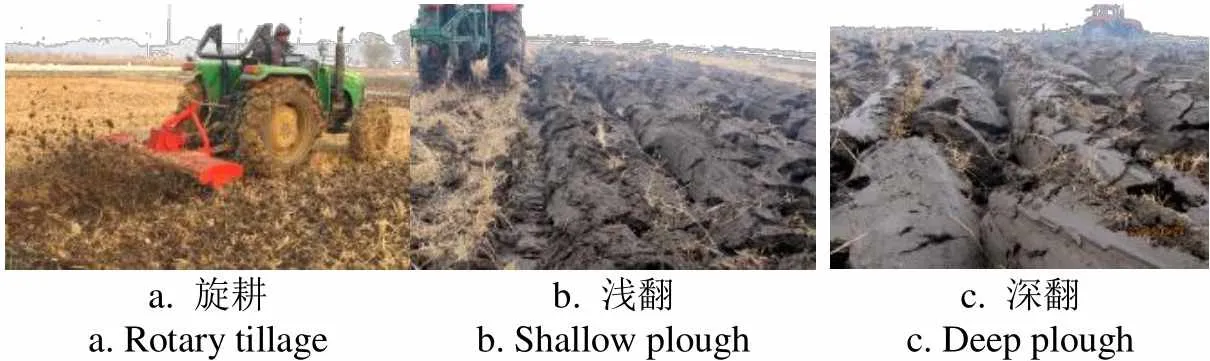
a. 旋耕a. Rotary tillageb. 淺翻b. Shallow ploughc. 深翻c. Deep plough
試驗采用大田對比法,每個處理區長40 m,寬30 m,面積1 200 m2。各處理2年施肥一致,施肥種類分別為尿素(N 46%)、二銨(N 16%,P2O546%)、硫酸鉀(K2O 50%);施用量按照純N、P2O5、K2O計算,分別為150、70、75 kg/hm2;施用方法:N按照基肥、返青肥、穗肥(施用比例為4:3:3)施肥,K按基肥、穗肥(施用比例為3:2)施肥,P肥作為基肥一次性施入;基肥在春季水田水整地時施入,全層施肥,追肥分別在返青期、孕穗期葉面噴施,K肥追肥時期與水稻第2次追施N肥時一致,K肥和N肥混合后葉面噴施。水田灌溉管理模式為淺-濕-干間歇灌溉模式,年際間一致。供試水稻品種為龍慶稻3號。插秧時期,2015年為5月15日,2016年為5月22日。
1.3 調查項目與方法
土壤取樣方法:于2015年秋季在每個處理的縱向中心處,橫向中間處各挖一個60 cm×60 cm×60 cm土壤剖面,用容積100 cm3的環刀分層取原狀土樣和化學分析樣品,取樣層次分別為0~10 cm、>10~20 cm、>20~30 cm土層,取3次平行樣,取的環刀用膠帶密封后帶回實驗室備用。考慮到耕層土壤的不均一性,化學樣品0~10 cm和10~20 cm土層土壤每個處理按S形取樣5點,混合后,按對角線四分法留500 g左右土樣帶回實驗室備用。
化學指標分析方法:土壤pH值采用美國產原位土壤pH計測定,測定位置分別為5、15、25 cm,每層測5點,取平均值;土壤堿解氮采用擴散吸收法測定;土壤速效磷含量測定采用碳酸氫鈉提取法測定[19];速效鉀含量測定采用鹽酸浸提-AAS法測定;土壤有機質采用重鉻酸鉀外加熱法測定;陽離子代換量采用乙酸胺交換法[20]。
物理指標測定方法:用土壤DIK-1130土壤三相測定儀測定土壤固相、液相和氣相;土壤容重采用環刀法測定;土壤含水率采用烘干法測定;土壤飽和導水率采用DIK-4012土壤透水儀測定;土壤通氣系數采用采用DIK-5001土壤通氣儀測定[21];土壤質地組成采用MS-2000激光粒度儀測定,參照楊金玲等[22]校正系數進行土壤粒級分級的校正。
植株養分測定:于水稻分蘗初期、分蘗盛期、拔節期、抽穗期、灌漿期和成熟期每個處理取有代表性植株10株,帶回實驗室,烘干、粉碎后待測。植株全氮采用凱氏定氮法,全磷采用鉬銻抗比色法,全鉀采用火焰光度計法測定[20]。
水稻根系活力的測定:采用根系傷流法測定[23],在水稻分蘗末期,選取代表性植株5株,在距離地面留茬5 cm處剪去莖稈,所留根茬用脫脂棉覆蓋,然后用塑封膜密封(圖4),經過24 h后取下脫脂棉,稱重,記下脫脂棉增加的重量,即為根系傷流量,傷流量的多少反映根系的活力。
作物產量調查:每個處理取10株,室內考種調查產量性狀;產量田間實測,每個處理采用久保田收割機全區直接收獲。
1.4 數據分析
用Microsoft Excel及 DPS 6.85處理數據。
2 結果與分析
2.1 對土壤物理性質的影響
從表2看出,土壤固相比率在0~30 cm土層,淺翻和深翻處理比旋耕處理分別降低0.74%~4.80%和1.86%~3.90%;土壤通氣系數和飽和透水系數均呈增加趨勢,淺翻處理10~20 cm土層土壤的通氣系數和飽和透水系數比旋耕分別提高4.04倍和2.71倍,深翻處理比旋耕分別提高4.42倍和2.14倍,深翻處理20~30 cm土層土壤分別比旋耕提高1.86倍和2.87倍;淺翻和深翻處理土壤孔隙度與旋耕相比均有增加趨勢,0~30 cm土層淺翻增加幅度為0.44%~4.80%,深翻增加幅度為1.86%~3.93%;與旋耕處理相比,土壤容重隨土層的加深下降明顯,淺翻處理>10~20 cm土層比旋耕分別下降0.09 g/cm3,深翻處理下降0.08 g/cm3,>20~30 cm土層深翻處理土壤容重比旋耕下降0.03 g/cm3。2016年不同處理土壤各項物理指標變化趨勢與2015年基本一致。
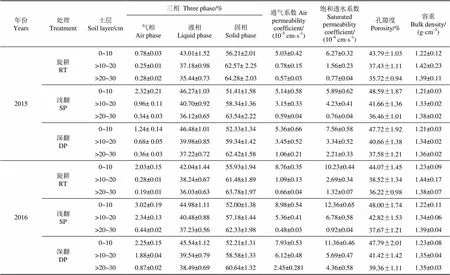
表2 深耕對土壤物理性質的影響
注:RT、SP、DP分別指旋耕、淺翻和深翻。
Note: RT, SP and DP refer to rotary tillage shallow plough and deep plough, respectly.
2.2 對土壤化學性質的影響
從表3看出,2015年旋耕處理土壤有機質、堿解氮、有效磷和速效鉀含量從表層到深層呈逐漸下降趨勢,由于黑土是一類黑土層厚的土壤,各土層土壤養分差異并不很明顯[24],翻耕后不會導致耕層土壤養分明顯下降,深層土壤養分含量與旋耕相比有增加趨勢。淺翻處理在>10~20 cm土層土壤的有機質、堿解氮、有效磷和速效鉀含量稍高于旋耕處理,深翻處理表現在>10~30 cm土層土壤有機質、堿解氮、有效磷和速效鉀含量高于旋耕處理。2016年各處理土壤養分變化趨勢與2015年趨勢一致。深翻處理使黑土型水稻土各層土壤養分趨于平均化,利于水稻各生育時期植株對土壤養分的吸收。

表3 深耕對土壤化學性質的影響
2.3 對水稻氮、磷、鉀素吸收的影響
從圖5看出,水稻籽實氮素含量深翻>淺翻>旋耕處理,說明深翻利于植株對深層土壤氮素的吸收;水稻籽實磷素和鉀素含量淺翻>深翻>旋耕。
2.4 對水稻根系活力及生長量的影響
水稻傷流量大小直接反映水稻主動吸收養分能力,是根系活力的重要表征指標。從圖6看出,深翻處理和淺翻處理水稻傷流量分別比旋耕增加12.17%和6.09%。從表4看出,淺翻和深翻處理水稻根系生長量和根系垂直長度均高于旋耕處理,淺翻處理根系干物質質量和根系長度比旋耕處理增加6.53%和10.81%,深翻處理比旋耕增加16.33%和21.62%,圖7是各處理水稻根系圖片。
2.5 對水稻產量的影響
從表5看出,淺翻和深翻處理可以提高水稻有效穗數和穗粒數,降低籽粒空癟率,提高產量。2015年淺翻和深翻處理水稻實測產量分別比旋耕處理增產6.91%和9.81%,2016年增產6.59%和7.84%。2016年淺翻和深翻處理比旋耕增產幅度差異沒有第2015年明顯,但2年試驗增產趨勢一致,說明加深耕層對于水稻增產有一定意義。
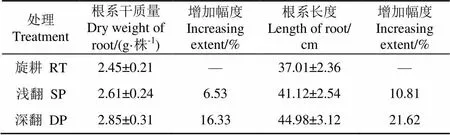
表4 深耕對根系生長影響

表5 深耕對水稻產量影響
3 討 論
日本學者采用深耕技術改良老朽化水田收到很好增產效果[25];但在沙質土上深耕可能會造成漏水、漏肥[24,26]。黑龍江省水田主要分布在低平原地區,土壤通透性差,排水不良,氧化還原電位低,水稻根系易受到還原性物質危害[27-28]。馮國祿等[29]認為,深耕是降低還原氣體含量的有效措施。另一方面長期旋耕整地的水田,耕層厚度約為10~12 cm,影響水稻根系生長,易發生倒伏[8],深耕擴大根系生活領域,利于根系吸收深層土壤養分[30],所以適當深耕有利于水稻養分累積。本研究證明,水稻對養分累積量,耕深13~15 cm的淺翻處理高于耕深22~25 cm的深翻處理,比較旋耕、淺翻、深翻耕層養分看出,淺翻作業后,由于垡塊之間產生較大空隙,耕層土壤迅速脫水干燥,有利于土壤產生“干土效應”,促進耕層養分礦化分解,土壤有效養分高于其他2處理,這對水稻養分吸收和積累作用很大。深翻區由于部分下層土翻到地表,導致耕層土壤養分含量降低,不利于水稻生育。盡管深耕處理下層土壤有效養分較高,但下土層水稻根系少,養分吸收量也較少。
從產量上看,連續耕翻2年,深翻增產7.84%~9.81%,淺翻增產6.91%~6.59%,二者產量差異不明顯。綜合考慮到深翻消耗動力大,不僅成本高,易造成耕層養分下降,還不利于插秧和收獲等田間作業,易導致機械水整地或插秧陷車等現象,作業經濟效益并不高。所以,不建議連續深翻,在黑土型水田耕翻整地耕深應以15 cm為宜。
4 結 論
1)深耕降低土壤固相比率和容重,體高土壤孔隙度。在0~30 cm土層,淺翻和深翻處理土壤固相比率比旋耕分別降低0.74%~4.80%和1.86%~3.90%;>10~20 cm土層土壤容重淺翻和深翻處理比旋耕分別下降0.09和0.08 g/cm3,>20~30 cm土層深翻處理土壤容重比旋耕下降0.03 g/cm3;淺翻和深翻處理0~30 cm土層土壤孔隙度與旋耕相比增加幅度分別為0.44%~4.80%和1.86%~3.93%;2年趨勢一致。
2)深耕提高土壤通氣系數和飽和透水系數。>10~20 cm土層土壤的通氣系數和飽和透水系數淺翻處理比旋耕分別提高4.04倍和2.71倍,深翻提高4.42倍和2.14倍;>20~30 cm深翻比旋耕提高1.86倍和2.87倍。
3)深耕可使土壤有機質、堿解氮、有效磷和速效鉀養分指標在各層趨于平均化,上下土層養分差異不明顯。
4)深耕可促進水稻根系生長及植株養分累積量,提高水稻產量,2015年淺翻和深翻處理水稻實測產量分別比旋耕增產6.91%和9.81%,2016年增產6.59%和7.84%,2年增產趨勢一致,但第2年深翻與淺翻相比增產幅度差異不大。
[1] 中華人民共和國國家統計局. 中國統計年鑒[M]. 北京:中國統計出版社,2016.
[2] 麻海春,魏延雪. 寒地水田耕作方式探討[J]. 農民致富之友,2016(6):144-145.
[3] 楊正梅.我國水田保護性耕作技術研究進展[J]. 安徽農業科學,2007,35(25):7797-7798.
Yang Zhengmei. Research progress on paddy-field conservation tillage technology in China[J]. Journal of Anhui Agri. Sci. 2007, 35(25): 7797-7798. (in Chinese with English abstract)
[4] 董力洪,藥林桃,曹曉琳,等. 南方雙季稻區水田機械化保護性耕作試驗[J]. 廣東農業科學,2015,42(24):17-21.
Dong Lihong, Yao Lintao, Cao Xiaolin, et al. Experimental study on paddy field mechanized conservation tillage in double-cropping areas in southern China[J]. Guangdong Agricultural Sciences, 2015, 42(24): 17-21. (in Chinese with English abstract)
[5] 花偉東,郭亞芬,張忠學. 坡耕地局部打破犁底層對水分入滲的影響[J]. 水土保持學報,2008,22(5):213-216.
Hua Weidong, Guo Yafen, Zhang Zhongxue. Influence of plough pan on broke partially slope farmland to moisture content infiltration[J]. Journal of Soil and Water Conservation, 2008, 22(5): 213-216. (in Chinese with English abstract)
[6] 宋日,吳春勝,牟金明,等. 打破犁底層對玉米根系生長發育的影響[J]. 耕作與栽培,2000(5):6-8.
Song Ri, Wu Chunsheng, Mu Jinming, et al. Effects on maize root growth and development after broken plough pan[J]. Tillage and Cultivation, 2000(5): 6-8. (in Chinese with English abstract)
[7] Arima S, Saisho K, Harada J. Morphological analysis of the rice root system based on root diameter[J]. Japanese Journal of Crop Science, 2001(70): 408-417.
[8] 朱德峰,林賢青,曹衛星. 水稻深層根系對生長和產量的影響[J]. 中國農業科學,2001,34(4):429-432.
Zhu Defeng, Lin Xianqing, Cao Weixing. Effects of deep roots on growth and yield in two rice varieties[J]. Scientia Agricultura Sinica, 2001, 34(4): 429-432. (in Chinese with English abstract)
[9] 董桂春,王余龍,吳華,等. 水稻主要根系性狀對施氮時期反應的品種間差異[J]. 作物學報,2003,29(6):871-877.
Dong Guichun, Wang Yulong, Wu Hua, et al. Varietal differences in response of main root traits to nitrogen application time in rice (Oryza sativa L.)[J]. Acta Agronomica Sinica, 2003, 29(6): 871-877. (in Chinese with English abstract)
[10] 楊建昌. 水稻根系形態生理與產量、品質形成及養分吸收利用的關系[J]. 中國農業科學,2011,44(1):36-46.
Yang Jianchang. Relationships of rice root morphology and physiology with the formation of grain yield and quality and the nutrient absorption and utilization[J]. Scientia Agricultura Sinica, 2011, 44(1): 36-46. (in Chinese with English abstract)
[11] 周祖英. 水稻根系的生長特性與水田土壤[J]. 福建農業科技,1979(6):1-5.
Zhou Zuying. Growth characteristics of rice root system and paddy field soil[J]. Fujian Agricultural Science and Technology, 1979(6): 1-5. (in Chinese with English abstract)
[12] 鄭麗萍,徐海芳. 犁底層土壤入滲參數的空間變異性[J].地下水,2006,28(5):55-56.
Deng Liping, Xu Haifang. Spatial variability of the bottom of ploughed stratum[J]. Ground Water, 2006, 28(5): 55-56. (in Chinese with English abstract)
[13] 周勇,許綺川,夏俊芳,等. 南方多熟制稻區水田耕作新技術新裝備研究[J]. 安徽農業科學,2011,39(19):11922-11923,11927.
Zhou Yong, Xu Qichuan, Xia Junfang, et al. Study on new techniques and equipments for paddy field cultivation in multi-cropping rice region in southern China[J]. Journal of Anhui Agri. Sci., 2011, 39(19): 11922-11923, 11927. (in Chinese with English abstract)
[14] Sang Yoon Kim, Jessie Gutierrez, Pil Joo Kim. Unexpected stimulation of CH4emissions under continuous no-tillage system in mono-rice paddy soils during cultivation[J]. Geoderma, 2016, 267: 34-40.
[15] Hao Qingju, Cheng Binghong, Jiang Changsheng. Long-term tillage effects on soil organic carbon and dissolved organic carbon in a purple paddy soil of Southwest China[J]. Acta Ecologica Sinica, 2013, 33: 260-265.
[16] Chen Zhongdu, Shadrack Batsile Dikgwatlhe, Xue Jianfu, et al. Tillage impacts on net carbon flux in paddy soil of the Southern China[J]. Journal of Cleaner Production, 2015, 103: 70-76.
[17] Zhang Z S, Chen J, Liu T Q, et al. Effects of nitrogen fertilizer
sources and tillage practices on greenhouse gas emissions in paddy fields of central China[J]. Atmospheric Environment, 2016, 144: 274-281.
[18] Sang Yoon Kim, Jessie Gutierrez, Pil Joo Kim. Unexpected stimulation of CH4emissions under continuous no-tillage system in mono-rice paddy soils during cultivation[J]. Geoderma, 2016, 267: 34-40.
[19] 鮑士旦. 土壤農化分析[M]. 北京:中國農業出版社,2005:30-165.
[20] 魯如坤. 土壤農業化學分析[M]. 北京:中國農業科技出版社,1999.
[21] 翁德衡. 土壤物理性測定法[M]. 重慶:科學技術文獻出版社重慶分社,1979.
[22] 楊金玲,張甘霖,李德成,等. 激光法與濕篩-吸管法測定土壤顆粒組成的轉換及質地的確定[J]. 土壤學報,2009,46(5):772-780.
Yang Jinling, Zhang Ganlin, Li Decheng, et al. Relationships of soil particle size distribution between sieve-pipette and laser diffraction methods[J]. Acta Pedologica Sinica, 2009, 46(5): 772-780. (in Chinese with English abstract)
[23] 郭士偉,夏士健,朱虹霞,等. 水稻根系活力測定方法及超級稻兩優培九生育后期根系活力研究[J]. 土壤,2012,44(2):308-311.
Guo Shiwei, Xia Shijian, Zhu Hongxia, et al. Factors influencing collecting amount of rice roots bleeding and investigation on roots vigor after heading[J]. Soils, 2012, 44(2): 308-311. (in Chinese with English abstract)
[24] 黑龍江省土地管理局,黑龍江省土壤普查辦公室. 黑龍江土壤[M]. 北京:農業出版社,1992.
[25] 川口桂三郎. 水田土壤學[M]. 北京:農業出版社,1985.
[26] 中國科學院南京土壤研究所. 中國土壤[M]. 北京:科學出版社,1980.
[27] Zhang Z J, Wang Z D, Yao J X, et al. Effects of hydrological practices on nutrients export from paddy field: A review[J]. Ecology and Enveronment, 2007, 16(6): 1789-1794.
[28] Yin G X, Zhang Z Y, Guo X P, et al. Experimental study on effect of controlled drainage from ground surface on concentration and discharge of nitrogen[J]. Journal of Hohai University: Natural Sciences, 2006, 34(1): 21-24.
[29] 馮國祿,楊仁斌. 不同耕作模式下稻田水中氮磷動態特征及減排潛力[J]. 生態學報,2011,31(15):4235-4243.
Feng Guolu, Yang Renbin. Dynamic changes in nitrogen and phosphorus concentrations and emission-reduction potentials in paddy field water under different tillage models[J]. Acta Ecologica Sinica, 2011, 31(15): 4235-4243. (in Chinese with English abstract)
[30] 徐國偉,王賀正,翟志華,等. 不同水氮耦合對水稻根系形態生理、產量與氮素利用的影響[J]. 農業工程學報,2015,31(10):132-141. Xu Guowei, Wang Hezheng, Zhai Zhihua, et al. Effect of water and nitrogen coupling on root morphology and physiology, yield and nutrition utilization for rice[J]. Transactions of the Chinese Society of Agricultural Engineering (Transactions of the CSAE), 2015, 31(10): 132-141. (in Chinese with English abstract)
Black-soil paddy field experiment on improving soil physical and chemical properties and increasing rice yield by continuous deep ploughing
Wang Qiuju1, Gao Zhongchao1, Zhang Jinsong1, Chang Benchao1, Jiang Hui2, Sun Bing3, Guo Zhongyuan4, Jia Huibin5, Jiao Feng6, Liu Feng2※
(1.150086; 2.,150086,; 3.,,150086,; 4.152400,; 5.154007; 6.,163319,)
Rice is cultivated in large area in Heilongjiang Province. The area of rice cultivation in Heilongjiang is about 100 thousand hectares. For a long time, rotary or shallow ploughing is the main tillage mode of paddy soil. Rotary tillage depth is usually 8-10 cm, and shallow ploughing is 12-13 cm. Long term shallow ploughing has the following problems. First, it makes plough pan layer move upward, which leads to the shallower tillage layer and the rise of the plow bottom. With the reduction of effective space for roots growth, roots cannot absorb nutrients from deep soil and the soil nutrient supply per unit area will decrease. Second, it easily leads to rice lodging in late growth stage due to the shallow rooting zone. When the roots are hindered by the plough pan layer, they cannot grow vertically and only extend horizontally, which results in a decrease in the ability to support stems. The more roots in the deep soil, the stronger the ability of roots to fix the soil, and the stronger lodging resistance. Shallow ploughing leads to a decrease in the soil nutrient supply per unit area. In order to meet the growth of crops, a large amount of fertilizers have to be applied, especially nitrogen, which can cause late maturing rice, lodging and losses in yield. Third, soil aeration and water permeability are impeded by the plow bottom, the air in the upper and lower soil layers is not in circulation. As long as the soil is in the reduction state, it is easy to form reduced iron, manganese as well as reduced gases such as H2S, which results in rice roots poisoning and a reduction of yield. The results of the survey for rice cultivation in Heilongjiang area showed that the topsoil thickness of high-yield cropland soil is generally 15-17 cm, and the plough layer thickness is 7-8 cm. the medium-yield cropland soil is generally 12-15 cm and 8-10 cm, and low-yield is 8-10 cm and greater than 8-10 cm, respectively. In Honghe farm, long term production practice concluded that the yield of 20 cm deep ploughing was 10% higher than that of 8-10 cm. In order to clarify the effects of deep ploughing on soil physical and chemical properties and rice yield, in this paper, we carried out the research of large area contrast of deep tillage, shallow tillage and rotary tillage by use of the independent developed deep plough of paddy field. The results showed that shallow and deep ploughing can reduce soil solid ratio and bulk density. The soil solid phase ratio was 0.74%-4.80% and 1.86%-3.90% lower than rotary tillage respectively. The soil bulk density respectively decreased by 0.09 g/cm3and 0.08 g/cm3in the 10-20 cm soil layer. The soil bulk density of deep ploughing was decreased by 0.03 g/cm3than that of rotary tillage in the 20-30 cm soil layer. Compared with rotary tillage, the soil permeability coefficient and saturated permeability coefficient of shallow ploughing were increased by 4.04 and 2.71 times in the 10-20 cm soil layer, respectively, those of deep ploughing were 4.42 and 2.14 times, and those of deep ploughing were 1.86 and 2.87 times in the 20-30 cm soil layer. In two years, the change trend of soil aeration coefficient and saturated permeability coefficient was consistent. Deep ploughing can promote the growth of rice roots. The increase of root growth amount and length was 6.53%-16.33% and 10.81%-21.62%, respectively, and deep ploughing is better than shallow. Deep ploughing increases the yield of rice. In 2015, shallow and deep ploughing in rice yield increased by 6.91% and 9.81%, respectively compared with rotary tillage, and by 6.59% and 7.84% in 2016. The trend of increasing yield was consistent in two years.
soil; cultivation; organic matter; deep ploughing; physical and chemical properties; root; nutrient accumulation; yield
10.11975/j.issn.1002-6819.2017.09.016
S152
A
1002-6819(2017)-09-0126-07
2016-11-28
2017-02-24
農業部公益性行業專項(201503118-04);省自然科學基金(D2015005)
王秋菊,女,黑龍江省依蘭人,博士,副研究員,從事土壤改良研究。哈爾濱 黑龍江省農業科學院土壤肥料與環境資源研究所,150086。Email:bqjwang@126.com.
劉 峰,男,黑龍江集賢人,研究員,從事土壤改良研究。哈爾濱 黑龍江省農業科學院科研處,150086。Email:liufengjms@163.com.
王秋菊,高中超,張勁松,常本超,姜 輝,孫 兵,郭中原,賈會彬,焦 峰,劉 峰. 黑土稻田連續深耕改善土壤理化性質提高水稻產量大田試驗[J]. 農業工程學報,2017,33(9):126-132. doi:10.11975/j.issn.1002-6819.2017.09.016 http://www.tcsae.org
Wang Qiuju, Gao Zhongchao, Zhang Jinsong, Chang Benchao, Jiang Hui, Sun Bing, Guo Zhongyuan, Jia Huibin, Jiao Feng, Liu Feng. Black-soil paddy field experiment on improving soil physical and chemical properties and increasing rice yield by continuous deep ploughing[J]. Transactions of the Chinese Society of Agricultural Engineering (Transactions of the CSAE), 2017, 33(9): 126-132. (in Chinese with English abstract) doi:10.11975/j.issn.1002-6819.2017.09.016 http://www.tcsae.org
猜你喜歡
青少年科技博覽(中學版)(2022年6期)2022-12-27 19:44:27
礦山安全信息(2022年40期)2022-04-07 02:16:52
今日農業(2021年21期)2021-11-26 05:07:00
軍事文摘(2021年22期)2021-11-26 00:43:51
今日農業(2021年14期)2021-11-25 23:57:29
今日農業(2021年14期)2021-10-14 08:35:40
石油與天然氣地質(2021年1期)2021-02-22 14:14:44
今日農業(2020年20期)2020-11-26 06:09:10
文苑(2020年6期)2020-06-22 08:41:52
文苑(2019年22期)2019-12-07 05:29:00