
LIVE DREAMING
2017-06-05 15:01:42TEXTANDPHOTOGRAPHYBYWUHAO吳皓
漢語(yǔ)世界 2017年3期
TEXT AND PHOTOGRAPHY BY WU HAO (吳皓)
LIVE DREAMING
TEXT AND PHOTOGRAPHY BY WU HAO (吳皓)

A popular video app offers rural celebrity hopefuls a taste of fame. For others, it’s a glimpse of real life—or worse
游離在主流視線之外的快手直播充斥著殘酷,也載滿了夢(mèng)想
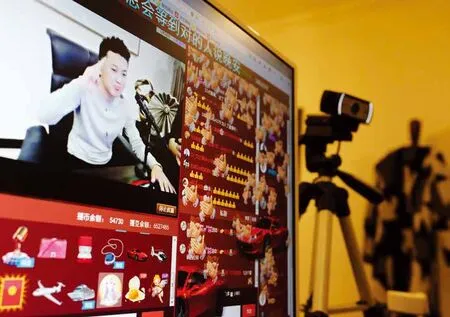
In his studio, producer Dai Rui still performs shows for old time’s sake and to keep his fans happy
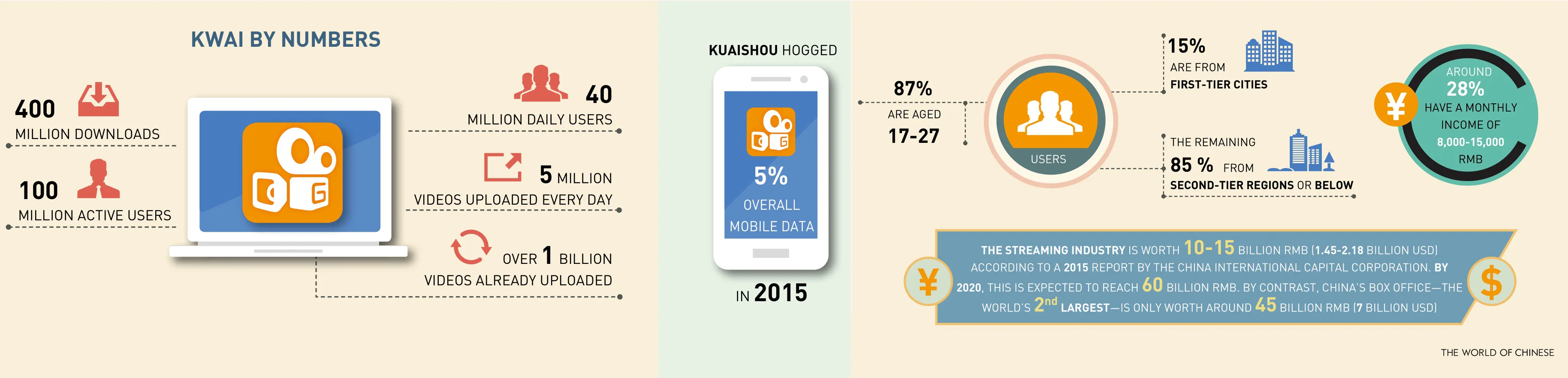
It’s valued at over 2 billion USD, has more users than the population of the US and UK combined, and is the fourth most popular app in China. But if you’ve never heard of the live-streaming app Kuaishou (快手, literally “Fast Hand”), you’re not alone.
On Kuaishou (or Kwai, as the English version is called), the stars are rural nobodies and their acts are worlds apart from the attractive urbanites paid to document branded lifestyles on mainstream apps like UpLive, YY, and Six Rooms, or celebrity app Huajiao. On Kuaishou, instead, there’s the 46-year-old woman who made a living eating everything from light bulbs to bugs and cacti; the heavily obese nine-year-old whose mother filmed him swigging from a beer bottle, carrying a lit cigarette; the 15-year-old proudly displaying her baby bump.
It is characters like these that have earned Kuaishou an unenviable reputation of being coarse and exploitative, an image that its CEO, Su Hua, takes issue with. “In most cases the videos are simple depictions of joyful moments in everyday situations,” Su told the Chinese site TechNode last June.
Kuaishou’s fanbase is the 674 million-strong, lower-middle and working classes from parts of the country rarely depicted on mainstream TV or cinema screens—rural, undeveloped, mostly impoverished. They are the people who deliver your takeouts, serve your meals, manicure your nails and put together your iPhones. And what they sometimes lack in means or sophistication, they often make up for in enthusiasm, humor, innovation, and authenticity.
To many of them, Kuaishou is a celebration of “real China,” as well as a rare, sometimes lucrative opportunity to grab some limelight. Attention seekers perform outlandish stunts for clicks and cash, such as lighting firecrackers on foreheads (or under groins), quaffing down bottles of high-strengthbaijiuor, in the case of one foolhardy foodie in Sichuan, downing a full glass of super-spicy chili oil (he ended up in hospital with severe tonsillitis and a stomach abscess for his troubles).
For less extroverted types, Kuaishou offers a chance to showcase real talent on a platform they can not only control, but directly profit from (fans show their appreciation by donating virtual gifts such as beer, flowers, and fancy cars; these can be converted to real currency, with the proceeds split equally between the recipient and the platform). There are decent earners like Qi Zhi’ang from Liaoning province, who posts videos playing guitar while his mother sings; the 17-year-old easily makes around 20,000 RMB a month from his 65 million paying fans. Or more modest moneymakers like Tangshan taxi driver Zhao Xinlong, who moonlights as Zhao Long’er, nighttime raconteur, cracking ribald jokes to around100,000 viewers who, together with advertisements for health products and Vietnamese “gold,” make him a much-needed extra 6,000 RMB a month, according to The Economist.
And then there are the major players—thewanghong(網(wǎng)紅, “web celebrities”). MC Brother Li dropped out of school at 15 to become a mechanic; the 30-year-old now makes 1 to 1.5 million RMB (146,000 to 218,000 USD) per month performinghanmai(喊麥,“microphone shouting”), loudly rapping over the thumping techno typically found in provincial nightclubs. Aspiring “stream queens”can look to the success of Wen’er, whose energetic chats andhanmaiperformances have earned her 12 million YY followers. Probablyhanmai’s biggest star, though, is MC Tianyou, a working-class northeasterner with over 17 million YY fans and a millionaire lifestyle, who raps about the tribulations of growing up poor and dreaming big in small-town China.
Launched in 2011, Kuaishou’s extraordinary growth had remained largely under the radar of the metropolitan beltway that dominates China’s official media, until last year. In January 2016, China Unicom announced that Kuaishou was generating more traffic on its network than mobile behemoths such as WeChat and Weibo. Then last September, a widely-shared article by Huo Qiming, who runs popular WeChat account “doctorx666”, entitled “The Brutal Grassroots Phenomenon: A Snapshot of China’s Countryside in an App,”finally brought Kuaishou under the mainstream microscope.
Huo used the app’s most extreme content to make a doom-laden if familiar argument about the abject state of China’s provincial interior. Rural education is in a state of crisis with dropout rates for secondary school as high as 63 percent, according to the China Agricultural Policy Research Center, Huo observed. Meanwhile, rural-urban migration and the subsequent dissolution of traditional family units have fostered indifferent attitudes toward education and a lack of parental and social guidance among “l(fā)eft-behind” children (one criticism that’s hard to refute is the extent of content involving minors that might be considered exploitative or even sexually suggestive).
“A lack of cultural nourishment and the absence of any guardians naturally means children’s common contact is with vulgar, brutal things,” Huo wrote. “China’s villages have been sowing a violent seed.” Those who’ve dropped out or failed their exams find themselves easily drawn to shallow fantasies of making quick money on the internet, Huo claimed—the gospel of mindless “might is right”materialism preached by streaming stars such as MC Tianyou.
Observing their lack of representation in popular culture, Huo pointed to the widening urbanrural divide and vast wealth gap as signs of a country increasingly deaf to the lifestyles of the majority of its citizens, questioning whether anyone considers what the isolated lives of the old and left-behind are like, and concluding: “No one cares.”
The regions where Kuaishou is most popular—such as China’s frozen northeast—have much in common with the Rust Belt communities whose fortunes have declined so precipitously in the US over the last two decades. The massive reforms of state-owned industry in the early 1990s saw vast swathes of redundancies, leaving those who’d grown up with “iron rice bowl” futures with neither jobs nor the know-how to find them. For the children of these laid-off industrial workers, a slowing economy has left them little better off than their parents—official statistics predict an annual GDP growth of 6.7 percent, the country’s lowest in decades.
Some parts of the northeast are already in full-blown recession. In 2015, one mining company, theLongmay Group, announced the lay-off of 40 percent of its work force, affecting 100,000 workers at 42 mines in four cities. The price of coal, the lifeblood of China’s industrial heartland, has fallen 60 percent since 2011, according to Shanghai energy consultants ICIS C1 Energy, and strikes and labor protests are on the rise. In former success stories like Shenyang, smoggy capital of Liaoning province, growth has slowed to 3.5 percent amid a housing glut and manufacturing decline. Across provinces like Heilongjiang and Jilin, aging industries like mines and steelmills are shuttering and offering their workers lump sum payoffs. As a result, hundreds of towns and cities face with bleak prospects for employment or income.
It is in such a hardscrabble culture of suburban frustration and small town subsistence that Kuaishou’s users have grown up. For those without the wealth, connections or education to seek better opportunities, Kuaishou gives them a chance to seek out their dreams or demonstrate skills to an audience of millions—a kind of online audition. Self-taught artist and full-time electrician Lu Xiaoyu, for example, managed to secure a number of clients for his 3D drawings and portraits after showcasing them on Kuaishou.
For every success story, however, there are millions more untold failures. And there may be tougher times to come. After years of allowing the live-stream market to flourish unimpeded, the government has stepped in to ensure that its contents remain more in tune with “socialist values.”There have been clampdowns, as well as arrests for producing pornographic content.
Those who do become celebrities through legitimate forms of entertainment such ashanmaiface a fate arguably worse than censorship: indifference. Despite receiving tens of thousands of appreciative clicks for each of her streaming videos,hanmaisinger Wen’er has had little success trying to cross over to mainstream entertainment. In September, she released the original composition “Shengnü Xinjing” (“Heart of a Leftover Woman”) on online music platform NetEase Cloud Music; it garnered just under a hundred comments.
Those who do get attention must also deal with scorn from the elites whose lifestyles they emulate. When GQ magazine profiled MC Tianyou, the backlash from readers was intense: “Disgusting,” commented one. Others wondered why the magazine was bothering to promote such a “shady” character, asking,“Why would you even interview this kind of person?”
The future does not look to be getting any easier for China’s live-streaming hopefuls. Although many breakout stars say they support the new regulations—for one thing, they thin out the competition—the introduction of requirements for streaming platforms to obtain broadcasting licenses this year is likely to have a knock-on effect on both the diversity and interest in apps such as Kuaishou and their aspiringwanghong.
Only the big hitters are expected to survive the impending cull, expert say—and their control of the new media does not bode well for the small-town rookies dreaming of life in the big time. Six Rooms CEO Li Yan, for example, plans to use algorithms and big data to calculate which facets of live streamers are most lucrative—looks, accent, style—and search for performers who fit the “perfect” mould. Live streaming may have started as an upstart revolution against the mainstream, but in the future looks destined to become simply another part of it.
