
Motion Behavior of a Semisubmersible in Freak Waves
2017-05-13 02:33:35DENGYanfeiYANGJianminXIAOLongfeiLIXin
船舶力學 2017年3期
關鍵詞:研究
DENG Yan-fei,YANG Jian-min,XIAO Long-fei,LI Xin
(State Key Laboratory of Ocean Engineering,Shanghai Jiao Tong University,Shanghai 200240,China)
Motion Behavior of a Semisubmersible in Freak Waves
DENG Yan-fei,YANG Jian-min,XIAO Long-fei,LI Xin
(State Key Laboratory of Ocean Engineering,Shanghai Jiao Tong University,Shanghai 200240,China)
The hydrodynamic performance of offshore structures is of great importance for achieving safe and economical designs.In the last few decades,an increasing number of reported accidents due to rough ocean waves call for in-depth investigations on the loads and motions of offshore structures,particularly the effects of freak waves.This paper aims at determining the sea conditions that may cause the maximum motion responses of offshore structures,which have a significant effect on the loads of mooring systems because of their tight relationship.A frequency-domain analysis was conducted to obtain the response amplitude operators(RAOs)of a semisubmersible platform of 500 meters operating depth,comparing with the experimental data.The motion behaviors under the New Year Wave and a‘Three Sisters’wave sequence were investigated with time-domain simulations.Thereafter,a series of predetermined extreme wave sequences with different wave group characteristics, such as the maximum crest amplitude and the time lag between successive high waves,are adopted to calculate the hydrodynamic performance of the semisubmersible with mooring systems.The study shows that the maximum motion responses depend on the largest wave crest amplitudes and the time lags between successive giant waves.This paper provides an important reference for future designs which could consider the most dangerous wave environment.
motion response;semisubmersible;freak wave;frequency-domain;time-domain
0 Introduction
Freak wave is a kind of giant asymmetric transient wave,which was first proposed by Draper[1]in 1965.There is no consensus definition about freak waves and many researchers regarded the rogue waves with the maximum wave height larger than twice the significant wave height and the maximum crest amplitude larger than 0.6 times of the maximum wave height as freak waves[2].In recent years,reports on the occurrence of freak waves and the damages caused by them are not rare[3-5].Therefore,the mechanism of freak waves and their impacts on marine structures are significant factors in offshore engineering researches to ensure a safe and economical design.
New Year Wave[6](Fig.1)is one representative freak wave,in which the significant wave height is Hs=11.92 m,and the maximum wave height is Hmax=2.15Hs,the maximum crest amplitude ηc=0.72Hmax.It was recorded at the Draupner platform located in the North Sea on January 1st,1995.

Fig.1 Registration of the New Year Wave
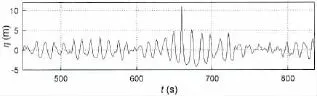
Fig.2 A‘Three Sisters’wave sequence
Extreme waves with several successive high waves(e.g.‘Three Sisters’wave)are a common type of freak waves as well.Wolfram et al[7]made a probability analysis of rogue waves recorded at North Alwyn from 1994 to 1998 and paid attention to the characteristics of waves immediately before and after the rogue wave events.Wolfram et al[7]concluded that the preceding and succeeding waves have steepness values around half the corresponding significant values and their heights are around the significant height.Fig.2 presents a‘Three Sisters’wave sequence which was generated in the wave tank in Shanghai Jiao Tong University and used to describe the extreme wave condition of the southern part of the North Sea.
The characteristics of freak waves suggest that freak waves are dreadful events and their interactions with marine structures should be seriously considered.Concerning the wave loads and motion responses,some meaningful explorations have been done to investigate the characteristics of the wave loads and the key parameters affecting the motion responses.Clauss et al[8]and Fonseca et al[9]studied the structural global loads induced by abnormal waves on a FPSO,and achieved conclusions in common.They revealed that the structural responses to the abnormal waves tightly related to the time and phase information of the wave sequences.Pang et al[10]investigated the nonlinear wave loads on a vertical cylinder of small diameter,and found that the loads under the action of freak waves were highly nonlinear and impulsive.Moctar et al[11]analyzed the effect of freak waves on a mobile jack-up drilling platform with CFD and FEM techniques.He suggested that the strong nonlinearity of wave loads needed special consideration.Chandrasekaran and Koshti[12]investigated the dynamic responses of the Tension Leg Platform(TLP)under the simulated freak wave series and concluded that the heave excitation under freak waves was significant and the TLPs encountered by freak waves were sensitive to the wave directionality effects.Clauss et al[13]studied the motion behavior and structural forces of a semisubmersible GVA 4000 by using both the numerical simulation and model tests and demonstrated the capability of numerical codes based on potential theory.
This paper presents the motion behavior of a semisubmersible under freak wave series with single high wave or successive high waves.Moreover,an in-depth sensitivity study of the wave crest amplitude and time lag between successive high waves was conducted to understand in which situation the maximum motion response occurs.
1 Mathematical formulations
For the numerical investigation of the motion response,the commercial hydrodynamic software SESAM is applied in the present work.A brief description of the relevant solvers with regard to the calculation of motion behaviors is given below.
The SESAM software is based on the potential theory with the governing equation as follows:

It is assumed that the wave is of small amplitude,and the boundary conditions are linear. Hence,based on the linear superposition theory,the total velocity potential Φ can be simply divided into three parts as

where ΦIis the incident wave potential,ΦRis the radiation potential and ΦDis the diffraction potential.
For the Wadam module,it assumed that the structure is experiencing simple harmonic oscillation.The velocity potential can be expressed as the product of spatial velocity potential and time factor and the problem is hence transformed into a steady problem.By applying the Green’s second theorem,the Laplace equation and the corresponding boundary conditions are then transformed into a boundary integral equation(BIE),which can be solved with the boundary element method(BEM).
The time-domain analysis conducted in deep C,a combination of SIMO and Riflex modules,directly solves the dynamic equations.It is allowed to include some of the nonlinearity of the system,such as nonlinear mooring forces,et al.Moreover,time-domain analysis is capable to simulate the motion behavior of the marine structure in a specific sea state.For some specific problems,such as freak waves and greenwater,the time-domain analysis can provide a visual representation of the occurrence of these phenomena and the whole response time series.
Based on the impulse response function[14],the motion of marine structures at any moment is regarded as superposition of a series of impulse motions,and the wave forces are handled in a similar way.The motion equation of time-domain analysis is given by

where mijis the mass matrix,μijis the added mass matrix,Cijis the damping matrix and Lijis the retardation function.
The SESAM software has been successfully used in resolving a large amount of hydrodynamic problems in industry.In this work,the frequency-domain results are presented as RAOs. The time-domain results are analyzed statistically to inspect the influence of wave group characteristics.
2 Description of semisubmersible
To investigate the motion behavior and wave forces,a semisubmersible platform has been selected.The dimensions of the semisubmersible are given in Tab.1.Half of the semisubmersible divided into 1 720 panels,has been modeled because of the structure symmetry of the platform(Fig.3). The mooring system is composed of 12 mooring lines,divided into 4 sets(Fig.4).
This platform had been designed for the South China Sea environment with 500 m water depth.The wave spectrum of operation condition is a Jonswap spectrum with the significant wave height Hs=6.0 m,the peak period Tp=11.2 s and the peakedness factor γ=2.0.
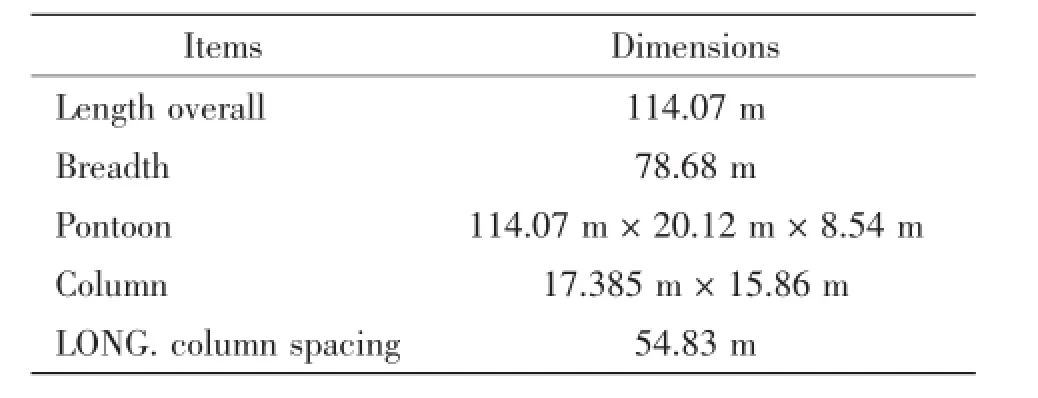
Tab.1 Dimensions of the semisubmersible
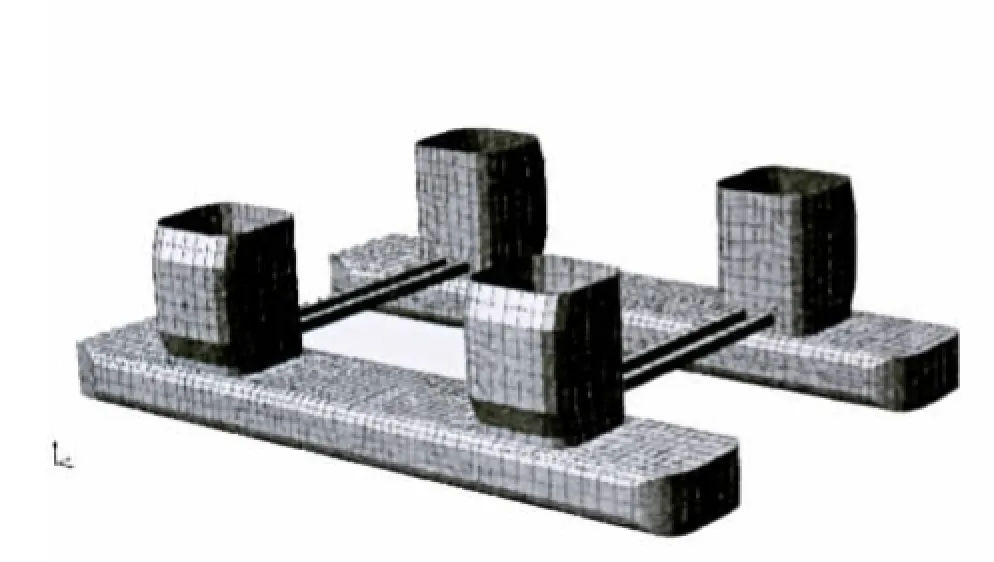
Fig.3 Panel model of semisubmersible
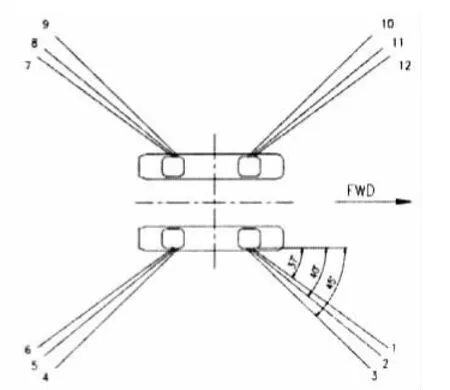
Fig.4 Mooring system arrangement
3 Results and discussions
3.1 RAO results
Frequency-domain analysis is an efficient method to inspect the hydrodynamic performance of marine structures.The present numerical model was validated by comparing the RAOs from frequency-domain calculation with the experimental results.Moreover,the results of frequency-domain analysis are necessary for the time-domain simulation as an input.
Fig.5 presents the numerical and experimental RAOs of surge,heave and pitch of the semisubmersible in head sea(β=180°).The model tests were performed in State Key Laboratory of Ocean Engineering,Shanghai Jiao Tong University.
In Fig.5,the simulated results agree well with the experimental data,both on the magnitude and the trend.It is noted that in ocean engineering,a rough frequency range 0.25 rad/s to 1.57 rad/s is usually regarded as the wave frequency and the frequency below 0.25 rad/s is regarded as low frequency.For surge motion,the RAO shows a large value in low frequencyarea,then sharply decreases as the frequency increases.Therefore,the surge motion has significant response of low frequency.It is due to the fact that the semisubmersible follows the elliptical motion of the water particle which is with a large excursion for very low frequency in shallow water.The heave and pitch motions exhibit the wave frequency characteristics,i.e.,large responses exist within the wave frequency range.The maximum RAO value of heave motion appears at the frequency near the corresponding natural frequency.
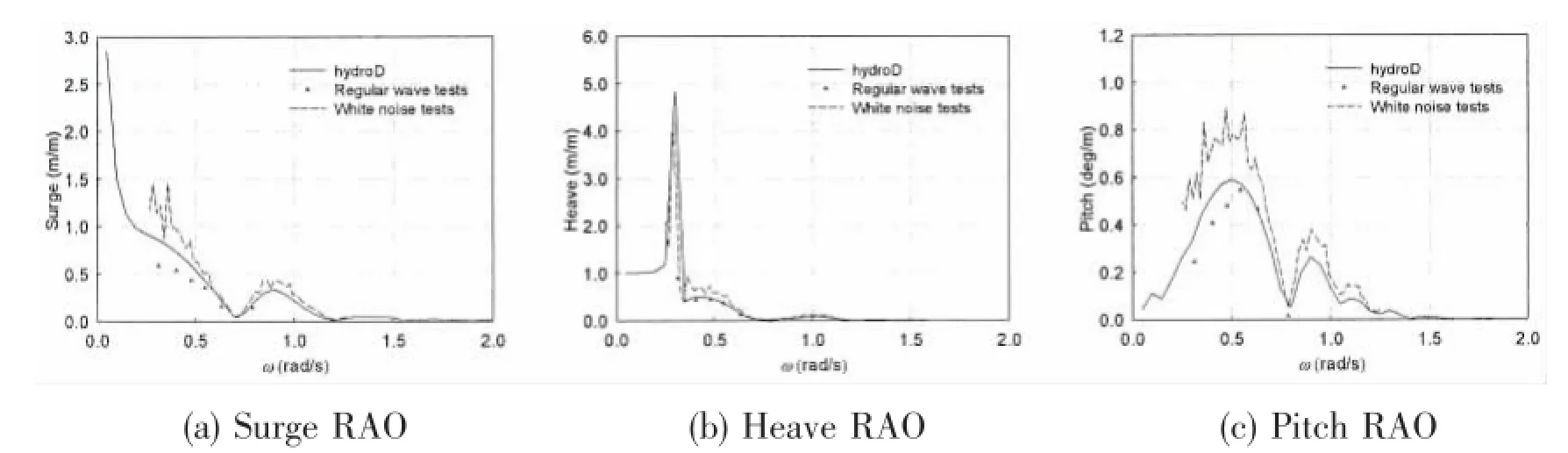
Fig.5 Comparison of RAOs between numerical calculation and experimental data
It is noted that the numerical results reflected the situations of a single semisubmersible in full scale,while the experimental study was carried out with mooring system in model scale. When considering mooring systems in numerical investigations,the results may be a little different. Tab.2 shows the natural periods of the semisubmersible.The experimental results were obtained from the decay tests in the physical basin.It is observed that the numerical results are in good agreement with the experimental data.The natural periods are consistent with the RAO results,i.e.,there are peaks of RAO at the frequency near the natural frequency.
3.2 Motion responses under New Year Wave
In general,the results of frequency-domain analysis are capable to reflect the global hydrodynamic performance of the marine structures.However,the frequency-domain analysis does not account for the mooring systems,the wind and the current environment.Moreover, for the sake of investigating the responses under the extreme sea state with transient high waves,the time-domain analysis is preferred.Statistics such as peak value,maximum double amplitudes,variance and average of responses and the response spectrum are of significance in the design work.
In this section,the nonlinear coupled time-domain analysis was conducted using the deepC module.It is noted that no additional damping was specified in the time-domain analyses besides the radiation damping.Previous research[13]showed that it is acceptable to access the freak wave effects by the time-domain solver based on frequency-domain data,which only considered the 1st order wave force and the mean drift force.To inspect the influence of such a single transient large wave,both the New Year Wave registration and a designed wave sequence in which the single large wave has been clipped are used as the incident waves.For simplici-ty,only the action of waves in head sea is considered in this work.Fig.6 shows the input wave sequences and the corresponding motion responses,in which the blue lines represent the New Year Wave case and the red lines are for the peak-clipped New Year Wave case.
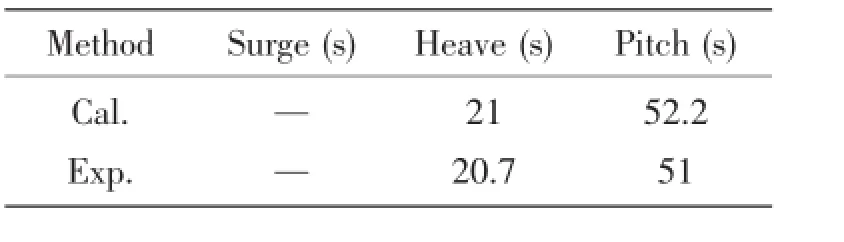
Tab.2 Natural periods of the semisubmersible
As we can see,the surge motion is governed by low frequency motion with the dominant period close to natural period.The wave frequency motion takes the form of small amplitude oscillation on the basis of low frequency motion.Even though the freak wave is a transient process,the results do show that large amplitude appears as the freak wave passes by and it decays as time goes on.More specifically,such a freak wave results in an immediate larger wave-frequency oscillation and a following large low-frequency response amplitude.The horizontal wave forces,including 1st order wave forces and mean drift wave forces,are shown in Fig.7.It is noted that the drift force is obtained by using the far field integration.As shown in the figure,the peak values of 1st order wave force and the drift force are synchronous with the freak wave and directly related to the crest amplitude of the wave sequences.By comparison,the maximum 1st order force of New Year Wave case is almost twice as large as that of the peak-clipped case and the mean drift force is much larger as the large wave exists,which is of the same order of magnitude as the 1st order force.In brief,the freak wave induces large horizontal forces for its large wave amplitude,which might be a direct reason for the large surge response.However,further investigations are needed to clarify how such a transient large wave affects the low-frequency surge motion.
For heave motion,the dominate frequency is the peak frequency of RAO,which is within the wave frequency range.The heave motion presents obvious wave frequency characteristics. A sudden large heave motion appears at the occurrence of freak wave and followed by a decay process.The maximum magnitude of heave motion is tightly related to the wave amplitude. The large crest amplitude of freak wave is very likely to cause several successive large heave oscillations.
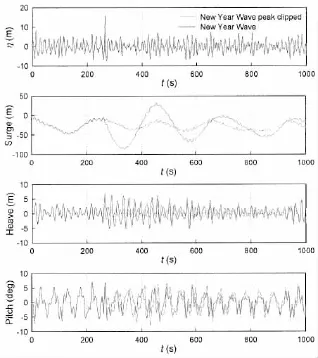
Fig.6 Motion responses of the original New Year Wave and the peak-clipped New Year Wave sequences
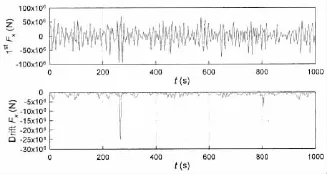
Fig.7 Horizontal wave forces of the original New Year Wave and the peak-clipped New Year Wave sequences
The pitch motion shows obvious wave frequency characteristics,accompanied by a relatively low frequency drift,which is consistent with the RAO results.When encountering the freak wave,a sudden pitch motion occurs.Though the crest value is not necessarily the largest, the large fluctuation is within a wave period,which is a very short duration.
Compared with the New Year Wave series,the heave and pitch motions are basically symmetry without a protruding peak.The phenomenon is consistent with published literature[13]. However,the freak wave does always result in a relatively large motion within a short time.It is noted that these transient motions are likely to cause the taut-slack process of the mooring lines.The taut-slack process may bring a huge snap tension,possibly resulting in the damage of mooring lines.As it is tightly related to the large relative movement during a short time, the maximum double amplitude is a significant statistic.
3.3 Motion responses under‘Three Sisters’wave
Also,to investigate the motion behaviors under‘Three Sisters’wave,the fore-mentioned‘Three Sisters’wave was used as an input in the time-domain analysis.Similarly,a peaksclipped‘Three Sisters’wave was designed and adopted for comparison.As shown in Fig.8,the‘Three Sisters’wave contains several successive high waves around an extremely high wave and for the peaks-clipped‘Three Sisters’wave, the peaks of several high waves were clipped.
From Fig.8,we can see that the surge response is significantly influenced by the successive high waves and even changes the direction of low-frequency motion when encountering a‘Three Sisters’wave.Fig.9 presents the horizontal forces due to the‘Three Sisters’wave sequence and the corresponding peakclipped sequence.When the‘Three Sisters’high waves exist,the 1st order wave force is nearly 50%larger and the mean drift force reaches a value of the same order of magnitude as 1st order wave force.
Since there exist several large waves during 650 s to 700 s in both the‘Three Sisters’wave and the peak-clipped sequence,the heave and pitch responses in this region are comparatively large.Moreover,the responses under‘Three Sisters’wave are more severe to acertain degree.
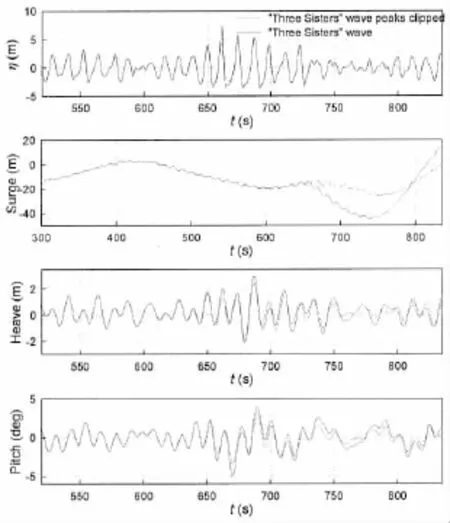
Fig.8 Motion responses of a‘Three Sisters’wave and a peaks-clipped‘Three Sisters’wave

Fig.9 Horizontal wave forces of a‘Three Sisters’wave and a peaks-clipped‘Three Sisters’wave
Discussion above has described the fundamental pattern of the motion responses under the actions of the freak wave and‘Three Sisters’wave sequences.To obtain a comprehensive understand of the impact of freak waves,further investigations about the influences of crest amplitude and the time lag between successive high waves are given below.
3.4 Influence of crest amplitude
To inspect the impact of freak wave crest amplitude,freak wave sequences with varied heights are generated by using an efficient model proposed by Kriebel and Alsina[15].This model embeds a freak wave within a realistic background random sea to maintain the statistical properties.Time-domain analysis of each freak wave sequence in the head sea was carried out and the heave and pitch motion were considered.
Fig.10 presents the overall and detailed time series of wave and responses for a comparison of situations with different crest amplitudes.The heave and pitch motions are directly related to the crest amplitude of freak wave series and the follow up wave response has been affected.
To acquire a quantity relation between the maximum double amplitude of heave and pitch,Fig.11 summarizes the statistics of wave series and the response results.Overall,the maximum double amplitudes of both heave and pitch grow linearly as the wave crest amplitude increases.
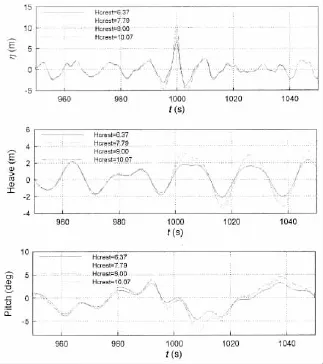
Fig.10 Comparison of motion behavior in freak wave sequences with varied crest amplitude:Wave sequence,heave,pitch
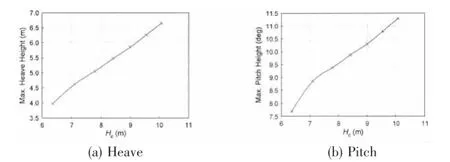
Fig.11 Relations between maximum double amplitudes and maximum wave crest amplitude
As the heave and pitch motions primarily dominated by wave frequency components, no resonance appears under the action of freak wave with single high wave.
3.5 Influence of time lags between successive high waves
The results in Fig.11 show that the maximum double amplitudes of heave and pitch mo-tion are directly related to the crest amplitudes of freak wave sequences with single high wave. However,it remains a question about what will happen under the action of freak waves with successive high waves,i.e.‘Three Sisters’waves.
A series of wave sequences with three high waves were designed for the simulation using the model developed by Kriebel and Alsina[15].These freak wave sequences are with a large peak of 9 m and two sub-peaks of 6 m, and the time lags between the high waves are varied from 6 s to 40 s.Part of these wave sequences are displayed in Fig.12.
Fig.13 shows the relations between maximum motion responses and the time lags of successive high waves.For heave motion,the maximum heave double amplitudes are plotted versus the normalized time lags to inspect the effect of the corresponding natural period.It is clear that the heave motions under the action of Three Sister Waves have tight relation with the time lags.Specifically,the maximum double amplitude of heave motion appears when the time lag is close to the integral multiple of the natural period and the trough appears at odd multiple of half period.It means that resonance happened to a certain degree for the heave motion under the action of Three Sister waves.As refer to the RAO of pitch motion in Fig.5, there are several obvious peaks at 50.24 s,12.56 s,and 6.98 s.As a result,the regularity between the maximum double amplitude of pitch motion and time lags is not as clear as the heave motion.However,large values can still be found at time lag 12.56 s.Therefore,the pitch under the action of‘Three Sisters’waves is sensitive to the time lag as well as the heave motion.
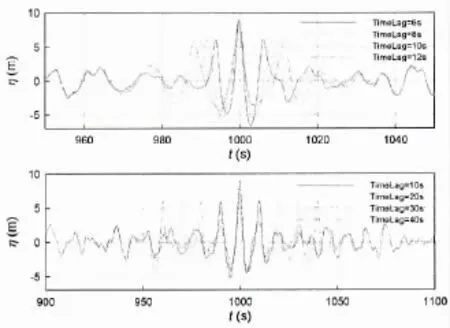
Fig.12‘Three Sisters’wave sequences with varied time lags between high waves

Fig.13 Relations between maximum double amplitudes and time lags of successive high waves
4 Conclusions
For the sake of investigating the impact of freak wave sequence on the motion behavior of a semisubmersible,frequency-domain analysis and time-domain simulation of platform’smotion under the action of New Year Wave are conducted.A series of freak wave sequences with different wave crest amplitudes and different time lags between successive high waves are generated as inputs of the time-domain-analysis,in order to inspect the cause-and-effect relation between the freak wave and the motion behavior of a semisubmersible.Some conclusions are drawn as follows.
(1)The RAO results from frequency-domain analysis agree well with the experimental data.
(2)The freak wave results in much larger 1st order wave force and mean drift wave force, hence leading to a much larger low-frequency surge amplitude.When the freak wave passes by,large relative heave motions and a sudden pitch response occur as well.
(3)The maximum double amplitudes of heave and pitch responses increase linearly as the crest amplitudes of freak wave sequences increase.
(4)Moreover,for the freak wave sequences with several successive high waves,the maximum double amplitudes of heave and pitch responses are directly related to time lags between adjacent high waves and corresponding natural periods.
The transient large amplitude motion of a semisubmersible is highly hazardous to the mooring systems for the taut-slack process.The sudden large displacement in heave and pitch needs serious concern.The low frequency drift motion is tightly related to the tension of mooring lines.Therefore,further investigation is required to inspect the impact of freak wave on the surge motion.
[1]Draper L.Freak wave[J].Marine Observer,1965,35(2):193-195.
[2]Klinting P,Sand S E.Analysis of prototype freak waves[C]//SCE Special Conference Nearshore Hydrodynamics,OH, USA.Dansk Hydraulisk Inst.,Hoersholm(Denmark),1987:618-632.
[3]Schulz M.IchSpürte den atem gottes[J].Der Spiegel,2001(51).
[4]Clauss G F,Schmittner C E,Hennig J.Systematically varied rogue wave sequences for the experimental investigation of extreme structure behavior[J].Journal of Offshore Mechanics and Arctic Engineering,2008,130(2):21009.
[5]Kharif C,Pelinovsky E,Slunyaev A.Rogue waves in the ocean[M].City:Springer Berlin Heidelberg,2009.
[6]Haver S,Anderson O J.Freak waves:Rare realizations of a typical population or typical realizations of a rare population? [C].The Proceedings of the International Offshore and Polar Engineering Conference.International Society of Offshore and Polar Engineers,2000:123-130.
[7]Wolfram J,Linfoot B,Stansell P.Long-and short-term extreme wave statistics in the north sea[J].Rogue Waves 2000, 2000:341-347.
[8]Clauss G F,Schmittner C E,Hennig J,et al.Bending moments of an FPSO in rogue waves[C]//ASME 2004 23rd International Conference on Offshore Mechanics and Arctic Engineering.American Society of Mechanical Engineers,2004:455-462.
[9]Fonseca N,Guedes Soares C,Pascoal R.Global loads on a FPSO induced by a set of freak waves[J].Journal of Offshore Mechanics and Arctic Engineering,2009,131(1):011103.
[10]Pang H,Zhang Q,Han T,et al.Numerical study of non-linear loads on vertical cylinders in freak waves[C]//The Fourteenth International Offshore and Polar Engineering Conference.International Society of Offshore and Polar Engineers, 2004:497-502.
[11]Moctar O E,Schellin T E,Jahnke T,et al.Wave load and structural analysis for a jack-up platform in freak waves[J]. Journal of Offshore Mechanics and Arctic Engineering,2009,131(2):021602.
[12]Chandrasekaran S,Yuvraj K.Dynamic analysis of a tension leg platform under extreme waves[J].Journal of Naval Architecture and Marine Engineering,2013,10(1):59-68.
[13]Clauss G F,Schmittner C E,Stutz K.Freak wave impact on semisubmersibles-time-domain analysis of motions and forces [C]//The Thirteenth International Offshore and Polar Engineering Conference.International Society of Offshore and Polar Engineers,2003.
[14]Cummins W E.The impulse response function and ship motions[R].David Taylor Model Basin Washington DC,1962.
[15]Kriebel D L,Alsina M V.Simulation of extreme waves in a background random sea[C]//The Tenth International Offshore and Polar Engineering Conference.International Society of Offshore and Polar Engineers,2000:31-37.
畸形波作用下半潛平臺運動響應研究
鄧燕飛,楊建民,肖龍飛,李欣
(上海交通大學海洋工程國家重點實驗室,上海200240)
海洋結構物的水動力性能研究對于安全、經濟的工程設計至關重要。近年來,由海浪巨大波浪引起的事故越來越多地見諸報道,因此,有必要深入研究波浪尤其是畸形波對結構物產生的載荷及運動響應。海上浮式平臺的運動響應與系泊載荷密切相關,而文中的出發點正是研究在何種波浪條件下會引起平臺的最大運動響應。通過對一座設計作業水深為500 m的半潛式平臺進行頻域計算,獲得了平臺在自由漂浮狀態下的響應函數(RAO),并與實驗數據進行了比較。通過時域模擬,獲得了新年波和“三姐妹”波作用下的平臺運動響應,研究了畸形波的存在對于平臺運動的影響。此外,還研究了畸形波中最大波峰值及連續大波的出現間隔對平臺垂蕩和縱搖運動的影響,可為后續研究和工程設計提供參考。
運動響應;半潛式平臺;畸形波;頻域模擬;時域模擬
U661.1
:A
國家自然科學基金重點資助項目(No.51239007)
鄧燕飛(1989-),男,上海交通大學博士研究生;
1007-7294(2017)03-0284-11
U661.1
:A
10.3969/j.issn.1007-7294.2017.03.004
楊建民(1958-),男,上海交通大學教授,博士生導師;
肖龍飛(1973-),男,上海交通大學研究員,博士生導師;
李欣(1975-),女,上海交通大學副教授,博士生導師。
Received date:2016-11-24
Foundation item:Supported by the National Natural Science Foundation of China(Grant No.51239007)
Biography:DENG Yan-fei(1989-),male,Ph.D.,candidate of Shanghai Jiao Tong University,E-mail:dengyanfei@sjtu.edu.cn;
YANG Jian-min(1958-),male,professor/tutor,E-mail:jmyang@sjtu.edu.cn.
猜你喜歡
體育科技文獻通報(2022年3期)2022-05-23 13:46:54
天津外國語大學學報(2021年3期)2021-08-13 08:32:18
遼金歷史與考古(2021年0期)2021-07-29 01:06:54
科技傳播(2019年22期)2020-01-14 03:06:54
遼金歷史與考古(2019年0期)2020-01-06 07:45:20
民用飛機設計與研究(2019年4期)2019-05-21 07:21:24
電子制作(2018年11期)2018-08-04 03:26:04
汽車工程學報(2017年2期)2017-07-05 08:13:02
國際商務財會(2017年8期)2017-06-21 06:14:14
電子制作(2017年23期)2017-02-02 07:17:19

- 船舶力學的其它文章
- Measuring the Acoustic Properties of Underwater Coating Material under Pressure-Acoustic Impedance Method
- Modal Pole Placement for Coupled Structural Acoustic System Based on Reduced Order Model
- Effect of Adiabatic Shear on Penetration Properties of Water-back Plate
- Safety Assessment of An Aging Offshore Jacket Platform by Integrating Analytic Hierarchy Process and Grey Clustering Method
- A Study on Connector Loads of Very Large Floating Structures near Islands and Reefs
- Three Dimensional Crack Path Prediction of Brittle Fracture in Weldment Under Fatigue Load