
自然風化過程對赤泥團聚體有機碳組分的影響
2017-04-10 12:20:22薛生國王瓊麗
生態學報 2017年4期
朱 鋒,李 萌,薛生國,*,鄒 奇,吳 昊,王瓊麗
1 中南大學 冶金與環境學院,長沙 410083 2 中南大學 國家重金屬污染防治工程技術研究中心,長沙 410083
自然風化過程對赤泥團聚體有機碳組分的影響
朱 鋒1,2,李 萌1,薛生國1,2,*,鄒 奇1,吳 昊1,王瓊麗1
1 中南大學 冶金與環境學院,長沙 410083 2 中南大學 國家重金屬污染防治工程技術研究中心,長沙 410083
以華中地區某氧化鋁企業赤泥堆場為研究對象,采集不同時間赤泥堆場(1a,10a,20a)0—20 cm樣品,采用物理分組方法,研究自然風化過程對赤泥團聚體有機碳組分的影響。結果發現,赤泥輕組有機碳分配比例隨堆存時間的延長呈上升趨勢。重組有機碳約占赤泥總有機碳的97.24%—99.11%,以粗顆粒有機碳和礦物結合態顆粒有機碳為主。3種堆存時間(1a,10a,20a)赤泥團聚體顆粒有機碳含量變化范圍分別為1.21—1.85、2.62—2.95、3.52—4.15 g/kg。顆粒有機碳含量在2—1 mm粒級赤泥團聚體中最高,隨赤泥粒級減小而降低,其中礦物結合態顆粒有機碳分配比例最高,游離態顆粒有機碳分配比例最低。這表明自然風化過程增加了赤泥有機碳組分含量,提高了赤泥中有機碳庫的穩定性。
赤泥;自然風化過程;輕組有機碳;重組有機碳;顆粒有機碳;土壤化
赤泥是氧化鋁工業生產過程中產生的高堿性固體廢棄物,生產1.0t氧化鋁約產生1.0—2.0t赤泥,全球氧化鋁企業每年赤泥排放量約為1.2億t[1]。如何大規模處置赤泥成為制約國內外氧化鋁企業可持續發展亟待解決的問題。赤泥資源化利用主要包括建筑材料的制備,有價金屬的回收和環境材料的應用[2]。由于其較高的鹽堿性,赤泥的利用率不到10%,大量赤泥以干法堆存的方式直接排放到赤泥堆場[3]。截止2015年,全球赤泥堆存量已超過34億t[4]。赤泥堆存不僅占用大量土地,而且對赤泥堆場及其周邊環境產生嚴重的大氣和地表水污染[5]。赤泥土壤化是實現赤泥規模化、生態化處置最具前景、且行之有效的方法[6]。赤泥堿性強,鹽分含量高,物理結構差,嚴重限制植物生長[7]。Courtney和Harrington[8]發現石膏和有機堆肥的添加能夠改良赤泥的理化性質,提高赤泥肥力。Jones等[9]發現向赤泥添加有機質和粗顆粒材料改善赤泥的物理性狀,有利于赤泥堆場的植被重建。但改良劑的添加成本高昂,極易帶來二次污染,且難以形成長期穩定的植被[10]。自然風化過程雖然周期較長,但形成植被較為穩定,無二次污染[11- 12]。Santini和Fey[13]通過對圭亞那某堆存超過30a的赤泥堆場開展野外生態調查,發現無需添加外源物質,自然風化過程也能夠改良赤泥堆場,實現鄉土植物的自然演替。Zhu等[14]發現華中某氧化鋁企業赤泥堆場也出現了草本植物的自然定植現象。
赤泥土壤化是通過物理方法、化學方法和生物方法將赤泥轉變為一種類似土壤的生長基質,使其具備植被生長的基本條件[4,15]。Courtney等[16]探究赤泥基質改良過程中的土壤發生現象,認為容重、孔隙度、團聚體穩定性等土壤物理學指標可用于量化赤泥成土過程。Zhu等[14]研究指出,自然風化過程中赤泥有機碳含量逐漸增加,與團聚穩定性呈正相關關系。目前,對于赤泥碳庫的動態過程和穩定機制的研究相對較少[17]。
土壤有機碳是土壤質量和肥力的重要指標[18]。由于土壤有機碳庫是由不同周轉周期的有機碳組分構成,在短時間內對于土壤質量的變化并不敏感。通過密度分組,可以將土壤有機碳分為輕組有機碳和重組有機碳,利用粒徑分組可以分離出土壤有機碳中的顆粒有機碳(53—2000 μm)。土壤輕組有機碳和顆粒有機碳代表土壤有機碳中的非保護有機碳組分,作為土壤碳庫變化的敏感指標,可用于探究土壤碳庫的動態變化特征[19]。依據在土壤母質上的不同位置,土壤顆粒有機碳可以分為游離態顆粒有機碳、閉蓄態顆粒有機碳和礦物結合顆粒有機碳[20]。有機碳的物理分組幾乎不破壞有機碳結構,分離的有機碳組分能夠有效的反映有機碳的結構和功能,尤其是有機碳庫的周轉特征[21]。因此,采用物理分組方法分離土壤有機碳不同組分,對研究土壤有機碳動態變化和固碳機制具有重要意義。已有研究表明,自然風化過程中有機碳含量的變化,對于赤泥物理結構和團聚體穩定性具有重要作用[7]。本研究以自然風化過程中不同堆存時間赤泥為研究對象,應用物理密度分組方法,探究自然風化過程對赤泥團聚體有機碳組分分布的影響,為赤泥團聚結構的形成和有機碳組分的固定提供理論依據。
1 研究區域概況
研究區位于華中某氧化鋁企業赤泥堆場(113°25′ E, 35°24′ N),該區域屬暖溫帶大陸性季風氣候,春夏秋冬四季分明。年平均溫度14 ℃,年平均降水量560 mm。全年分干、濕兩季,降水多出現在6—8月,1月降水量最少。氧化鋁生產過程中排放的赤泥由高架管道運輸到赤泥堆場。
選取3種不同堆存時間(1a,10a和20a)赤泥為研究對象,其中堆存時間為1a和10a赤泥堆場上均無植物生長,堆存時間為20a赤泥堆場上有少量植物生長,包括狗牙根(Cynodondactylon)和龍葵(Solanumnigrum)等。
2 研究方法
2.1 樣品采集
2014年8—9月對赤泥庫區進行系統調查,選取堆存1a赤泥(A),堆存10a赤泥(B)和堆存20a赤泥(C)3塊區域進行樣品采集。每塊區域選取5個點位進行采集,深度0—20 cm。每個點位隨機選取3個重復點采樣,將3個重復點位的樣品混合均勻,采用四分法取1.5 kg左右赤泥樣品作為該點位表層赤泥樣品,裝入樣品袋中,并帶回實驗室。各赤泥樣品經自然風干后,去除石礫及植物根系,過2 mm篩備用。
2.2 赤泥輕組有機碳含量的測定
赤泥輕組有機碳的分離采用Roscoe和Buurman的方法[22]。通過NaI重液(密度為1.8 g/cm3)分離得到赤泥輕組組分和重組組分。兩種組分有機碳含量采用碳氮元素分析儀 (VARIO MAX C/N,德國) 測定(干燒法),并計算兩種組分有機碳含量及分配比例。
2.3 赤泥重組有機碳組分含量的測定
赤泥重組有機碳的分散采用耿瑞霖等的分散方法[23]。通過六偏磷酸鈉(質量分數為0.5%)和超聲分散,得到團聚體內粗顆粒、細顆粒和礦物結合態顆粒,測定各顆粒組分的有機碳含量和分配比例。
2.4 赤泥顆粒有機碳含量的測定
赤泥顆粒態有機碳(POC)按照Cambardella和Elliott的方法[24]。通過六偏磷酸鈉和重液(密度為1.8 g/cm3)分離赤泥樣品得到顆粒有機碳,測定其含量,并計算顆粒有機碳分配比例。
2.5 赤泥團聚體內顆粒有機碳的測定
赤泥團聚體內顆粒有機碳的分離采用Golchin等的方法[25]。分離得到密度小于1.6 g/cm3的游離顆粒有機碳(fPOM<1.6)、密度小于1.6 g/cm3閉蓄態顆粒有機碳(oPOM<1.6)、密度為1.6—2.0 g/cm3的閉蓄態顆粒有機碳(oPOM1.6—2.0)、礦物結合有機碳(Mineral>0.05 mm)和礦物結合有機碳(Mineral<0.05 mm)。測定赤泥團聚體內各顆粒有機碳含量,并計算其分配比例。
2.6 數據處理與分析
數據處理與分析采用Microsoft Excel 2003和SPSS 13.0。不同處理差異顯著性用One-way ANOVA(單因素方差分析)檢驗,多重比較采用Duncan法。雙變量的相關系數為雙變量相關性分析中的Pearson系數。相關圖表在Origin 8.0 中完成。
3 結果與分析
3.1 赤泥團聚體輕組有機碳分布
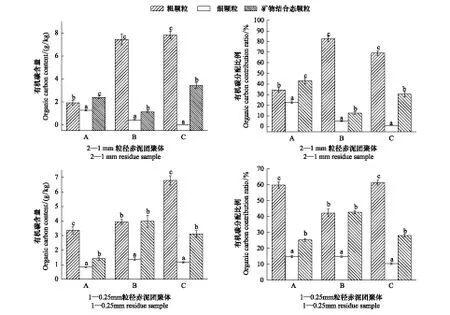
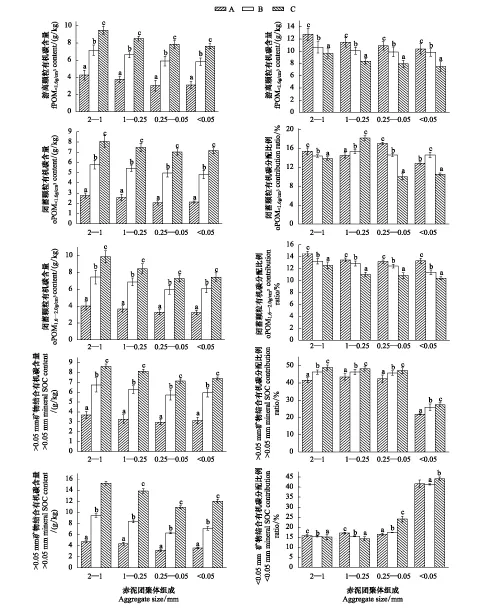
赤泥自然風化過程中赤泥團聚體輕組有機碳(LFOC)含量變化見表1。3種堆存時間(1a,10a和20a)赤泥團聚體輕組有機碳含量變化范圍分別為0.028—0.039、0.029—0.065、0.056—0.241 g/kg。赤泥1—0.25 mm團聚體LFOC含量最高,A、B區域赤泥0.25—0.05 mm團聚體LFOC含量最低,C區域赤泥2—1 mm團聚體LFOC含量最低。自然風化過程中各粒級團聚體LFOC含量大體上達到差異顯著水平(P<0.05),其中赤泥2—1 mm、0.25—0.05 mm團聚體中A組和B組赤泥團聚體LFOC含量差異呈現不顯著水平(P>0.05)。各粒徑赤泥團聚體LFOC含量均表現為A 不同小寫字母表示顯著差異(P<0.05) 表2 自然風化過程中赤泥團聚體輕組有機碳(LFOC)分配比例 不同小寫字母表示顯著差異(P<0.05) 自然風化過程中不同粒級赤泥團聚體LFOC分配比例范圍見表2.A、B、C 3塊區域LFOC分配比例分別為 0.52%—0.71%、0.36%—0.87%、0.77%—2.06%。其中,1—0.25 mm團聚體LFOC分配比例最高,A、B區域赤泥0.25—0.05 mm團聚體LFOC分配比例最低,C區域赤泥2—1 mm團聚體LFOC分配比例最低。自然風化過程中B組和C組赤泥團聚體LFOC分配比例差異均達到顯著水平(P<0.05),其中0.25—0.05 mm、<0.05 mm團聚體中A組和B組赤泥團聚體LFOC分配比例差異呈現不顯著水平(P>0.05)。2—1 mm、0.25—0.05 mm團聚體LFOC分配比例表現為B 3.2 赤泥團聚體重組有機碳分布 赤泥自然風化過程中團聚體重組有機碳(HFOC)含量變化見表3。不同堆存時間赤泥團聚體HPOC含量變化范圍分別為5.36—5.69、7.46—8.49、11.06—12.11 g/kg。A、B區域赤泥均表現為2—1 mm團聚體HFOC含量最高,<0.05 mm團聚體HFOC含量最低。C區域赤泥中0.25—0.05 mm團聚體HFOC含量最高,2—1 mm團聚體HFOC含量最低。各粒徑不同堆存時間A、B、C組赤泥團聚體HFOC含量均達到差異顯著水平(P<0.05)。各粒徑赤泥團聚體HFOC含量均表現為A 表3 自然風化過程中團聚體重組有機碳(HFOC)含量 不同小寫字母表示顯著差異(P<0.05) 赤泥自然風化過程中團聚體重組有機碳(HFOC)分配比例見表4。不同堆存時間赤泥團聚體HPOC分配比例變化范圍分別為99.29%—99.47%、99.13%—99.64%、97.94%—99.23%。不同堆存時間赤泥均表現為1—0.25 mm團聚體HFOC分配比例最低,A、B組赤泥0.25—0.05 mm團聚體HFOC分配比例最高,C組赤泥2—1 mm團聚體HFOC分配比例最高。自然風化過程中赤泥團聚體HFOC分配比例差異均達到顯著水平(P<0.05)。 表4 自然風化過程中團聚體重組有機碳(HFOC)分配比例 不同小寫字母表示顯著差異(P<0.05) 赤泥團聚體有機碳以重組有機碳為主,將2—0.25 mm團聚體重組經過六偏磷酸鈉分散為3種顆粒:團聚體內粗顆粒,團聚體內細顆粒,和礦物結合態顆粒。各顆粒有機碳含量見圖1。2—1 mm和1—0.25 mm赤泥團聚體中主要以粗顆粒和礦物結合態顆粒為主,細顆粒有機碳含量最低。隨著堆存時間增加,粗顆粒有機碳含量增加最為顯著,而細顆粒和礦物結合態顆粒有機碳含量變化并不明顯。赤泥大團聚體重組不同顆粒有機碳中,細顆粒有機碳分配比例最低,礦物結合態顆粒有機碳分配比例次之,粗顆粒有機碳分配比例最高。隨著堆存時間的增加,赤泥大團聚體重組有機碳中細顆粒有機碳分配比例逐漸降低。 3.3 赤泥顆粒有機碳分布 赤泥自然風化過程中團聚體顆粒有機碳(POC)含量變化見表5。不同堆存時間赤泥團聚體POC含量變化范圍分別為1.21—1.85、2.62—2.95、3.52—4.15 g/kg。赤泥顆粒有機碳含量在2—1 mm團聚體中最高,在0.25—0.05 mm團聚體中最少。各粒徑不同堆存時間A、B、C組赤泥團聚體POC含量均達到差異顯著水平(P<0.05)。各粒徑赤泥團聚體POC含量均表現為A 表5 自然風化過程中團聚體顆粒有機碳(POC)含量 不同小寫字母表示顯著差異(P<0.05) 赤泥自然風化過程中團聚體顆有機碳(POC)分配比例見表6。不同堆存時間赤泥團聚體POC分配比例變化范圍分別為21.24—28.65%、20.46—27.28%、25.64—29.16%。不同堆存時間赤泥顆粒有機碳在2—1 mm團聚體中分配比例最高,<0.05 mm團聚體中次之,在0.25—0.05 mm團聚體中分配比例最低。 3.4 赤泥團聚體內顆粒有機碳分布 本文對2—1 mm,1—0.25 mm,0.25—0.05 mm和<0.05 mm赤泥團聚體內顆粒有機碳的物理組分進行相關分析(圖2)。自然風化過程中赤泥團聚體內顆粒有機碳含量均呈增加趨勢。赤泥各粒級團聚體內顆粒有機碳含量由高到低依次為2—1 mm,1—0.25 mm,<0.05 mm,0.25—0.05 mm。赤泥團聚體內各顆粒有機碳中,礦物結合有機碳(Mineral<0.05mm)含量最高,其后依次為閉蓄態顆粒有機碳(oPOM1.6—2.0),游離顆粒有機碳(fPOM<1.6),礦物結合有機碳(Mineral>0.05 mm),閉蓄態顆粒有機碳(oPOM<1.6)含量最低。 圖1 赤泥大團聚體重組不同顆粒有機碳含量及分配比例Fig.1 The content and proportion of organic carbon in the scattered aggregate of the residue aggregate 團聚體組成/mmAggregatesize顆粒有機碳分配比例POCproportion/%ABC2—128.65±1.32b27.28±1.35a29.16±1.08c1—0.2525.78±1.08b23.45±1.64a26.48±1.46c0.25—0.0521.24±0.64b20.46±1.21a25.64±1.22c<0.0528.46±1.48c26.72±1.43a28.12±0.98b 不同小寫字母表示顯著差異(P<0.05) 對于>0.05 mm各粒級赤泥團聚體,礦物結合有機碳(Mineral>0.05 mm)分配比例最高,達到40%—50%。對于<0.05 mm粒級團聚體,礦物結合有機碳(Mineral<0.05 mm)分配比例最高,達到40%—45%。上述結果表明,礦物結合有機碳是赤泥團聚體內最主要的顆粒有機碳。 圖2 赤泥團聚體內顆粒有機碳含量及分配比例Fig.2 The content and proportion of particle organic carbon in residue aggregate 4.1 自然風化過程對赤泥團聚體有機碳物理組分的影響 土壤團聚體輕組有機碳是由處于不同分解階段的植物殘體、真菌菌絲、微生物殘骸以及一些吸附在有機碳碎片上的礦物顆粒組成,其化學成分多為碳水化合物、蛋白、多酚和烷基化合物等,對于土壤結構的形成和穩定,尤其是大團聚體(>0.25 mm)的穩定具有重要的作用,能夠表征土壤物質循環[26]。不同分解階段的地上凋落物和地下根系是土壤輕組有機碳的主要來源[27],赤泥堆場上植被極難存活,僅在堆存20年的赤泥堆場上發現有少量草本植物入侵。因此,赤泥團聚體中輕組有機碳含量極低,分配比例也較少,有機碳組分以重組有機碳為主。相比于A、B區域,C區域赤泥團聚體中輕組有機碳含量和分配比例略微增加,主要原因可能是該區域有少量植物生長,其殘體和根系對赤泥中輕組有機碳的含量有一定的影響,但影響較小。因此隨著堆存時間的增加,赤泥輕組有機碳分配比例整體上變化并不明顯。自然堆存過程中,赤泥理化性質逐漸改善,鹽堿性降低,微生物群落結構和數量可能得到顯著增加,微生物殘骸也可能是導致赤泥團聚體輕組有機碳含量和分配比例增加的原因。 土壤重組有機碳是由輕組有機碳經過徹底分解后殘留或者新合成的、以芳香族物質為主的有機物,主要存在于有機-無機復合體中,結構較為穩定[28]。因此,重組有機碳對于土壤系統變化的反應較輕組有機碳慢,但它能夠更好地反映土壤保持有機碳的能力。自然風化過程中,赤泥總有機碳含量顯著增加,而部分有機碳含量的增加來源于微生物的新陳代謝活動以及植物根系和植物殘體,因此在有植物生長的區域,重組有機碳分配比例較其他區域略低。同時,赤泥團聚體中重組和輕組有機碳含量之和略低于赤泥總有機碳含量,這可能是由于赤泥團聚體有機碳在進行物理分組過程中,部分有機碳被清洗掉,主要為易溶于鹽溶液(NaI)的有機碳,即鹽溶性有機碳[29]。對赤泥重組有機碳分散后的各有機碳含量分析結果表明,重組有機碳主要分布在礦物結合態顆粒和粗顆粒中。粗顆粒在形成過程中,需要更多有機碎片的膠結,因此粗顆粒中有機碳含量較高。礦物結合態顆粒與粘粒能夠相互作用,而粘粒能夠保護有機碳不被分解,因此礦物結合態顆粒具有較高的穩定性,同時粘粒更容易吸附難以被微生物分解的疏水性有機質,促使礦物結合態有機碳更為穩定[30]。 土壤顆粒有機碳含量反映了土壤中非保護有機碳的數量,其分配比例反映了土壤中非保護性有機碳的相對數量。顆粒有機碳比例越高,有機碳中不穩定部分越高。顆粒有機碳受外界條件的影響很敏感,提高土壤顆粒有機碳含量對于提高團聚體穩定性和緩解大氣二氧化碳濃度上升至關重要[31]。研究表明,森林(0—30 cm)土壤顆粒有機碳分配比例為55%—68%[32]。本研究中,赤泥團聚體顆粒有機碳分配比例為20%—30%,表明赤泥中有機碳不穩定部分較低,赤泥團聚體穩定性較差。隨著堆存時間的增加,赤泥團聚體顆粒有機碳分配比例呈現上升趨勢,表明赤泥中不穩定性有機碳含量逐漸增加,有利于提高赤泥團聚體穩定性。顆粒有機碳主要來源于新鮮枯落物的輸入,與新鮮植物殘體的分解速度有關[15]。在A和B區域赤泥堆場無植物生長,在C區域赤泥堆場也僅由少量植物生長。因此,隨著堆存時間的增加,盡管赤泥顆粒有機碳含量逐漸增加,顆粒有機碳分配比例變化并不明顯。 土壤有機碳庫分為周轉時間較短的活性碳庫和周轉時間較長的穩定碳庫,土壤有機碳庫的變化主要表現為活性有機碳庫的變化。輕組有機碳和顆粒有機碳代表了土壤有機碳中的非保護性組分,其活性較強,而重組有機碳屬于土壤穩定碳庫[21]。赤泥團聚體中輕組有機碳分配比例極低,以重組有機碳為主,這表明研究區域赤泥團聚體有機碳較為穩定。隨著堆存時間的增加,赤泥輕組有機碳和顆粒有機碳分配比例基本保持不變,表明赤泥有機碳庫變化較小,赤泥保持有機碳能力較強。 4.2 自然風化過程對赤泥團聚體內顆粒有機碳的影響 土壤團聚體內顆粒有機碳對于微團聚體形成和穩定,以及微團聚體對有機碳儲備和穩定具有重要作用。Six等[33]研究表明,土壤微團聚體保護的顆粒有機碳能夠形成一個有機碳庫,對于外界生態系統的變化較為敏感,是描述土壤有機碳儲備的指標。 隨著堆存時間的增加,赤泥團聚體內游離顆粒有機碳含量顯著增加,這表明自然風化過程促進赤泥團聚體內游離顆粒有機碳含量的增加。同時,赤泥團聚體游離顆粒有機碳(fPOM)含量隨粒徑的減小呈現下降趨勢,在2—1 mm和1—0.25 mm粒級團聚體中含量最高。此研究結果與Saha等[34]等一致,認為土壤團聚體游離顆粒有機碳含量的比例依賴于土壤團聚體顆粒的大小,且土壤團聚體內游離顆粒有機碳含量主要積累于>1 mm大團聚體中。在土壤中,游離顆粒有機碳含量主要取決于分解速度,以及凋落物的多少[35],微生物的活性可能更有利于土壤游離顆粒有機碳在土壤中的積累[36]。自然風化過程中,赤泥堆場原生植物極少,微生物的活性對于游離顆粒有機碳的積累作用可能更為明顯。在C區域赤泥堆場出現少量草本植物的生長,植物根系的存在和葉片的凋落也影響著赤泥團聚體內游離顆粒有機碳的含量和分布。 土壤閉蓄態顆粒有機碳(oPOM)是有機碳中相對不穩定的組分,是土壤全碳變化的一個重要指標[37]。研究結果表明,赤泥團聚體閉蓄顆粒有機碳含量(oPOM<1.6+ oPOM1.6—2.0)高于赤泥團聚體游離顆粒有機碳含量。Golchin等[38]通過對澳大利亞五種自然土壤有機碳分析,發現包含在密度組分中的有機物質的分解程度的增加順序為fPOM 隨著堆存時間的增加,赤泥團聚體內礦物結合有機碳含量逐漸增加,在赤泥團聚體內顆粒有機碳組分中,礦物結合有機碳分配比例最高,這表明自然風化過程對赤泥團聚體內礦物結合有機碳分布特征具有一定影響,赤泥團聚體內顆粒有機碳逐漸趨于穩定。赤泥團聚體內礦物結合有機碳含量隨著團聚體粒徑減少而逐漸下降,這一結果符合土壤團聚體等級形成概念,微團聚體與粘粒在有機質和多價陽離子粘結條件下形成較大一級的團聚體,因此大團聚體中有機碳含量高于微團聚體[39]。礦物結合有機碳比閉蓄顆粒有機碳更為穩定,不易被微生物分解,因此在本研究中,赤泥團聚體內礦物結合有機碳分配比例最高。團聚體內礦物結合有機碳貢獻率的變化取決于土壤母質,赤泥堆場在氣候條件及微生物等外界因素作用下,理化性質發生了較大改變,因此其貢獻率也出現了很大的變化。自然風化過程中,赤泥理化性質得到改良,微生物對活性有機碳的分解,使得赤泥團聚體內礦物結合有機碳含量顯著增加,分配比例也呈上升趨勢。本研究中赤泥團聚體內礦物結合有機碳(Mineral<0.05 mm)的貢獻率在微團聚體中比大團聚體中更為明顯,這與一些土壤有機碳含量較低的農田土壤的相關研究結果類似,礦物結合有機碳(Mineral<0.05 mm)多存在于<0.25 mm團聚體中[33]。 自然風化過程不僅提高了赤泥總有機碳含量,也增加了赤泥團聚體水平中有機碳不同組分的含量,對赤泥團聚體各有機碳物理組分分配比例產生極大的影響。隨著堆存時間的增加,赤泥活性有機碳庫變化較小,且以穩定有機碳庫為主,赤泥有機碳趨于穩定。自然風化過程改變了赤泥有機碳組分的結構、穩定和功能,影響了赤泥碳庫的穩定,對于赤泥物理結構的改變和鄉土植物的自然定植具有重要意義。 (1)自然風化過程中,赤泥輕重組有機碳組分含量顯著增加,重組有機碳分配比例均在97%以上,以粗顆粒有機碳和礦物結合態顆粒有機碳為主,細顆粒有機碳含量最低; (2)赤泥團聚體顆粒有機碳分配比例為20%—30%,隨著堆存時間的增加,赤泥團聚體顆粒有機碳分配比例呈現上升趨勢; (3)隨著堆存時間的增加,赤泥團聚體內顆粒有機碳各組分含量逐漸升高。礦物結合有機碳分配比例最高,其次是閉蓄態顆粒有機碳,游離態顆粒有機碳分配比例最低。 [1] Pan X L, Yu H Y, Tu G F. Reduction of alkalinity in bauxite residue during Bayer digestion in high-ferrite diasporic bauxite. Hydrometallurgy, 2015, 151: 98- 106. [2] Santini T C, Kerr J L, Warren L A. Microbially-driven strategies for bioremediation of bauxite residue. Journal of Hazardous Materials, 2015, 293: 131- 157. [3] Liu W C, Chen X Q, Li W X, Yu Y F, Yan K. Environmental assessment, management and utilization of red mud in China. Journal of Cleaner Production, 2014, 84: 606- 610. [4] Xue S G, Zhu F, Kong X F, Wu C, Huang L, Huang N, Hartley W. A review of the characterization and revegetation of bauxite residues (red mud). Environmental Science and Pollution Research, 2016, 23(2): 1120- 1132. [5] Kaur N, Phillips I, Fey M V. Amelioration of bauxite residue sand by intermittent additions of nitrogen fertiliser and leaching fractions: the effect on growth of kikuyu grass and fate of applied nutrients. Science of the Total Environment, 2016, 550: 362- 371. [6] Jones B E H, Haynes R J. Bauxite processing residue: a critical review of its formation, properties, storage, and revegetation. Critical Reviews in Environmental Science and Technology, 2011, 41(3): 271- 315. [7] Zhu F, Zhou J Y, Xue S G, Hartley W, Wu C, Guo Y. Aging of bauxite residue in association of regeneration: a comparison of methods to determine aggregate stability & erosion resistance. Ecological Engineering, 2016, 92: 47- 54. [8] Courtney R, Harrington T. Growth and nutrition ofHolcuslanatusin bauxite residue amended with combinations of spent mushroom compost and gypsum. Land Degradation & Development, 2012, 23(2): 144- 149. [9] Jones B E H, Haynes R J, Phillips I R. Addition of an organic amendment and/or residue mud to bauxite residue sand in order to improve its properties as a growth medium. Journal of Environmental Management, 2012, 95(1): 29- 38. [10] Banning N C, Sawada Y, Phillips I R, Murphy D V. Amendment of bauxite residue sand can alleviate constraints to plant establishment and nutrient cycling capacity in a water-limited environment. Ecological Engineering, 2014, 62: 179- 187. [11] Bradshaw A. The use of natural processes in reclamation-advantages and difficulties. Landscape and Urban Planning, 2000, 51(2-4): 89- 100. [12] Young I W R, Naguit C, Halwas S J, Renault S, Markham J H. Natural revegetation of a boreal gold mine tailings pond. Restoration Ecology, 2013, 21(4): 498- 505. [13] Santini T C, Fey M V. Spontaneous vegetation encroachment upon bauxite residue (red mud) as an indicator and facilitator of in situ remediation processes. Environmental Science & Technology, 2013, 47(21): 12089- 12096. [14] Zhu F, Xue S G, Hartley W, Huang L, Wu C, Li X F. Novel predictors of soil genesis following natural weathering processes of bauxite residues. Environmental Science and Pollution Research, 2016, 23(3): 2856- 2863. [15] 朱鋒, 韓福松, 薛生國, 郭穎, 李萌, 廖嘉欣. 氧化鋁赤泥堆場團聚體的分形特征. 中國有色金屬學報, 2016, 26(6): 1316- 1323. [16] Courtney R, Harrington T, Byrne K A. Indicators of soil formation in restored bauxite residues. Ecological Engineering, 2013, 58: 63- 68. [17] Gr?fe M, Klauber C. Bauxite residue issues: IV. old obstacles and new pathways forinsituresidue bioremediation. Hydrometallurgy, 2011, 108(1- 2): 46- 59. [18] 吳敏, 劉淑娟, 葉瑩瑩, 張偉, 王克林, 陳洪松. 喀斯特地區坡耕地與退耕地土壤有機碳空間異質性及其影響因素. 生態學報, 2016, 36(6): 1619- 1627. [19] 雷利國, 江長勝, 郝慶菊. 縉云山土地利用方式對土壤輕組及顆粒態有機碳氮的影響. 環境科學, 2015, 36(7): 2669- 2677. [20] 陳茜, 梁成華, 杜立宇, 陳新之, 王峰. 不同施肥處理對設施土壤團聚體內顆粒有機碳含量的影響. 土壤, 2009, 41(2): 258- 263. [21] 張軍科, 江長勝, 郝慶菊, 吳艷, 謝德體. 耕作方式對紫色水稻土輕組有機碳的影響. 生態學報, 2012, 32(14): 4379- 4387. [22] Roscoe R, Buurman P. Tillage effects on soil organic matter in density fractions of a Cerrado Oxisol. Soil and Tillage Research, 2003, 70(2): 107- 119. [23] 耿瑞霖, 郁紅艷, 丁維新, 蔡祖聰. 有機無機肥長期施用對潮土團聚體及其有機碳含量的影響. 土壤, 2010, 42(6): 908- 914. [24] Cambardella C A, Elliott E T. Particulate soil organic-matter changes across a grassland cultivation sequence. Soil Science Society of America Journal, 1992, 56(3): 777- 783. [25] Golchin A, Oades J M, Skjemstad J O, Clarke P. Study of free and occluded particulate organic matter in soils by solid state13C Cp/MAS NMR spectroscopy and scanning electron microscopy. Australian Journal of Soil Research, 1994, 32(2): 285- 309. [26] Sheng H, Zhou P, Zhang Y Z, Kuzyakov Y, Zhou Q, Ge T D, Wang C H. Loss of labile organic carbon from subsoil due to land-use changes in subtropical China. Soil Biology and Biochemistry, 2015, 88: 148- 157. [27] Liu M Y, Chang Q R, Yang X Y. Soil carbon fractions under different land use types in the tablelands of the Loess Plateau. Plant Nutrition and Fertilizer Science, 2010, 16(6): 1418- 1425. [28] Tan Z, Lal R, Owens L, Izaurralde R C. Distribution of light and heavy fractions of soil organic carbon as related to land use and tillage practice. Soil and Tillage Research, 2007, 92(1- 2): 53- 59. [29] 廖敏, 彭英, 陳義, 謝曉梅, 吳春艷, 唐旭, 劉玉學, 楊生茂. 長期不同施肥管理對稻田土壤有機碳庫特征的影響. 水土保持學報, 2011, 25(6): 129- 133, 138- 138. [30] Marín-Spiotta E, Gruley K E, Crawford J, Atkinson E E, Miesel J R, Greene S, Cardona-Correa C, Spencer R G M. Paradigm shifts in soil organic matter research affect interpretations of aquatic carbon cycling: transcending disciplinary and ecosystem boundaries. Biogeochemistry, 2014, 117(2- 3): 279- 297. [31] Beguería S, Angulo-Martínez M, Gaspar L, Navas A. Detachment of soil organic carbon by rainfall splash: experimental assessment on three agricultural soils of Spain. Geoderma, 2015, 245- 246: 21- 30. [32] 董洪芳, 于君寶, 管博. 黃河三角洲堿蓬濕地土壤有機碳及其組分分布特征. 環境科學, 2013, 34(1): 288- 292. [33] Six J, Elliott E T, Paustian K, Doran J W. Aggregation and soil organic matter accumulation in cultivated and native grassland soils. Soil Science Society of America Journal, 1997, 62(5): 1367- 1377. [34] Saha D, Kukal S S, Sharma S. Land use impacts on SOC fractions and aggregate stability in Typic Ustochrepts of Northwest India. Plant & Soil, 2011, 339(1- 2): 457- 470. [35] van Lützow M, K?gel-Knabner I, Ekschmitt K, Matzner E, Guggenberger G, Marschner B, Flessa H. Stabilization of organic matter in temperate soils: mechanisms and their relevance under different soil conditions-a review. European Journal of Soil Science, 2006, 57(4): 426- 445. [36] John B, Yamashita T, Ludwig B, Flessa H. Storage of organic carbon in aggregate and density fractions of silty soils under different types of land use. Geoderma, 2005, 128(1- 2): 63- 79. [37] Conant R T, Six J, Paustian K. Land use effects on soil carbon fractions in the southeastern United States. II. changes in soil carbon fractions along a forest to pasture chronosequence. Biology and Fertility of Soils, 2004, 40(3): 194- 200. [38] Golchin A, Oades J M, Skjemstad J O, Clarke P. Soil structure and carbon cycling. Australian Journal of Soil Research, 1994, 32(5): 1043- 1068. [39] Bronick C J, Lal R. Soil structure and management: a review. Geoderma, 2005, 124(1/2): 3- 22. Effects of natural weathering processes on the distribution characteristics of organic carbon and its composition in bauxite residue aggregates ZHU Feng1,2, LI Meng1, XUE Shengguo1,2,*, ZOU Qi1, WU Hao1, WANG Qiongli1 1SchoolofMetallurgyandEnvironment,CentralSouthUniversity,Changsha410083,China2ChineseNationalEngineeringResearchCenterforControlandTreatmentofHeavyMetalPollution,CentralSouthUniversity,Changsha410083,China Revegetation is regarded as a promising approach for large-scale remediation of bauxite residue in disposal areas. Formation of an aggregate structure and the dynamic processes of the organic pool are essential factors for achieving revegetation due to the high alkalinity, salinity and poor physical structure of the residues. The physical fractionation of organic carbon may identify specific organic carbon pools that are responsible for carbon management and control. Physical density fractionation facilitates the separation of soil organic carbon fractions and their associated mineral particles from different locations. Spontaneous vegetation encroachment upon bauxite residue at a disposal area in Central China, over a 20-year period, has revealed that natural soil-forming processes may convert the residues to a soil-like medium. Residue samples from three different stacking ages (1 year, 10 years and 20 years) were collected in order to determine the effects of natural soil-forming processes on aggregate formation and organic carbon fractions. The contents and distribution ratios of light fraction organic carbon (LFOC), heavy fraction organic carbon (HFOC), particulate organic carbon (POC) and POC intra-residue aggregates were determined in this study. The results indicated that the content of organic carbon fractions in bauxite residue increased significantly under natural soil-forming processes. The proportion of LFOC of the total organic carbon was 0.36%—2.06%. With increasing stacking age, the distribution ratio of LFOC increased. Most organic carbon (97.24%—99.11%) was held in the HFOC, which indicated that organic carbon dynamics in the residues were controlled by the behavior of this fraction. In the HFOC, coarse POC and mineral-combined organic carbon predominated, whereas the distribution ratio of fine POC was relatively small. POC content was highest in 2—1 mm residue aggregates and lowest was in the 0.25—0.05 mm residue aggregate ranges in the three different stacking ages 1.21—1.85 g/kg (1 year), 2.62—2.95 g/kg (10 years), and 3.52—4.15 g/kg (20 years). Mean weight diameter was positively correlated with total organic carbon, LFOC, HFOC, and POC (r=0.908**, 0.908**, 0.889**, 0.793**respectively;P< 0.01). The content of free POC, occluded POC, and mineral-combined POC (Mineral: Mineral>0.05 mmand Mineral<0.05 mm) decreased with decrease in aggregate sizes. The order in a diminishing sequence for the distribution ratio of POC intra-residue aggregate size was 2—1 mm, 1—0.25 mm, <0.05 mm, and 0.25—0.05 mm. Among these, mineral-combined POC was the major fraction, and the proportion of free POC was the lowest. Natural soil-forming processes increased total organic carbon and fraction contents, and further enhanced the stability of organic carbon in bauxite residues, which was beneficial for organic carbon sequestration. The findings of this study may provide a theoretical basis for understanding carbon sequestration and contribute to improving the physical structure of bauxite residue. bauxite residue; natural weathering processes; light fraction organic carbon; heavy fraction organic carbon; particulate organic carbon; soil formation 國家自然科學基金面上資助項目(41371475);國家公益性(環保)行業科研專項資助項目(201509048) 2016- 05- 20; 2016- 08- 29 10.5846/stxb201605200976 *通訊作者Corresponding author.E-mail: sgxue70@hotmail.com;sgxue@csu.edu.cn 朱鋒,李萌,薛生國,鄒奇,吳昊,王瓊麗.自然風化過程對赤泥團聚體有機碳組分的影響.生態學報,2017,37(4):1174- 1183. Zhu F, Li M, Xue S G, Zou Q, Wu H, Wang Q L.Effects of natural weathering processes on the distribution characteristics of organic carbon and its composition in bauxite residue aggregates.Acta Ecologica Sinica,2017,37(4):1174- 1183.




4 討論
5 結論
