Full Scale Test on Cost Effective Liquefaction Countermeasure for a Highway Embankment
2017-04-10 18:16:35MitsuOKAMURA
地震研究 2017年1期
Mitsu+OKAMURA

Abstract:Desaturation of ground by air injection attracts considerable attention in recent years as an innovative cost effective technique for liquefaction countermeasureThis paper describes an insitu air injection test which aimed to verify effectiveness of the use of higher air injection pressures to desaturate very wide zone from a single air injectorIn the test,air was injected in liquefiable foundation soils immediately below a highway embankmentObservations revealed that the soil around the injector was desaturated effectively and the zone of influence extended more than 9 m from the injectorThis radius was about 5 times larger than that achieved in the past test,leading to a dramatic reduction in execution cost
Keywords:liquefaction,countermeasure,desaturation,embankment
CLC Number:TU441Document Code:AArticle ID:1000-0666(2017)01-0045-07
Introduction
Liquefaction countermeasure techniques have been used to ameliorate liquefaction resistances of loose sand depositsMost of the techniques,however,are only available for improving foundation soils without any structuresTechniques that are applicable to soils blow existing structures are limited and particular costly,if anyA challenge that geotechnical engineers have been facing is that the remedial countermeasure works for a large number of existing structures including road embankment,river and coastal levees which are susceptible to liquefaction induced damage
Desaturation of ground by air injection(Okamura et al,2011)attracts considerable attention in recent years as an innovative technique for liquefaction countermeasure,largely due to its cost effectivenessThe execution cost of the technique is approximately one-tenth of the other techniques available for soil improvement below existing structuresBut the cost is still too extensive for such long structures as road embankments and river levees,since the volume of liquefiable soils below the linear long structures are hugeThis is because ground improvement for liquefaction countermeasure has never executed for highway embankments
Okamura et al(2011)has conducted insitu tests where air was injected at a depth of 6 m with the injection pressure of 45 kPa(the hydrostatic pressure 32 kPa+ the net injection pressure 13 kPa)in Kochi prefecture,ShikokuThe influence zone where soil was effectively desaturated extended around the injection point with a diameter of about 35 mThe execution cost of the technique at this time was similar to those ground improvement techniques such as sand compaction pilesThis is still far beyond allowable cost to remediate long road embankments which is susceptible to liquefaction damage
Since the material of this technique is air alone,installation cost of injection pipes occupied a larger part of execution cost,more than a halfReduction of the number of injection pipes will make this technique more cost effectiveFor soils directly below high embankments,because of higher effective overburden pressures,air injection with higher injection pressure can be executed without disturbing soilsIt has reported that the higher the injection pressures,the wider the zone of influence around an injection pipe(Yasuhara et al,2008).
This paper describes an insitu air injection test at a highway embankment aiming at verifying the effectiveness of the use of higher air injection pressure to widen the zone of influence and reduce the number of injection pipe by applying a higher injection pressure
1Factors Controlling Liquefaction Resistance of Unsaturated SandExistence of air in pores of soil is considered to enhance a liquefaction resistanceAir in the pores plays a role of absorbing generated excess pore pressures by reducing its volumeChange in volume of the pore fluid,that is air water mixture,may be the factors dominating this mechanism
Considering a soil mass of its pore filled with air and waterFor a small change in the pore pressure Δp,we obtain the volumetric strain of the soil using the Boyles law as Where p0 and e denote the pressure of the fluid and the void ratio of the soil mass respectivelyIn the above equation,compressibility of soil grain and water is ignoredThe highest value of the volumetric strain for a soil is achieved when the Δp attains its possible maximum value which is equal to the effective confining stress σc′This highest value of the volumetric strain is hereafter termed as the potential volumetric strain,εv*
Effects of the factors appeared in Eq(1)were individually investigated through a series of triaxial tests on Toyoura sand specimens at a relative density of 40%Three testing parameters including the initial effective confining pressure,σc′,the buck pressure and the degree of saturation Sr,were varied between tests while the void ratio of the specimens was kept as a constant throughout the test seriesIt should be noted that the back pressure p0,is the absolute pressure instead of the ordinary used gauge pressureIt was found that the liquefaction resistances of the partially saturated sand increase with the initial confining pressures,with the liquefaction resistances being higher for lower SrAlso the liquefaction resistance depends on the back pressure;the liquefaction resistance decreases as the pressure increases(Okamura,Soga,2006).
The liquefaction resistance ratio,which is the liquefaction resistance of partially saturated sand normalized with respect to that of fully saturated sand,is plotted against the potential volumetric strain in Figure 2All the data lies along a unique curve,confirming that the potential volumetric strain is the determining factor of the effect of degree of saturation on this specific sand at relative density of 40%It was also found that data retrieved from literature,which was obtained from tests on specimens prepared using different sand at different relative densities and at different confining pressures,lies along the same curve(Okamura,Soga,2006).This indicates that the effect of the degree of saturation on liquefaction resistance is dominated by the factor εv
The test was conducted at a construction site of highway embankment of the West Nippon Expressway Company near the mouth of Imagiri River,Tokushima prefecture,as shown in Figure 1
Figure 3 indicates the soil profile at the siteAlluvium loose sand deposit extends from the surface to the depth of about 12 mThis layer was judged liquefiable and set as the target layer of desaturation by air injectionFines content of the layer was mostly lower than 20% and several thin clay seams being sandwichedThe ground water table was below 05 m from the surfaceSoil water retention characteristics were tested on disturbed samples with a pressure plate apparatus and the minimum pressure observed at the onset of drainage,recognized as an air entry value,was in a range between 1 kPa to 10 kPa
Figure 4 shows a more detailed boring log and locations of air injectorsThere were several thick clay seams at the depths of 5 m and between 9 m and 12 mAs these clay seams were expected to impede upward flow of injected air,injectors were set at several depths so that the whole the sand layer can be desaturatedIn order to monitor the evolution of desaturated zone during injection,electrodes were installed at intervals of 25 m in plan and 05 m in depthElectric resistivity of soil depends on several parameters including water content,void ratio,temperature,ionic content,resistivity of solid phase,particle size and pressureThe influences of these factors on the resistivity may be dissimilar among different soil types,however,desaturation technique by air injection does not alter these parameters with only exception of volumetric water content(degree of saturation).Therefore,change in the electric resistivity during air injection is expected to be uniquely related to change in the degree of soil saturation
22Air Injection
Air injection was conducted one by one from each air injectorIn this paper,two injection processes at a depth 83 m in the A-1 hole and 82 m in the S-1 hole are discussedThe photo of the injection controlling system at the site was depicted in Figure 5In the injection test,injection air pressure increased gradually until injected air started flowing into soilThe pressure was found to be 80 kPa
Figure 1Locations of the expected Nankai Earthquake
and Shikoku where insitu tests were conductedFigure 2Relationship between potential volumetric
strain and liquefaction resistance ratioFigure 3Soil profile at the test siteFigure 4Arrangement of air injectors and electrodesFigure 5Air injection system at the siteAt the injection point,the effective vertical stress and the hydrostatic pressure were approximately σv′=100 kPa and Phyd= 75 kPa,respectivelyThe injection pressure increased further to 150 kPa,which is sum of Phyd and two thirds of σv′Figure 6 depicts time histories of injection pressures and flow rateAir flow rate increased with time while the pressure was kept to be constant,suggesting that the desaturated zone expanded and degree of saturation of soil in the zone decreasedFigure6Time histories of pressures and
flow rate of injected air23Results and Discussions
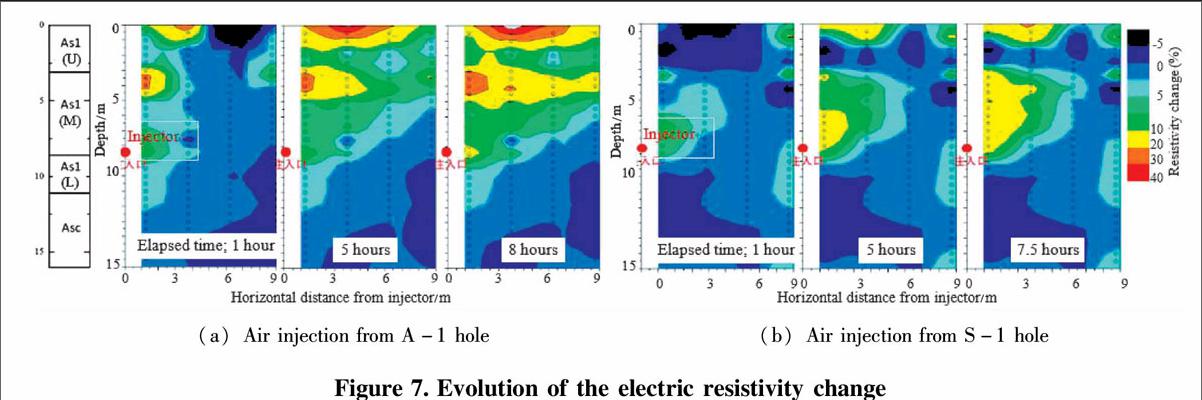
Figure 7 indicates variations in the electric resistivity change(ρa-ρb)/ρb observed during injection at 83 m in A-1 hole,where ρa and ρb denote the pre and postinjection resistivity,respectivelyThe yellow and red zones in the figure corresponds to resistivity increase due to the decrease in degree of saturation by the air injectionThe desaturated zone seems to have extended diagonally upwards from the injection point with timeAt 75 hours after initiation of injection,the zone of influence at the depth of injection point extended about 5 m and more than 9 m at a shallower depthMore than 16 hours after halting the injection at the A-1 hole,which was considered to be long enough to dissipate excess pore pressures,very similar injection test was conducted from the S-1 hole Although the zone of influence was somewhat narrower than the injection from the A-1 hole,soils in the radius of 5 m was effectively desaturated in 65 hours
(a)Air injection from A-1 hole(b)Air injection from S-1 holeFigure 7Evolution of the electric resistivity changeThe diameters of the zone of influence attained in the tests are more than three times larger than that observed in the previous test at the Kochi site(Okamura et al,2011).This means that the number of boring wholes for air injector can be reduced less than one ninth,resulting in very significant reduction in execution costThe most important difference in test conditions between this study and Kochi site is the net injection pressure,ieair pressure at an injector minus hydrostatic pressureSince injected air tends to flow upward owing to the buoyancy force,a higher injection pressure pushes the injected air not only upward but also horizontallyHigher pressure is also effective to desaturate soil more uniformlySince the natural soil is inherently heterogeneous and injected air tends to flow only within preferential path ways where permeability is high and soils outside the ways will be remained in saturated conditionApplication of higher air pressure,that is higher suction pressure,can be effective to reduce such a heterogeneous distribution in degree of saturation in the zone of influence
3Gas-liquid Two-phase Flow Simulation of In-situ Test31TOUGH2 Simulation
Air injection at a certain location underground creates influence zone around the injection pointDuring the air injection,simultaneous flow of water and air occurs,and thus the effects of capillary pressures and the mutual flow interaction between the two phases should be addressed in a computational mannerIn this study,a gas-liquid two-phase simulator TOUGH2(Pruess et al,1999)that accounts for the above requisites was utilized to estimate the extent of the influence zone
In TOUGH2,a mass balance may be expressed in integral form for arbitrary subvolume Vn,bounded by a surface area of Γn,given asddt∫VnMКdVn=∫ΓnFК·ndΓn+∫VnqКdVn(2)where К denotes the component,MК is the amount of component К with a dimension of mass per volume,FК is the flux of component К,n is the outward unit vector normal to the volume surface,qК is the rate of generation of component К within the volume
Eq(2)is discretized in space to numerically solve multiphase flow processesAfter discretized as a first-order finite difference,the flux and sink and source terms are evaluated at the next time stepAn iterative procedure is adopted to solve in time until a prescribed time
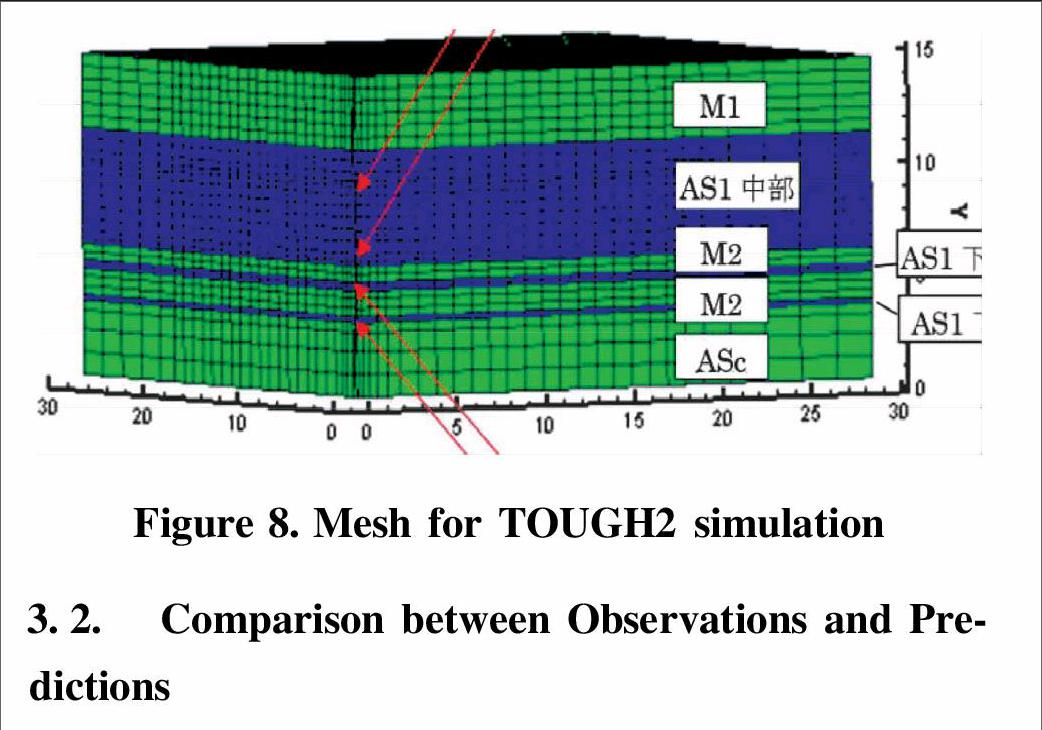
The simulated domain with a dimension of 28 m wide and 13 m deep has no-flow boundaries for both water and air except a top surface boundary open for flow,and has be five different layers as shown in Figure 8,compatible to Figure 3Air pressure exerted at injection points is fixed to 150 kPa following the in-situ test conditionThe hydraulic conductivity for each layer was evaluated by constant-head permeability tests using the boring samplesThe relation between the capillary pressure and the degree of saturation for each layer was determined through soil water retention experiments,together with the well-fitted predictions
Figure 8Mesh for TOUGH2 simulation32Comparison between Observations and PredictionsPredictions of the evolution in degree of saturation utilizing the ground model and parameters constrained in the previous section are shown in Figure 9A desaturated bulb augments as the prediction proceeds both upward and laterally,and upward evolution is impeded by the bottom of clay layer at -31 mThis is quite similar to that observed in the injection from S-1 holeAlthough insitu observations did not provide magnitude of degree of saturation,observed electric resistivity(Figure 7)and simulated degree of saturation(Figure 9)are qualitatively quite comparable This indicates that the model may be capable of predicting desaturation processes mediated by air injectionFigure 9Predicted evolution in degree of saturation during air injection under arbitrary conditions,and be applicable to field problems as flow characteristics are identified
4Conclusions
In this study,an insitu air injection test was conducted which aimed to examine the effectiveness of the use of higher air injection pressures to desaturate very wide zone from a single air injectorIn the test,air was injected in liquefiable foundation soils immediately below a highway embankment with the net injection pressure as high as 75 kPaObservations revealed that soils around the injector effectively desaturated and the zone of influence extended more than 5 m from the injectorThis radius is about 3 times larger than that achieved in the past test,leading to a dramatic reduction in execution cost
The insitu injection tests were numerically simulated with a gas-liquid two phase flow simulator TOUGH2The simulated desaturated zone augments as time in very similar manner to the evolution of observed electric resistivity changeThe simulator may be capable of predicting desaturation processes mediated by air injection under arbitrary conditions,and be applicable to field problems as flow characteristics are identified
References:
Japanese Geotechnical Society.1998.Remedial measures against soil Liquefaction.
KIMURA T.1988.Development of geotechnical centrifuges in Japan[J].Proc Int Conf Centrifuge,98(2):945-954.
OKAMURA M,INOUE T.2012.Preparation of fully saturated model ground[J].Int J Physical Modelling in Geotechnics,12(1):39-46.
OKAMURA M,NOGUCHI K.2009.Liquefaction resistance of unsaturated non-plastic silt[J].Soils and Foundations,49(2):221-229.
OKAMURA M,SOGA Y.2006.Effects of pore fluid compressibility on liquefaction resistance of partially saturated sand[J].Soils and Foundations,46(5):93-104.
OKAMURA M,TAKEBAYASHI M,NISHIDA K,et al.2011.In-Situ Desaturation Test by Air Injection and Its Evaluation through Field Monitoring and Multiphase Flow Simulation[J].ASCE J of Geotechnical and Geoenvironmental Engineering,137(7):643-652.
PURESS K,OLDENBURG C,MORIDIS G.1999.TOUGH2 Users Guide Version 2.0[K].Berkeley,CA,197.
Public Works Research Institute Soil Dynamics Division.1998.Design manual of sheet piling as a countermeasure against liquefaction-induced river dike failure(Revised version)[M].Public Works Research Institute,Ministry of Construction.
SCHOFIDLD A N.1980.Cambridge geotechnical centfifuge operations[J].Geotechnique,30(3):227-268.
Shin-etsu Chemical Co.,Ltd.2010.Metolose Brochure,Cellulose Dept,2-6-1 Ohtemachi,Chiyoda-ku,Tokyo.
YASHUHARA H,OKAMURA M,KOCHI Y.2008.Experiments and Predictions of Soil Desaturation by Air-Injection Technique and the Implications Mediated by Multiphase Flow Simulation[J].Soils and Foundations,48(6):791-804.