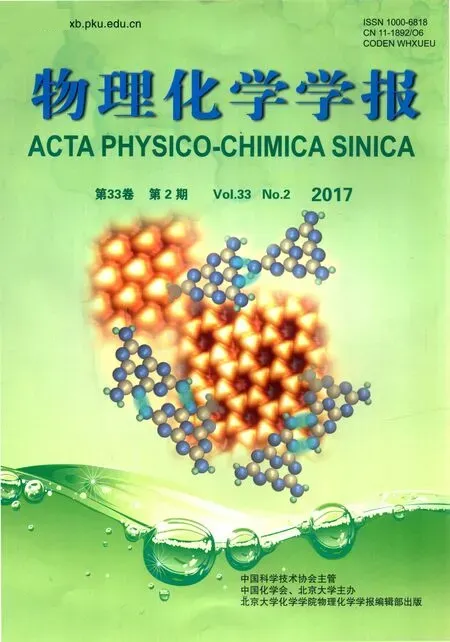
三聚氰胺與蜜勒胺在Au(111)表面的自組裝和氫鍵識別
2017-03-10 08:09:23石何霞王文元
物理化學學報 2017年2期
關鍵詞:結構
王 利 石何霞 王文元 施 宏 邵 翔,2,*
(1中國科學技術大學化學物理系,中國科學院城市污染物轉化重點實驗室,合肥 230026;2中國科學技術大學量子信息與量子科技前沿協同創新中心,合肥 230026)
三聚氰胺與蜜勒胺在Au(111)表面的自組裝和氫鍵識別
王 利1石何霞1王文元1施 宏1邵 翔1,2,*
(1中國科學技術大學化學物理系,中國科學院城市污染物轉化重點實驗室,合肥 230026;2中國科學技術大學量子信息與量子科技前沿協同創新中心,合肥 230026)
三聚氰胺和蜜勒胺(即三聚氰胺的三聚體)均為合成石墨型氮化碳(g-C3N4)的前驅體分子,具有與不同相 g-C3N4的結構基元類似的骨架結構。本文利用低溫掃描隧道顯微鏡(STM)對比研究了三聚氰胺與蜜勒胺在Au(111)表面上的自組裝結構,并對兩種分子可能形成的氫鍵類型進行識別。研究發現,三聚氰胺在表面上僅有一種氫鍵方式,形成兩種組裝結構;而蜜勒胺卻可以形成三種類型的氫鍵,并組裝成六種有序結構,而且不同類型的氫鍵在表面的比例隨著分子在表面覆蓋度的變化而變化。特別的,有些氫鍵類型之間可以在探針作用下發生轉變。這些研究結果將為利用氫鍵構建和調控表面功能性納米結構提供新方法,同時也為研究g-C3N4的表面原位合成及相關理化性質打下基礎。
三聚氰胺;蜜勒胺;Au(111);掃描隧道顯微鏡;氫鍵;自組裝
1 Introduction
Two-dimensional(2D)self-assembled porous networks of organic molecules have gained substantial interests due to their versatile applications serving as templates,receptors and mi-croreactors1,2.Such porous networks can be constructed with various intermolecular interactions including van der Waals interactions3-5,hydrogen bonding6-8,metal coordination9,10,halogen bonding11,12and covalent bonding13,14etc.Hydrogen bonding(HB) in particular,has been widely investigated in tuning the molecular ordering in one-dimensional throughout three-dimensional systems.
Melamine(1,3,5-triazine-2,4,6-triamine,Fig.1a)has a triazine structure with three terminal amino groups and is widely used as an archetypical building block of hydrogen bonding networks. It has been found to form highly ordered hexagonal structure on Au(111)15and Ag(111)16,and was also frequently utilized to construct multicomponent 2D porous networks with other molecules such as perylene tetra-carboxylic di-imide(PTCDI)6,7, perylene tetra-carboxylic di-anhydride(PTCDA)17and cyanuric acid(CA)18-23etc.These co-assembly structures have been successfully applied to control the deposited guest molecules such as C60and thiols6,7.In addition,melamine can form two dimensional covalent structures through the polycondensation reactions with aldehyde groups and acyl chloride24.
Melem(2,5,8-triamino-tri-s-triazine,Fig.1(b-d))is a condensed derivative of melamine.It has similar 3-fold symmetry and three amino groups as melamine but with more acceptor sites for hydrogen bonding.However,melem has received much less attention despite its high potential for richer hydrogen bond-based self-assemblies25-28.Moreover,melem has been proved an important intermediate for fabrication of graphitic carbon nitride(g-C3N4)from melamine29.The g-C3N4was recently found an efficient metal-free photocatalytic catalyst for producing hydrogen from water under visible light30.And it has been continuously found with more and more new applications31.In this regard,it would be of great interest to investigate the adsorption and assembly behavior of melem,which may build the connections to the in situ synthesis of g-C3N4on metal surfaces.
In this report,we have conducted a comparison study of selfassembling behavior of both melamine and melem on an Au(111) surface.Based on the molecular structures shown in Fig.1, melamine is proposed to form only one type of hydrogen bonds (Fig.1a)whereas melem may form three types of hydrogen bonds (Fig.1(b-d)).The higher assembling diversity of melem can thus be anticipated.Our high resolution scanning tunneling microscopy (STM)experiments facilitated clearly the identification of various types of hydrogen bonds of melem,and revealing their involvements in distinct assembly structures.More interestingly,we found the tip scanning can trigger the transformation of the hydrogen bonds,thus providing a new strategy to tailor the functionality of the assembled porous nanostructures.

Fig.1 Basic hydrogen bonds for melamine(a)andmelem(b-d)molecules
2 Experimental methods
The experiments were performed on a commercial low-temperature STM(LT-STM,Createc Co.)which is housed in a UHV chamber with base pressure lower than 1 × 10⁻⁸Pa.The atomically flat Au(111)surface was prepared by repeated cycles of Ar+sputtering and annealing.The melamine(Sigma Aldrich,98%)and melem molecules(Ambinter,90+%)were thoroughly degassed (100 °C for melamine,300 °C for melem)inside a Knudsen-cell type evaporator(Createc Co.)for 10 h in vacuum before deposition.During deposition the substrate was kept at room temperature.All STM measurements were conducted at liquid nitrogen temperature.The STM images were collected with the electrochemically etched tungsten tips in constant current mode. All the biases are referred to the sample.
3 Results and discussion
The assembly structures of melamine on Au(111)was already investigated by Silly et al.15in 2008.Recently we revisited this system and explored its interaction with small gaseous molecules such as CO and CO2,and found the exposure to CO can induce the production of both Au adatom and Au vacancies trapped in the melamine hexagonal pores32.Fig.2 shows the typical assembly structures of melamine.The structure I is a honeycomb(HC) structure(termed as Mela-HC)while the structure II is a closepacked structure(termed as Mela-CP).In both phases,the melamine molecules connect side by side with a pair of hydrogen bonds as proposed in Fig.1a.From the structural model shown in Fig.2 one can recognize a relatively crowded atomic arrangements in Mela-CP structure,highlighted by the red ovals,which may lead to weak repulsions between these end-groups.As a result, Mela-CP structure usually appears as small domains or narrow ribbons mixing with the widely spread Mela-HC structure.Large domains of Mela-CP can only be formed at high coverages(data not shown here).
With the analogous molecular structure,melem was found to form similar honeycomb assembly(termed as mele-HC structure) as melamine on Au(111)surface,but with obviously larger unit cell(1.45 nm versus 1.0 nm)and larger pores(0.7 nm versus 0.4 nm).As shown in Fig.3a,in such structure each melem molecule can be clearly identified as a triangle plate with side length around 0.7 nm,consistent with a flat-lying configuration of melem on Au(111)surface.The model in Fig.3b shows that the melemmolecules connect each other by forming side-by-side type hydrogen bonds(termed as SS-HBs,see in Fig.1b),similar to the HBs within the Mela-HC structure.However,the close-packed directions of the melem honeycombs were found to orientate along the<112ˉ>direction of the Au(111)surface,deviating from the<213ˉ>direction for the melamine honeycombs15.This is possibly due to the different molecule-substrate interactions between melem and melamine.We also noticed that in the Mele-HC phase we never observed recognizable protrusions which could be assigned as gold adatoms,significantly different from the assemblytrapped gold adatoms on the HC structures of melamine33.This phenomenon can be attributed to the decreased diffusion rates of melem molecules due to the increased adsorption strength,as well as to the larger pore size leading to the decreased Au-melem interactions.

Fig.2 Typical assembly structures of melamine on Au(111)surface

Fig.3 STM images and corresponding unit cell models of melem self-assembly structures on Au(111)surface
The honeycomb structure delegates the most diluted ordered phase(~0.9 nm2·molecule-1)of melem on the surface.In contrast, the densest phase is shown in Fig.3e,corresponding to a closepacked(termed as Mele-CP)assembly with periodicity of(0.9 ± 0.1)nm,i.e.0.7 nm2·molecule-1.The tentative model in Fig.3f proposes that the melem molecules also lie flat in this phase and connect each other with the head-tail type hydrogen bonds (shortened as HT-HBs,see in Fig.1d).The close-packed directions of the melem molecules align parallel to the molecular mirror planes,and orientate along the<11ˉ0>directions of the substrate. The combination of Mele-HC and Mele-CP structures leads to the formation of a series of large pin-wheel(termed as Mele-PW) structures as shown in Fig.3c.As illustrated by the model in Fig.3d,the Mele-CP domains shape into various triangles and connect each other by the SS-HBs interactions,forming large pinwheels with tunable periodicity depending on the molecular density,which is similar to the assembly behavior of trimesic acid on Au(111)surface8.
The above three kinds of structures are exactly the same as what reported for melem assembling on Ag(111)under UHV conditions25.This is understandable since Ag and Au have significant similarity in both lattice constant and electronic properties.Particularly in such a physisorbed assembly system,the lateral intermolecular interactions dominate the molecular ordering. However,we still found exceptions of melem on Au(111),such as the flower-like(termed as Mele-FW)structure shown in Fig.4.As can be found in the high-resolution image in Fig.4b as well as themolecular model in Fig.4c,all the melem molecules in this Mele-FW structure also take a flat-lying configuration on the surface and interact with each other by the SS-HBs(see the dashed lines in Fig.4c).The hexagonal pores in this structure are distributed periodically with rhombic unit cell size of(2.5 ± 0.1)nm,corresponding to3times of that in the Mele-HC structure.Their close-packed directions are aligned with the<11ˉ0>directions of the Au(111)surface,which turn 30°relative to the close-packed direction of the honeycombs in the Mele-HC structure.Therefore, this structure can actually be regarded as a special Mele-HC structure with their hexagonal pores filled regularly.Taking any hexagonal pore in the Mele-HC structure for example,we fill additional melem molecules into all of its nearest neighbored pores,but leave all the next-nearest neighbored pores unfilled.By following this strategy,the Mele-FW structure can be produced. Furthermore,as shown by the model in Fig.4c,the filled melem molecules(highlighted by yellow circles)can form up to six hydrogen bonds with the neighboring molecules,yielding enhanced stability for both interacting molecules.This situation is however not able to be fulfilled in the melamine system,most possibly due to the insufficient size of the melamine pores as well as the lack of hydrogen bonding sites.As a matter of fact,when second layer melamine molecules adsorb on the melamine honeycomb structure,they can only be trapped above the hexagonal pores weakly and can be moved readily under the tip scanning(see the Supporting Information in Ref.32),which is drastically different from the incorporated melem molecules in the Mele-FW structure here.

Fig.4 Flower-type structure of melem onAu(111)surface
Only the SS-HBs and HT-HBs of the melem molecules are found in the above four types of assembly structures,indicating their dominance in the melem film over the surface.However,the third type of hydrogen bonding,ASS-HBs as proposed in Fig.1c, appeared rather rarely on the surface despite its principle similarity as the SS-HBs.This type of hydrogen bonding was not even observed in the melem assemblies on Ag(111)25.Here in our experiments,we frequently observed some domain boundaries of the Mele-HC structure consisting of close-packed melem molecules, as shown in Fig.5(a-c).As revealed by the high-resolution STM image together with the molecular model,these antiphase domain boundaries are constructed based on the combination of both ASSHBs and SS-HBs.Interestingly,upon annealing the film to about 100 °C,they gradually transformed into a series of squashed hexagonal(SH)pores incorporated into the Mele-HC domains,as shown in Fig.5d.The high resolution STM image in Fig.5e clearly evidences that the melem molecules around these SH pores were also composed of ASS-HBs mixed with SS-HBs,as shown by the model in Fig.5f.Judging from the number of the molecules,we propose that the transformation of the anti-phase domain boundary to the SH pores is accompanied with desorption of some melem molecules.Its occurrence indicates that substantial strains may exist in these close-packed regions consisting of both SS-HBs and ASS-HBs,which may be ascribed to the crowded end-group arrangements as shown in Fig.5c.
In contrast to that in the antiphase domain boundary,the ASSHBs in the stripes of SH pores seem to be readily accommodated with the common Mele-HC structure,as shown by the model in Fig.5f.But a hard transition from ASS-HBs to SS-HBs at the end of a finite stripe of SH cannot be avoided,which will inevitably lead to the instability of the existing structure.Therefore,upon the stimulation of external forces,the SH pores is anticipated to transform back to normal hexagonal pores composed of only SSHBs.In fact,this is exactly what we observed in our experiments. As shown in Fig.6a,we found a stripe consisting of 5 SH pores. These SH pores were rather stable under normal scanning conditions such as 1.7 V and 100 pA.However,once we switched to higher minus biases,for instance -2.7 V in Fig.6b,part of the SH pores would be transformed back to the normal hexagonal ones, indicating the transformation of ASS-HBs to SS-HBs,as evidenced by the subsequent image taken at normal scanning condition.Keep scanning with such higher minus biases can finally transform all of the SH pores(data not shown).We also tried other biases,but normally a bias smaller than -2.5 V was required to turn on the transition,thus defining a threshold for such a process. As a comparison,large positive biases were found incapable ofdoing so until very high values.When the bias got above the work function of the surface,field emission started and the molecular film was drastically destructed by other mechanisms such as electron beam bombardment.Therefore,the hydrogen bonding transition displays an electron hole-mediated characteristic.And the observed phenomenon may provide a manipulation strategy of porous nanostructures constructed based on hydrogen bonds, which may find new applications in host-guest chemistry.

Fig.5 STM images of the ASS-HBs of melem on Au(111)surface

Fig.6 Transition of the ASS-HBs to SS-HBs under tip manipulation
4 Conclusions
In conclusion,we have studied the self-assemblies of both melamine and melem on Au(111)with low temperature STM.In contrast to the only one type of hydrogen bonding between melamine,melem can form up to three types of intermolecular hydrogen bonds.As a result,melamine was found to form two types of assembled structures whereas melem form six.And the combination of the hydrogen bonding patterns in various assemblies can be clearly identified with our high resolution STM. Their distributions were found closely relied on the molecular coverage on the surface.Furthermore,we found that different types of hydrogen bonding can be transformed upon the tip manipulation,with which the constructed assembly structure can be tuned.These findings should provide basic understanding of the adsorption of cyanamide oligmors on metal surfaces,and pave aroute forin situsynthesis of nitrogen-doped two-dimensional carbon materials such as g-C3N4.
(1)Kudernac,T.;Lei,S.;Elemans,J.A.;De Feyter,S.Chem.Soc. Rev.2009,38,402.doi:10.1039/b708902n
(2)Bonifazi,D.;Mohnani,S.;Llanes-Pallas,A.Chem.-Eur.J.2009,15,7004.doi:10.1002/chem.200900900
(3)Furukawa,S.;Uji-i,H.;Tahara,K.;Ichikawa,T.;Sonoda,M.; De Schryver,F.C.;Tobe,Y.;De Feyter,S.J.Am.Chem.Soc.2006,128,3502.doi:10.1021/ja0655441
(4)Lei,S.;Tahara,K.;Feng,X.;Furukawa,S.;De Schryver,F.C.; Müllen,K.;Tobe,Y.;De Feyter,S.J.Am.Chem.Soc.2008,130,7119.doi:10.1021/ja800801e
(5)Chen,T.;Yan,H.J.;Pan,G.B.;Wan,L.J.;Wang,Q.Q.;Wang, M.X.Chem.J.Chin.Univ.2008,29,113.[陳 婷,嚴會娟,潘革波,萬立駿,王其強,王梅祥.高等學校化學學報,2008,29, 113.]
(6)Madueno,R.;R?is?nen,M.T.;Silien,C.;Buck,M.Nature2008,454,618.doi:10.1038/nature07096
(7)Theobald,J.A.;Oxtoby,N.S.;Phillips,M.A.;Champness,N. R.;Beton,P.H.Nature2003,424,1029.doi:10.1038/ nature01915
(8)Ye,Y.;Sun,W.;Wang,Y.;Shao,X.;Xu,X.;Cheng,F.;Li,J.; Wu,K.J.Phys.Chem.C2007,111,10138.doi:10.1021/ jp072726o
(9)Langner,A.;Tait,S.L.;Lin,N.;Chandrasekar,R.;Meded,V.; Fink,K.;Ruben,M.;Kern,K.Angew.Chem.2012,124,4403. doi:10.1002/anie.201108530
(10)Lin,T.;Shang,X.S.;Adisoejoso,J.;Liu,P.N.;Lin,N.J.Am. Chem.Soc.2013,135,3576.doi:10.1021/ja311890n
(11)Zheng,Q.N.;Liu,X.H.;Chen,T.;Yan,H.J.;Cook,T.;Wang, D.;Stang,P.J.;Wan,L.J.J.Am.Chem.Soc.2015,137,6128. doi:10.1021/jacs.5b02206
(12)Shang,J.;Wang,Y.;Chen,M.;Dai,J.;Zhou,X.;Kuttner,J.; Hilt,G.;Shao,X.;Gottfried,J.M.;Wu,K.Nat.Chem.2015,7, 389.doi:10.1038/nchem.2211
(13)Grill,L.;Dyer,M.;Lafferentz,L.;Persson,M.;Peters,M.V.; Hecht,S.Nat.Nano2007,2,687.doi:10.1038/nnano.2007.346
(14)Yang,B.;Bj?rk,J.;Lin,H.;Zhang,X.;Zhang,H.;Li,Y.;Fan, J.;Li,Q.;Chi,L.J.Am.Chem.Soc.2015,137,490410. doi:1021/jacs.5b00774
(15)Silly,F.;Shaw,A.Q.;Castell,M.R.;Briggs,G.A.D.;Mura, M.;Martsinovich,N.;Kantorovich,L.J.Phys.Chem.C2008,112,11476.doi:10.1021/jp8033769
(16)Schmitz,C.H.;Ikonomov,J.;Sokolowski,M.Surf.Sci.2011,605,1.doi:10.1016/j.susc.2010.09.006
(17)Swarbrick,J.;Rogers,B.;Champness,N.;Beton,P.J.Phys. Chem.B2006,110,6110.doi:10.1021/jp056517k
(18)Bombis,C.;Kalashnyk,N.;Xu,W.;L?gsgaard,E.; Besenbacher,F.;Linderoth,T.R.Small2009,5,2177. doi:10.1002/smll.200900301
(19)Zhang,H.M.;Xie,Z.X.;Long,L.S.;Zhong,H.P.;Zhao,W.; Mao,B.W.;Xu,X.;Zheng,L.S.J.Phys.Chem.C2008,112, 4209.doi:10.1021/jp076916a
(20)Staniec,P.;Perdigao,L.;Rogers,B.;Champness,N.;Beton,P.J.Phys.Chem.C2007,111,886.doi:10.1021/jp064964+
(21)Perdig?o,L.M.;Champness,N.R.;Beton,P.H.Chem. Commun.2006,538.doi:10.1039/B514389F
(22)Xu,W.;Dong,M.;Gersen,H.;Rauls,E.;Vázquez-Campos,S.; Crego-Calama,M.;Reinhoudt,D.N.;Stensgaard,I.; Laegsgaard,E.;Linderoth,T.R.Small2007,3,854. doi:10.1002/smll.200600407
(23)Zhang,X.;Chen,T.;Chen,Q.;Wang,L.;Wan,L.J.Phys. Chem.Chem.Phys.2009,11,7708.doi:10.1039/b907557g
(24)Jensen,S.;Greenwood,J.;Früchtl,H.A.;Baddeley,C.J.J. Phys.Chem.C2011,115,8630.doi:10.1021/jp111237q
(25)Eichhorn,J.;Schl?gl,S.;Lotsch,B.V.;Schnick,W.;Heckl,W. M.;Lackinger,M.CrystEngComm2011,13,5559.doi:10.1039/ c1ce05342f
(26)Uemura,S.;Aono,M.;Komatsu,T.;Kunitake,M.Langmuir2010,27,1336.doi:10.1021/la103948n
(27)Uemura,S.;Aono,M.;Sakata,K.;Komatsu,T.;Kunitake,M.J. Phys.Chem.C2013,117,24815.doi:10.1021/jp406810c
(28)Uemura,S.;Sakata,K.;Aono,M.;Nakamura,Y.;Kunitake,M.Front.Chem.Sci.Eng.2016,10,294.doi:10.1007/s11705-016-1564-4
(29)Zheng,Y.;Lin,L.;Wang,B.;Wang,X.Angew.Chem.Int.Ed.2015,54,12868.doi:10.1002/anie.201501788
(30)Wang,X.;Maeda,K.;Thomas,A.;Takanabe,K.;Xin,G.; Carlsson,J.M.;Domen,K.;Antonietti,M.Nat.Mater.2009,8, 76.doi:10.1038/nmat2317
(31)Zhang,X.;Wang,H.;Wang,H.;Zhang,Q.;Xie,J.;Tian,Y.; Wang,J.;Xie,Y.Adv.Mater.2014,26,4438.doi:10.1002/ adma.201400111
(32)Wang,L.;Chen,Q.;Shi,H.;Liu,H.;Ren,X.;Wang,B.;Wu, K.;Shao,X.Phys.Chem.Chem.Phys.2016,18,2324. doi:10.1039/c5cp0 5976c
(33)Mura,M.;Silly,F.;Burlakov,V.;Castell,M.R.;Briggs,G.A. D.;Kantorovich,L.N.Phys.Rev.Lett.2012,108,176103. doi:10.1103/PhysRevLett.108.176103
Identifying the Hydrogen Bonding Patterns of Melamine and Melem Self-Assemblies on Au(111)Surface
WANG Li1SHI He-Xia1WANG Wen-Yuan1SHI Hong1SHAO Xiang1,2,*
(1Department of Chemical Physics,CAS Key Laboratory of Urban Pollutant Conversion,University of Science and Technology of China,Hefei 230026,P.R.China;2Synergetic Innovation Center of Quantum Information and Quantum Physics, University of Science and Technology of China,Hefei 230026,P.R.China)
Melamine and melem molecules are widely used precursors for synthesizing graphitic carbon nitride (g-C3N4),the latter also a hot two-dimensional material with photocatalytic applications.The molecular structures of both are respectively identical to the repeating units of two distinct g-C3N4phases.In this work,the adsorption and self-assembly of melamine and melem on an Au(111)surface were investigated with low-temperature scanning tunneling microscopy(STM).Particularly,the patterns of hydrogen bonds(HBs)in their assemblies were identified and compared.It was found that melamine can only form one type of HB and two kinds of assembly structures,whereas melem can form three types of HBs and six kinds of assembly structures in total. Moreover,the involved HBs can be transformed by tip manipulation.These findings may provide a new strategy for tuning the functionality of surface self-assemblies by manipulating intermolecular hydrogen bonds.This also paves a route for the in situ synthesis of g-C3N4on metallic surfaces and subsequent investigations of their physicochemical properties.
Melamine;Melem;Au(111);Scanning tunneling microscopy;Hydrogen bond;Selfassembly
O647
10.3866/PKU.WHXB201611033
Received:October 28,2016;Revised:November 2,2016;Published online:November 3,2016.
*Corresponding author.Email:shaox@ustc.edu.cn;Tel:+86-551-63600765.
The project was supported by the National Natural Science Foundation of China(91227117,21333001,91545128).
國家自然科學基金(91227117,21333001,91545128)資助項目? Editorial office of Acta Physico-Chimica Sinica
猜你喜歡
小獼猴智力畫刊(2023年4期)2023-04-23 08:49:58
哲學評論(2021年2期)2021-08-22 01:53:34
中華詩詞(2019年7期)2019-11-25 01:43:04
模具制造(2019年3期)2019-06-06 02:10:54
中學生數理化·高一版(2018年1期)2018-02-10 05:20:03
影視與戲劇評論(2016年0期)2016-11-23 05:26:01
七彩語文·寫字與書法(2016年7期)2016-07-28 21:40:22
七彩語文·寫字與書法(2016年6期)2016-07-15 19:36:34
人間(2015年21期)2015-03-11 15:23:21
現代企業(2015年9期)2015-02-28 18:56:50