近30年長江口北支演變及其對物種多樣性的影響
2017-02-14 03:34:57吳逢潤童春富
海洋學報 2017年2期
關鍵詞:物種
吳逢潤,童春富*
(1.華東師范大學 河口海岸學國家重點實驗室,上海200062)
近30年長江口北支演變及其對物種多樣性的影響
吳逢潤1,童春富1*
(1.華東師范大學 河口海岸學國家重點實驗室,上海200062)
分汊河口演變特征及其生態效應是當前河口海岸研究的重要熱點問題。長江口北支是長江口第一級分汊的重要水道,其演變會對區域生態與環境條件產生深遠的影響。本文在已有研究結果基礎上,結合遙感影像分析與水域生態現狀調研,闡述了近30年來長江口北支河道的演變特征和生態現狀,并對河道演變對物種多樣性的影響進行了深入的探討。結果表明,近30年來北支演變的突出特點在于北支中上段束窄明顯,而下段河道雖然有一定程度的束窄,但口門仍呈喇叭口形態;大量的圈圍工程是導致北支中上段河道束窄的最重要因素;隨著河勢變化,北支分流比下降,分沙比上升,河道水深、河槽容積的下降,使北支鹽水入侵加劇,水、沙、鹽倒灌南支的風險增加。北支演變導致水體鹽度條件的改變,使得區域生物類群以適應高鹽、咸淡水環境的種類為主;而河道水深、水動力條件、水體含沙量等的變化均會對生物類群的組成產生影響。北支目前仍然是大型底棲動物、魚類等生物類群的重要棲息地和育幼場,且具有較高的生物多樣性。因此,北支治理仍需考慮維持北支水域生態系統的結構與功能不被破壞,確保區域的可持續發展。未來北支的演變趨勢及其生態效應,需要在有效監測的基礎上進行綜合分析。
長江口;北支演變;物種多樣性
1 引言
分汊河口是一類分布廣泛的河口類型。它的形成與河口區域的水動力條件、泥沙輸移及邊界特征密不可分[1]。分汊河口的演變特征及規律一直是河口海岸研究關注的焦點[2]。早期的相關研究主要關注河道地形及河勢的演變,包括河寬、河槽深度、河道容積以及水沙特征、沖淤條件等的變化[3-6]。而近年來更多學者開始著眼于河口演變的生態效應研究,主要涉及河口演變引起的生物群落組成及物種多樣性的變化、生態系統服務功能的改變等[7-10]。
長江口是世界特大型淤泥質河口,具有“三級分汊、四口入海”的典型分汊河口特征。自徐六涇而下,長江口被崇明島分為南北兩個分支,北支是其第一級分汊的重要水道。近年來,北支河勢改變,潮流作用增強,徑流作用減弱,導致涌潮、鹽水入侵以及鹽水倒灌現象頻繁發生,對長江口水域環境條件,包括南支重要水源地及取水口供水安全產生影響,已引起了廣泛關注[11-13]。目前對于北支的相關研究主要包括河道演變[14-15]、水沙輸運特性[16-19]、沉積動力環境[20-21]以及鹽水入侵與倒灌[22-25]、綜合治理與開發[26]等諸多方面。部分研究也涉及北支內浮游動物[27-28]、魚類[29-30]、鳥類[31]、底棲動物[32-33]等生物類群,鮮有研究涉及北支演變的生態影響。
近30年來北支演變特征如何?在這樣的演變條件下,其對物種多樣性會產生什么樣的影響,區域生態現狀如何?本文在已有研究基礎上,結合遙感影像分析與區域生態現狀調研,對相關問題進行了深入探討,進一步揭示了北支作為生物棲息地對現狀生物類群的重要性,以期為長江口北支的綜合整治、河口地區的生態保護提供科學依據。
2 區域概況及研究方法
2.1 區域概況
長江口北支位于崇明島北部,西起崇頭,東至連興港,沿途流經上海崇明縣、江蘇海門市及啟東市(圖1)。該區域屬北亞熱帶季風氣候區,氣候溫暖濕潤,洪枯季雨量變化分明。水道兩岸表層沉積物主要以黏土質粉砂、砂以及粉砂質砂為主,自口外至口內沉積物粒度總體上由細變粗[34]。北支內潮汐屬不規則半日潮[35],在歷史上曾是長江入海的主通道[36]。18世紀之后,由北支入海的徑流逐漸減少,河寬逐漸縮窄,河槽容積不斷下降。20世紀50年代以來,大規模的圍堤工程進一步束窄了北支河道,引起了北支河道水流和泥沙條件的變化,并出現了水、沙、鹽向南支倒灌的現象[37-38]。

圖1 長江口北支采樣站點及重要斷面圖Fig.1 Sampling sites and important transects in the North Branch of Yangtze Estuary
2.2 研究方法
2.2.1 歷史數據收集匯總
收集近30年來長江口北支河道相關的文獻資料,對近30年來北支河道的圈圍工程、平均河寬、河道水深、分流比、分沙比等數據信息進行匯總,歸納總結近30年長江口北支河道的演變特征,作為遙感影像分析結果的補充。
2.2.2 遙感信息提取與分析
選取1985、1990、1995、2001、2005、2009年中6幅云量較少的Landsat 5 TM遙感影像及2015年一期Landsat 8 TM遙感影像作為數據源。根據遙感影像中的岸線遙感解譯標志,對各年份的遙感影像進行目視解譯,并利用ArcMap10.2軟件數字化,以10年為間隔提取繪制1985、1995、2005及2015年的北支岸線,對比分析近30年來長江口北支岸線的演變過程[39-40]。同時,沿北支自上而下垂直于河道中心線分別在崇頭(A)、青龍港(B)、三條港(C)及北支口門連興港(D)附近布設4條代表性斷面,提取計算全部7個代表年份中河道重要斷面寬度,以及由崇頭斷面(A)、口門斷面(D)與兩側堤岸岸線所圍成的北支水域面積等數據信息,并分析其30年來的變化特征。
2.2.3 生態現狀調查
2013年5月對北支中下段水域生態現狀進行了取樣調查。調查共設置3個斷面(BA,BB,BC),每斷面設置2個站點,具體調查站點如圖1所示。主要調查分析方法參照中華人民共和國國家標準《海洋調查規范第六部分:海洋生物調查(GB/T 12763.6-2007)》執行。采用阿氏網拖網采集底上的大型底棲動物及魚類。每站點拖3網,每次拖網15 min。所有樣品在現場固定以后,帶回實驗室進行鑒定、計數(尾),測定生物量(濕質量,g)及魚類體長。
2.2.4 數據處理
(1)優勢度
采用相對多度、相對生物量及Pinkas相對重要性指數來表示不同種類的優勢度特征[41-42]。其中,每個站點的生物個體數和生物量均利用3網調查數據的平均值進行表示。
相對多度N(%)= 某種生物個體數/全部生物個體數×100% .
(1)
相對生物量B(%)= 某種生物生物量/全部生物生物量×100% .
(2)
相對頻度F(%)= 某種生物出現的次數/總調研次數×100% .
(3)
Pinkas相對重要性指數(IRI) = (某種生物相對多度+某種生物相對生物量)×某種生物相對頻度.
(4)
(2)多樣性水平
采用Margalef物種豐富度指數、Shannon-Wiener多樣性指數、Pielou均勻度指數對相應生物類群的多樣性特征進行測度[42]。
Margalef物種豐富度指數:
(5)
Shannon-Wiener多樣性指數:
H′=-∑PilnPi,
(6)
Pielou均勻度指數:
(7)
式中,S為總物種數;N為總個體數;Pi為第i種個體數占總個體數的比例。
3 研究結果
3.1 近30年北支演變
近30年北支岸線變遷特征如圖2所示。近30年來,北支的束窄主要集中在三條港以上的河段。重要斷面寬度變化特征如圖3所示。2015年北支口門處河寬約10.0 km,與1985年的11.9 km相比束窄了16.0%;2015年崇頭斷面寬度僅為2.3 km,與1985年相比束窄了49.2%;上段青龍港斷面由1985年的2.6 km下降至2015年的1.0 km;中段三條港斷面由1985年的8.8 km束窄至2015年的6.3 km,寬度下降28.4%。此外,北支水域面積明顯縮減(圖4),1985年北支水域面積426.2 km2,2015年該面積縮減為285.9 km2,僅占1985年水域面積的67.1%,年均縮減率為1.1%。
從表1中不難看出,20世紀80年代以來,長江口北支先后進行了江濱沙圈圍、永隆沙圈圍、靈甸沙圈圍等7個主要區域的圈圍工程,圈圍總面積達到110.7 km2。大規模的圍堤工程,致使北支水道束窄明顯。其中,90年代實施的圩角沙群圈圍束窄了崇頭斷面;1978年開始建設的興隆沙圈圍以及90年代實施的新躍沙、靈甸沙、崇明北湖等北支中段及上段的圈圍工程極大程度地束窄了北支中上段的河道。近30年來,北支水道不斷萎縮,其河道平均河寬呈現明顯的下降趨勢;上段青龍港斷面河道水深在20世紀末增加,而在2003年發生明顯減小,2005年之后又有一定程度的增加,但與20世紀80年代相比,斷面水深明顯下降;中下段三條港斷面水深自1985至2005年明顯下降,2009年水深雖然有所增加,但較20世紀80年代水深仍然是下降的。0 m以下河槽容積近30年來持續下降,1984—2009年間整體下降65.3%。此外,北支河道的分流比自1980年至1991年呈現上升趨勢,而自20世紀末以來下降明顯。而北支河道的分沙比20世紀80年代呈現下降趨勢;自2004年以來,除2004年大潮期以外,整體相比20世紀80年代有所上升且總體上大潮期分沙比均小于小潮期。
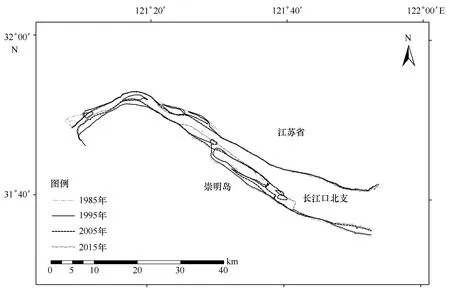
圖2 近30年來長江口北支河道岸線的變遷Fig.2 Variation of the shoreline of the North Branch of Yangtze Estuary in last 30 years
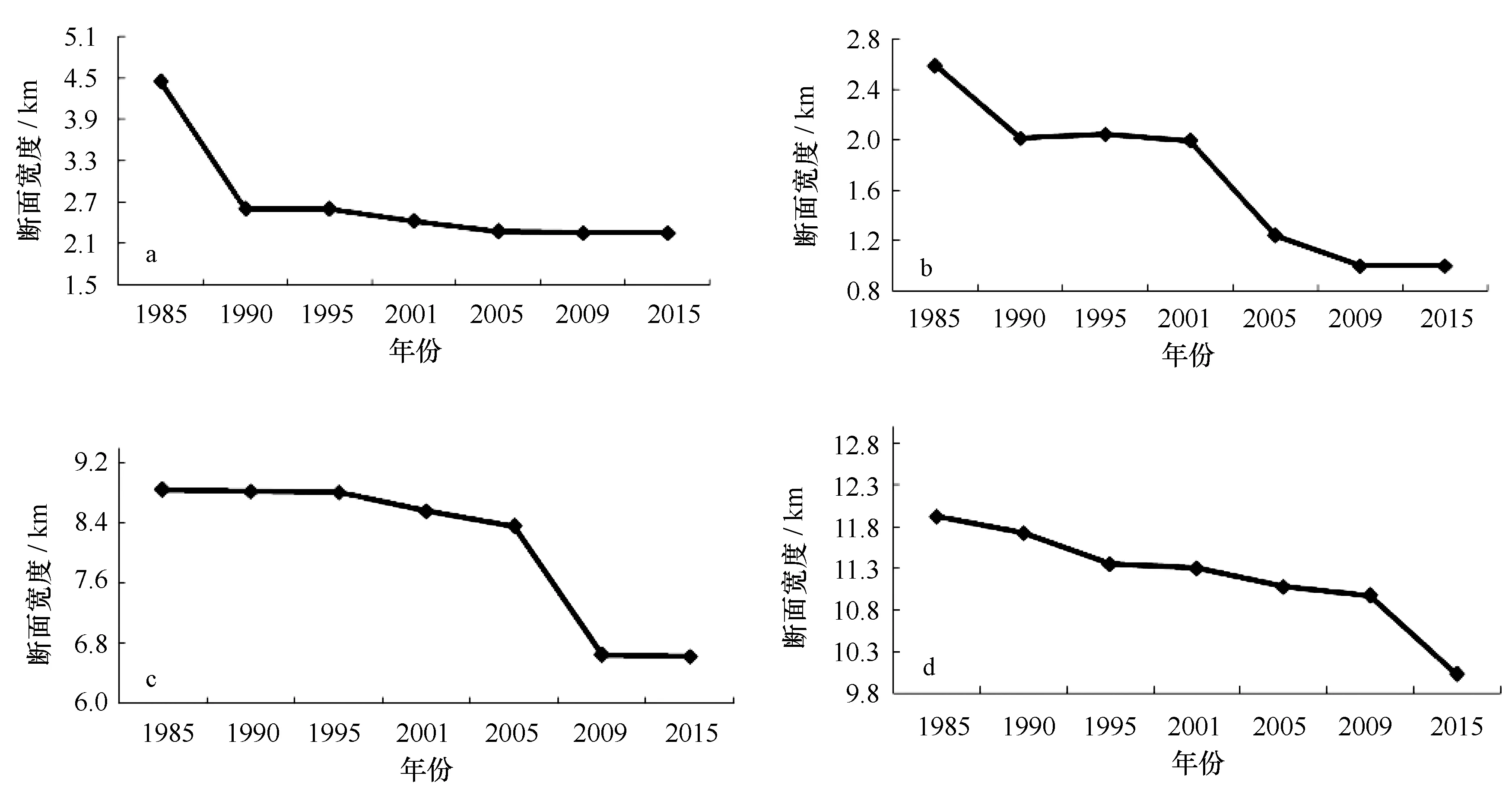
圖3 1985—2015年長江口北支重要斷面的寬度變化Fig.3 Variation of the widths of the important transects of the North Branch of Yangtze Estuary in 1985—2015a.崇頭斷面, b.青龍港斷面, c.三條港斷面, d.口門斷面a.Chongtou transect, b.Qinglonggang transect, c.Santiaogang transect, d.Exit transect
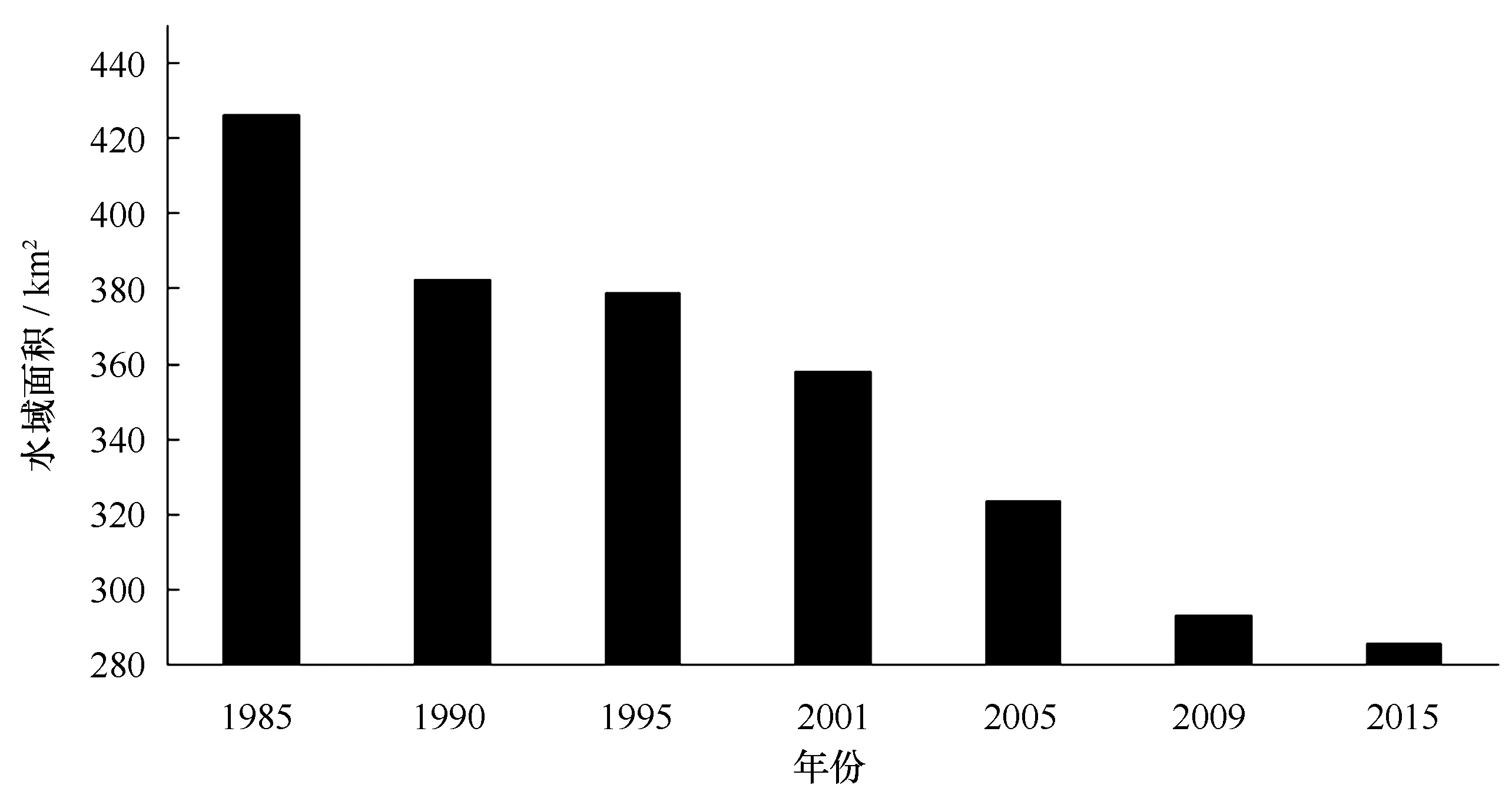
圖4 1985—2015年長江口北支水域面積的變化Fig.4 Variation of the water area of the North Branch of Yangtze Estuary in 1985—2015
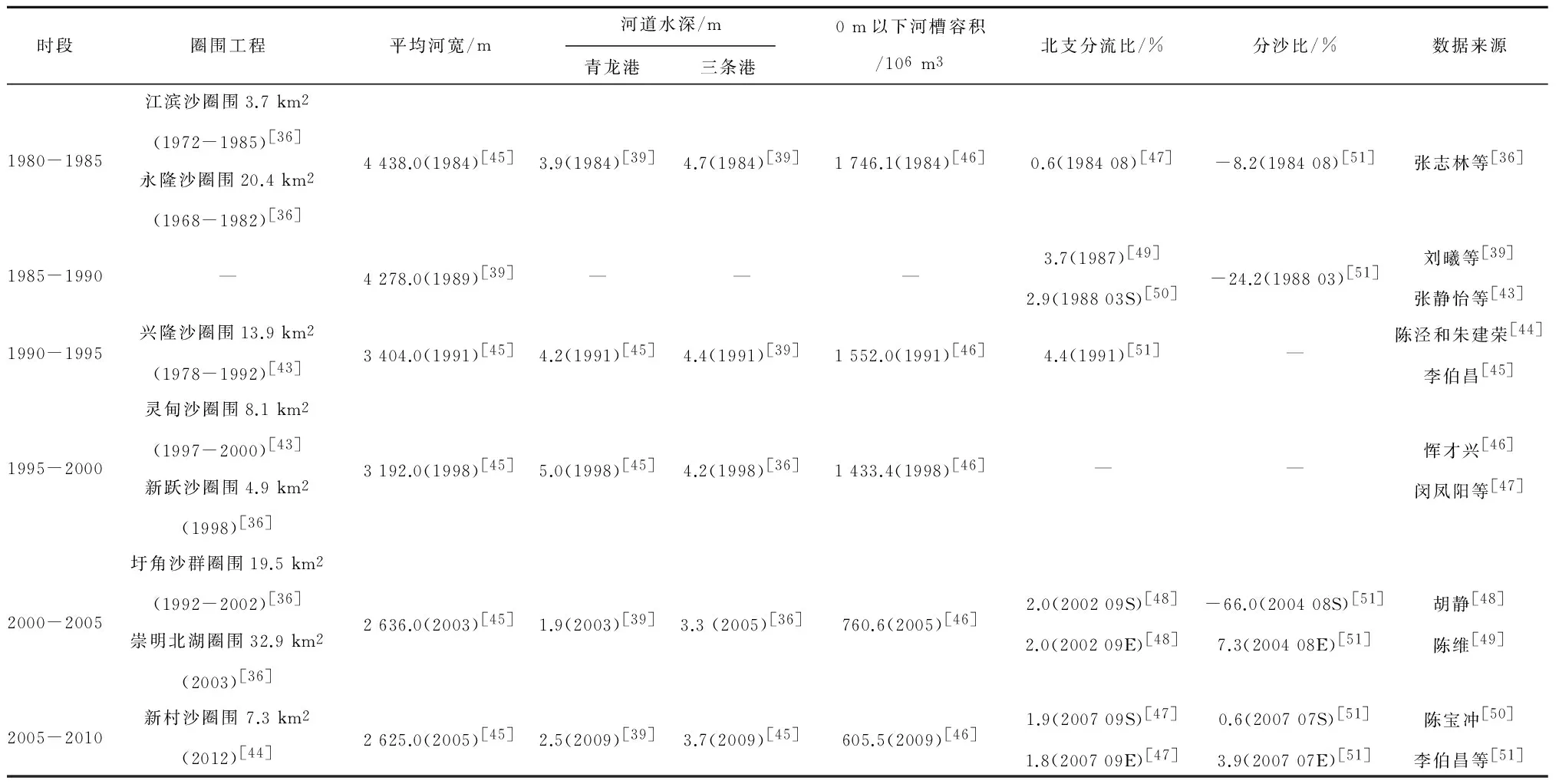
時段圈圍工程平均河寬/m河道水深/m 青龍港 三條港 0m以下河槽容積/106m3北支分流比/%分沙比/%數據來源1980-1985江濱沙圈圍3.7km2(1972-1985)[36]永隆沙圈圍20.4km2(1968-1982)[36]4438.0(1984)[45]3.9(1984)[39]4.7(1984)[39]1746.1(1984)[46]0.6(198408)[47]-8.2(198408)[51]張志林等[36]1985-1990—4278.0(1989)[39]———3.7(1987)[49]2.9(198803S)[50]-24.2(198803)[51]劉曦等[39]張靜怡等[43]1990-1995興隆沙圈圍13.9km2(1978-1992)[43]3404.0(1991)[45]4.2(1991)[45]4.4(1991)[39]1552.0(1991)[46]4.4(1991)[51]—陳涇和朱建榮[44]李伯昌[45]1995-2000靈甸沙圈圍8.1km2(1997-2000)[43]新躍沙圈圍4.9km2(1998)[36]3192.0(1998)[45]5.0(1998)[45]4.2(1998)[36]1433.4(1998)[46]——惲才興[46]閔鳳陽等[47]2000-2005圩角沙群圈圍19.5km2(1992-2002)[36]崇明北湖圈圍32.9km2(2003)[36]2636.0(2003)[45]1.9(2003)[39]3.3(2005)[36]760.6(2005)[46]2.0(200209S)[48]2.0(200209E)[48]-66.0(200408S)[51]7.3(200408E)[51]胡靜[48]陳維[49]2005-2010新村沙圈圍7.3km2(2012)[44]2625.0(2005)[45]2.5(2009)[39]3.7(2009)[45]605.5(2009)[46]1.9(200709S)[47]1.8(200709E)[47]0.6(200707S)[51]3.9(200707E)[51]陳寶沖[50]李伯昌等[51]
注:表中月份后S為大潮期,E為小潮期,-表示無相應記錄。
3.2 北支水域生態現狀
3.2.1 大型底棲無脊椎動物
調查期間共采集大型底棲無脊椎動物標本1 346頭,分屬3門4綱11目23科34種,如表2所示。各斷面優勢種組成有一定差異。上側斷面(BA)以黑龍江河籃蛤(Potamocorbulaamurensis)占優勢(IRI>20),其無論相對多度(80.00%)還是相對生物量(93.72%)均最大;中間斷面(BB)以安氏白蝦(Exopalaemonannandalei)和細指長臂蝦(Palaemontenuidactylus)為主要優勢種(IRI>20),兩者相對多度(29.35%,26.13%)明顯高于其他物種,而該斷面生物量以細指長臂蝦(21.92%)和短文蛤(Meretrixpetechialis)(18.67%)為主;下側斷面(BC)以安氏白蝦為優勢種(IRI>20),安氏白蝦(24.84%)和糠蝦(Acanthomysissp.)(20.50%)在數量上居多,但由于糠蝦個體較小,斷面生物量主要以安氏白蝦(65.68%)為主。從斷面的多樣性特征來看,如圖5所示,口內從上至下,幾種多樣性指數均是增加的。
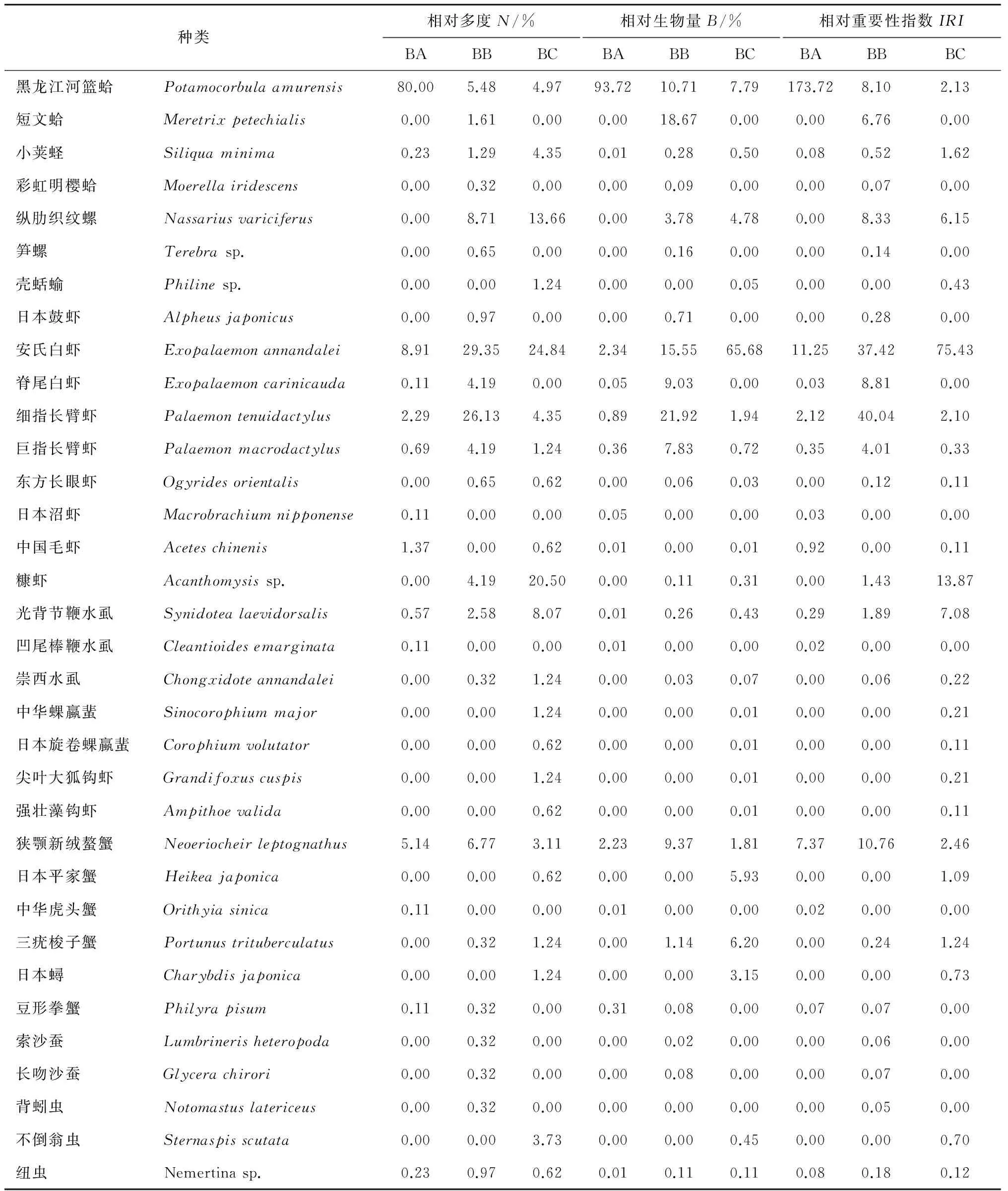
表2 長江口北支各斷面大型底棲無脊椎動物組成特征

圖5 長江口北支各斷面大型底棲無脊椎動物物種多樣性Fig.5 Species diversity of the benthic macroinvertebrate assemblages in the different transects of the North Branch of Yangtze Estuary
3.2.2 魚類
調查期間共采集魚類標本243尾,分屬5目5科10種。其中,海洋魚類2種,洄游魚類2種,定居性河口魚類5種,淡水魚類1種。各斷面魚類種類組成及數量特征如表3所示。棘頭梅童魚(Collichthyslucidus)在3個斷面上均占優勢(IRI>20)。上側斷面(BA)除棘頭梅童魚外,紅狼牙蝦虎魚(Odontamblyopusrubicundus)也為優勢種(IRI>20),棘頭梅童魚在數量上居多(71.71%),而生物量以紅狼牙蝦虎魚為主(47.10%);中間斷面棘頭梅童魚數量高于其他物種(79.17%),生物量以紅狼牙蝦虎魚(27.59%)、短吻紅舌鰨(Cynoglossusjoyneri)(24.54%)、棘頭梅童魚(23.44%)為主;下側斷面魚類生物量基本以棘頭梅童魚為主(78.61%),而棘頭梅童魚的數量也遠高于其他種類(97.44%)。
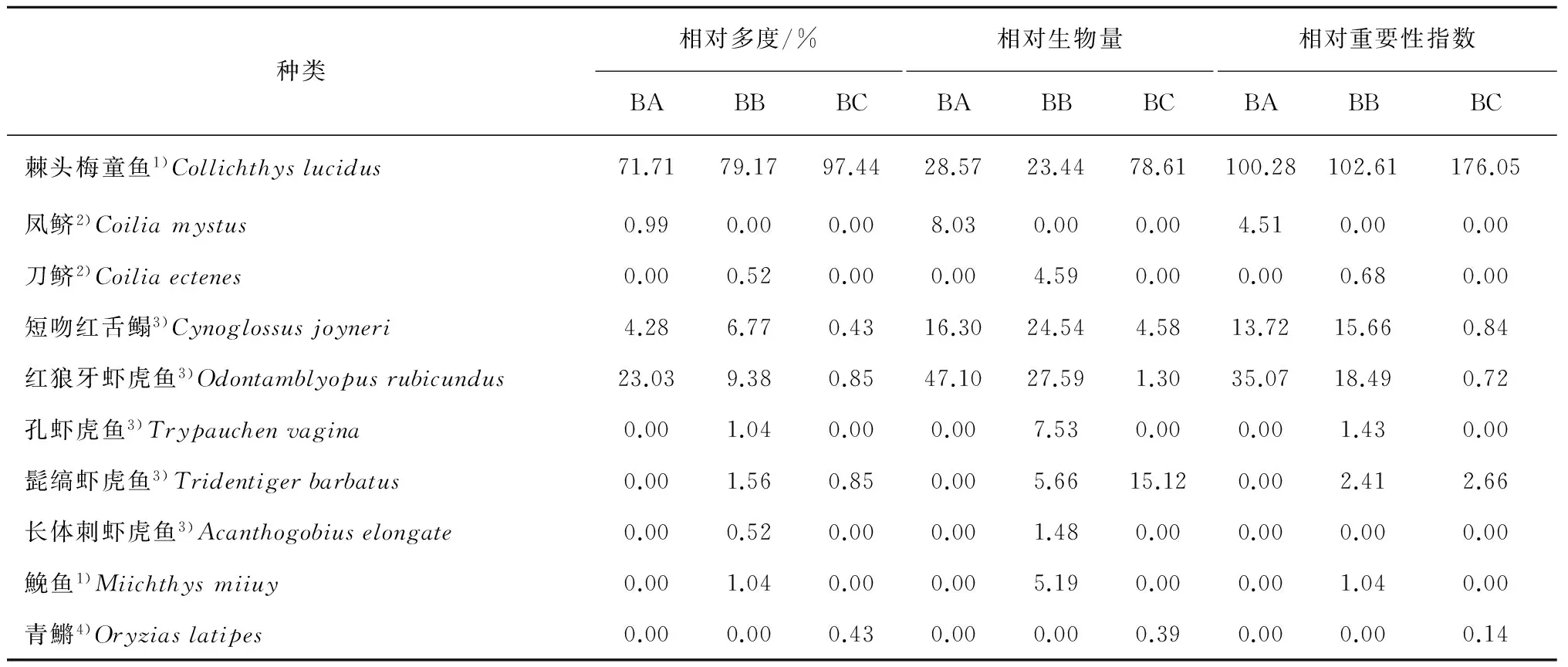
表3 長江口北支各斷面魚類組成特征
注:1)海洋魚類 Marine fish;2)洄游魚類 Migratory fish;3)定居性河口魚類 Resident estuarine fish;4)淡水魚類 Freshwater fish。
各斷面魚類物種多樣性如圖6所示。相對而言中間斷面(BB)物種多樣性水平相對較高,其Margalef物種多樣性指數及Shannon-Wiener多樣性指數均高于其他斷面。但是由于各斷面基本上都是棘頭梅童魚在數量上占絕對優勢,其均勻度水平都較低。
此外,從調查到的魚類體長特征來看,如表4所示,調查期間北支水域魚類主要以幼魚為主。
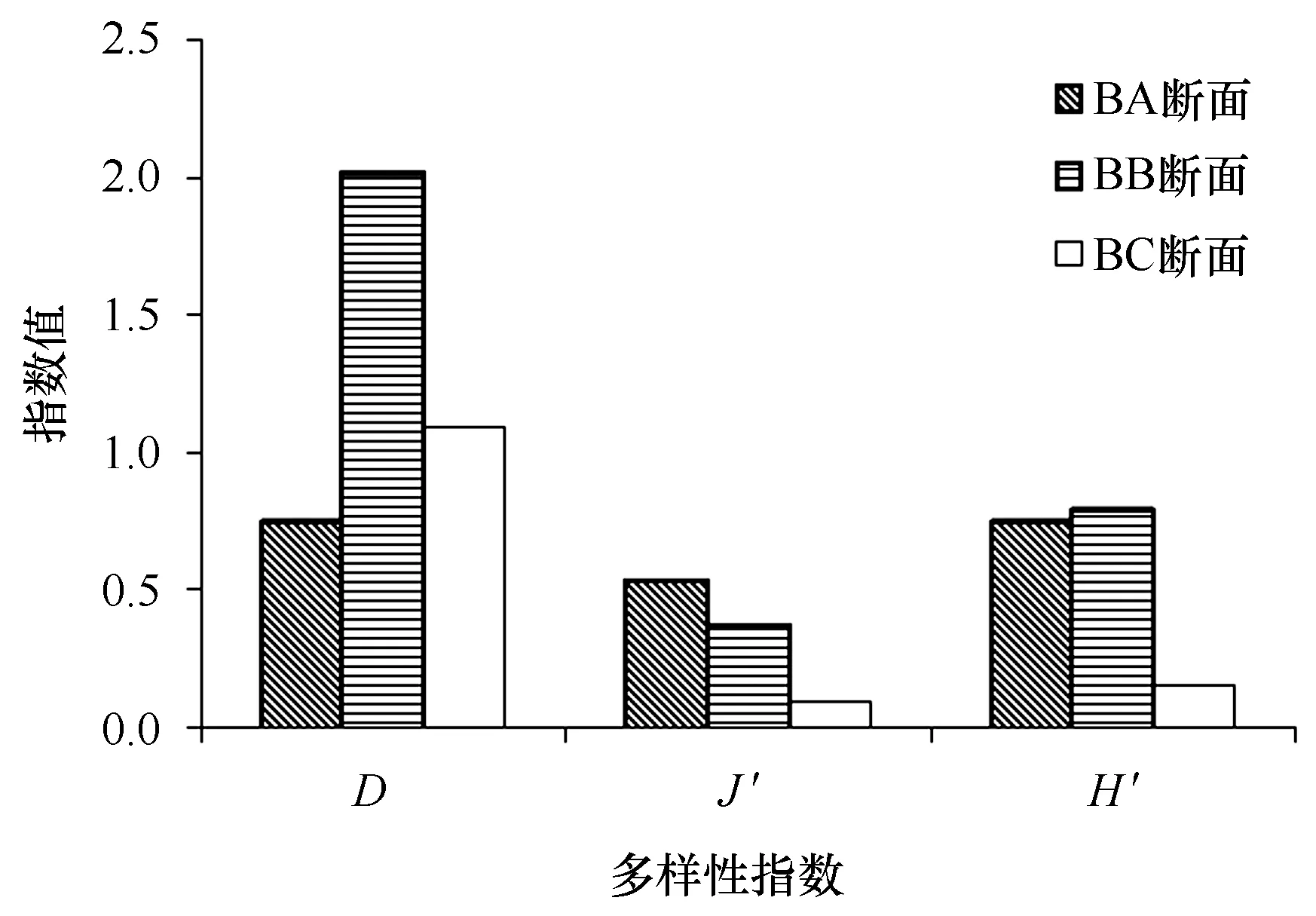
圖6 長江口北支各斷面魚類物種多樣性Fig.6 Species diversity of the fish assemblages in the different transects of the North Branch of Yangtze Estuary

種類體長/mm調查值資料值(成魚)[52-53]棘頭梅童魚Collichthyslucidus15.57~27.3980~160鳳鱭Coiliamystus62.39~131.7256~220刀鱭Coiliaectenes87.89~119.9296~410短吻紅舌鰨Cynoglossusjoyneri25.15~115.88150~200紅狼牙蝦虎魚Odontamblyopusrubicundus36.79~190.6170~300孔蝦虎魚Trypauchenvagina47.64~109.61100~125髭縞蝦虎魚Tridentigerbarbatus31.77~65.8060~110長體刺蝦虎魚Acanthogobiuselongate54.9256~69魚免魚Miichthysmiiuy51.51~70.72450~550青魚將Oryziaslatipes20.5730~40
4 討論
4.1 北支演變與鹽水入侵
根據本文研究結果,近30年來北支演變的突出特點在于北支中上段束窄明顯,而下段河道雖然有一定程度的束窄,但口門仍呈喇叭口形態。大量的圈圍工程是導致北支中上段河道束窄的最重要因素。北支中上段的束窄,造成北支徑流分流比下降,使得徑流作用減弱,從而削弱了徑流對河床的沖刷作用;另一方面,雖然近年來長江口入海泥沙量顯著下降,但是北支分沙比有所增大,整體上向北支的凈泥沙輸送量增加[51],兩方面結合,加快了北支的淤淺,集中體現在河道水深以及0 m以下河槽容積的下降。河槽容積及河道地形的改變,對北支水域的水文過程產生深刻影響,使徑流和潮流作用對比發生明顯改變。在北支中上段高、低潮位整體抬升,漲潮流速增大,常形成涌潮[11],由此也增加了水、沙、鹽倒灌南支的風險。
河口區作為咸淡水交匯的區域,鹽水在徑流與潮流的相互作用下在分汊河口內移動,潮流作用相對強烈的河道內,鹽水沿河道上溯。近30年來北支水動力條件的改變,尤其是徑流作用的相對減弱和潮流作用的相對增強,加劇了北支鹽水入侵[37]。鹽水入侵影響了北支水域尤其是北支中上段的水質狀況。已有的研究表明北支中段三條港長期處于高鹽度狀態,而枯季大潮期徑流作用較弱、潮流優勢作用明顯,更加劇烈的鹽水入侵使得上段青龍港鹽度也顯著上升[54]。除此之外,鹽水入侵嚴重時段,鹽水可以從北支倒灌進入南支,對青草沙水庫、陳行水庫、東風西沙水庫取水口的水質造成影響[55]。
4.2 北支演變對物種多樣性的影響
鹽度是影響河口區魚類、大型底棲動物以及浮游動物等生物類群物種多樣性及其分布的重要因素[56-59]。從水域生態現狀調研結果來看,北支仍然是大型底棲動物、魚類等生物類群的重要棲息地和育幼場,具有較高的生物多樣性。與北支河道演變相伴隨的鹽水入侵勢必會對區域生物類群的物種組成、分布以及多樣性造成一定程度的影響。20世紀80年代末期,北支水域浮游甲殼動物以適應高鹽度的橈足類占優勢,而淡水枝角類尚存21種[60];到了2010年調查時,僅記錄到枝角類5種[61]。此外,北支水域中浮游動物、浮游植物及大型底棲動物的物種組成及多樣性受到豐枯季及離口門距離差異引起的鹽度差異的影響[27,32,62]。從長江口南北支已有研究結果看,鹽度差異是導致南北支水生生物種類組成差異的重要原因。如2005年長江口魚類調查表明,北支水域魚類以海洋魚類、河口魚類為主,主要優勢種為棘頭梅童魚、紅狼牙蝦虎魚,而南支水域魚類則以淡水種為主[29]。同年,大型底棲動物調查結果表明,南支大型底棲動物以淡水和半咸水種為主,而北支則以混合高鹽水種為主[63]。此外,長江口浮游動物已有的研究均表明鹽度是導致南北支水域浮游動物群落結構差異的決定性因素[27-28]。在世界其他河口的相關研究中也獲得了類似的研究結果。如1993年Marques等研究發現人工促淤改變了蒙德古河口南支的水動力條件,減少了淡水流入量,使得南支水域鹽度明顯高于北支,造成兩條汊道的底棲動物群落結構出現明顯差異[64];1999年Colonnello等人發現在委內瑞拉奧里諾科河口建壩后,壩址下游區域由于徑流量下降,導致鹽水入侵加劇,區域植被格局發生了徹底的改變,水域生物類群的組成與分布也發生了明顯的變化[65]。此外,在河口浮游動物、魚類的相關研究中也有較多類似的報道[66-67]。
除了鹽度以外,北支演變引起的河道水深、水沙特征及水動力條件的改變也可能對區域生態系統造成直接或間接的影響。近30年來,北支河道總體呈淤淺態勢。水深條件的改變,可能會使相應區域生物類群的組成發生明顯變化。一些學者曾對印度維拉爾河口以及歐洲西部斯海爾德河口大型底棲無脊椎動物的群落組成及分布進行研究,結果發現區域內大型底棲動物群落組成和分布受到水深的影響,不同類別的底棲動物適宜生存的水深有所不同[68-69]。此外,眾多研究表明,魚類、浮游動物群落同樣受到水深條件的影響,河道的淤淺可能導致適應深水環境的物種的多度下降[70-71]。此外,隨著北支演變而產生的北支中上段漲、落潮流速的增大[35],水體懸沙濃度減小[72]均可能對相應的生物類群及其棲息環境產生影響。具體而言,不同水生生物所能耐受的水體最大流速存在差異,而高流速的水體往往不適宜許多物種的生存[68,73];而對于部分水生生物,懸沙濃度也是影響其種群密度的重要因素[74-75],北支懸沙濃度的減小可能導致適應高懸沙濃度的物種被替代。但是,所有的因子的作用并不是孤立進行的,而是相互聯系、相互制約的。不同因子的相互作用及其生態效應,還有待于未來系統監測基礎上的綜合分析。
綜上所述,近30年來,由于圍墾等人類活動的影響,北支河段河勢發生了明顯的改變,由此引發的生境條件的改變,尤其是鹽度的變化,對區域大型底棲動物、魚類等生物類群的物種組成、多樣性及空間分布等產生了一定程度的影響。北支水域主要生物類群以適應高鹽、咸淡水環境的種類為主。但北支水域仍然是魚類等水生生物的重要棲息地和育幼場,且具有較高的生物多樣性。北支的治理,仍需要考慮維持區域生態系統的結構與功能不被破壞,確保區域的可持續發展。其重要的途徑是保證現有的水域面積(包括近岸濕地)不會進一步喪失,同時減少北支口門的進潮量,降低鹽水倒灌南支的風險。而為了減少北支口門的進潮量,可以考慮以生態工程代替鋼筋混凝土的硬工程:以覆蓋植被的攔門沙脊降低口門區河道寬度和容積。具體攔門沙脊的布設方式需要根據區域地形、水動力條件等研究確定。未來北支的演變趨勢及其生態效應,需要在有效監測的基礎上進行綜合分析。
[1] 孫志林, 金元歡. 分汊河口的形成機理[J]. 水科學進展, 1996, 7(2): 144-150.
Sun Zhilin, Jin Yuanhuan. Mechanism of formation of an anabranchedestuary[J]. Advances in Water Science, 1996, 7(2): 144-150.
[2] 陳吉余. 21世紀的長江河口初探[M]. 北京: 海洋出版社, 2009.
Chen Jiyu. A Preliminary Study of the Yangtze Estuary in the 21st Century[M]. Beijing: China Ocean Press, 2009.
[3] 陳吉余, 惲才興, 徐海根, 等. 兩千年來長江河口發育的模式[J]. 海洋學報, 1979, 1(1): 103-111.
Chen Jiyu, Yun Caixing, Xu Haigen, et al. The development model of the Changjiang River Estuary during last 2000 years[J]. Haiyang Xuebao, 1979, 1(1): 103-111.
[4] Van Der Wal D, Pye K, Neal A. Long-term morphological change in the Ribble Estuary, northwest England[J]. Marine Geology, 2002, 189(3/4): 249-266.
[5] Blott S J, Pye K, Van Der Wal D, et al. Long-term morphological change and its causes in the Mersey Estuary, NW England[J]. Geomorphology, 2006, 81(1/2): 185-206.
[6] Allison M A, Vosburg B M, Ramirez M T, et al. Mississippi River channel response to the Bonnet Carré Spillway opening in the 2011 flood and its implications for the design and operation of river diversions[J]. Journal of Hydrology, 2013, 477: 104-118.
[7] 陳吉余, 陳沈良. 長江口生態環境變化及對河口治理的意見[J]. 水利水電技術, 2003, 34(1): 19-25.
Chen Jiyu, Chen Shenliang. The changes of ecologic environment in Yangtze River estuary and some suggestions for estuary regulation[J]. Water Resources and Hydropower Engineering, 2003, 34(1): 19-25.
[8] Lane R R, Day J W Jr, Marx B D, et al. The effects of riverine discharge on temperature, salinity, suspended sediment and chlorophyll in a Mississippi delta estuary measured using a flow-through system[J]. Estuarine, Coastal and Shelf Science, 2007, 74(1/2): 145-154.
[9] De Vriend H J, Wang Zhengbing, Ysebaert T, et al. Eco-Morphological problems in the Yangtze Estuary and the Western Scheldt[J]. Wetlands, 2011, 31(6): 1033-1042.
[10] Ferguson G J, Ward T M, Ye Qifeng, et al. Impacts of drought, flow regime, and fishing on the fish assemblage in Southern Australia’s largest temperate estuary[J]. Estuaries and Coasts, 2013, 36(4): 737-753.
[11] 宋澤坤. 近30年來長江口北支灘涂圍墾對水動力和河槽沖淤演變影響分析[D]. 上海: 華東師范大學, 2013.
Song Zekun. Analysis of reclamation in the North Branch and its effects on hydrodynamic environment and morphological change for nearly 30 years[D]. Shanghai: East China Normal University, 2013.
[12] Wu Hui, Zhu Jiianrong, Chen Bingrui, et al. Quantitative relationship of runoff and tide to saltwater spilling over from the North Branch in the Changjiang Estuary: A numerical study[J]. Estuarine, Coastal and Shelf Science, 2006, 69(1/2): 125-132.
[13] Yu Shipeng, Yang Jingsong, Liu Guangming. Impact assessment of Three Gorges Dam's impoundment on river dynamics in the North Branch of Yangtze River Estuary, China[J]. Environmental Earth Sciences, 2014, 72(2): 499-509.
[14] 陸婷婷. 長江口北支河道演變及其影響分析[J]. 中國水運, 2014, 14(7): 204-205.
Lu Tingting. Evolution of North Branch of Yangtze River Estuary and its impact analysis[J]. China Water Transport, 2014, 14(7): 204-205.
[15] 楊芳麗, 韓婷, 閆軍, 等. 長江口北支河段演變分析及航道治理思路初探[J]. 水運工程, 2014 (12): 79-82.
Yang Fangli, Han Ting, Yan Jun, et al. River regime and regulation of Beizhi reach in lower reach of the Yangtze River[J]. Port & Waterway Engineering, 2014(12): 79-82.
[16] 陳煒, 李九發, 李占海, 等. 長江口北支強潮河道懸沙運動及輸移機制[J]. 海洋學報, 2012, 34(2): 84-91.
Chen Wei, Li Jiufa, Li Zhanhai, et al. The suspended sediment transportation and its mechanism in strong tidal reaches of the North Branch of the Changjiang Estuary[J]. Haiyang Xuebao, 2012, 34(2): 84-91.
[17] Dai Zhijun, Du Jinzhou, Chu Ao, et al. Sediment characteristics in the North Branch of the Yangtze Estuary based on radioisotope tracers[J]. Environmental Earth Sciences, 2011, 62(8): 1629-1634.
[18] Li Xie, Zhang Zhenke, Zhang Yunfeng, et al. Sedimentation and morphological changes at Yuantuojiao Point, estuary of the North Branch, Changjiang River[J]. Acta Oceanologica Sinica, 2013, 32(2): 24-34.
[19] Li Zhanhai, Li M Z, Dai Zhijun, et al. Intratidal and neap-spring variations of suspended sediment concentrations and sediment transport processes in the North Branch of the Changjiang Estuary[J]. Acta Oceanologica Sinica, 2015, 34(1): 137-147.
[20] 周開勝, 孟翊, 劉蒼字, 等. 長江口北支沉積特征及北支河道演變[J]. 泥沙研究, 2009(6): 65-73.
Zhou Kaisheng, Meng Yi, Liu Cangzi, et al. Sedimentation characteristic and channel evolvement in the North Branch of the Yangtze River Estuary[J]. Journal of Sediment Research, 2009(6): 65-73.
[21] Lin Xiaobiao, Hou Lijun, Liu Min, et al. Gross nitrogen mineralization in surface sediments of the Yangtze Estuary[J]. PLoS One, 2016, 11(3): e0151930.
[22] 朱建榮, 吳輝, 顧玉亮. 長江河口北支倒灌鹽通量數值分析[J]. 海洋學研究, 2011, 29(3): 1-7.
Zhu Jianrong, Wu Hui, GuYuliang. Numerical analysis of the inverted salt flux from the North Branch into the South Branch of Changjiang River Estuary[J]. Journal of Marine Sciences, 2011, 29(3): 1-7.
[23] Zhang Erfeng, Savenije H H G, Wu Hui, et al. Analytical solution for salt intrusion in the Yangtze Estuary, China[J]. Estuarine, Coastal and Shelf Science, 2011, 91(4): 492-501.
[24] Li Lu, Zhu Jianrong, Wu Hui. Impacts of wind stress on saltwater intrusion in the Yangtze Estuary[J]. Science China Earth Sciences, 2012, 55(7): 1178-1192.
[25] Qiu Cheng, Zhu Jianrong. Influence of seasonal runoff regulation by the Three Gorges Reservoir on saltwater intrusion in the Changjiang River Estuary[J]. Continental Shelf Research, 2013, 71: 16-26.
[26] 吳華林, 張俊勇, 劉高峰. 長江口北支綜合整治與開發思路探討[J]. 長江流域資源與環境, 2011, 20(S1): 9-13.
Wu Hualin, Zhang Junyong, Liu Gaofeng. Discussion of comprehensive control and development of the North Branch of the Changjiang Estuary[J]. Resources and Environment in the Yangtze Basin, 2011, 20(S1): 9-13.
[27] 鄭金秀, 胡菊香, 彭建華, 等. 長江口南北支浮游動物群落生態學研究[J]. 生態環境學報, 2011, 20(6): 1102-1106.
Zheng Jinxiu, Hu Juxiang, Peng jianhua, et al. Zooplankton community ecology in north and south branches at Yangtze River Estuary[J]. Ecology and Environment, 2011, 20(6): 1102-1106.
[28] 高倩, 徐兆禮, 莊平. 長江口北港和北支浮游動物群落比較[J]. 應用生態學報, 2008, 19(9): 2049-2055.
Gao Qian, Xu Zhaoli, Zhuang Ping. Comparison of mesozooplankton communities in North Channel and North Branch of Yangtze River Estuary[J]. Chinese Journal of Applied Ecology, 2008, 19(9): 2049-2055.
[29] 張衡, 朱國平, 陸健健. 長江河口濕地魚類的種類組成及多樣性分析[J]. 生物多樣性, 2009, 17(1): 76-81.
Zhang Heng, Zhu Guoping, Lu Jianjian. Fish species composition and diversity of Yangtze River estuarine wetland[J]. Biodiversity Science, 2009, 17(1): 76-81.
[30] 楊剛, 張濤, 莊平, 等. 長江口棘頭梅童魚幼魚棲息地的初步評估[J]. 應用生態學報, 2014, 25(8): 2418-2424.
Yang Gang, Zhang Tao, Zhuang Ping, et al. Preliminary assessment of habitat of juvenileCollichthyslucidusin the Yangtze Estuary[J]. Chinese Journal of Applied Ecology, 2014, 25(8): 2418-2424.
[31] 孫永濤, 張金池. 長江口北支濕地鳥類多樣性研究——鳥類物種多樣性研究[J]. 濕地科學與管理, 2010, 6(3): 50-53.
Sun Yongtao, Zhang Jinchi. Bird diversity in the estuary wetland of North Branch of Yangtze River—species diversity of birds[J]. Wetland Science & Management, 2010, 6(3): 50-53.
[32] 羅民波, 沈新強, 徐兆禮, 等. 長江口北支水域潮間帶大型底棲動物研究[J]. 海洋環境科學, 2006, 25(4): 43-47.
Luo Minbo, Shen Xinqiang, Xu Zhaoli, et al. Study on intertidal macrobenthos in North Branch of Changjiang Estuary[J]. Marine Environmental Science, 2006, 25(4): 43-47.
[33] 趙開彬, 劉婧, 吳惠仙, 等. 長江口北支大型底棲動物群落周年變化特征[J]. 生物學雜志, 2014, 31(3): 1-6.
Zhao Kaibin, Liu Jing, Wu Huixian, et al. Anniversary variation characteristics of benthic animal community in the North Branch of the Yangtze River estuary[J]. Journal of Biology, 2014, 31(3): 1-6.
[34] 張風艷. 長江口北支表層沉積物特征分析及其環境與物源意義[D]. 上海: 華東師范大學, 2011.
Zhang Fengyan. Study on the characteristics of surface sediment in north branch of Changjiang Estuary and analysis of its sedimentary environment and sediment source[D]. Shanghai: East China Normal University, 2011.
[35] 宋澤坤, 程和琴, 胡浩, 等. 長江口北支圍墾對其水動力影響的數值模擬分析[J]. 人民長江, 2012, 43(15): 59-63.
Song Zekun, Cheng Heqin, Hu Hao, et al. Numerical simulation analysis of influence of reclamation of North Branch in the Yangtze River Estuary on hydrodynamic characteristics[J]. Yangtze River, 2012, 43(15): 59-63.
[36] 張志林, 阮偉, 劉桂平, 等. 長江口北支近期河勢演變與航道資源開發研究[J]. 海洋工程, 2009, 27(3): 96-103.
Zhang Zhilin, Ruan Wei, Liu Guiping, et al. Recent river regime evolution of the North Branch of the Yangtze River Estuary and development research of navigational channel resources[J]. The Ocean Engineering, 2009, 27(3): 96-103.
[37] 張二鳳, 陳沈良, 劉小喜. 長江口北支異常強鹽水入侵觀測與分析[J]. 海洋通報, 2014(5): 491-496.
Zhang Erfeng, Chen Shenliang, Liu Xiaoxi. Observation and analysis of abnormal strong saltwater intrusion in the North Branch of the Yangtze Estuary[J]. Marine Science Bulletin, 2014(5): 491-496.
[38] 趙捷, 何青, 王憲業, 等. 長江口南北支水沙特性觀測研究[J]. 長江流域資源與環境, 2015, 24(1): 21-29.
Zhao Jie, He Qing, Wang Xianye, et al. Field observations on the characteristics of current and sediment of the South and North Branches in the Yangtze Estuary[J]. Resources and Environment in the Yangtze Basin, 2015, 24(1): 21-29.
[39] 劉曦, 楊麗君, 徐俊杰, 等. 長江口北支水道萎縮淤淺分析[J]. 上海地質, 2010, 31(3): 35-40.
Liu Xi, Yang Lijun, Xu Junjie, et al. The evolution of the north branch of Yangtze River Estuary characterized by being narrower and shallower[J]. Shanghai Geology, 2010, 31(3): 35-40.
[40] 李曉敏, 張杰, 馬毅. 1974年以來長江口北支沙洲演變過程遙感監測[J]. 人民長江, 2014, 45(21): 45-48, 53.
Li Xiaomin, Zhang Jie, Ma Yi. Remote sensing monitoring of sandbars evolution in north branch of Yangtze River estuary since 1974[J]. Yangtze River, 2014, 45(21): 45-48, 53.
[41] Laffaille P, Feunteun E, Lefeuvre J C. Composition of fish communities in a European macrotidal salt marsh (the Mont Saint-Michel Bay, France)[J]. Estuarine, Coastal and Shelf Science, 2000, 51(4): 429-438.
[42] 童春富. 長江河口潮間帶鹽沼植被分布區及鄰近光灘魚類組成特征[J]. 生態學報, 2012, 32(20): 6501-6510.
Tong Chunfu. Characteristics of the fish assemblages in the intertidal salt marsh zone and adjacent mudflat in the Yangtze Estuary[J]. Acta Ecologica Sinica, 2012, 32(20): 6501-6510.
[43] 張靜怡, 黃志良, 胡震云. 圍涂對長江口北支河勢影響分析[J]. 海洋工程, 2007, 25(2): 72-77.
Zhang Jingyi, Huang Zhiliang, Hu Zhenyun. Effect of the reclamation project on the North Branch of Yangtze River Estuary[J]. The Ocean Engineering, 2007, 25(2): 72-77.
[44] 陳涇, 朱建榮. 長江口北支新村沙圍墾工程對鹽水入侵的影響[J]. 華東師范大學學報(自然科學版), 2014(4): 163-172.
Chen Jing, Zhu Jianrong. Impact of the reclamation project of Xincunsha on the saltwater intrusion in the North Branch of the Changjiang Estuary[J]. Journal of East China Normal University (Natural Science), 2014(4): 163-172.
[45] 李伯昌. 1984年以來長江口北支演變分析[J]. 水利水運工程學報, 2006(3): 9-17.
Li Bochang. Channel evolution in North Branch of Changjiang River Estuary since 1984[J]. Hydro-Science and Engineering, 2006(3): 9-17.
[46] 惲才興. 圖說長江河口演變[M]. 北京: 海洋出版社, 2010.
Yun Caixing. Caption of the Yangtze River Estuary Evolution[M]. Beijing: China Ocean Press, 2010.
[47] 閔鳳陽, 汪亞平, 高建華, 等. 長江口北支潮周期尺度水沙通量及分流分沙比[C]// 第十四屆中國海洋(岸)工程學術討論會論文集.北京:海洋出版社, 2009.
Min Fengyang, Wang Yaping, Gao Jianhua, et al. Water sediment flux, water and sediment spilt ratio of North Branch of Yangtze Estuary in a tidal cycle scale[C]//The 14th China Ocean (Coast) Engineering Workshop Proceedings. Beijing:China Ocean Press, 2009.
[48] 胡靜. 長江河口水沙分流和輸移的探討[D]. 上海: 華東師范大學, 2007.
Hu Jing. Flow and sediment ratios and transport in the Yangtze River Estuary[D]. Shanghai: East China Normal University, 2007.
[49] 陳維. 長江口北支、北槽沖淤變化及河勢演變分析[D]. 上海: 上海海洋大學, 2012.
Chen Wei. Analysis on morphological change and evolution of river regime in the North Passage and North Branch of the Changjiang River Estuary[D]. Shanghai: Shanghai Ocean University, 2012.
[50] 陳寶沖. 長江口北支河勢的變化與水、沙、鹽的輸移[J]. 地理科學, 1993, 13(4): 346-352.
Chen Baochong. The change of the general form and the transport of the water,load and salt in the north-branch of the Changjiang River mouth[J]. Scientia Geographica Sinica, 1993, 13(4): 346-352.
[51] 李伯昌, 余文疇, 陳鵬, 等. 長江口北支近期水流泥沙輸移及含鹽度的變化特性[J]. 水資源保護, 2011, 27(4): 31-34.
Li Bochang, Yu Wenchou, Chen Peng, et al. Variation characteristics of sediment transport and salinity in north branch channel of Yangtze River Estuary in recent years[J]. Water Resources Protection, 2011, 27(4): 31-34.
[52] 中國水產科學研究院東海水產研究所, 上海市水產研究所. 上海魚類志[M]. 上海: 上海科學技術出版社, 1990.
East China Sea Fisheries Research Institute, Chinese Academy of Fishery Sciences, Shanghai Fisheries Research Institute. Shanghai Fishes[M]. Shanghai: Shanghai Scientific & Technical Publishers, 1990.
[53] 莊平, 王幼槐, 李圣法, 等. 長江口魚類[M]. 上海: 上海科學技術出版公司, 2006.
Zhuang Ping, Wang Youhuai, Li Shengfa, et al. Fishes of the Yangtze Estuary[M]. Shanghai: Shanghai Scientific & Technical Publishers, 2006.
[54] 顧玉亮, 吳守培, 樂勤. 北支鹽水入侵對長江口水源地影響研究[J]. 人民長江, 2003, 34(4): 1-3.
GuYuliang, Wu Shoupei, Le Qin. Impact of intruded saline water via north branch of the Yangtze River on water source areas in the estuary area[J]. Yangtze River, 2003, 34(4): 1-3.
[55] 李路. 長江河口鹽水入侵時空變化特征和機理[D]. 上海: 華東師范大學, 2011.
Li Lu. Spatial-temporal dynamic characteristics of saltwater intrusion in the Changjiang Estuary[D]. Shanghai: East China Normal University, 2011.
[56] Josefson A B, Hansen J L S. Species richness of benthic macrofauna in Danish estuaries and coastal areas[J]. Global Ecology and Biogeography, 2004, 13(3): 273-288.
[57] Loshin D. Chapter 1-Market and business drivers for big data analytics[M]// Loshin D. Big Data Analytics. Boston: Morgan Kaufmann, 2013: 1-9.
[58] Gain A K, Uddin M N, Sana P. Impact of river salinity on fish diversity in the south-west coastal region of Bangladesh[J]. International Journal of Ecology and Environmental Sciences, 2008, 34(1): 49-54.
[59] Dou Pou, Cui Baoshan, Xie Tian, et al. Macrobenthos diversity response to hydrological connectivity gradient[J]. Wetlands, 2014, 36(S1): 45-55.
[60] 曾強. 長江口南、北支水域的浮游甲殼動物調查[J]. 淡水漁業, 1993, 23(1): 33-35.
Zeng Qiang. A study of crustacean plankton in South and North Branches of Yangtze Estuary[J]. Freshwater Fishery, 1993, 23(1): 33-35.
[61] 楊吉強, 王瓊, 劉艷, 等. 長江口浮游甲殼動物空間分布特征[J]. 生物學雜志, 2014, 31(3): 11-14.
Yang Jiqiang, Wang Qiong, Liu Yan, et al. The spatial distribution characteristics of crustacean plankton in the Yangtze River Estuary[J]. Journal of Biology, 2014, 31(3): 11-14.
[62] 劉笑, 薛俊增, 吳惠仙. 長江口北支浮游植物群落結構周年變化特征[J]. 生物學雜志, 2014, 31(3): 20-24.
Liu Xiao, Xue Junzeng, Wu Huixian. Annual variation of phytoplankton community in the North Branch of the Yangtze River Estuary[J]. Journal of Biology, 2014, 31(3): 20-24.
[63] 章飛軍, 童春富, 張衡, 等. 長江口潮下帶春季大型底棲動物的群落結構[J]. 動物學研究, 2007, 28(1): 47-52.
Zhang Feijun, Tong Chunfu, Zhang Heng, et al. Community structure of macrobenthic fauna in subtidal areas of the Yangtze River Estuary in spring[J]. Zoological Research, 2007, 28(1): 47-52.
[64] Marques J C, Maranh?o J C, Pardal M A. Human impact assessment on the subtidal macrobenthic community structure in the Mondego Estuary (Western Portugal)[J]. Estuarine, Coastal and Shelf Science, 1993, 37(4): 403-419.
[65] Colonnello G, Medina E. Vegetation changes induced by dam construction in a tropical estuary: the case of the Manamo River, Orinoco Delta (Venezuela)[J]. Plant Ecology, 1999, 139(2): 145-154.
[66] Watanabe K, Kasai A, Antonio E S, et al. Influence of salt-wedge intrusion on ecological processes at lower trophic levels in the Yura Estuary, Japan[J]. Estuarine, Coastal and Shelf Science, 2014, 139: 67-77.
[67] Jutagate T, Sawusdee A, Thapanand-Chaidee T, et al. Effects of an anti-salt intrusion dam on tropical fish assemblages[J]. Marine and Freshwater Research, 2010, 61(3): 288-301.
[68] Chertoprud M V, Chertoprud E S, Saravanakumar A, et al. Macrobenthic communities of the Vellar Estuary in the Bay of Bengal in Tamil-Nadu in South India[J]. Oceanology, 2013, 53(2): 200-210.
[69] Ysebaert T, Herman P M J, Meire P, et al. Large-scale spatial patterns in estuaries: estuarine macrobenthic communities in the Schelde Estuary, NW Europe[J]. Estuarine, Coastal and Shelf Science, 2003, 57(1/2): 335-355.
[70] Mansor M I, Mohammad-Zafrizal M Z, Nur-Fadhilah M A, et al. Temporal and spatial variations in fish assemblage structures in relation to the physicochemical parameters of the Merbok Estuary, Kedah[J]. Journal of Natural Sciences Research, 2012, 7(2): 110-127.
[71] Schlacher T A, Th W. Small-scale distribution and variability of demersal zooplankton in a shallow, temperate estuary: Tidal and depth effects on species-specific heterogeneity[J]. Cahiers de Biologie Marine, 1995, 36(3): 211-227.
[72] 楊云平, 張明進, 鄧金運, 等. 長江口懸沙濃度變化的同步性和差異性[J]. 地理學報, 2014, 69(4): 1615-1627.
Yang Yunping, Zhang Mingjin, Deng Jinyun, et al. The synchronicity and difference in the change of suspended sediment concentration in the Yangtze River Estuary[J]. Acta Geographica Sinica, 2014, 69(4): 1615-1627.
[73] Johnson J A, Arunachalam M. Relations of physical habitat to fish assemblages in streams of Western Ghats, India[J]. Applied Ecology and Environmental Research, 2010, 8(1): 1-10.
[74] Ellis J, Cummings V, Hewitt J, et al. Determining effects of suspended sediment on condition of a suspension feeding bivalve (Atrinazelandica): results of a survey, a laboratory experiment and a field transplant experiment[J]. Journal of Experimental Marine Biology and Ecology, 2002, 267(2): 147-174.
[75] Ooi A L, Chong V C. Larval fish assemblages in a tropical mangrove estuary and adjacent coastal waters: Offshore-inshore flux of marine and estuarine species[J]. Continental Shelf Research, 2011, 31(15): 1599-1610.
Evolution of the North Branch of Yangtze Estuary in last 30 years and corresponding effects on species diversity
Wu Fengrun1, Tong Chunfu1
(1.StateKeyLaboratoryofEstuarineandCoastalResearch,EastChinaNormalUniversity,Shanghai200062,China)
The evolution characteristics of the anabranched estuary and their ecological effects are important issues of current estuarine and coastal research. The North Branch is one of the first order bifurcations of Yangtze Estuary. Its evolution would have profound effects on regional ecological and environmental conditions. In this study, we expounded the evolution characteristics of the North Branch of Yangtze Estuary in last 30 years, based on the pre-existing results and also the remote sensing image analysis. Together with the recent ecological investigation in the water area, their corresponding effects on species diversity were discussed thoroughly. The results proved that the prominent feature of the evolution was that the middle and upper segments of the North Branch got narrowed significantly, while the lower segment was less narrowed and still had a funnel shape. A large number of reclamations taken place in the middle and upper areas were responsible for this. With the changes of river regime, the water depth, channel volume and the split ratio of water of the North Branch decreased, while the split ratio of sediment went up. These had contributed to the intensive saltwater intrusions into the North Branch, and also the increased risks of the sediment and saltwater spilling into the South Branch. The North Branch evolution altered the salinity conditions of the water, which led to the dominant biomes appeared to be those adapted to the high salinity and brackish water. Furthermore, the variations of the water depth, hydrodynamic and sediment concentration of the water could also have effects on the biomes. However, at present, the North Branch was still an important habitat and nursery area for many biomes, such as the benthic macroinvertebrates, the fishes and so on, and still had higher biodiversity. As a consequence, we need to sustain the ecosystem structure and functions of the area to ensure the sustainable development of the region. We also need a comprehensive analysis on the basis of effective monitoring in the future to reveal the evolution trends of the North Branch and their corresponding effects.
Yangtze Estuary; North Branch evolution; species diversity
10.3969/j.issn.0253-4193.2017.02.007
2016-06-20;
2016-10-09。
上海市科委自然科學基金(15ZR1411200);教育部留學回國人員科研啟動基金。
吳逢潤(1993—),男,山東省新泰市人,從事河口及濕地生態學研究。E-mail:52152601021@ecnu.cn
*通信作者:童春富(1977—),男,副研究員,浙江省蘭溪市人,從事河口及濕地生態學研究。E-mail:cftong@sklec.ecnu.edu.cn
Q178.53
A
0253-4193(2017)02-0072-14
吳逢潤,童春富. 近30年長江口北支演變及其對物種多樣性的影響[J].海洋學報,2017,39(2):72—85,
Wu Fengrun, Tong Chunfu. Evolution of the North Branch of Yangtze Estuary in last 30 years and corresponding effects on species diversity[J]. Haiyang Xuebao,2017,39(2):72—85, doi:10.3969/j.issn.0253-4193.2017.02.007
猜你喜歡
課堂內外·初中版(科學少年)(2025年1期)2025-02-28 00:00:00
課堂內外·初中版(科學少年)(2025年2期)2025-02-28 00:00:00
課堂內外·初中版(科學少年)(2024年12期)2024-12-02 00:00:00
英語世界(2023年10期)2023-11-17 09:18:18
中學生博覽(2022年7期)2022-06-21 21:48:14
大科技·百科新說(2021年8期)2021-11-03 10:55:16
學苑創造·A版(2021年5期)2021-06-28 19:51:42
少兒美術(快樂歷史地理)(2020年9期)2020-03-19 05:10:56
科學大眾(中學)(2019年3期)2019-05-17 10:04:30
汽車觀察(2018年10期)2018-11-06 07:05:26