2種木質素單體在紫花苜蓿莖中沉積的研究
2017-01-09 03:07:14張樹振王琰張博
新疆農業科學 2016年12期
張樹振,王琰,張博
(新疆農業大學草業與環境科學學院/新疆草地資源與生態重點實驗室,烏魯木齊 830052)
2種木質素單體在紫花苜蓿莖中沉積的研究
張樹振,王琰,張博
(新疆農業大學草業與環境科學學院/新疆草地資源與生態重點實驗室,烏魯木齊 830052)
【目的】紫花苜蓿是優質的豆科牧草,木質素的存在影響其利用效率。從木質素單體角度出發,研究愈創木基木質素(guaiacyl lignin,簡稱G木質素)和紫丁香基木質素(syringyl lignin,簡稱S木質素)在紫花苜蓿莖中不同節間的沉積。【方法】運用組織化學染色方法,對紫花苜蓿莖中2種木質素單體進行單獨染色,制作臨時切片,在顯微鏡下觀測、拍照。【結果】紫花苜蓿上部節間沉積較少的木質素,下部節間沉積較多的木質素,這種差異主要由木質化的次生木質部大量生成和髓木質化引起;2種木質素單體沉積存在差異,上部節間,髓射線有S木質素沉積,無G木質素沉積;下部節間則在髓薄壁細胞有S木質素沉積,無G木質素沉積。【結論】2種木質素單體主要沉積在苜蓿莖的初生韌皮部、初生木質部、次生木質部和髓等組織,且下部節間沉積較多的木質素。2種木質素單體在苜蓿莖的沉積存在差異,在髓射線和髓薄壁細胞均表現為S木質素的沉積范圍高于G木質素。
紫花苜蓿;莖;G木質素;S木質素
0 引 言
【研究意義】紫花苜蓿(MedicagosativaL.)是優質的豆科牧草,在畜牧業生產中具有重要地位,營養價值高是苜蓿得到畜牧業青睞的重要原因之一,苜蓿初花期粗蛋白含量高達17%~20%,有些品種甚至達到22%以上[1]。然而家畜對飼草的利用效率不僅取決于其營養成分,還受到飼草消化率的影響,相關學者在如何提高苜蓿消化率方面做了大量研究[2-3]。研究表明木質素是影響牧草消化率的主要因子之一,木質素含量與消化率呈極顯著負相關關系[4]。此外,有學者研究發現不同木質素單體組成比例也對牧草消化率產生影響。鑒于此,如何通過育種、栽培和加工手段降低木質素含量或改變木質素組成,進而提高苜蓿利用效率已成為當前研究的熱點之一[5-6]。【前人研究進展】木質素是植物體內的重要大分子物質,在牧草中主要由愈創木基木質素(guaiacyl lignin,簡稱G木質素)和紫丁香基木質素(syringyl lignin,簡稱S木質素)2種木質素單體組成[7-8]。木質素在紫花苜蓿各器官均有沉積,其中莖中木質素沉積顯著高于其它器官,且在莖中各組織沉積也存在差異[9-10]。【本研究切入點】前人有關木質素在苜蓿莖中的沉積研究主要從木質素水平開展,有關木質素單體間的比較研究鮮有報道。研究2種木質素單體在苜蓿莖中沉積是否一致,在苜蓿莖的各節間中是否存在差異。【擬解決的關鍵問題】利用組織化學染色方法,從木質素單體角度出發,研究木質素在苜蓿莖中各節間的沉積,比較2種木質素單體的沉積差異,分析木質素單體在苜蓿莖中沉積規律為品質改良提供科學依據。
1 材料與方法
1.1 材 料
選用新疆大葉紫花苜蓿(MedicagosativaL. cv. Xinjiang Daye)為試驗材料,盆栽種植。
1.2 方 法
當苜蓿長出第7節間后(從基部數起,下同),對第1至第6節間分別橫切,2種木質素單體單獨染色,分別制作成臨時切片,比較2種木質素單體沉積差異。G木質素用間苯三酚-鹽酸染液染色[9],G木質素存在部位被染成紅色;S木質素利用莫氏染色法染色[11],S木質素存在的部位被染成紅色。制作好的切片在Nikon-SMZ1000顯微鏡下觀測、拍照,試驗圖片用photoshop軟件進行處理。
2 結果與分析
2.1 紫丁香基木質素在苜蓿莖中的沉積
紫丁香基木質素(S木質素)主要沉積在苜蓿莖的初生韌皮部、初生木質部、次生木質部和髓等組織,在苜蓿莖的表皮、厚角組織、綠色組織、次生韌皮部和形成層均無S木質素沉積。上部至下部節間S木質素沉積范圍逐漸增大,主要由次生木質部加厚和髓木質化比例增加所致。髓組織在第3節間就有S木質素沉積,且從第3至第1節間沉積面積逐漸擴大;維管束間的髓射線在第1至第6節間均有S木質素沉積。圖1
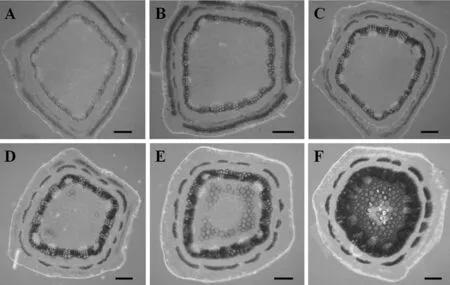
注:A、B、C、D、E和F分別為第6、5、4、3、2和1節間,紅色為紫丁香基木質素沉積部位,圖中標尺為200 μm
Note: A、B、C、D、E and F are the sixth, the fifth, the fourth, the third, the second and the first internode from the base of Alfalfa. Red indicates the deposition of S-lignin. All bars are 200 μm
圖1 紫丁香基木質素在苜蓿莖的沉積
Fig.1 S-lignin deposition in alfalfa stem
2.2 愈創木基木質素在苜蓿莖中的沉積
愈創木基木質素(G木質素)主要沉積在苜蓿莖的初生韌皮部、初生木質部、次生木質部等組織;在苜蓿莖的表皮、厚角組織、綠色組織、次生韌皮部和木質部內部的髓薄壁組織均無G木質素存在。各節間由上至下表現為,次生韌皮部和次生木質部逐漸加厚,且次生木質部全部有G木質素沉積,G木質素在髓薄壁組織沒有沉積,而髓射線在第5和第6節間沒有沉積,第1至第4節間才有G木質素沉積。圖2
2.3 兩種木質素單體在苜蓿莖中的沉積差異
兩種木質素單體在苜蓿莖中的沉積存在差異,上部節間(圖3A、3B)紫丁香基木質素的沉積范圍比愈創木基木質素要廣,表現為髓射線(圖3A、3B,箭頭所指)僅有紫丁香基木質素,而無愈創木基木質素,在初生韌皮部表現為紫丁香基木質素的沉積范圍比愈創木基木質素廣;下部節間(圖3C、3D)兩種木質素單體在髓射線和初生韌皮部均有沉積,且差異不大,但兩種木質素單體在髓的沉積表現出明顯的差異,表現為有紫丁香基木質素沉積,而無愈創木基木質素沉積。圖3
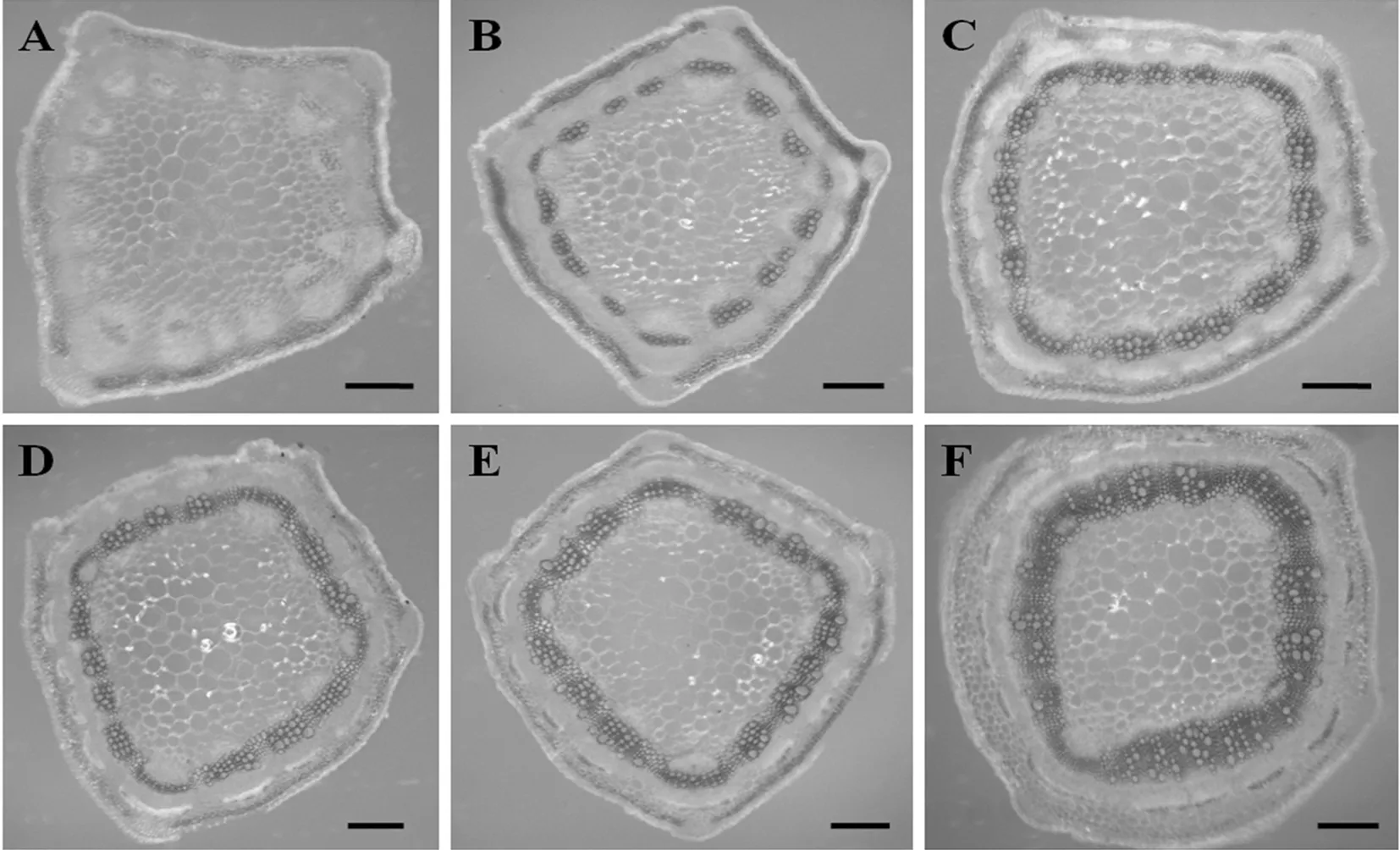
注:A、B、C、D、E和F分別為第6、5、4、3、2和1節間,紅色為愈創木基木質素沉積部位,圖中標尺為200 μm
Note: A、B、C、D、E and F are the sixth, the fifth, the fourth, the third, the second and the first internode from the base of Alfalfa. Red indicates the deposition of G-lignin. All bars are 200 μm
圖2 愈創木基木質素沉積部位
Fig.2 G-lignin deposition in alfalfa stem

注:A和B為第6節間,C和D為第1節間;A和C為愈創木基木質素染色圖,B和D為紫丁香基木質素染色圖。c:形成層;co:厚角組織;pp:初生韌皮部;sp:次生韌皮部;px:初生木質部;sx:次生木質部;pi:髓。圖中標尺為200 μm
Note: A and B: The sixth internode; C and D: The first internode; A and C: Red indicates the deposition of G-lignin; B and D: Red indicates the deposition of S-lignin. c, cambium; ch, chlorenchyma; co, collenchyma; pp, primary phloem; sp, secondary phloem; px; primary xylem; sx, secondary xylem; pi, pith. All bars are 200 μm
圖3 兩種木質素單體沉積比較
Fig.3 Comparison of two lignin monomers deposition
3 討 論
研究表明2種木質素單體由上到下木質素沉積面積逐漸擴大,這與王曉娟等[10]研究結果一致。這種節間沉積上的差異和莖的作用密切相關,與上部節間相比下部節間需承受更大的力,而木質素具有提高莖稈抵抗力的作用[1];Jung等[12]研究表明隨發育進行苜蓿木質素含量逐漸增加,不同節間木質素沉積上的差異可能還和其發育時期有關,上部節間出現晚,處于發育早期,沉積較少的木質素,下部節間出現早發育時間長,沉積較多的木質素,符合木質素沉積規律。
不同組織木質化的模式存在差異,表皮、厚角組織、綠色組織、次生韌皮部、形成層均無木質素的沉積,而初生木質部、次生木質部和出生韌皮部在各節間均有木質素沉積,這與Engels等[9]在木質素水平上的研究結果一致。兩種木質素單體在結構上的差異使得其降解難度不同[5],但到目前為止還未在自然界獲得純正的木質素單體。
4 結 論
2種木質素單體在髓和髓射線的沉積存在差異,這為木質素單體的獲得提供了可能。此外,2種木質素單體在相同組織的沉積差異由哪些因子引起,2種木質素單體在不同組織的合成調控機制是否存在差異都有待進一步研究。
References)
[1] [1]洪紱曾. 苜蓿科學[M]. 北京: 中國農業出版社, 2009.
HONG Fu-zeng. (2009)AlfalfaScience[M]. Beijing: Chinese Agricultural Press.(in Chinese)
[2]Shadle, G., Fang, C., Reddy, M. S. S., Jackson, L., Jin, N., & Dixon, R. A. (2007). Down-regulation of hydroxycinnamoyl coa: shikimate hydroxycinnamoyl transferase in transgenic alfalfa affects lignification, development and forage quality.Phytochemistry, 68(11):1,521-1,529.
[3]Getachew, G., Ibáez, A. M., Pittroff, W., Dandekar, A. M., Mccaslin, M., & Goyal, S., et al. (2012). A comparative study between lignin down regulated alfalfa lines and their respective unmodified controls on the nutritional characteristics of hay.Fuel&EnergyAbstracts, 170(3):192-200. G
[4]Reddy, M. S. S., & Dixon, R. A. (2005). Targeted down-regulation of cytochrome p450 enzymes for forage quality improvement in alfalfa (medicago sativa l.).ProceedingsoftheNationalAcademyofSciencesoftheUnitedStatesofAmerica, 102(46):16,573-16,578.
[5]李楨,王宏芝,李瑞芬,等.植物木質素合成調控與生物質能源利用[J].植物學報,2009,44(3):262-272.
LI Zhen, WANG Hong-zhi, LI Rui-fen, et al.(2009). Lignin biosynthesis and manipulation in plants and utilization of biomass energy [J].ChineseBulletinofBotany, 44(3):262-272.(in Chinese)
[6]Dien, B. S., Miller, D. J., Hector, R. E., Dixon, R. A., Chen, F., & Mccaslin, M., et al. (2011). Enhancing alfalfa conversion efficiencies for sugar recovery and ethanol production by altering lignin composition.BioresourceTechnology, 102(11):6,479-6,486.
[7]Weng, J. K., Xu, L., Bonawitz, N. D., & Chapple, C. (2008). Emerging strategies of lignin engineering and degradation for cellulosic biofuel production.CurrentOpinioninBiotechnology, 19(2):166-172.
[8]Fu, C., Mielenz, J. R., Xiao, X., Ge, Y., Hamilton, C. Y., & Jr, R. M., et al. (2011). Genetic manipulation of lignin reduces recalcitrance and improves ethanol production from switchgrass.ProceedingsoftheNationalAcademyofSciences, 108(9):3,803-3,808.
[9]Engels FMJung HG. (1998). Alfalfa stem tissues: cell-wall development and lignification.AnnalsofBotany, 82(5):561-568.
[10]王曉娟,張樹振,林雙雙,等.紫花苜蓿(MedicagosativaL.)生物能源利用的研究進展[J].中國農業科學,2013,46(8):1 694-1 705.
WANG Xiao-juan, ZHANG Shu-zhen, LIN Shuang-shuang, et al.(2013). Advances in study on bio-energy utilization of stem cell wall components in alfalfa (MedicagosativaL.) [J].ScientiaAgriculturaSinica, 46(8):1,694-1,705.(in Chinese)
[11]Patten, A. M., Cardenas, C. L., Cochrane, F. C., Laskar, D. D., Bedgar, D. L., & Davin, L. B., et al. (2005). Reassessment of effects on lignification and vascular development in the irx4 arabidopsis, mutant [J].Phytochemistry, 66(17):2,092-2,107.
[12]Jung, H. G., & Engels, F. M. (2002). Alfalfa stem tissues: cell wall deposition, composition, and degradability.CropScience, 42(2):524-534.
Fund project:Supported by International science and technology cooperation project of Xinjiang Uygur Autonomous Region (20156008)and Earlier stage projects of Xinjiang Agricultural University(XJAU201303)
The Study of Two Lignin Monomers Deposition in Alfalfa Stem
ZHANG Shu-zhen, WANG Yan, ZHANG Bo
(CollegeofPrataculturalandEnvironmentalSciences,XinjiangAgriculturalUniversity/XinjiangKeyLaboratoryofGrasslandResourcesandEcology,Urumqi830052,China)
【Objective】 Alfalfa (MedicagosativaL.) is a high quality forage legume, while the lignin cannot be well utilized by livestock. This project aims to study the guaiacyl lignin (G-lignin) and syringyl lignin (S-lignin) deposition pattern in stem of alfalfa and compare their differences.【Method】In this study, 2 kinds of lignin in the stem of alfalfa were individually stained with the method of histochemical staining, and the temporary sections were made and observed under the microscope.【Result】The results showed that the bottom internode had the most lignin deposition, and the least lignin deposition at top internode. The main reason for this was that the ligninfied proportion of secondary xylem and pith parenchyma were increased. There were significant differences of lignin deposition between two Lignin Monomers, there were S-lignin deposition but no G-lignin deposition in pith ray at top internode of alfalfa, and the same phenomenon was also showed in pith at bottom internode of alfalfa.【Conclusion】Lignin Monomers deposition sites were mainly in the primary xylem and secondary xylem, primary phloem, it had the most lignin deposition at the bottom of alfalfa stem. There was a significant difference between the 2 kinds of lignin monomers in the stem of Alfalfa, and the thickness and proportion of S lignin monomer were more than that of G lignin monomer in pith and pith ray cell of alfalfa.
alfalfa; stem; G-lignin; S-lignin
2016-08-26
新疆維吾爾自治區國際科技合作計劃項目(20156008);新疆農業大學校前期課題(XJAU201303)
張樹振(1988-),男,山東菏澤人,講師,研究方向為牧草栽培與生產,(E-mail)xjauzsz@163.com
張博(1963-),男,甘肅人,教授,研究方向為牧草遺傳育種,(E-mail)xjauzb@sina.com
10.6048/j.issn.1001-4330.2016.12.023
S551+7
:A
:1001-4330(2016)12-2339-05
猜你喜歡
音樂探索(2022年2期)2022-05-30 21:01:37
體育科技文獻通報(2022年3期)2022-05-23 13:46:54
天津外國語大學學報(2021年3期)2021-08-13 08:32:18
遼金歷史與考古(2021年0期)2021-07-29 01:06:54
科技傳播(2019年22期)2020-01-14 03:06:54
小天使·一年級語數英綜合(2019年8期)2019-08-27 02:23:00
民用飛機設計與研究(2019年4期)2019-05-21 07:21:24
中國特種設備安全(2018年11期)2019-01-08 02:08:32
小學科學(學生版)(2018年7期)2018-08-13 09:33:04
汽車工程學報(2017年2期)2017-07-05 08:13:02