
A new algorithm ofglobaltightly-coupled transient heat transfer based on quasi-steady flow to the conjugate heat transfer problem
2016-12-24 08:39:22FnchoMengSujunDongJunWngDechunGuo
Fncho Meng,Sujun Dong,?,Jun Wng,Dechun Guo
aSchoolof Aeronautic Science and Engineering,Beihang University of Aeronautics and Astronautics,Beijing 100191,China
bThermal Design Department,Beijing Aerospace Technology Research Institute,Beijing 100074,China
Letter
A new algorithm ofglobaltightly-coupled transient heat transfer based on quasi-steady flow to the conjugate heat transfer problem
Fanchao Menga,Sujun Donga,?,Jun Wanga,Dechun Guob
aSchoolof Aeronautic Science and Engineering,Beihang University of Aeronautics and Astronautics,Beijing 100191,China
bThermal Design Department,Beijing Aerospace Technology Research Institute,Beijing 100074,China
H I G H L I G H T S
.An algorithm is put forward and implemented using OpenFOAMfor long-term conjugate heat transfer(CHT)problem.
.Hypothesis of quasi-steady flow is verified acceptable to general CHT problem.
.Computational efficiency is further improved with greatly reduced flow update frequency.
.Update step of the flow can be reasonably determined using engineering empirical formula.
A R T I C L E I N F O
Article history:
Received 3 June 2016
Received in revised form
25 July 2016
Accepted 7 August 2016
Available online 31 August2016
Conjugate heattransfer Loosely-coupled Quasi-steady Computationalfluid dynamics
Concerning the specific demand on solving the long-term conjugate heat transfer(CHT)problem,a new algorithm of the global tightly-coupled transient heat transfer based on the quasi-steady flow field is furtherputforward.Compared to the traditionalloosely-coupled algorithm,the computationalefficiency is furtherimproved with the greatly reduced update frequency ofthe flow field,and moreover the update step of the flow field can be reasonably determined by using the engineering empirical formula of the Nusseltnumber based on the changes ofthe inletand outletboundary conditions.Taking a ductheated by innerforced airflow heating process as an example,the comparing results to the tightly-coupled transient calculation by Fluentsoftware shows thatthe new algorithm can significantly improve the computational efficiency with a reasonable accuracy on the transient temperature distribution,such as the computing time is reduced to 22.8%and 40%while the duct wall temperature deviation are 7%and 5%respectively using two flow update time step of 100 s and 50 s on the variable inlet-flow rate conditions.
?2016 The Authors.Published by Elsevier Ltd on behalf of The Chinese Society of Theoretical and Applied Mechanics.This is an open access article under the CC BY-NC-ND license(http:// creativecommons.org/licenses/by-nc-nd/4.0/).
The phenomena of the conjugate heat transfer(CHT)exists in various engineering fields ranging from power,energy,chemical, nuclear to aerospace.On the one hand,CHT phenomena concerns the coupling effects of different physic patterns at fluid-solid interface during a process of heat transfer,such as the displacement, deformation,heat transfer,phase change and so on.On the other hand,it also refers to the coupling effects of different physic process at fluid-solid interface,such as flowing,radiation,and combustion.
Concerning the rapid solving approaches of CHT,some researchers proposed a loose-coupled transient conjugate heat transfer method[1-4],which conserved the unsteady characteristic by solving respectively each part in transient state and exchanged the real-time information by the boundary conditions or moving mesh.This method can also use differenttransientupdate steps for different physical variables[5,6].Some researchers put forward a loosely-coupled algorithm based on the quasi-steady flow field.It considered that the flow field is approximately devised into a certain number of quasi-steady states governed by Navier-Stokes(N-S)equation during the whole CHT process[7-9].
In this article,a new loosely-coupled algorithm of the global tightly-coupled transient heat transfer based on the quasisteady flow field is further put forward,concerning the specific demands on solving problems of the long-term CHT problem.The implementation of the algorithm is fulfilled by the open source software of OpenFOAM[10-12].
According to the algorithm,the flow field is updated in steady state and the energy equations of the fluid and solid fields are solved in tightly-coupled transient state.The flow diagram of its overall algorithm is shown in Fig.1:
(1)Atinstant t0,initialize the temperature field in fluid and solid region.
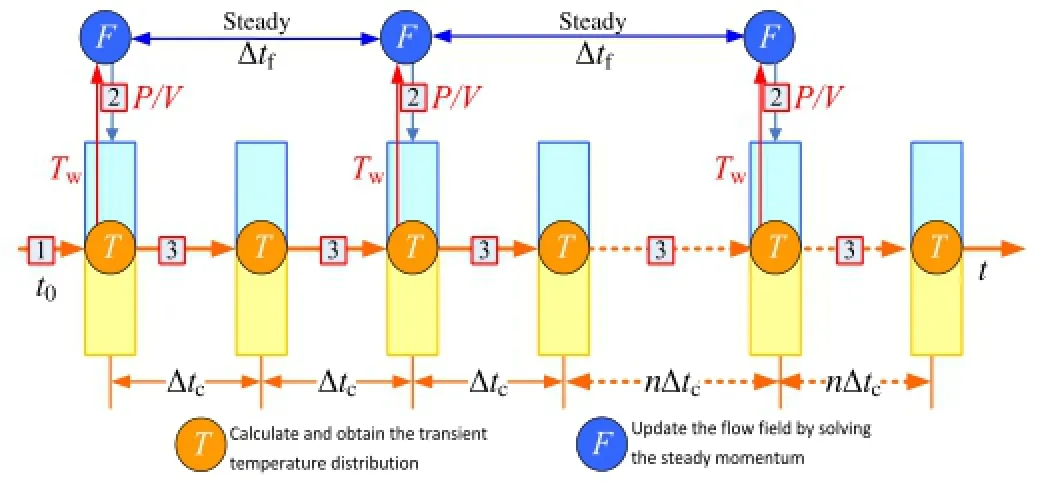
Fig.1.Flow diagram ofthe new algorithm.
(2)Update the flow field by solving the steady momentum, energy and turbulence equations in the fluid region with the fluid-solid coupled interface as the boundary of fixed temperature and eventually obtain a steady flow field.
(3)Calculate and obtain the transient temperature distribution of each instant until next update of fluid flow by solving the transient energy equations in fluid and solid region at the same time with the fluid-solid interface as the coupled boundary of heat flux.
(4)Repeat steps 2 and 3 and alternately operate the update of flow field and the calculation of transient temperature field until finalinstant.
So it is clear that the new algorithm retains the strong coupling characteristics of energy in CHT problem.The whole algorithm proceeds,however,mainly with the time step of transient temperature field,involving the update of steady flow field only at one or more moment,which avoids the time-consuming problem in the calculation of transient flow field.
Besides,distinct from normalloosely-coupled algorithm based on quasi-steady flow field,the calculation ofsteady flow field in the new algorithm is responsible for delivering the velocity and pressure field to the calculation of fluid-solid coupled transient heat transfer,rather than only updating the heat flux at the fluid-solid coupled interface.Thus,the fluid field needs to be updated barely when a large change of the boundary conditions or temperature fields considerably influences the velocity distribution and eventually changes the Nusselt number a lot atthe fluid-solid interface.
In order to determine update step of the flow field reasonably, a method based on threshold of Nusselt number is put forward. According to the calculation method of transient heat transfer, the temperature error threshold can be transformed to Nusselt number threshold.Then,with engineering empirical formula or dimensional analysis result of Nusselt number,its variation can be monitored in transient calculation.The threshold of Nusselt number is determined by the requirement of calculation accuracy and the variation of Nusselt number is determined by the working condition.So they determine the update frequency of flow field together.
In the application of this algorithm,by simplifying Nusselt number engineering empiricalformula,Nusseltnumber threshold can be transformed to threshold ofotherparameterwhich is easier to be monitored.For example,the engineering empiricalformula of the Nusselt number for the case offorced convection ofthe laminar flow in a duct is shown as

where Nu,Re,Pr are respectively the number of Nusselt,Reynolds, Plandlt,ηis the coefficient of viscosity,l and d are respectively the duct length and duct diameter.The subscript of f and w imply respectively the fluid and the duct wall.
We can see that,the temperature of the fluid and the duct wall affects the coefficientofconvection through affecting the property ofthe fluid,which usually can be neglected when the temperature changes not too much.Then the Nusselt number only depends on the inner flow velocity as below.

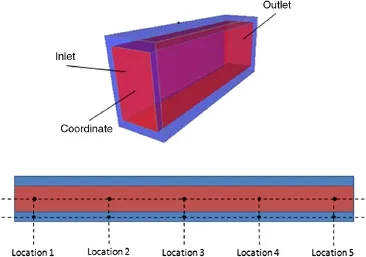
Fig.2.The inner-air-heated duct model.
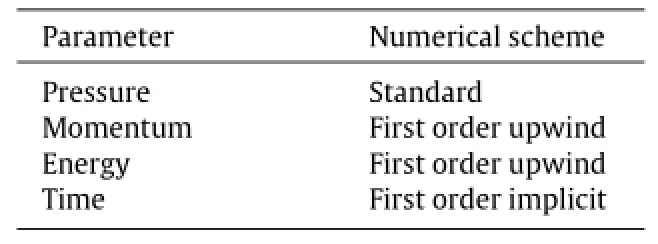
Table 1 The numericalscheme ofthe two algorithms.
Thus,we can obtain the maximum change width ofinner flow velocity that can ensure the heat intensity maintaining in a certain bias range,and then determine the update time of flow field.If the inlet velocity and outlet pressure of the flow do not change any during the whole calculation process,there is no need to update the flow field after obtaining a steady flow field at the initialmoment.
Analyze the accuracy of the algorithm for a transient temperature distribution with a variable inlet flow velocity.The specific geometric model is shown in Fig.2.The duct length is 328 mm. The dimension of inner wallcross-section is 10.4 mm X 6.4 mm, and the thickness of the upper or the bottom side is 1.3 mm.Suppose the inlet flow velocity changes linearly with an acceleration of 0.3 m/s for each 100 s while the initial velocity is 2 m/s.
Tightly-coupled algorithm of Fluent software is used as a matched group.To analyze the influence of different algorithm on the solution,both algorithms use the same grid-resolution and numerical scheme.Mash of this modelhas 1 733 837 cells.Table 1 gives the numericalscheme ofthe two algorithms.
First of all,the update moments of quasi-steady flow field have to be determined.According to the engineering empirical formula of the Nusselt number Eq.(1)and its correlation formula with flow velocity Eq.(2),the deviation of inlet velocity is respectively 0.3 m/s and 0.15 m/s corresponding to 100 s and 50 s of the updated step time ofthe quasi-steady flow field,which willbring the deviation of the Nusselt number of 5%and 2.5%.
Figures 3 and 4 give the contrast curves ofthe relative deviation of the temperature rise at each location between the tightlycoupled calculation results by tightly-coupled algorithm and the new algorithm,respectively with the update step time of 100 s and 50 s.We can draw the conclusions from that:
(1)For the inlet flow velocity linearly change condition,the deviation of the new loosely-coupled algorithm will grow up overtime,but it will be effectively corrected by updating the flow field.Moreover,within each stage of steady flow field,the deviation curves appear to be ofparabola form,which means thatthe deviation's decrease rate is significantly reduced after it rapidly drops to a certain value.Thus,considering the update of flow field largely affecting the computing efficiency,we suggest that the update intervalshould be set no less than the drastically dropped stage of the deviation.
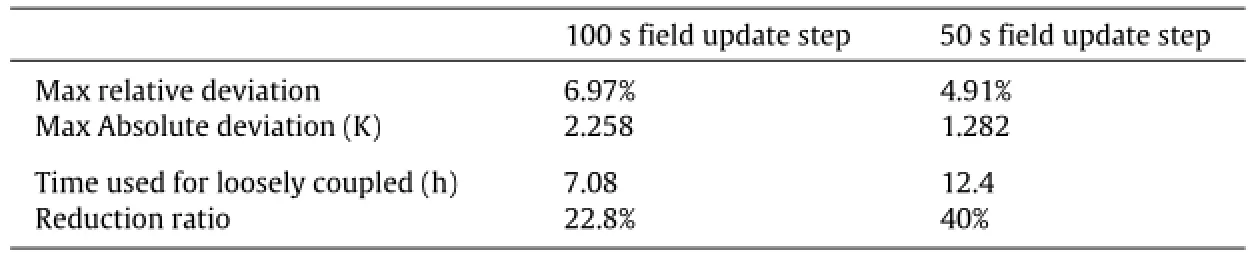
Table 2 The comparison of the max wall-temperature difference and time consumed between the two algorithms.Calculation time for tightly coupled as 31 h.
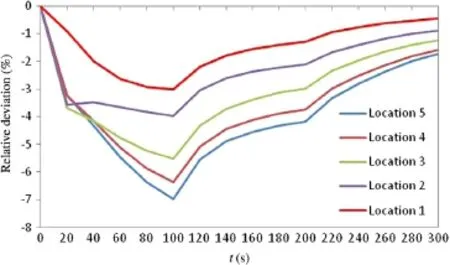
Fig.3.(Color online)The contrast curves of the relative deviation of the walltemperature-rise at different location by the two methods with 100 s as the fluid update time step.
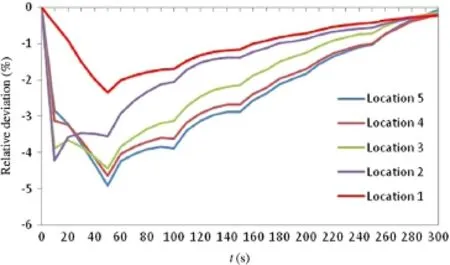
Fig.4.(Color online)The contrast curves of the relative deviation of the walltemperature-rise at different location by the two methods with 50 s as the fluid update time step.
(2)The maximal relative and absolute deviations of the duct temperature rise are respectively(6.97%,1.8 K)and(4.91%,1.3 K) with the two update step of the flow field of 100 s and 50 s. Over the whole heat transfer process,flow field updating restricts absolute deviations less than 5%and 2.5%,which are also within the expected range at the first.
Above all,to the solution problemoftransient temperature field affected by the variable flow field due to the variable inlet flow velocity,the new algorithm can control the temperature derivation within expected range and at the same time with a higher calculation efficiency,by determining the quasi-steady flow update step time reasonably using the engineering empiricalformula of the Nusselt number.
Table 2 gives the maximal deviation of the inner duct temperature rise and the time consumed by our new algorithm and the tightly-coupled algorithm using Fluent software for the case above-mentioned with the variable inlet flow velocity.
It can be seen that to the case of variable inlet flow velocity, the calculation time consumed is reduced to 22.8%and 40% respectively with 6.97%and 4.91%of the relative deviation of the temperature rise by using two quasi-steady flow update step time of100 s and 50 s.
Overall,compared with the traditional loosely-coupled algorithm which only update the heat flux at the fluid-solid coupled interface,the new algorithm can avoid the big problem about the update step time of the flow field and control the temperature derivation within expected range by using the engineering empiricalformula ofthe Nusselt number according to the changes at inlet and outlet boundaries.
Compared with the tightly-coupled algorithm using FLUENT, the new algorithm can significantly enhance the computation efficiency while ensuring the accuracy ofthe transienttemperature field.
[1]P.T.Bauman,R.Stogner,G.F.Carey,et al.,Loose-coupling algorithm for simulating hypersonic flows with radiation and ablation,J.Spacecr.Rockets 48(2011)72-80.
[2]V.Kazemi-Kamyab,A.H.van Zuijlen,H.Bijl,A high order time-accurate loosely-coupled solution algorithm for unsteady conjugate heat transfer problems,Comput.Methods Appl.Mech.Engrg.264(2013)205-217.
[3]V.Kazemi-Kamyab,A.H.van Zuijlen,H.Bijl,Accuracy and stability analysis of a second-order time-accurate loosely coupled partitioned algorithm for transientconjugate heattransfer problems,Internat.J.Numer.Methods Fluids 74(2014)113-133.
[4]R.L?hner,C.Yang,J.Cebral,et al.Fluid-structure-thermalinteraction using a loose coupling algorithm and adaptive unstructured grids,in:29th AIAA Fluid Dynamics Conference,1998.
[5]Q.Li,P.Liu,G.He,Fluid-solid coupled simulation of the ignition transient of solid rocket motor,Acta Astronaut.110(2015)180-190.
[6]B.A.Miller,A.R.Crowell,J.J.McNamara,Loosely coupled time-marching of fluid-thermal-structural interactions,in:54th AIAA/ASME/ASCE/AHS/ASC Structures,Structural Dynamics,and Materials Conference,2013.
[7]D.Kontinos,Coupled thermal analysis method with application to metallic thermalprotection panels,J.Thermophys.Heat Transfer 11(1997)173-181.
[8]Y.K.Chen,F.S.Milos,T.Gokcen,Loosely coupled simulation for twodimensionalablation and shape change,J.Spacecr.Rockets 47(2010)775-785.
[9]S.Zhang,F.Chen,H.Liu,Time-adaptive,loosely coupled strategy forconjugate heat transfer problems in hypersonic flows,J.Thermophys.Heat Transfer 28 (2014)1-12.
[10]M.S.Gandhi,M.J.Sathe,J.B.Joshi,et al.,Two phase natural convection:CFD simulations and PIV measurement,Chem.Eng.Sci.66(2011)3152-3171.
[11]F.Habla,H.Marschall,O.Hinrichsen,et al.,Numerical simulation of viscoelastic two-phase flows using openFOAM,Chem.Eng.Sci.66(2011) 5487-5496.
[12]D.V.R.Fontoura,E.M.Matos,J.R.Nunhez,A three-dimensionaltwo-phase flow modelwith phase change inside a tube of petrochemicalpre-heaters,J.Fuel 110(2013)196-203.
?Corresponding author.
E-mail address:dsj@buaa.edu.cn(S.Dong).
http://dx.doi.org/10.1016/j.taml.2016.08.005
2095-0349/?2016 The Authors.Published by Elsevier Ltd on behalf of The Chinese Society of Theoreticaland Applied Mechanics.This is an open access article under the CC BY-NC-ND license(http://creativecommons.org/licenses/by-nc-nd/4.0/).
 Theoretical & Applied Mechanics Letters2016年5期
- Theoretical & Applied Mechanics Letters的其它文章
- A modified airfoil-based piezoaeroelastic energy harvester with double plunge degrees of freedom
- The performance of proper orthogonaldecomposition in discontinuous flows
- Side force controlon slender body by self-excited oscillation flag
- The Richtmyer-Meshkov instability of a'V'shaped air/helium interface subjected to a weak shock
- High temperature effects in moving shock reflection with protruding Mach stem
- Numericalinvestigation of unsteady mixing mechanism in plate film cooling