CHANGE HAS ARRIVED
2016-12-16 07:48:54
漢語世界 2016年6期
CHANGE HAS ARRIVED
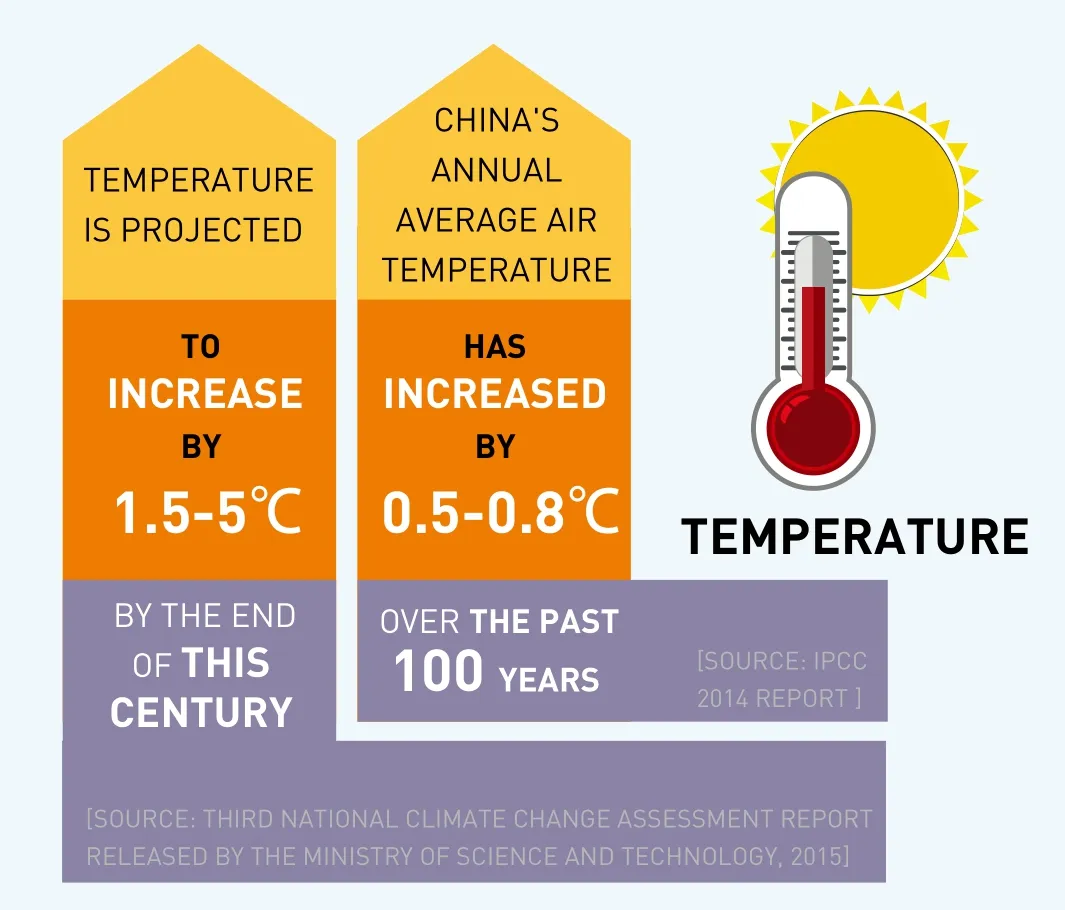
The planet is warming at an alarming rate, and more concise data means that the effects can be better measured. Whether it’s building bridges in cities or preparing for floods in the countryside, the numbers are showing that the concern over climate change is no longer just handwringing. China has experienced noticeable climate change over the past century. According to the Intergovernmental Panel on Climate Change (IPCC) report in 2014, China’s annual average air temperature increased by 0.5 to 0.8 degrees Celsius over the past 100 years, which was slightly greater than the global average.
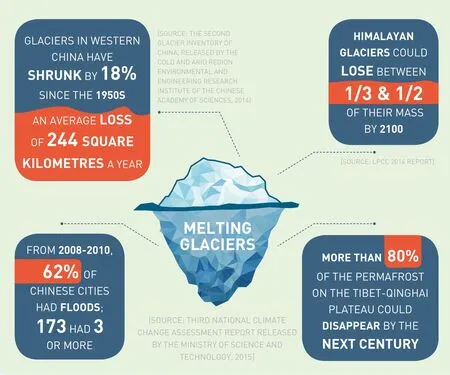
The most immediate problem for China is glaciers. Projections show that a temperature rise of 4 degrees could trigger rapid melting of glaciers on a global scale and China’s western region, known as the Third Pole, is in serious danger. The Third National Assessment Report on Climate Change in 2015, claims that glaciers in western China have shrunk by 18 percent since the 1950s, an average loss of 244 square kilometers a year. The 2014 IPCC report predicted that the Himalayan glaciers could lose one-third to one-half of their mass by 2100.
These shrinking glaciers result in flooding from glacial lakes in the west all the way to the Yangtze River Delta, causing an increase in flooding. From 2008 to 2010, 62 percent of Chinese cities experienced flooding; 173 cities had three or more floods in that period, according to an assessment from the China Environment Forum and Western Kentucky University.
The glacial melting is also causing droughts. The closest glacier to a major city in the world, outside of Urumqi, has retreated more than 180 meters, shedding nearly a quarter of its mass. This is very likely to bring serious water disruptions to the two million people in Urumqi, according to researchers at the Tianshan Glacier Station, Urumqi Glacier No.1. As glaciers shrink, so too do the freshwater lakes and streams upon which so many rural residents depend. Climate change has also accelerated desertification. The New York Times recently claimed that China’s deserts have been spreading at an annual rate of more than 1,300 square miles for years.
[SOURCE: THIRD NATIONAL CLIMATE CHANGE ASSESSMENT REPORT RELEASED BY THE MINISTRY OF SCIENCE AND TECHNOLOGY, 2015]
The effects of climate change on agriculture are already measurable. According to a paper in the Journal of Environmental Economics and Management, changing climate conditions from 2001 to 2009 led to a net economic loss of approximately 200 million USDin China’s corn and soybean sectors in 2009 alone. And the IPCC report in 2007 concluded that under the worst case scenario, the expected effects of temperature and precipitation change could cause a drop in China’s rain-fed yields of rice, wheat, and maize of between 20 and 36 percent over the next 20 to 80 years.
Another oft-overlooked element to climate change is the spread of disease in traditionally cooler areas, and such has been the case with malaria and dengue fever in parts of China. In 2014, China saw its worst outbreak of dengue fever in the southern province of Guangdong, with six people killed and thousands infected, according to the Health Department of Guangdong Province.
For the authorities, the question is how to best avoid the affects of nearfuture climate change and all signs point to infrastructure being the best response. That, however, does not come cheap. With once-every-20-years flooding predicted to occur as frequently as every four years by 2050, preparing for climate change in the PRC could cost 44 billion USD a year by 2050, according to a report from the Asian Development Bank in 2013.
While no particular natural phenomenon is necessarily “caused” by climate change directly, the effects of a warming globe are now clearly visible, and figuring out how to deal with the barrage of troubles will be an expensive problem for generations to come. - SUN JIAHUI (孫佳慧)

[SOURCE: MPACTS OF CLIMATE CHANGE ON AGRICULTURE: EVIDENCE FROM CHINA, BY CHEN SHUAI, CHEN XIAOGUANG AND XU JINTAO, 2014 ]