Love of Chinese Language Expressed in Couplets
2016-12-14 20:34:14
CHINA TODAY 2016年12期
THE traditional Chinese couplet is an artistic combination of poetry and calligraphy. A couplet, as the Chinese– yinglian or duilian – for this duo implies, is composed of a pair (fu) of antithetical lines of poetry that are inscribed on strips of paper pasted to the door jambs (ying) either side of a house entrance, or engraved on a plaque and hung above it. The two lines follow specific syntactic rules: They have the same number of characters, an identical meter, and inverse tone patterns where the meaning of every two corresponding characters is related. They are written, in ancient Chinese style, from right to left in vertical columns.
Succinct but imbued with luminary ideas and executed in flowing calligraphy, the couplet is a unique form of classical Chinese art and literature which is shared by countries that have historical and cultural ties with China, such as Vietnam, Korea, Japan, and Singapore. The couplet was recognized as Chinas national intangible cultural heritage in 2006.
History
The couplet is believed to have its roots in the antithetical style of ancient Chinese writing. The earliest known example, from AD 290, is that of a pair of rhyming verses of identical meter. In the ensuing centuries the couplet and other literary forms,including parallel prose and the eight-line poem, drew upon one another. However, the couplet eventually developed and matured into a discrete literary category.
In ancient times it was the tradition at lunar New Year to engrave auspicious sentiments intended to ward off evil spirits on peach wood plaques and hang them on either side of a house gateway. The earliest known couplet was written at Spring Festival 964 by the King of Later Shu. It said: “The New Year is bathed in forefathers blessings; the joyous festival promises everlasting youth and wealth.”Writing counterpoints on peach wood blocks thereafter became the custom which the country as a whole followed.
By the 14th century, when paper became commonplace, peach wood plaques had been superseded by inscribed vertical strips of red paper that were pasted on door frames on Spring Festival eve. The practice carries on to this day.
It is said that Zhu Yuanzhang (1328-1398), founding emperor of the Ming Dynasty, ordained that all families in the country should attach couplets to their gates for Spring Festival. The ruler would take great delight in touring the capital city of Jinling (todays Nanjing) incognito to read those he saw. On one such excursion he noticed a house in the city which had not followed his directive. Upon enquiring why, he learned that all members of the family were illiterate. The monarch thereupon, on a whim, offered to compose a couplet for the household. Inspired by the familys way of making a living – castrating pigs – the emperor mischievously wrote: “Two hands to incise the path to life or death; one blade to slice the root of sins.”
Writing couplets later became a popular pastime among Chinese scholars, as both a vehicle for literary conversation and word play. The trend carried on through to the 17th century and became a main feature of popular culture. Through cultural exchanges it was also introduced to Chinas neighboring countries, where it also thrived.
Roles
Couplets perform different functions on diverse occasions. Some express good wishes for the New Year, others congratulate newly-weds, wish seniors well on their birthdays, or mourn the passing and celebrate the life of deceased ones at funerals. Couplets also extol the beauty of scenic spots, promote the advantages and special features of a particular trade, and act as a medium for exchanging thoughts with or poking fun at friends or like-minded acquaintances.
The couplet evolved from poetry, and therefore shares many of its rules. For instance the last character of the first line (pasted on the right-hand side) has an oblique tone, while that of the second line (on the left) is more even, with a far stricter meter and rhyme scheme. And corresponding characters in the two columns must be the same part of speech, conveying an associable but not identical meaning, and also seamlessly fit into their context.
Compared with conventions on the length of poem, the couplet is more flexible. It may vary from one or two words to each line to several hundred. Like ancient Chinese writing, it has no punctuation. The couplet is often accompanied by a horizontal verse (hengpi) that summarizes or highlights the central points of the two vertical columns.
An ideal vehicle for self-expression, lyricism, and communication, the couplet appeared widely in ancient buildings – from imperial palaces to private gardens and studies. Executed in the finest calligraphy, it was an esteemed ornamentation, engraved on wood, stone, and bamboo strips as well as inscribed on paper. Writing couplets is the traditional reserve of the dry-witted master wordsmith.
Presence in the Forbidden City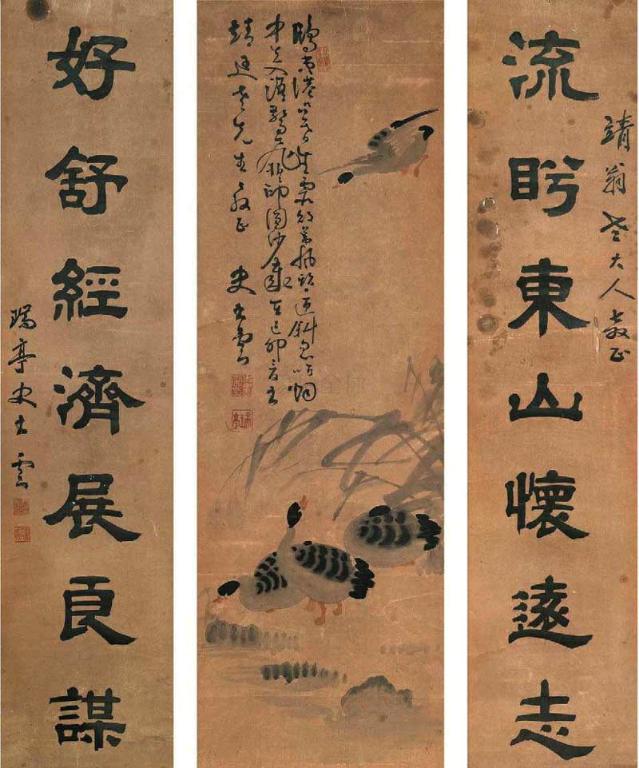
The Forbidden City in central Beijing was home to 24 emperors of the Ming (1368-1644) and Qing(1644-1911) dynasties and their families. The worlds largest extant wood-structure palace complex, it includes dozens of sub-compounds subdi-vided into the Outer Court, where the monarch held court and presided over state ceremonies, and the Inner Court, the living quarters of the ruler and his entourage.
Couplets are ubiquitous on these majestic build- ings with elaborately carved beams and gorgeously painted pillars. Some were the personal calligraphy of emperors, but most were the works of court officials. Three hundred and nineteen pairs survive to this day.
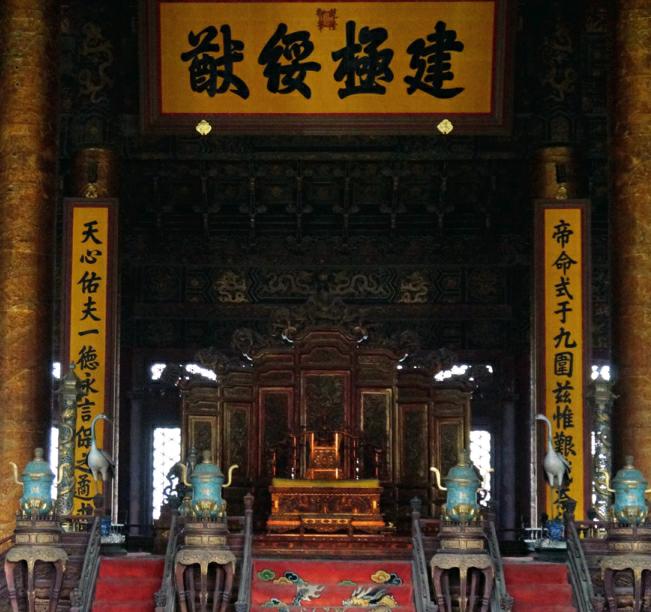
Of all buildings in the Forbidden City, the Taihe(Supreme Harmony) Hall is the largest and of greatest significance. As site of the imperial throne it constituted the ceremonial seat of imperial power. The couplets in this hall were written by Qing Emperor Qianlong (1711-1799). They read: “By heavenly ordinance the emperor rules the nation, a challenging mission that he must perform with awe; In godly blessing is the rule of virtue, the high road to lasting peace which the emperor must forever adhere to.”
The Qianqing (Heavenly Purity) Hall was where Qing emperors handled daily state affairs. The couplets in this building were written by Emperor Kangxi (1654-1722). They read: “Role model for all his subjects, the emperor must be circumspect and far-sighted, and diligently cultivate his moral character; Following the teachings of ancient sages, the emperor should not ignore the reality of peoples livelihood, and be aware of their difficulties.”
Most of the couplets in the Forbidden City are in the form of inscribed plaques hung on columns(either at the entrance of a building or inside it) and walls. But some are innovative exceptions. For instance the pair on the opera stage in Shufang Zhai Palace is engraved on the shell of a qin (a sevenstring plucked musical instrument). And those outside the Yangxin (Mental Cultivation) Hall are inlaid with jade.