China Is the Main International Force Supporting Globalization
2016-12-14 20:03:55ByJOHNROSS
CHINA TODAY 2016年12期
By+JOHN+ROSS
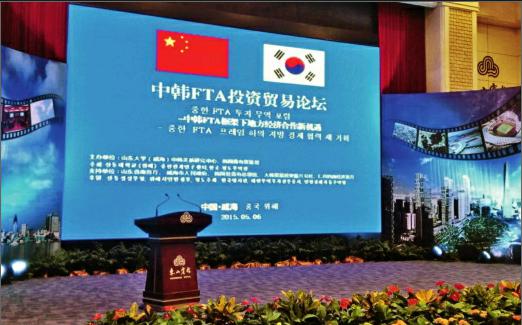
DECEMBER 2016 marks the first anniver- sary of Chinas major free trade agreements(FTAs) with South Korea and Australia. So far China has signed 14 free trade pacts with 22 countries and regions in Asia, Latin America, Oceania, and Europe. The rise of protectionist rhetoric in some countries has made China the largest economy that unequivocally supports progress towards free trade. It is consequently crucial to analyze both the fundamental issues involved, that is, the most powerful forces driving the process of globalization, and the immediate practical consequences for China of pushing for FTAs.
The Importance of Trade
First, when analyzing the most powerful forces of economic development, international trade is one of the clearest issues where economic theory and the facts of economic development completely coincide. Economic theory states that international trade will aid economic development: Numerous and repeated factual studies show a positive correlation between the trade openness of an economy and its speed of economic development.
Trades importance does not arise from some “magic effect” of crossing national borders. The distance from Shanghai to Beijing and from Shanghai to Osaka is approximately the same, but the importance of trade does not mean that there is some extra benefit to be gained from Shanghais trade with Japan rather than with another part of China.
International trades importance follows from the proven fact stated in the first sentence of chapter one of the founding work of modern economics, Adam Smiths The Wealth of Nations: “The greatest improvement in the productive powers of labor, and the greater part of the skill, dexterity, and judgment with which it is directed, or applied, seem to have been the effect of the division of labor.” Modern econometrics fully confirmed Smiths analysis.
The key role of international trade follows directly from the decisive role of division of labor. As Smith immediately observed: “The division of labor is limited by the extent of the market” – increasing division/socialization of labor required an increasing market size. It was for this fundamental economic reason that Smith advocated free trade. Marx, incidentally, had the same position as Smith on this – albeit using the term “socialization of labor” instead of “division of labor.”
“Opening up”
These fundamental economic forces of course explain the success of Chinas “reform and opening-up” process since 1978 – and why China seeks new FTAs. Given the success of the “opening-up” policy, it corresponds to Chinas national self-interest to press forward with proposals for freer trade and FTAs.
But the fact that this advantage of division of labor to economic development is the foundation of trade means equally that developing it is in the interests of other countries as well as China. This is why China has been able to secure its free trade agreements with South Korea, Australia and other countries, and why it wants more.
It is also the beneficial effects of such globalization that have helped generate rapid economic growth in China, India and other developing countries, thereby helping lift hundreds of millions of people out of poverty. Globalization is consequently decisively important for countries, but particularly developing countries and the worlds poorest people, to achieve economic development.
U.S. Economic History
If China since 1978 dramatically illustrates the advantages of open trade, U.S. history provides one of the most dramatic examples of the negative effect of protectionism. The passing of the Smoot-Hawley Tariff Act in 1930 which raised U.S. tariffs, against the advice of huge numbers of U.S. economists, was a decisive factor in the depth of the Great Depression.
Following the devastating experience of the Great Depression after World War II, the U.S. turned policy 180 degrees and actively built a globalized world trade order. The U.S. played a decisive role in seven rounds of negotiations under the General Agreement on Tariffs and Trade(GATT), each of which further liberalized world trade. This culminated in 1995 in the creation of the World Trade Organization (WTO). Every U.S. President from Truman to Obama declared support for freer trade.
TPP and TTIP
Nevertheless it is important to realize that the U.S. began to break with the goal of an increasingly globalized world economy, in reality if not in rhetoric, under Obama. Obamas Trans-Pacific Partnership (TPP) and the Trans-Atlantic Trade and Investors Partnership(TTIP) initiatives differed decisively from previous trade agreements under GATT, and the creation of the WTO. Their ostensible support of freer trade thinly disguised regionalized U.S. protectionism.
Such underlying content was highlighted in the TPP. The U.S. and China are the worlds first and second largest trading nations. The foundation of a genuine U.S. orientation towards freer trade in the Pacific would have been to negotiate with China. But instead the U.S. deliberately excluded China from the TPP negotiations –confirming that, as numerous Western analysts noted, the TPPs real aim was not to liberalize trade but to form a bloc under U.S. dominance against China.
But as the TPP did nothing to improve the position of the U.S. population, and indeed would have worsened it, the TPP became politically toxic. All three of the candidates with major support during the U.S. presidential election and primaries – Trump, Clinton and Sanders –were forced to declare opposition to the TPP.
China Has Become the Main Pillar of Globalization
The above processes create the strategic fact that it is China that has now become the worlds largest single economy which is unequivocally committed to free trade and globalization – although the EU is also, at least in theory, a supporter of this process, and Germany, its most powerful economy, is an enormous beneficiary of globalized trade. The worlds most rapidly growing major economy along with China, India, is also sharply increasing its economic openness. The percentage of Indias economy devoted to trade is, at current exchange rates, now even slightly above Chinas. The powerful positive effect of foreign trade is once more confirmed by the fact that the worlds five most rapidly growing non-oil dominated economies since the early 1990s with populations of more than five million – in descending order China, Cambodia, Vietnam, Laos, and India – all have high percentages of trade in GDP. Therefore Chinas decisive task is to place itself decisively among and help lead the process of the rapidly growing economies pursuit of the advantages of internationalization and globalization.
Chinas Policy and RCEP
Chinas strategic policy of supporting freer trade and globalization can be broken down into a series of initiatives which in present circumstances give it key advan- tages towards playing a still greater global role.
Chinas most important proposal is to support the Regional Comprehensive Economic Partnership (RCEP) –the proposed FTA between the 10 member states of the Association of Southeast Asian Nations (ASEAN) (Brunei, Myanmar, Cambodia, Indonesia, Laos, Malaysia, the Philippines, Singapore, Thailand, Vietnam) and the six states with which ASEAN has existing FTAs (Australia, China, India, Japan, South Korea, and New Zealand). RCEP negotiations were formally launched in November 2012 at the ASEAN Summit in Cambodia. China is pushing for them to be concluded as rapidly as possible.
The RCEP has numerous advantages over the TPP. In particular, key proposed RCEP participants are rapidly growing economies (China, India, Vietnam, and ASEAN as a whole) whereas the TPP was based on slowly growing economies (Japan and the U.S.).
Like Chinas existing FTAs, the RCEP builds on real trading relationships – China takes about one third of Australian exports and more than 20 percent of South Koreas. With full implementation of the FTA agreement with Australia, for example, 95 percent of Australian exports to China will be tariff free.
Unlike the TPP and TTIP, which were primarily based on giving international jurisdiction to institutions which would be controlled by a single country (the U.S.), Chinas existing FTAs, like the RCEP, emphasize harmonization of national standards, with international supervision and interference reduced to an absolute minimum.
In summary, China has now publicly become the worlds largest nation supporting and acting as a pillar of globalization. As globalization is the process which has brought immense benefits to the world economy, and particularly to developing countries, this creates key international strategic openings for China which correspond both with its own national interests and those of other countries.