International Cooperation on Education for Sustainable Development
2016-12-14 19:48:52BystaffreporterLI
CHINA TODAY 2016年12期
By+staff+reporter+LIU+YI
SUSTAINABLE development is an issue of common concern throughout the world today. Countries attending the UN Summit in September 2015 reached a consensus on the new global framework for development – that of Sustainable Development Goals (SDGs). In contrast to the Millennium Development Goals adopted in 2000, the SDGs signify that countries across the globe are aware of the strong impact environmental issues will have on humankind in future.
China explicitly put forward the idea of “ecological progress” for the 13th Five-Year Plan period that began this year. On the global scale, the Chinese government took the lead in ratifying the Paris Agreement reached at the 2015 Paris Climate Change Conference. However, as a developing country China is still challenged by outdated notions of development and practices.
“Sustainable development is for our future generations. Unless students and the public comprehend just how imperative it is, the concept is nothing more than empty talk,” Executive Vice President of Tongji University Wu Jiang said during an interview with China Today. “Education is the key to sustainable development.”
A respected expert in architectural heritage protection and utilization, Professor Wu Jiang has been involved in education for sustainable development for more than 30 years. He has witnessed the concepts penetration into Chinas education circles, especially higher education. In 2012, he initiated the founding of the Global Universities Partnership on Environment for Sustainability (GUPES). This was a milestone in his career as an education administrator and advocator of sustainable development education.
Transforming the Existing Educational System
Tongji University, founded in 1907, has a long-established reputation for its urban planning and construction disciplines. As environmental deterioration appeared earlier in cities than in the countryside, it is natural that the university should focus on such issues. In 1988, Tongji established the College of Environmental Engineering, the first of its kind in China. As of today, Tongjis built environment is around 20th in the QS World University Rankings by Subjects.
Tongji promoted on campus green architecture, water recycling and reuse, and garbage sorting. It also established the campus energy management system that has been adopted in more than 120 of Chinas universities. But more importantly, Tongji has spared no efforts to promote the sustainable development concept in all its courses. The content of each is reviewed through the lens of sustainable development. Any facet of knowledge that goes against the concept is immediately checked and rectified.
“In the past, all students of engineering technology regarded cost-efficiency as paramount. Effectiveness and functionality were therefore the prime benchmarks in the construction of a building,” Professor Wu Jiang said. “But pollution and resource problems have forced us to take the environmental dimension into consideration. That entails thoroughgoing changes to courses, from program and curriculum design to lecture content.”
New energy vehicles are a prime example of Tongjis transformation of its traditional curricula. In 2002, at the initiation of then Vice President of Tongji University Wan Gang, now Chinas Minister of Science and Technology, it established the New Energy Vehicles Engineering Center. “Tongji now ranks first in China in automobile studies,” Wu Jiang said. “But the thinking and practice from the perspective of sustainable development has been consistent.”
Wu Jiang went on to say that Tongjis research on applying new energy technologies to public transportation and rail transportation began early. Their findings showed that although sedans can run on new energy, they nevertheless oc- cupy disproportionate amounts of road and space resources. In 2010, therefore, the university produced new energy buses that were used at the Shanghai Expo. But public transportation might not always meet personalized demands, so why not create a smart renting system that enables people to use new energy cars in a time-sharing way? Wu Jiang is pondering this possibility.
Amid this ethos, Tongji students are dedicated to research and innovations of sustainable development. The Green Seed, for example, is a club that a dozen or so students set up in 2012. It encourages students at Tongji and other universities across the country to put knowledge gained from lectures to use on investigations of environmental issues.
In the past several years, Green Seed participants have undertaken a wide range of research projects – from processing discarded cellphones, to the illicit online wildlife trade, to agricultural water usage in the Dunhuang region, to the developmental status quo of nongovernmental environmental organizations in China. They carried out many field surveys and even raised detailed solutions to these issues.
International Exchanges and Cooperation
In 2002, Tongji University and the United Nations Environment Programme (UNEP) jointly established the UNEP-Tongji Institute of Environment for Sustainable Development (IESD).
This is a platform for Tongji University to integrate disciplines and subjects with the underlying theme of sustainable development. This concept has now been fully incorporated with other subjects, such as environmental laws, transportation, design and creation, construction, and modern agriculture. These minor, sustainability-oriented programs are open to all students.
More important, the IESD has become an international medium for sustainable development education. Of the 350 or so students from more than 50 countries that have received master and doctorate degrees in environmental management and environmental engineering, 70 percent are from developing countries.
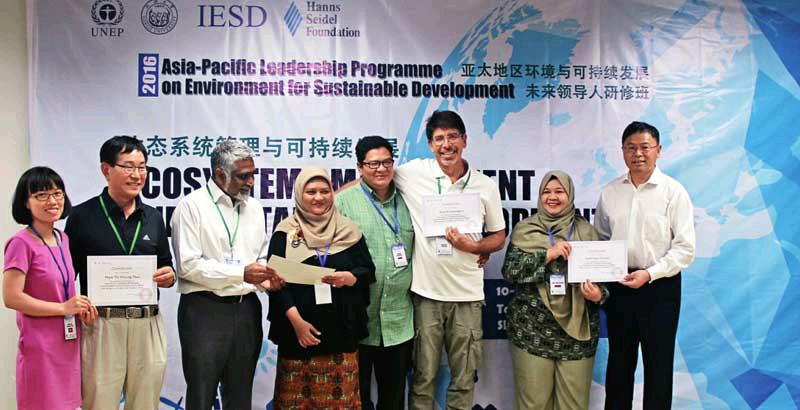
The institute also runs short-term training courses for targeted groups. One successful example is the Asia-Pacific Leadership Programme on Environment for Sustainable Development (APLP), which started in 2004. The week-long training course is designed for officials in government departments of environment, agriculture, forestry, and foreign affairs in Asia-Pacific countries. Their awareness of environmental issues will undoubtedly reinforce the implementation and practice of related policies.
“Trainees from developing countries usually find Chinas experience more useful than that of the developed countries,” Professor Wu Jiang said. “This is because Chinas environmental experience is both recent and proven, and so of excellent reference value.”
The water treatment technology transfer projects, led by IESD Deputy Dean Li Fengting, are under construction in Ethiopia, Kenya, and 10 other African countries. Li, a water processing expert, is in the midst of applying Chinas potable water and waste water treatment technologies in African cities. The projects, which embody model environmental cooperation between China and Africa, are hailed by locals, and also have the full support of Chinas Ministry of Science and Technology.
Leader of Education for Sustainable Development
Certain early sustainable development concepts appeared on the Chinese campus in the early 1980s when Wu Jiang was a student at Tongji University. At that time, however, Chinas focus was almost exclusively on economic growth, and the concept of sustainability was barely comprehended throughout the world at large. Only in the last decade or so have people become aware of the detrimental high-pollutant downside to high energy consumption, and accordingly adjusted production and lifestyle modes.
“Why did we protect the environment, build green architectures, and promote garbage sorting?” Professor Wu asked, rhetorically. “Solely for a cleaner environment?”
Wu believes that sustainable develop- ment is not so much a technical issue of“how” but one – more to do with values– of “why.” The culprit of environmental deterioration is the serious contradiction among generations. We exploited resources, leaving few for our offspring. The development of one generation has thus been at the cost of opportunities for the succeeding ones.
“We need to re-establish these values: It is immoral to plunder the resources that our children and grandchildren should inherit!” Wu declared.
He believes that inculcating values and ethics in students is at the core of sustainable development education. The knowledge and technologies that students learn are only tools. Whether they are used to destroy the environment or nurture it for the future is determined by the values that students hold. But Professor Wu added frankly: “This mission cant be completed by one or two persons, or even in one or two generations.”
It was in this spirit that Wu Jiang initiated a global university alliance. He found that many colleges were aware of the importance of education for sustainable development, but needed to explore this new field together and learn from one another.
In June 2012, the Global Universities Partnership on Environment for Sustainability (GUPES) was established in Nairobi under the guidance of the UNEP. Professor Wu Jiang was elected as its first president.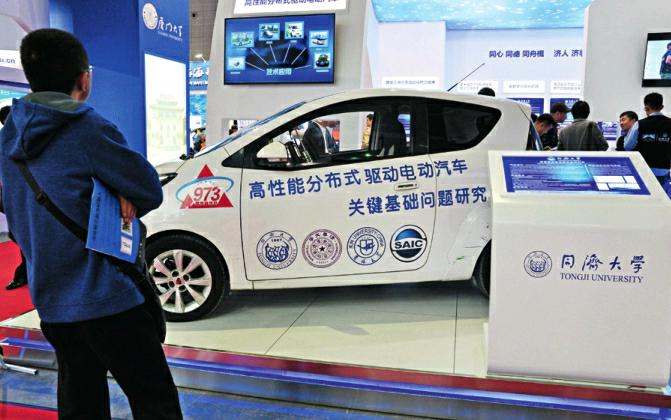
Four years later, over 800 universities have joined GUPES, and some 200 universities have filed for participation. The partnership just concluded its yearly conference at MIT in Boston, U.S., last September. Wu Jiang introduced at this event Tongjis experience, and discussed with his foreign peers how to establish an inter-generational education network for sustainable development.
These growing international exchanges also gave Wu Jiang a new angle on traditional Chinese culture. “Chinese ancients held to the concept of fengshui for construction. In modern language, feng means the air, and shui the water resource,” Wu Jiang said. “This is our forefathers understanding of sustainable environment and ecological cycle.”
Professor Wu advocates searching out sustainable development concepts in Chinese culture, for instance, caring for the next generation in a big family, the unity of man and nature, and ecological progress. “This is Chinese peoples contribution to sustainable development,”Professor Wu Jiang said. “We are proactively participating in the progress of sustainable development.”