
Precipitation responses to radiative processes of water- and ice-clouds: an equilibrium cloud-resolving modeling study
2016-11-23 03:30:22XINJinandLIXiaoFan
關鍵詞:大氣
XIN Jin and LI Xiao-Fan
School of Earth Sciences, Zhejiang University, Hangzhou, China
Precipitation responses to radiative processes of water- and ice-clouds: an equilibrium cloud-resolving modeling study
XIN Jin and LI Xiao-Fan
School of Earth Sciences, Zhejiang University, Hangzhou, China
Cloud radiative processes are important in regulating weather and climate. Precipitation responses to radiative processes of water- and ice-clouds are investigated by analyzing mean equilibrium simulation data from a series of two-dimensional cloud-resolving model sensitivity experiments in this study. The model is imposed by zero vertical velocity. The exclusion of water radiative processes in the presence of ice radiative processes, as well as the removal of ice radiative processes, enhances tropospheric longwave radiative cooling and lowers air temperature and the saturation mixing ratio. The reduction in the saturation mixing ratio leads to an increase in vapor condensation and an associated release of latent heat, which increases rainfall. The elimination of water radiative processes strengthens local atmospheric warming in the upper troposphere via a reduction in longwave radiative cooling. The enhanced warming increases the rain source via an increase in the melting of graupel, which increases rainfall.
ARTICLE HISTORY
Revised 29 March 2016
Accepted 12 April 2016
Radiative processes;water-cloud; ice-cloud;precipitation; longwave radiative cooling; equilibrium cloud-resolving model simulation
云輻射過程對制約天氣與氣候很重要。本文通過分析二維云分辨模式敏感性試驗模擬平衡態平均資料研究降水對水云及冰云輻射過程的響應。模式給定的垂直速度為零。存在冰云輻射過程時去除水云輻射過程,以及去除冰云輻射過程會加強大氣長波輻射冷卻和降低空氣溫度及飽和混合比。飽和混合比的減少導致水汽凝結增加及其相關的潛熱釋放的增加,從而增加降雨。去除水云輻射過程通過減少長波輻射冷卻增加對流層上部局地大氣變暖。而增強的變暖通過霰的融化增強而增加降水源與降水。
1. Introduction
Cloud radiative processes play an important role during the development of precipitation systems. Gray and Jacobson(1977) revealed that the nocturnal precipitation peak - a major component of the diurnal cycle of precipitation - is associated with the secondary circulation forced by the diferent radiative heating between cloudy and clear-sky regions. Lilly (1988) described the cloud radiative efects on unstable thermal stratifcation for the growth of stratiform clouds in the upper troposphere. Dudhia (1989)found important cloud radiative efects on environmental destabilization. Tao and Simpson (1993) revealed that enhanced precipitation corresponds to strengthened longwave radiative cooling over both the tropics and midlatitudes. Fu, Krueger, and Liou (1995) showed that enhanced precipitation is associated with increased clearsky longwave radiative cooling, while reduced precipitation is related to weakened longwave radiative cooling. Sui et al. (1997); Sui, Li, and Lau (1998), Gao, Cui, and Li (2009),and Gao and Li (2010) revealed an enhanced nocturnal precipitation peak in response to the nocturnal longwave radiative cooling by a weakened saturation mixing ratio. Cloud radiative processes also have important impacts on climate change. For example, doubled carbon dioxide may change precipitation through the radiation-induced change in vertical thermal stratifcation (e.g. Li, Shen, and Liu 2014), although the enhanced water vapor owing to doubled carbon dioxide may increase precipitation ultimately (e.g. Allen and Ingram 2002). The diurnal cycle of radiation may produce a warm and humid climate equilibrium state (e.g. Gao, Zhou, and Li 2007). Thus, cloud radiative processes are crucial in regulating weather and climate.
The release of latent heat associated with precipitation corresponds to radiation in the thermal balance in the absence of heat divergence. However, the heat divergence associated with large-scale circulations may make such latent heat-radiation responses complicated. For example,the exclusion of cloud radiative processes can reduce or enhance pre-summer rainfall, depending on the response of heat divergence to cloud radiative processes (e.g. Wang,Shen, and Li 2010; Shen, Wang, and Li 2011a, 2011b; Liu,Shen, and Li 2014; Shen et al. 2016).
When large-scale circulations are absent, the precipitation responses to cloud radiative processes become rather simple. However, interaction between waterand ice-cloud may afect the precipitation responses to cloud radiative processes. The objective of this study is to investigate the dominant thermal and cloud microphysical responses to water and ice radiative processes in the absence of large-scale circulations. The questions to be discussed include: What is the nature of the precipitation responses to water and ice radiative processes?What are the diferences in the precipitation responses to water (ice) radiative processes in the presence and absence of ice (water) radiative processes? And what is the physical link responsible for the diferences in precipitation responses to radiation? To discuss these concerns, we analyze equilibrium model simulation data from a set of two-dimensional cloud-resolving model sensitivity experiments conducted by Gao, Zhou, and Li (2007), Ping, Luo, and Li (2007), and Gao (2008), by employing the analysis method developed by Liu, Shen,and Li (2014). The model is imposed with zero vertical velocity, which excludes the efects of large-scale circulations. The model setup and sensitivity experiments are briefy described in section 2. The results are presented in section 3. A summary is given in section 4.
2. Model and experiments
The data used in this study come from Gao, Zhou, and Li(2007), Ping, Luo, and Li (2007), and Gao (2008). The model used in these studies was a modifed two-dimensional cloud-resolving model (Soong and Ogura 1980; Soong and Tao 1980; Tao and Simpson 1993; Sui et al. 1994; Sui,Li, and Lau 1998; Li et al. 1999; Li, Sui, and Lau 2002). The prognostic equations of specifc humidity and fve cloud species, including cloud water, raindrops, cloud ice, snow and graupel, had the source/sink terms from cloud microphysical schemes (Lin, Farley, and Orville 1983; Rutledge and Hobbs 1983, 1984; Tao, Simpson, and McCumber 1989;Krueger et al. 1995). The prognostic equation of potential temperature had the source/sink terms from radiation schemes (Chou, Kratz, and Ridgway 1991; Chou and Suarez 1994; Chou et al. 1998) and the release of latent heat from cloud microphysical schemes. The model was furnished with lateral periodic boundaries. The basic model setup was a model domain of 768 km, with a horizontal grid mesh of 1.5 km, 33 vertical levels, and a time step of 12 s. The top of the model was at 42 hPa.
The control experiment (CTL) included cloud radiative efects (Gao, Zhou, and Li 2007). The three sensitivity experiments without water (no water radiation, NWR),ice (no ice radiation, NIR), and cloud (no cloud radiation,NCR) radiative efects were identical to the CTL except that water, ice, and the total hydrometeor mixing ratio were set to zero in the calculation of radiation in NWR (Gao 2008),NIR (Ping, Luo, and Li 2007), and NCR (Gao 2008), respectively. In the four experiments, the model was forced by zero vertical velocity and a constant zonal wind of 4 m s-1zonally and vertically, and a constant SST of 29 °C. The vertical temperature and specifc humidity profles observed during TOGA COARE at 0400 LST 19 December 1992 were used as the initial conditions. The model was integrated for 40.5 days to reach a quasi-equilibrium state (Figure 1 in Gao 2008).
Comparisons between the results of NWR and CTL,and NCR and NIR, are conducted to study the efects of water radiative processes on precipitation in the presence and absence of ice radiative processes, respectively. Comparisons between NIR and CTL, and NCR and NWR, are carried out to study the efects of ice radiative processes on precipitation in the presence and absence of water radiative processes, respectively. Model domain mean data from the last 10 days of integration are used in the following discussion.
3. Results
The exclusion of water radiative processes increases the rain rate from CTL to NWR by 12.3% in the presence of ice radiative processes, and increases the rain rate from NIR to NCR by 6.5% in the absence of ice radiative processes(Table 1). The removal of ice radiative processes increases the rain rate from CTL to NIR by 43.1% in the presence of water radiative processes, and increases the rain rate from NWR to NCR by 35.6% in the absence of water radiative processes.
Rainfall separation analysis using the scheme of Tao et al. (1993) shows that the increases in the rain rate come mainly from the increases in the convective rain rate. The exclusion of water or ice radiative processes reduces the fractional coverage of stratiform rainfall. The removal of water (ice) radiative processes barely changes the fractional coverage of convective (FCCR) rainfall in the presence of ice (water) radiative processes, but it increases the FCCR rainfall in the absence of ice (water) radiative processes.
To examine the cloud processes responsible for surface precipitation, the cloud budget is analyzed. The cloud budget is expressed by:

where,

Figure 1.Vertical profles of diferences between NWR and CTL (NWR-CTL), averaged for 10 days over the model domain, (a) in local temperature change (LTC; black), release of latent heat (RLT; red), convergence of vertical heat fux (CVHF; green), and radiation (Rad;orange); and (b) in radiation (Rad; orange) and its components of solar radiative heating (SRad; red) and longwave radiative cooling(LRad; blue). Units: °C d-1.
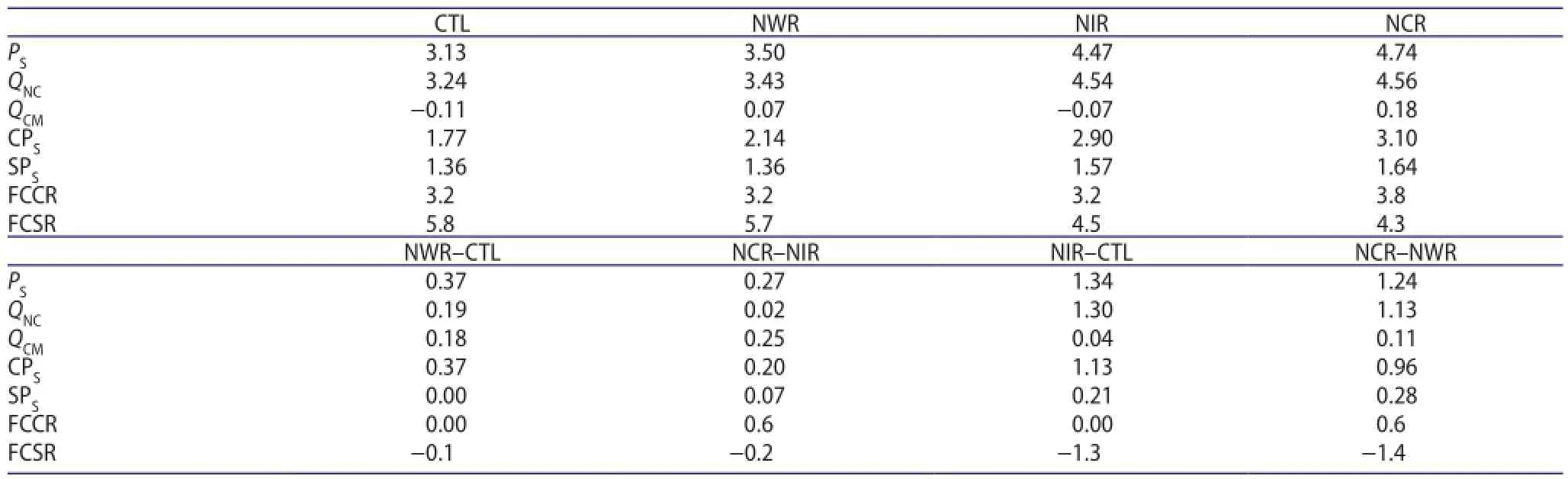
Table 1.Cloud microphysical budgets (PS, QNC,and QCM), convective (CPS) and stratiform (SPS) rain rate, FCCR and stratiform (FCSR)rainfall, averaged from day 31 to day 40 over the model domain in CTL, NWR, NIR, and NCR; and their diferences (NWR-CTL, NCR-NIR,NIR-CTL, and NCR-NWR).
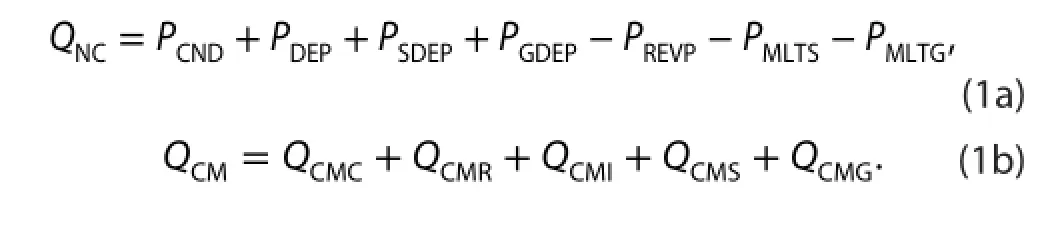
Here, PSis the surface rain rate; QNCis the net condensation;PCNDis vapor condensation to cloud ice; PDEP, PSDEP, and PGDEPare vapor deposition to cloud ice, snow, and graupel,respectively; PREVP, PMLTS, and PMLTGare the evaporation of raindrops, melting snow and graupel to vapor, respectively; QCMis hydrometeor change/convergence; and QCMC,QCMR, QCMI, QCMSand QCMGare the hydrometeor changes in cloud water, raindrops, cloud ice, snow, and graupel,respectively.
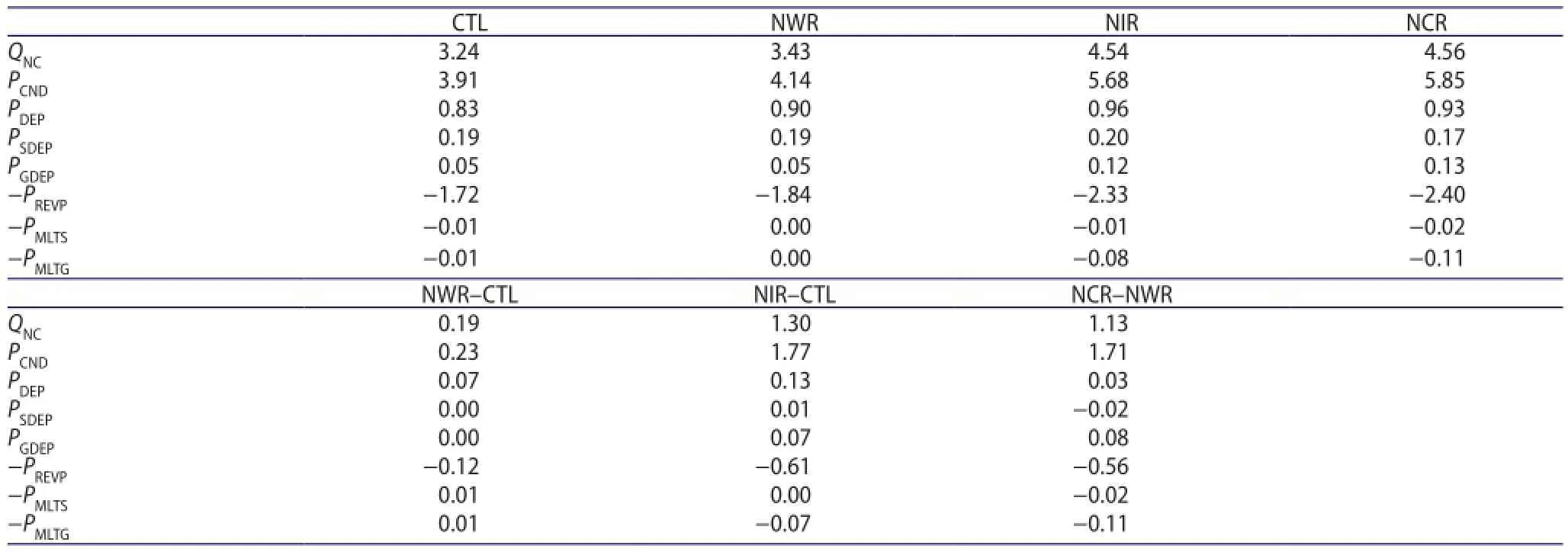
Table 2.Breakdown of QNCaveraged from day 31 to day 40 over the model domain in CTL, NWR, NIR, and NCR; and their diferences(NWR-CTL, NIR-CTL, and NCR-NWR).
The enhanced precipitation from CTL to NWR corresponds to the strengthened net condensation and hydrometeor change from a gain in CTL to a loss in NWR. The increase in precipitation from NIR to NCR is mainly related to the hydrometeor change from a gain in NIR to a loss in NCR. The strengthened precipitation from CTL to NIR and NWR to NCR is mainly associated with the enhanced net condensation.
The enhanced net condensation from CTL to NWR results mainly from the increases in PCND(Table 2). The hydrometeor change from the gain in CTL to the loss in NWR is mainly associated with the raindrop change from the increase in CTL to the decrease in NWR. The raindrop change (QCMR) in the rain budget can be written as:

Here, PRAUTis the auto-conversion from cloud water to raindrops; PRACWis the collection of cloud water by raindrops; PGACWis the accretion of cloud water by graupel; PSMLTand PGMLTare the melting of snow and graupel,respectively, to raindrops; and T0= 0 °C. The calculations of the rain budget, Equation (2), show that the increase in the mean rain rate from CTL to NWR is associated with the increase in PRACW, which corresponds to the increase in PCND.
To examine the cloud microphysical responses to water radiative processes, the heat budget is analyzed. Local temperature change is associated with condensational heating,convergence of vertical heat fux, and radiation. In the presence of ice radiative processes, the exclusion of water radiative processes from CTL to NWR generally enhances longwave radiative cooling below 10 km by emitting more longwaveradiation into space in NWR than in CTL, since the change in radiation is determined by the change in longwave radiation(Figure 1). The enhanced longwave radiative cooling from CTL to NWR turns to lower air temperature and associated saturation mixing ratio, which increases vapor condensation and the associated release of latent heat. Thus, the increase in therelease of latent heat corresponds to the enhancement in radiative cooling.

Table 3.Breakdown of QCMaveraged from day 31 to day 40 over the model domain in CTL, NWR, NIR, and NCR; and their diferences(NWR-CTL and NCR-NIR).
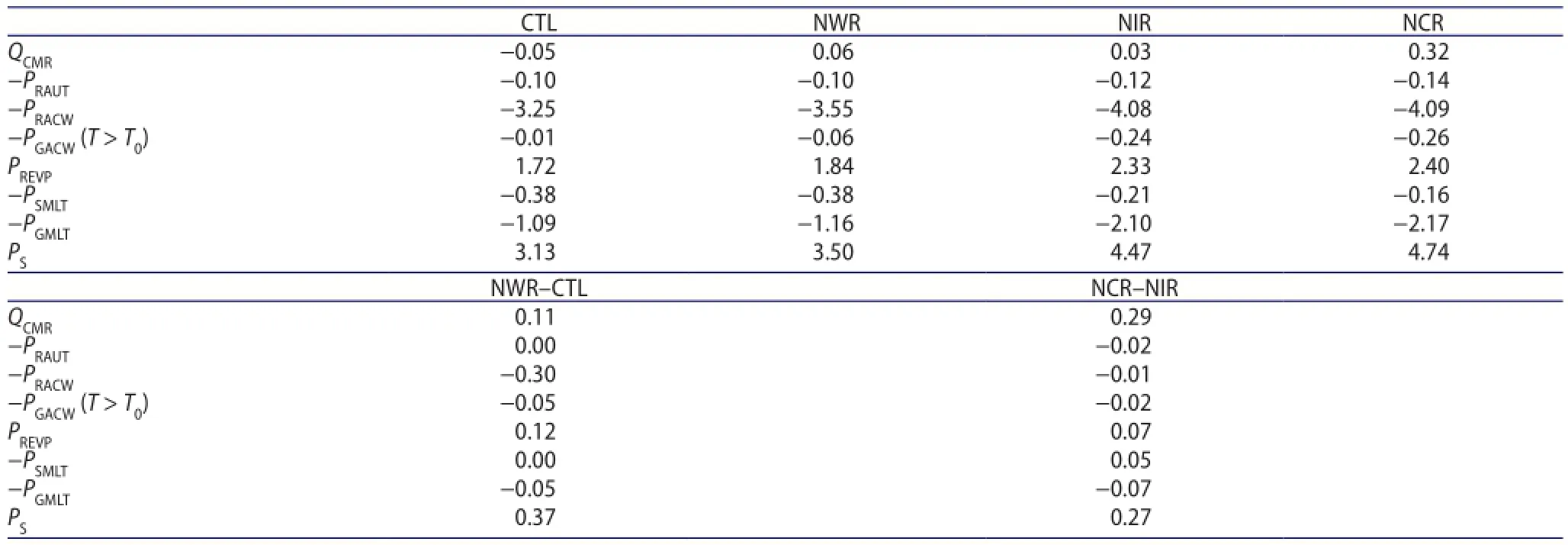
Table 4.The rain budgets averaged from day 31 to day 40 over the model domain in CTL, NWR, NIR and NCR; and their diferences(NWR-CTL and NCR-NIR).

Figure 2.Vertical profles of diferences between NCR and NIR (NCR-NIR), averaged for 10 days over the model domain, (a) in local temperature change (LTC; black), release of latent heat (RLT; red), convergence of vertical heat fux (CVHF; green), and radiation (Rad;orange); and (b) in radiation (Rad; orange) and its components of solar radiative heating (SRad; red) and longwave radiative cooling(LRad; blue). Units: °C d-1.

Figure 3.Vertical profles of diferences between NIR and CTL (NIR-CTL), averaged for 10 days over the model domain, (a) in local temperature change (LTC; black), release of latent heat (RLT; red), convergence of vertical heat fux (CVHF; green), and radiation (Rad;orange); and (b) in radiation (Rad; orange) and its components of solar radiative heating (SRad; red) and longwave radiative cooling(LRad; blue). Units: °C d-1.
The hydrometeor change from the gain in NIR to the loss in NCR is mainly related to the strengthened raindrop loss (Table 3). The calculations of the rain budget, Equation(2), also reveal that the increase in precipitation from NIR to NCR corresponds mainly to the strengthened raindrop loss (Table 4). The increase in raindrop loss from NIR to NCR may result from the increase in rain hydrometeors (mass integration of the mixing ratio of rain hydrometeors) from 1.24 mm in NIR to 1.27 mm in NCR, which may correspond mainly to the increase in rain source from PGMLT.
In the absence of ice radiative processes, the removal of water radiative processes from NIR to NCR enhances longwave radiative cooling in the lower troposphere by emitting more longwave radiation in NIR than in NCR(Figure 2(b)). The elimination of water radiative processes generally reduces the longwave radiative cooling in the upper troposphere by trapping more longwave radiation due to strengthened ice hydrometeors by the enhanced radiative cooling in the lower troposphere. This leads to the enhanced local atmospheric warming (Figure 2(a)). Since PGMLTis proportional to the air temperature, the enhanced melting of graupel to rain corresponds to the suppressed longwave radiative cooling.
The enhanced mean net condensation from CTL to NIR and NWR to NCR (Table 1) results mainly from the increased PCND(Table 2). The exclusion of ice radiative processes enhances the longwave radiative cooling regardless of the water radiative processes below 8 km (Figures 3(a)and 4(a)), while it slightly strengthens solar radiative heating (Figures 3(b) and 4(b)). The enhanced radiative cooling lowers air temperature and the associated saturation mixing ratio, which increases relative humidity and vapor condensation and the associated release of latent heat. Above 8 km, the weakened solar radiative heating is largely ofset by the reduced longwave radiative cooling, which barely changes radiation. Thus, the increased mean net condensation from CTL to NIR and NWR to NCR corresponds to theenhanced radiative cooling via the strengthened release of latent heat.
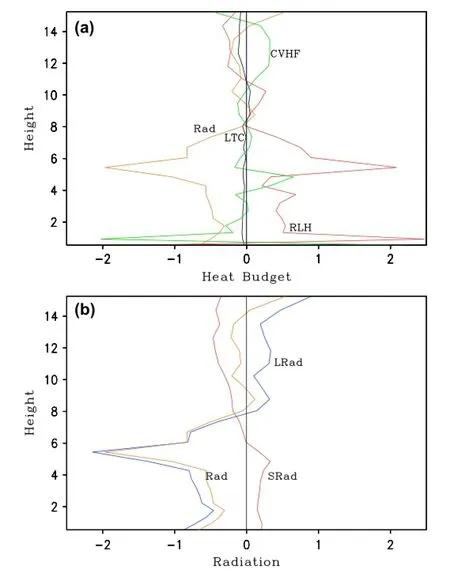
Figure 4.Vertical profles of diferences between NCR and NWR (NCR-NWR), averaged for 10 days over the model domain, (a) in local temperature change (LTC; black), release of latent heat (RLT; red), convergence of vertical heat fux (CVHF; green), and radiation (Rad;orange); and (b) in radiation (Rad; orange) and its components of solar radiative heating (SRad; red) and longwave radiative cooling(LRad; blue). Units: °C d-1.
4. Summary
In this study, the precipitation responses to the radiative processes of water- and ice-clouds are examined by analyzing the data from a two-dimensional equilibrium cloud-resolving model imposed with zero vertical velocity. In the presence of ice radiative processes, the exclusion of water radiative processes generally enhances the mean longwave radiative cooling throughout the troposphere,which enhances the release of latent heat associated with the increase in vapor condensation through the decrease in air temperature and saturation mixing ratio. In the absence of ice radiative processes, the removal of water radiative processes reduces the longwave radiative cooling in the upper troposphere, which increases local atmospheric warming. As a result, the enhancement in warming causes a rain source via an increase in the melting of graupel, which leads to an increase in rainfall. The exclusion of ice radiative processes enhances the longwave radiative cooling in the mid and lower troposphere through an increase in the release of latent heat, regardless of the water radiative processes.
The model was imposed with zero vertical velocity in this study, whereas it was imposed with non-zero vertical velocity in the simulation of pre-summer rainfall event by Liu, Shen, and Li (2014) and Shen et al. (2016). Comparison between the experiments imposed with zero and non-zero vertical velocity shows the diferences and similarities in the radiative efects on rainfall. In the presence of radiative efects of ice (water) clouds, the exclusion of radiative efects of water (ice) clouds increases rainfall in the experiment imposed with zero vertical velocity, but it decreases rainfall in the experiment imposed with nonzero vertical velocity. In the absence of the radiative efects of ice (water) clouds, the removal of the radiative efects of water (ice) clouds increases rainfall in both experiments. Even if cloud radiative processes cause similar changes in rainfall, the associated physical processes may be diferent. For example, in the absence of the radiative efects ofwater clouds, the exclusion of the radiative efects of ice clouds increases rainfall through an increase in net condensation in the experiment imposed with zero vertical velocity, and a hydrometeor change from a gain to a loss in the experiment imposed with non-zero vertical velocity. This indicates the efects of large-scale dynamics on the rainfall responses to cloud radiative processes.
Acknowledgements
The authors thank W.-K. TAO at NASA/GSFC for his cloudresolving model.
Disclosure statement
No potential confict of interest was reported by the authors.
Funding
This work was supported by the National Natural Science Foundation of China [grant number 41475039]; the National Basic Research Program of China [grant number 2015CB953601].
Notes on contributors
XIN Jin is a master candidate at the School of Earth Sciences,Zhejiang University. His main research interest is cloudresolving modeling of convective development. His recent paper on the modeling of depositional growth of ice crystal has been accepted by the Journal of Tropical Meteorology.
LI Xiao-Fan is a professor at the School of Earth Sciences,Zhejiang University. His main research interests are cloudresolving modeling of precipitation systems and quantitative analysis of precipitation processes. His recent publications include papers in Quarterly Journal of the Royal Meteorological Society, Atmospheric Research, Atmospheric Science Letters,Dynamics of Atmospheres and Oceans, Advances in Atmospheric Sciences and other journals.
References
Allen, M. R., and W. J. Ingram. 2002. “Constraints on Future Changes in Climate and the Hydrologic Cycle.” Nature 419: 224-232.
Chou, M.-D., D. P. Kratz, and W. Ridgway. 1991. “Infrared Radiation Parameterizations in Numerical Climate Models.” Journal of Climate 4: 424-437.
Chou, M.-D., and M. J. Suarez. 1994. An Efcient Thermal Longwave Radiation Parameterization for Use in General Circulation Model, NASA Tech. Memo. 104606, Vol. 3, 85 pp.[Available from NASA/Goddard Space Flight Center, Code 913, Greenbelt, MD 20771.]
Chou, M.-D., M. J. Suarez, C.-H. Ho, M. M.-H. Yan, and K.-T. Lee. 1998. “Parameterizations for Cloud Overlapping and Shortwave Single-scattering Properties for Use in General Circulation and Cloud Ensemble Models.” Journal of Climate 11: 202-214.
Dudhia, J. 1989. “Numerical Study of Convection Observed during the Winter Monsoon Experiment Using a Mesoscale Two-dimensional Model.” Journal of the Atmospheric Sciences 46: 3077-3107.
Fu, Q., S. K. Krueger, and K. N. Liou. 1995. “Interactions of Radiation and Convection in Simulated Tropical Cloud Clusters.” Journal of the Atmospheric Sciences 52: 1310-1328.
Gao, S. 2008. “A Cloud-resolving Modeling Study of Cloud Radiative Efects on Tropical Equilibrium States.” Journal of Geophysical Research 113: D03108. doi:http://dx.doi. org/10.1029/2007JD009177.
Gao, S., X. Cui, and X. Li. 2009. “A Modeling Study of Diurnal Rainfall Variations during the 21-Day Period of TOGA COARE.”Advances in Atmospheric Sciences 26: 895-905.
Gao, S., and X. Li. 2010. “Precipitation Equations and Their Applications to the Analysis of Diurnal Variation of Tropical Oceanic Precipitation.” Journal of Geophysical Research 115: D08204. doi:http://dx.doi.org/10.1029/2009JD012452.
Gao, S., Y. Zhou, and X. Li. 2007. “Efects of Diurnal Variations on Tropical Equilibrium States: A Two-dimensional Cloudresolving Modeling Study.” Journal of the Atmospheric Sciences 64: 656-664.
Gray, W. M., and R. W. Jacobson Jr. 1977. “Diurnal Variation of Deep Cumulus Convection.” Monthly Weather Review 105: 1171-1188.
Krueger, S. K., Q. Fu, K. N. Liou, and H.-N. S. Chin. 1995.“Improvements of an Ice-phase Microphysics Parameterization for Use in Numerical Simulations of Tropical Convection.”Journal of Applied Meteorology 34: 281-287.
Li, X., C.-H. Sui, K.-M. Lau, and M.-D. Chou. 1999. “Large-scale Forcing and Cloud-Radiation Interaction in the Tropical Deep Convective Regime.” Journal of the Atmospheric Sciences 56: 3028-3042.
Li, X., C.-H. Sui, and K.-M. Lau. 2002. “Dominant Cloud Microphysical Processes in a Tropical Oceanic Convective System: A 2D Cloud Resolving Modeling Study.” Monthly Weather Review 130: 2481-2491.
Li, X., X. Shen, and J. Liu. 2014. “Efects of Doubled Carbon Dioxide on Rainfall Responses to Large-scale Forcing: A Twodimensional Cloud-resolving Modeling Study.” Advances in Atmospheric Sciences 31: 525-531.
Lilly, D. K. 1988. “Cirrus Outfow Dynamics.” Journal of the Atmospheric Sciences 45: 1594-1605.
Lin, Y.-L., R. D. Farley, and H. D. Orville. 1983. “Bulk Parameterization of the Snow Field in a Cloud Model.” Journal of Climate and Applied Meteorology 22: 1065-1092.
Liu, J., X. Shen, and X. Li. 2014. “Water Radiative Processes on Heat, Cloud Microphysical and Surface Precipitation Budgets Associated with Pre-summer Torrential Precipitation.” Terrestrial Atmospheric Oceanic Science 25: 41-50.
Ping, F., Z. Luo, and X. Li. 2007. “Microphysical and Radiative Efects of Ice Clouds on Tropical Equilibrium States: A Twodimensional Cloud-resolving Modeling Study.” Monthly Weather Review 135: 2794-2802.
Rutledge, S. A., and P. V. Hobbs. 1983. “The Mesoscale and Microscale Structure and Organization of Clouds and Precipitation in Midlatitude Cyclones. VIII: A Model for the“Seeder-Feeder” Process in Warm-frontal Rainbands.” Journal of the Atmospheric Sciences 40: 1185-1206.
Rutledge, S. A., and P. V. Hobbs. 1984. “The Mesoscale and Microscale Structure and Organization of Clouds and Precipitation in Midlatitude Cyclones. XII: A Diagnostic Modeling Study of Precipitation Development in Narrow Cold-Frontal Rainbands.” Journal of the Atmospheric Sciences 41: 2949-2972.
Shen, X., W. Huang, C. Guo, and X. Jiang. 2016. “Precipitation Responses to Radiative Efects of Ice Clouds: A Cloudresolving Modeling Study of a Pre-summer Torrential Precipitation Event.” Advances in Atmospheric Sciences 33.
Shen, X., Y. Wang, and X. Li. 2011a. “Radiative Efects of Water Clouds on Rainfall Responses to the Large-scale Forcing during Pre-summer Heavy Rainfall over Southern China.”Atmospheric Research 99: 120-128.
Shen, X., Y. Wang, and X. Li. 2011b. “Efects of Vertical Wind Shear and Cloud Radiative Processes on Responses of Rainfall to the Large-scale Forcing during Pre-summer Heavy Rainfall over Southern China.” Quarterly Journal of the Royal Meteorological Society 137: 236-249.
Soong, S. T., and Y. Ogura. 1980. “Response of Tradewind Cumuli to Large-scale Processes.” Journal of the Atmospheric Sciences 37: 2035-2050.
Soong, S. T., and W.-K. Tao. 1980. “Response of Deep Tropical Cumulus Clouds to Mesoscale Processes.” Journal of the Atmospheric Sciences 37: 2016-2034.
Sui, C.-H., K.-M. Lau, W.-K. Tao, and J. Simpson. 1994. “The Tropical Water and Energy Cycles in a Cumulus Ensemble Model. Part I: Equilibrium Climate.” Journal of the Atmospheric Sciences 51: 711-728.
Sui, C.-H., K.-M. Lau, Y. N. Takayabu, and D. Short. 1997. “Diurnal Variations in Tropical Oceanic Cumulus Convection during TOGA COARE.” Journal of the Atmospheric Sciences 54: 639-655.
Sui, C.-H., X. Li, and K.-M. Lau. 1998. “Radiative-Convective Processes in Simulated Diurnal Variations OfTropical Oceanic Convection.” Journal of the Atmospheric Sciences 55: 2345-2357.
Tao, W.-K., and J. Simpson. 1993. “The Goddard Cumulus Ensemble Model. Part I: Model Description.” Terrestrial Atmospheric Oceanic Sciences 4: 35-72.
Tao, W.-K., J. Simpson, and M. McCumber. 1989. “An Ice-water Saturation Adjustment.” Monthly Weather Review 117: 231-235.
Tao, W.-K., J. Simpson, C.-H. Sui, B. Ferrier, S. Lang, J. Scala,M.-D. Chou, and K. Pickering. 1993. “Heating, Moisture, and Water Budgets of Tropical and Midlatitude Squall Lines: Comparisons and Sensitivity to Longwave Radiation.” Journal of the Atmospheric Sciences 50: 673-690.
Wang, Y., X. Shen, and X. Li. 2010. “Microphysical and Radiative Efects of Ice Clouds on Responses of Rainfall to the Largescale Forcing during Pre-Summer Heavy Rainfall over Southern China.” Atmospheric Research 97: 35-46.
輻射過程; 水云; 冰云; 降水; 長波輻射冷卻; 云分辨模式平衡態模擬
29 January 2016
CONTACT LI Xiao-Fan xiaofanli@zju.edu.cn.
? 2016 The Author(s). Published by Informa UK Limited, trading as Taylor & Francis Group.
This is an Open Access article distributed under the terms of the Creative Commons Attribution License (http://creativecommons.org/licenses/by/4.0/), which permits unrestricted use, distribution, and reproduction in any medium, provided the original work is properly cited.
猜你喜歡
軍事文摘(2023年10期)2023-06-09 09:15:06
科學(2022年5期)2022-12-29 09:48:56
家庭影院技術(2021年8期)2021-11-02 07:19:00
空間科學學報(2021年4期)2021-08-30 08:31:18
中國石油石化(2021年10期)2021-07-16 07:31:30
學生天地(2020年18期)2020-08-25 09:29:24
家庭影院技術(2019年1期)2019-01-21 02:25:02
中國篆刻(2017年3期)2017-05-17 06:20:46
河北書畫研究(2016年2期)2016-08-24 02:14:50
新農業(2016年18期)2016-08-16 03:28:27
 Atmospheric and Oceanic Science Letters2016年4期
- Atmospheric and Oceanic Science Letters的其它文章
- Assessment of surface drag coefficient parametrizations based on observations and simulations using the Weather Research and Forecasting model
- A multidecadal oscillation in the northeastern Pacific
- Cooling effect of urban parks and their relationship with urban heat islands
- Influences of the interannual variability of vegetation LAI on surface temperature
- The link between the Victoria mode in the preceding boreal winter and spring precipitation over the southeastern USA and Gulf of Mexico
- Biogenic isoprene emissions over China: sensitivity to the CO2inhibition effect