An Experimental Design of a Study on Meta—Cognitive Strategy with the Perspective of Error Analysis in Listening Training
2016-11-16 17:42:52熊煥力
校園英語·上旬 2016年10期
熊煥力

【Abstract】Though abundant work has been done in both meta-cognitive strategy and error analysis, less has been done in the exact execution model of applying meta-cognitive strategy with the perspective of error analysis. This study explored the construction of an integrative execution model of meta-cognitive strategy with the perspective view of error analysis. This thesis involves 2 research questions: 1) Will the training of applying meta-cognitive strategies with the help of error analysis improve students listening performance significantly? 2) If any, will this improvement significantly correlated to students conscious application of meta-cognitive strategies with the help of error analysis?
【Key words】meta-cognitive strategy; error analysis; language proficiency; experimental study
1. Introduction
In the 1970s, the study of second language acquisition started, since Rubin put forward “what the ‘good language learner can teach us” (Rubin, 1975).That also signed the beginning that the study of strategies in learning and using a second language has been becoming an important part in the applied linguistics. At the same period, the term “Meta-cognition”, as a psychological concept, was first introduced to the domain of education and learning. The influential educational psychologist John Flavell earned his great reputation for a series of academic papers in the late 1970s, indicating that successful learning consists of being able to “think about thinking”. “Meta-cognition” is often simply defined as “knowledge about ones own cognitive system; thinking about ones own thinking; essential skill for learning to learn”.
Error analysis originated by the late 1960s and got into rapid development in the 1970s.Error analysis (EA) is a branch of Applied Linguistics which plays a significant part in the study on second language learning. error analysis is the study and analysis of errors committed by second and foreign language learners. Corder revived EA in his article “The Significance of Learners Errors” (1967). He helped the shift in linguistics from a behavioristic view of language to a more rationalistic view and thus indicated the shift in language teaching emphasis from teaching towards a student of learning. The theory of error analysis seemed had been fading away. But the significance of language learners own errors have never degraded, both teachers and students could learn a lot from the students errors.
2. Objectives of the Study
The goals of this project are:
● To encourage students self-regulation in their L2 learning;
● To develop an integrative model to account for this self-regulation;
● To apply that model to explore the mechanisms of error analysis underlying the conducting of meta-cognitive Strategies;
● To suggest improvements on the methods used in developing the model and its application.
3. Methodology
3.1 Hypothesis
The positive effect of meta-cognitive strategies has been widely accepted. This present study was to construct an integrative execution model of meta-cognitive strategy with the perspective of error analysis. In order to achieve that, this experiment first attempted to explore the effect of the combined training of both error analysis and meta-cognitive strategy by answering two research questions: 1) will the training improve students listening performance significantly;2) is this improvement significantly correlated to students conscious application of target strategies.
3.2 Method
As a methodological principal, the research done in this thesis aims to offer a new model to account for a fixed model for conducting meta-cognitive strategies, with the help of error analysis.
With respect to quantitative study, an essential element of the present research or any scientific research in general, special attention is directed to the datas range, size, significance and representation. Most data used in this thesis are collected from a monthly TEM4 model test. The scores would be collected and sifted through in the first place, and analyzed and classified.
As for qualitative studies, two methods were adopted. One is the questionnaire of 12 items which aim to inquire into students ability of adopting any specific meta-cognitive strategies or specific aspects of error analysis. The higher a students score is, the more proficiency the student has achieved before or after the experiment. The homework was important for monitoring and evaluating students performance, the progress of the training, the application of the target strategies.
3.3 Instrument
3.3.1 Pre-test and Post-test
In order to prove negate the hypothesis by proving whether the introduction of the combined training can significantly enhance students listening performance, the data analysis was carried out for the pre-test (the first quiz of the first month) and the post-test (the last quiz of the last month of the term). The purpose for the pre-test was to choose the regular group and experimental group from the classes of the same grade and check whether these two chosen groups were at the same level or significantly different before the training.
3.3.2 Pre-questionnaire and Post-questionnaire
Students would be required to take part in a questionnaire. The questionnaire consists of 13 questions, 12 of which are multiple- choice questions and 1 is an open question. With the same questions, students scores of their post-questionnaire may vary from what they had obtained in the pre-questionnaire, which may contribute to explaining whether students consciousness for the involved strategies had increased.
3.3.3 Interviews and Students Homework
Informal interviews were carried out during the experiment both in the experimental group and the regular group. The purpose was to probe into students ideas and attitudes and actual application of the involved strategies.
3.4 Procedures of the Experiment
3.4.1 The Selection of Experimental Group and Regular group
At the beginning of this study, the researcher carried out a pre-test with band 4 paper from the same book of SPARK series. The researcher would collect data from all the participants. By analyzing these data through descriptive statistics and independent samples t-test, the researcher tried to choose the regular group and experimental group.
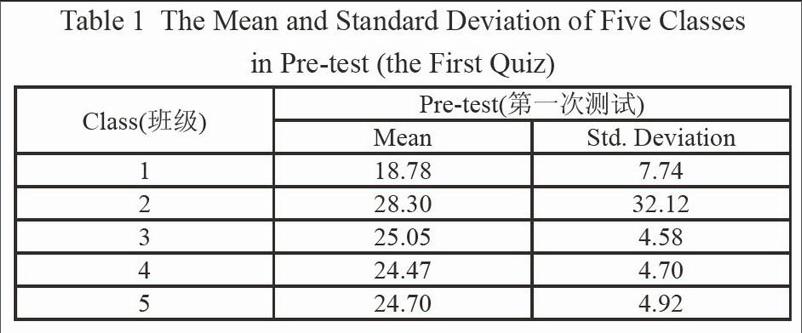
The first rough selection came out from the simple idea that choosing the class with the highest mean and the class with the lowest mean score.
From the table above, the result indicates that though class 2 seems to be the best class among the five, students there vary great in their scores. Therefore, this study tends to choose class 4, which enjoys the second highest mean score only with standard deviation of 4.70, as the regular group and class 1 as the experimental group.
According to this table, the 5﹪significance value ( p value) of the normal distribution for a two-tailed test is 0.000 , which indicates class 1 is significantly different from class 4. And the mean of class 1 is lower than class 4, thus, class 1 enjoys significantly lower English proficiency than class 4 in pre-test.
3.4.2 The Design of the Experiment
The whole experiment was carefully designed for ensuring both the credibility and reliability in proving or negating the hypothesis.
The materials for evaluating students performance consisted of two kinds, one of TEM 4 model test is for monthly data analysis, and another one is students homework for quantitative analysis. So, homework had played an important role in conducting the training of both these two skills.
The researcher began the training by deliberately illustrating the requirements and exact way of doing homework. When doing homework, students were required to involve 4 parts: exact dictation script of the material, the correction of the script, the error analysis of the work, the future plan/ improvement method. The focus of this homework training lied in the emphasis on the combination of both error analysis and meta-cognitive strategies.
Then the other material used in this present experiment-TEM4 model tests (SPARK series), served as the means for monthly data collection and further statistical analysis. Among the 4 model tests, the first model test (test of September) served as the pre-test, and the last model test was considered as the post-test.
In the end of this term, the researcher employed SPSS13.0 for testifying whether the hypothesis was verified or not.
4. Summary
All in all, this paper presents a mixed model that students L2 learning could surely be improved with the help of both error analysis and meta-cognitive strategies, which would contribute much more for students successful learning as instructed by error analysis. Both qualitative and quantitative data would be collected, sifted and analyzed for judging students proficiency in both meta-cognitive strategies and error analysis, and students improvement.
References:
[1]Baker,A.(1970).Modern physics and anti-physics.Reading Mass:Addison-Wesley.
[2]Cohen A.D.(2000).Strategies in learning and using a second language(pp.70,80,90).Beijing:Foreign Language and Research Press.
[3]Corder,S.P.(1967).The Significance of Learners Errors[J].International Review of Applied Linguistics,5,161-170.
[4]Flavell,J.H.(1977).Cognitive development[M].Englewood Cliffs,NJ:Prentice-Hall.
[5]Krashen,S.(1985).The input hypothesis:issues and implications.London:Longman.
[6]Liu,Ximei.(2006).Error analysis of students writing in junior two and its implication.Unpubslihed MA dissertation.Hebei Normal University.
[7]OMalley,M.& Valdez Pierce,L.(1996).Authentic assessment for english language learners.New York:Addison Wesley.