MO DERN RITUALOF THE ENGLISH NAME
2016-10-31 10:23:30BYHATTYLlU
漢語世界 2016年5期
BY HATTY LlU
?
BY HATTY LlU
Chinese naming customs in the age of globalization
貽笑大方?辦公室里亂飛的英語名字也是有存在的合理性的。
Though Sun never called himself 中山 in his personal writings—and kept changing his names to Takano,“Mr. Aloha from Hawaii,” and more—the Chinese pronunciation of this alias under duress, Zhongshan, has somehow ended up as his offcial name in Chinese history books. Every Chinese city has a street, park,square, or school that bears this name. Chinatowns around the world, meanwhile, have structures that commemorate a Dr. Sun Yat-sen, which was yet another one of Sun's assumed names from later life and used only in his writings in English: it is a corrupted spelling of a stylized form (逸仙, Yut-seen in Cantonese) of a baptismal name (日新, Yut-sen) he adopted while studying in Hong Kong.
Known today as the “Nation's Father”, Sun is undoubtedly China's most famous example of success achieved under a foreign-language name. For the half million students who depart China each yearto study abroad, as well as hordes of young professionals and entrepreneurs hoping to stay competitive in a global economy, adopting a foreign name is as much a strategy to prevent awkward mispronunciation as it signals their arrival on the world stage. As it becomes de rigueur for even preschools to offer English classes,thus requiring children to adopt an English name for the beneft of foreign teachers, the task of fnding the right name becomes a source of parental anxiety, a business opportunity, and a fashpoint in ongoing debates about Chinese language and identity in the modern era.
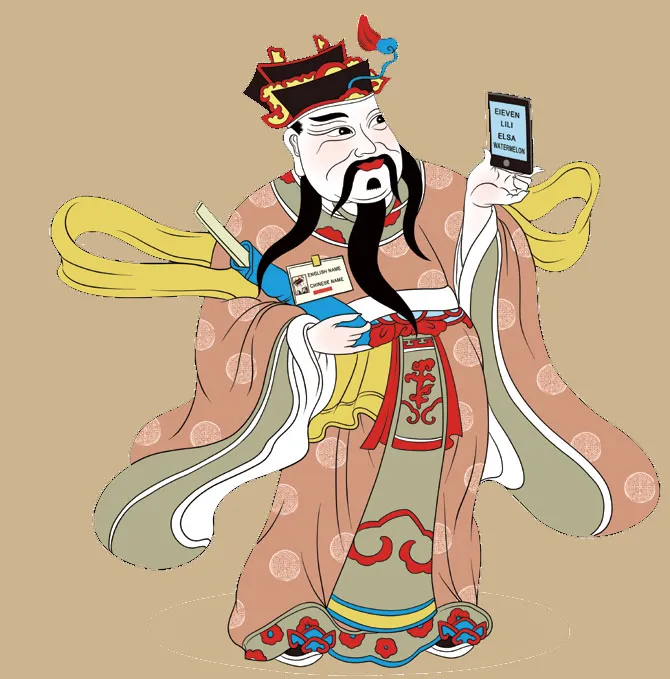
In late 2015, American entrepreneur Lindsay Jernigan received a smattering of both English and Chinese media attention when she set up Best English Name, a Shanghai-based consulting business devoted—or so it seemed from the media coverage—not so much to helping Chinese clients locate the perfect name as it is to steer them away from comically bad ones. At that time, the phenomenon of Chinese students and professionals running afoul of English naming conventions was already well documented in English media. Journalist Peter Hessler's memoir, River Town, featured the unforgettable Chinese student named “Mo Money”; Public Radio International's coverage of this issue introduced us to “Cinderella”,“DreamJazz”, and “Yes”. In Chinese media, a mother on Sina Weibo received both serious answers and criticism for asking whether her kindergartener should be called“Watermelon” or “Eleven”.
The crux of the issue behind these unusual names, wrote Jernigan for lifestyle blog Popsugar, are naming cultures which are “wildly different”in English and Chinese. Culture was also focal point of Chinese-American writer Huan Hsu's refections, published by Slate way back in 2009, on why the Chinese adopt English names and why this practice remains widespread in spite of rising nationalism. Hilarity ensues, according to Jernigan, when Chinese naming customs get transposed onto English,such as the emphasis on a name that has a clear meaning and is unique. Culture can also, Hsu asserts, lead to different attitudes toward purpose of a name and the absoluteness of one's identity, which in the traditional Chinese context has always been amorphous, a little utilitarian, and prone to changing along with one's life circumstance.
The multiple identities of Sun Yatsen, who was born before China's 20th-century modernizing push and attended a Confucian school, ft the pattern of China's ancient naming traditions well. Since at least the Zhou Dynasty (1046 BCE - 256 BCE), as recorded in the Book of Rites (《禮記》),a person had at least two names in his or her lifetime. A personal name, or ming (名), would be assigned at three months after an infant's birth; it was subdivided into a “big name,” noted in the family's genealogical records, and a“small name” or “milk name” used by close family members.
Additional names may be assigned when a person starts Confucian or missionary school or, as in the case of Sun, when a person is baptized. Both men and women of a certain status also received a zi (字), or courtesy name, when they reached the age of majority. Together, ming and zi make up mingzi (名字), the modern Chinese word for someone's personal name.
While a courtesy name is assigned with the understanding that this will be their primary form of address out in public for the rest of their adult life,a person might still pick up a variety of hao (號), or “styles,” in later life. These could be adopted for almost any reason including commemorating a personal achievement, service to the emperor, or a change of one's residence or career. It could also simply be a pen name.
In contrast to the ming and zi, whose meanings often complement or contrast one another and are chosen to ft with the names of the rest of the family, a hao can have any meaning,origin, or length. Their meanings are often literal and make a direct reference to some characteristic of the person. Eleventh century poet and offcial Su Shi (蘇軾), for instance,wrote under the hao of Dongpo Jushi(東坡居士), “Resident of the Eastern Slope”.
Far from observing an ancient rite, today's tradition of adopting English names are rooted in China's present manner of engagement with the globe: though popular in Hong Kong since colonial times and briefy present in mainland cities and Christian schools in the late 19th to early 20th centuries, the current wave of English naming started after the reform and opening-up in the late 1970s, as businesspeople sought better ways to communicate with newly arrived foreign investors. Hsu's claim,however, that ancient rites might still shape present attitudes toward identity is not without base. He quotes a Chinese friend named Sophie who“fits” between English name, screen name, nicknames among friends, and the “small name” still used by her parents because, she says, “a name is just a daihao (代號)”—a code for who she really was.
利用多媒體進行教學,內容更加豐富多彩,有利于吸引學生興趣,保持學生的注意力。多媒體教學可以利用學生多種感官進行學習,多樣的內容使得學生能從多個角度學習掌握,減少學習方式的單一和枯燥,減輕學生學習心理的負擔,讓學生樂在其中。比如在新一篇詩詞講授之前,可以利用多媒體播放詩歌朗誦,并引導學生進行模仿練習,訓練學生朗誦技巧,而且一些經典朗誦的水平都比較高,也能彌補一些小學教師教學能力的不足,使得課堂更加豐富,學生的學習體驗更加立體多方面。比如在學習《游子吟》時,情感飽滿的詩歌朗誦就比較容易帶動學生情緒,讓學生感染到那種厚重的情感,還兼顧訓練了學生的朗誦技巧,培養了新的興趣。
An internet backlash also followed Chinese media's profling of Jernigan's business earlier this year, which was somehow always accompanied by well-meaning articles from evenCCTV on what Chinese do wrong when choosing their English name. Among the defenses that Chinese bloggers marshalled for why“haphazard naming” was not as big of a deal as the media claimed was these names were not legal name changes and easily changed again, that it was easy to have multiple English names for different settings, and that they were essentially being treated like a hao or its modern equivalent, the internet name (網名).
Curiously, at least one of these well-meaning guides to English naming from the Chinese media actually refects the attitudes of these critics. An article from Sina.com's parenting vertical advises that for young children, parents pick a name that is easy for the child to say and remember—like “Sisi”, “Momo”,or “Lolly”, which regularly crop on English media's list of weird Chinese names. Alternatively, parents could confer with their children and pick a name that they like, which might have given some answers to one bemused blogger from Henan Province earlier this year, who wrote of how her mother's kindergarten class was stuffed to the gills with Elsas, Annas, and an Ultraman. Implicit in these suggestions is the idea that English names are transient. Like the ancient hao, they are chosen according to a person's needs and preferences of the moment, with the understanding that they can be replaced in the next stage of the addressee's life.
There is also a distinction between using an English name out of convenience or preference and Westernizing one's identity. Another parenting guide, this time from an online naming and fortune-telling service, cautioned new parents against deliberately giving their children“Westernized” legal names. This is defned as names that are composed of Chinese characters but that approximate common English names,or at least follow English phonetic rules when rendered in pinyin: “Lili”,“Yuna”, and “Anni” are examples. Putting on Western pretensions, argues the author, “conveys to others…a devaluation of your own culture. Such an impression…is too a high price to pay for just a name.” Like the ming of old, the legal names of Chinese children “should still refect their cultural heritage and their ancestral ties.”
This is not to say that established naming traditions in either culture can't learn new tricks. Composite English names, such as “DreamJazz”in the example from PRI, are a particular breed of handles that result from substituting two English words for the two individually meaningful characters that make up many Chinese names. For years a mainstay of weird-name lists in the Anglosphere, it is gaining a veneer of legitimacy along with the rising profle of Chinese celebrity Angelababy, who chose her stage name in classic fashion by mashing together her primary school English name, “Angela”, and“Baby”, her childhood “small name.”
Socially, English names are also flling an important gap in communication left open by Chinese culture. Hsu notes that English names are attractive in the Chinese workplace because they are more egalitarian and less confusing than older, hierarchical forms of address. In traditional Chinese culture, it was verboten for people without close personal relationships to address one another by name, and for younger or subordinate individuals to use their seniors' names. Instead, one used each other's last name preceded by a variety of titles, such as “Teacher”,“Uncle”, or even “Old”. English names, which exist outside of the ritual and emotional implications of the Chinese ming, are the ideal compromise between distance and familiarity. It makes work much more effcient, Hsu writes, when employees don't have to agonize over their social position relative to every other person in their extensive, modern professional orbits.
The Chinese blogosphere has one other favorite line of defence against the mockery of their weird English names in the media: pointing out that Chinese names adopted by Westerners who reside or do business in China also run the gamut from the overly literal to the grandiose,from Sun Wukong after the Monkey King to Hua Mulan as in the ancient Chinese poem (or Disney movie). A psychological study might be needed to fgure out why we all seem to reach for the stars when we get the chance to reinvent our identity in a new language, but maybe it's rooted an intrinsic creative impulse we share.
After all, if someone came to us in our preschool or turbulent teenaged years with the offer to pick out a new name, any name we liked—would any of us stopped our imagination running wild?
THlS lS NOT TO SAY THAT ESTABLlSHED NAMlNG TRADlTlONS lN ElTHER cULTURE cAN'T LEARN NEW TRlckS
猜你喜歡
中等數學(2022年2期)2022-06-05 07:10:50
中國生殖健康(2020年5期)2021-01-18 02:59:48
小學生學習指導(低年級)(2020年6期)2020-07-25 02:31:36
北極光(2019年12期)2020-01-18 06:22:10
小太陽畫報(2019年10期)2019-11-04 02:57:59
中國生殖健康(2018年5期)2018-11-06 07:15:40
小學生學習指導(低年級)(2018年9期)2018-09-26 05:59:44
瘋狂英語·新讀寫(2018年2期)2018-09-07 09:32:10
文學教育(2016年18期)2016-02-28 02:34:38
中學語文(2015年21期)2015-03-01 03:52:07