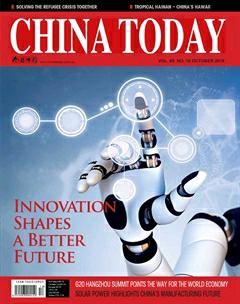
Blueprint for Medium- and Long-term Development of the World Economy
2016-10-26 01:30:24ByBIANYONGZU
CHINA TODAY 2016年10期
By BIAN YONGZU
?
Blueprint for Medium- and Long-term Development of the World Economy
By BIAN YONGZU
The G20 has shifted from a short-term mechanism of crisis response to one that will boost longterm economic development.
THE 11th Summit of the Group of 20 (G20)major economies concluded in Hangzhou on September 5, 2016. The G20 Leaders’ Communiqué, released after the meeting, stated that the participating countries are determined to take into account the UN 2030 Agenda for Sustainable Development and lead the way in transforming their economies in a more innovative and sustainable manner, so to better reflect the shared interests of both present and future generations. It is clear that the G20 Leaders’ Summit this year has created a blueprint for medium and long-term development of the global economy.
Mitigating the Risks of Financial Crisis
The 2008 Financial Crisis made leaders of countries around the world realize that their economies are closely interconnected, and that no single country could remain unscathed amid the turbulence. Since then the G20 has been upgraded to a major forum for global governance and international economic cooperation,and has made substantial contributions to dealing with the financial crisis and promoting economic growth. However, the marginal effect of some measures adopted has waned. Last July, the International Monetary Fund(IMF) cut its forecasts for 2016 global economic growth by 0.1 percentage points to 3.1 percent. The U.S. economy has been recovering and gaining momentum since last year, but the latest statistics show that it grew at a sluggish 1.2 percent in the second quarter over the first quarter, well below the 2.5 percent that economists had expected. Data also show that the U.S. economy grew just 0.8 percent in the first quarter of the year, instead of 1.1 percent as previously estimated. Bulk commodity prices have not bounced back, and emerging economies such as Russia and Brazil are still trapped in recession. China’s economy has also been noticeably affected by the lackluster world economy, with its GDP growing only 6.9 percent in 2015 and further slowing to 6.7 percent during the first half of 2016.
Some measures have even produced negative effects. For example, to boost economic development, the central banks of some countries significantly increased liquidity in their domestic markets, with Japan and some European countries experiencing negative interest rates. However, these funds did not go into the real economy. The measure only resulted in aggravated fluctuations in capital markets, and failed to change the trend of the global economic downturn.
Different countries have always held different opinions on how to stimulate global economic growth. Some believe that insufficient demand causes slow economic growth, and hope that enhancing fiscal incentives will boost global demand. Others believe efforts should be made to conduct supply-side reform to tackle oversupply and accelerate the transformation and upgrade of economic structure. Many Western countries have inconsistent monetary policies, resulting in a higher probability of risk to the world economy.
Therefore, the G20 has shifted its focus from a shortterm mechanism of crisis response to one that will boost long-term global economic development. China has a wealth of experience on this front.
China makes a development plan, known as the “Five-Year Plan,” every five years to address the major issues facing domestic and international society. The Chinese government sets goals for its medium to long-term development based on its conditions. During the planning process, experts from various fields pool their wisdom and efforts to improve the plan and lay down guidelines for the next step in China’s economic development.
China’s fast economic development is, to a large extent, attributable to the implementation of its Five-Year Plans, which are conducive to achieving more comprehensive social development. A. Michael Spence, winner of the Nobel Prize for Economics, said that China has hugely benefited from Five-Year Plans, and that China’s experience in this regard is worth consideration by its Western counterparts.
The G20 Summit in Hangzhou has explored manyavenues to create a blueprint for the medium to longterm development of the world economy, and has rolled out concrete plans. This prompted many to observe that the Hangzhou Summit has been the most fruitful G20 so far, compared with previous ones.

Chinese President Xi Jinping and other participant leaders pose for a group photo ahead of the opening ceremony of the G20 Summit in Hangzhou, capital of east China’s Zhejiang Province, on September 4, 2016.
Structural Reform Necessary
In my opinion, the summit has achieved the following results with long-term significance:
The world’s economy needs structural reforms. The communiqué reiterated the essential role of structural reforms in boosting productivity and potential output, as well as promoting innovative growth in G20 countries. It stated that the choice and design of structural reforms should be consistent with countries’ specific economic conditions. The participant countries endorsed the nine priority areas of structural reforms and a set of guiding principles to provide useful, high-level guidance to members. They supported a quantitative framework consisting of a set of indicators to help monitor and assess progress on structural reforms and challenges, and eradicating the elements that hold back economic growth. This will be improved over time.
The Chinese government has focused on structural reforms over the past several years and achieved good results. Therefore, structural reforms should also be applied to the world economy and international economic order. Compared with the financial situation during the Bretton Woods era, although the U.S. dollar is no longer the only global currency, it still occupies a dominant position. Over half of international transactions are conducted in U.S. dollars. The greenback’s share of global currency reserves is about 63 percent, and it figures in 87 percent of transactions on the foreign exchange market. However, this monopoly is not conducive to promoting global economic balance and boosting growth potential because it does not promote the interests of emerging economies.
It is also crucial that developed countries work out how to conduct structural reforms to employment. A high unemployment rate is one of the biggest social problems facing developed countries. The World Employment and Social Outlook - Trends 2016 released by the International Labor Organization pointed out that although unemployment in the U.S. and some EU countries fell in 2015, many people are still jobless. The major reason is that although welfare systems under current economic conditions are generally of premium quality in developedcountries, governments can’t afford to provide such highlevel benefits.
Infrastructure Investment Effective in Promoting Growth
Enhancing investment in infrastructure construction is conducive to boosting economic growth. The communiqué mentioned that infrastructure connectivity is key to achieving sustainable development and shared prosperity. Leaders endorsed the Global Infrastructure Connectivity Alliance, launched this year, to enhance synergy and cooperation among various infrastructure connectivity programs. The World Bank Group was asked to serve as Secretariat of the Alliance.
China’s experience has proved that increasing investment in infrastructure can effectively stimulate economic growth and potentially create new economic growth points. Current bulk commodity prices have slumped. As costs in terms of raw materials and manpower are relatively low, the costs of infrastructure construction show a corresponding decrease. More private investors are willing to get involved because they know they are likely to receive relatively high returns in the future as the economy recovers. Increasing investment in infrastructure will also promote the development of industries such as steel, cement, glass, telecommunications and high-end manufacturing, thereby creating potential new economic growth points.
So far the demand for infrastructure construction remains high in most developing countries. According to the Asian Development Bank (ADB), more than 600 million people in Asia and the Pacific have no electricity, and Asia as a whole will need as much as US $730 billion per year in infrastructure investment over the coming eight to 10 years. Developed countries face a similar situation. The American Society of Civil Engineers forecast that the U.S. needs to invest US $1.4 trillion in infrastructure between now and 2025. These figures show that there remains a great need for infrastructure investment around the world.
The G20 Summit has attached great importance to the role of infrastructure construction in promoting economic growth, and it also plays a crucial role in driving sustainable development of the global economy. In October, 2014 China took the lead to establish the Asian Infrastructure Investment Bank, which is accelerating investment in this field. However, it would benefit most developing countries if the international financial institutions such as the World Bank could promote their efficiency in boosting investment in infrastructure construction.
The focus on innovation-driven development and exploring a new engine for global economic growth by encouraging innovation was one of the highlights of the Hangzhou Summit this year.
Innovation: New Engine for Global Economic Growth
The Hangzhou Summit emphasized the importance of innovation. The communiqué said that countries are committed to tackling the root causes of weak growth by taking innovation as a key element of their effort to identify new growth engines for individual countries and the world economy. This will also contribute to creating new and better jobs. The focus on innovation-driven development and exploring a new engine for global economic growth by encouraging innovation was one of the highlights of the Hangzhou Summit this year.
Under the pressure of the economic downturn, traditional manufacturing industries have played a limited role in boosting global economic development. A retrospective of global economic cycles and principles of economic development shows that future global economic development will be backed by a new information and technology revolution. As Foreign Minister of China Wang Yi said, the world needs to use a new industrial revolution and a digital economy as opportunities to develop a blueprint for innovative growth.
China has already set a good example as regards innovation. The Chinese government has consistently accelerated the upgrading and transformation of enterprises and encouraged technological improvement, achieving substantial results. According to the National Bureau of Statistics of China, the country’s Purchasing Managers Index(PMI) for manufacturing in August registered 50.4, indicating expansion of the manufacturing sector. The high-tech manufacturing industry PMI was 52.6,and that of the consumer goods manufacturing industry was 51.2 in the same month. During the first half of 2016, the added value of the high-tech industry and equipment manufacturing industry grew by 10.2 percent and 8.1 percent year-on-year respectively: 4.2 percentage points and 2.1 percentage points higher than that of the industrial enterprises above the designated size as a whole, accounting for 12.1 percent and 32.6 percent of the added value of the industrial enterprises above the designated size, an increase of 0.7 percentage points and 1.2 percentage points compared with the same period last year. The added value of the high-tech industry climbed 12.2 percent in July yearon-year, accelerating from June’s 10.6 percent increase,and was nearly double that of the entire industrial sector.
The G20 Hangzhou Summit has concluded, but the results achieved during the meeting will gradually show their effectiveness. Those results, in part, reflect China’s experience and wisdom. Countries around the world are at different development stages, so they face different problems and challenges. However, all countries are willing to overcome these problems, and with joint efforts to achieve common and sustainable development. The Hangzhou Summit depicted precisely such a blueprint for our future.C
BIAN YONGZU is a research fellow with Chongyang Institute for Financial Studies, Renmin University of China.