
India as the Next Global Manufacturing Center
2016-10-25 01:07:32byIftikharGilani
China Pictorial 2016年10期
by+Iftikhar+Gilani
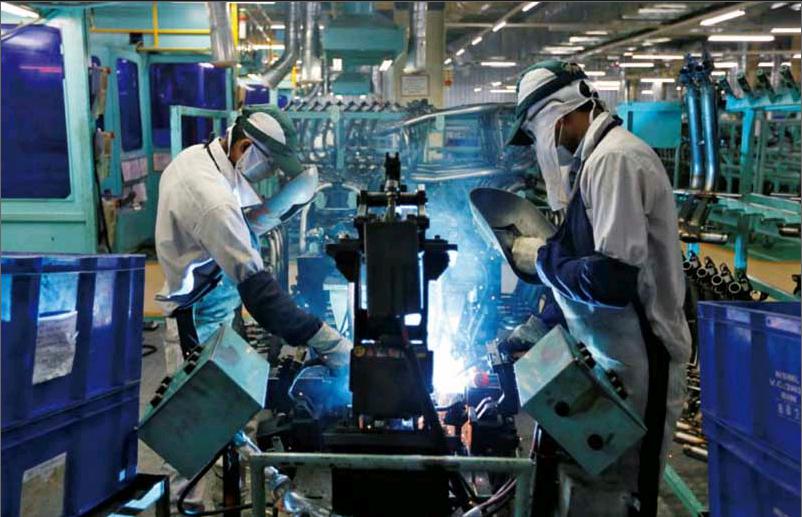
Since Prime Minister Narendra Modi riding on a mas- sive electoral mandate assumed office two years ago in May 2014, his single biggest focus has been to revive the economy. The main pillars of economy in India are manufacturing, agriculture and services. While China has focused on cheap, high-volume commodity production, India has seen high growth in the service sector. For many years, India has harbored the hope of being in the forefront of economic growth, but its attempts kept faltering as coalition governments held back much-needed reforms for nearly 25 years.
The Indian economy, which grew at a nearly double-digit rate in the middle of the last decade, slowed down to 5.08 percent in 2012 before recovering to 7.2 percent in 2015. Flagship initiatives like Make in India, Skill India, Startup India, coupled with a second wave of FDI reforms allowing 100 percent inflow into civil aviation and food processing sectors while also easing norms in defense and pharmaceuticals, are all aimed at making India the next global manufacturing hub. To support this goal, the Modi government has also begun work on connecting major metros under Diamond Quadrilateral Rail Corridor project, cleaning north Indias major river, the Ganga, to make it navigable and building 100 smart cities.
Although various policy interventions have helped India improve its position on the World Banks Ease of Doing Business index by climbing 12 spots to 130th, it is still a faraway proposition to be presented as a model to the world, considering that Mexico ranks 38th, Russia 51th and Pakistan 138th. Amitabh Kant, who just retired as secretary of the Department of Industrial Policy and Promotion, the key agency for the “Make in India” initiative, says India will break into the top 50 within the next two years. Enumerating the steps that the government has taken over the past two years, Kant, the man behind Modis economic reform programs and now Chief Executive Officer of Niti Aayog which replaced the all-powerful National Planning Commission, points out that: right from creating a single window facility for addressing investor con- cerns, identifying key manufacturing sectors to creating a common platform to unite state governments, bureaucracy and corporate leaders, the government has shown seriousness of intent to raise Indias “ease of doing business” rank internationally. Overhauling complex compliance procedures and reforming archaic labor laws will put an end to institutionalized corruption and encourage entrepreneurship. Easing the FDI norms in construction, rail infrastructure and defense is only the beginning of a series of positive signals.
Despite intentions to scale up manufacturing since 1991, industrys contribution to the GDP has declined. The challenge for manufacturing in India has been that it lacks linkages. The lack of infrastructure pushes up the logistics cost, which is 14 percent of GDP, one of the highest globally. Despite several attempts, India has not been able to build adequate roads, ports and railways to move goods and raw materials. Two years ago, farmers in the northeastern states had to sell their bumper crops at below cost because there was not enough transport capacity to move their produce to other parts of the country. A businessman in an industrial area on the outskirts of the national capital Delhi said that a consignment which he had ordered from China reached Mumbai port in 12 days. But, he lamented, pointing towards a huge cargo truck parked near his factory, that it took 20 days to reach Delhi.
The idea of promoting manufacturing was also to ensure that Indias demographic dividend finds meaningful employment. But, so far, labor conundrum has ensured that in labor-intensive manufacturing, China, Vietnam and other East Asian countries have a massive lead. With 65 percent of the population below the age of 35, India boasts of an unparalleled generational dividend and a natural future manufacturing destination. But, as former central home secretary G. K. Pillai said, this youth bulge could prove to be a demographic disaster, if proper employment opportunities are not created in time. He added that the youth bulge combined with several non-military security threats in the form of bad governance, illegal migration, cyber terrorism, environmental degra- dation, climate change, organized crime and counterfeit currency rackets was a perfect recipe for disaster in the coming years.
Between 2016 and 2030, India will add 241 million people to the population of workers. China is way behind, adding just 10 million during the same period. There are also concerns on the surplus male population, as the sex ratio in the country has dropped to the lowest level since Independence in 1947. “An unskilled, underutilized, frustrated young population will derail economic growth, undermine harmony and breed violence,” warns the prominent Hyderabad-based civil rights activist Jayaprakash Narayan.
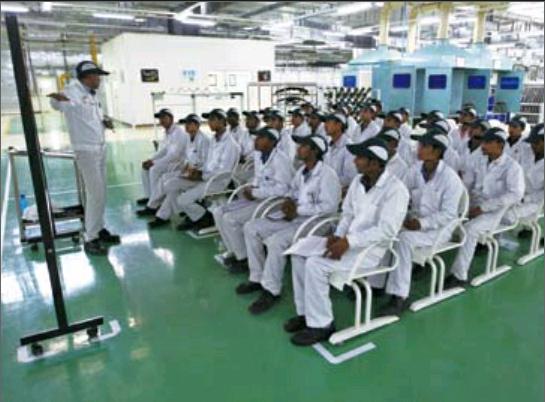
To address this challenge, which, besides economic problems, could become a security challenge as well, the Modi government has come up with Skill India and Startup India campaigns along with the supportive “Make in India”, “Digital India” and core infrastructure development schemes. The “Skill India” program is to make youth skilled for better industry positioning. The government aims to train more than 400 million people by 2022. In a country where success or failure of monsoon decides the fortune of half of the population, even some basic level technological training to framers could work wonders. According to the latest National Sample Survey Office data, only 2.2 percent of people in the 15-59 age group have formal vocational training and 8.6 percent have non-formal vocational training. In comparison, the skilled manpower population in developed economies is: UK – 68 per- cent; Germany – 75 percent, the U.S. – 52 percent and Japan – 80 percent. Currently, industries across sectors are facing shortage of skilled manpower, and they spend heavily on training manpower for specific purposes. The “Skill India” campaign will ensure that youths get specific training and find a suitable job.
The success of “Skill India” is linked to another flagship program called Startup India. India has an extremely strong entrepreneurial culture with more than 48 million small businesses. However, in terms of value creation India stands nowhere near the iconic Silicon Valley. “Ideas are abundant in this country with a strong consumer base of 1.25 billion people, but the missing ecosystem to incubate those ideas and lack of support system to scale it up make it challenging for entrepreneurs to create value,” said the Prime Minister when launching this initiative.
The “Startup India” campaign could be a game changer for the country where more than 90 percent of the over 460 million workforce is part of the unorganized sector. Currently, Indias micro, small and medium enterprises (MSMEs) contribute nearly 8 percent of the countrys GDP, 45 percent of the manufacturing output, and 40 percent of the countrys total exports. In the fast growing economy, even small institutional support could trigger entrepreneurial activity leading to major socioeconomic transformation. Small businesses in India create 1.3 million jobs every year, and innovation and creativity driven startup push could double this number in the shortest possible time.
Experts here, however, believe that the main factor in Chinas success was its investment in health and education that provided fuel to its explosive growth. India has under-invested in these key areas and, hence, its economic growth is poorly supported by quality human capital. They say that there are several factors because of which India has not been able to develop into a manufacturing superpower. These include erratic and deficient power supply, inadequate logistics and transport facilities, stringent labor laws, lack of transparency on processes and clearances, lack of investment in R&D and strategic planning, political interests, land disputes and, to top it all, the mindset of people who prefer white collar jobs. Also to be factored in among these negatives are innumerable levies and laws, which stand in the way of setting up projects, and the monster corruption and unending scams that put off global investors.
The longest wait, however, has been for tax reforms which can improve the countrys competitiveness. But first, the government has to break the political logjam, thus enabling crucial legislation through Parliament. That would pave the way for a uniform goods and services tax, intellectual property rights policy and a bankruptcy code, all of which the industry has been waiting for long.
The government of India has set an ambitious target of increasing the contribution of manufacturing output to 25 percent of the GDP by 2025. Currently, it is 16 percent. Indias manufacturing sector has the potential to touch US$1 trillion by 2025. There is potential for the sector to account for 25-30 percent of the countrys GDP and create up to 90 million domestic jobs by 2025. Business conditions in the Indian manufacturing sector continue to remain positive. With the help of the “Make in India” drive, India is on the path to becoming the hub for hi-tech manufacturing as global giants such as GE, Siemens, HTC, Toshiba, and Boeing have either set up or are in the process of setting up manufacturing plants in India, attracted by Indias market of more than a billion consumers and the surge in purchasing power.
The government of India has also an ambitious plan to locally manufacture as many as 181 products. This move could help infrastructure sectors such as power, oil and gas, and automobile manufacturing that require large capital expenditure, and revive the 185,000-crore-rupee (US$27.14 billion) Indian capital goods business. An official who visited China along with President Pranab Mukherjee earlier this year said that big Chinese business groups – such as Shanghai Automotive Company, Chint Group(that deals in renewable energy proposes to invest US$1.5 billion in India), Sopo Group, Dingshen (manufacturing sector that could create 3,000 jobs), and Shanghai Electric Company – have plans to make substantial investments in India. Besides, CFLD desires to set up 10 industrial parks in India and has applied for loans from the BRICS New Development Bank. He further said that Alibaba Group would raise its stake, from 30 to 70 percent and may also tie up with the governments Mudra Bank. “We can expect Chinese investments in India over the next few months to surpass their total investments made during the past year,” he said. The worlds thirdlargest smartphone maker, Huawei, is considering plans to set up its manufacturing unit in India, while Chinas top car maker, SAIC Motor, is planning to take over U.S. car maker General Motorsfacility in the western state of Gujarat.
The state power utilities of Rajasthan, Madhya Pradesh and Tamil Nadu have awarded Supervisory Control and Data Acquisition Systems (SCADA) implementation of 17 towns to M/s Dongfang Electronics, a duly empaneled company from China under the Restructured Accelerated Power Development & Reforms Program(R-APDRP). Huawei Telecommunications (India) Private Limited has been given security clearance by Ministry of Home Affairs(MHA) to set up a unit for electronics/telecom hardware and support services in Sriperumbudur, in the southern state of Tamil Nadu.
He further said that given the glut in the Chinese economy, the industrial and business groups are looking more keenly at India as a prospective market. States with better environment and infrastructure – Gujarat, Andhra Pradesh, Tamil Nadu and Maharashtra– are on the radar of Chinese investors.
He explained that investments from China are the key to reduce the growing trade gap between the two neighbors. However, he also rued the fact that delay in business visas to Chinese nationals is delaying investments in India notwithstanding demands for FDI from the Modi government to boost the economy and create more jobs faster.
India-China bilateral trade, which was as low as US$2.92 billion in 2000, reached US$41.85 billion in 2008, making China Indias largest trading partner in goods. In 2015, bilateral trade stood at US$70.4 billion. Indias exports to China touched US$ 8.86 billion, whereas Chinas exports were US$61.54 billion. In 2015, the trade deficit was US$52.67 billion. Investment from Chinese firms in India in 2015 totaled US$870 million – a six-fold increase compared to the previous year.
Investors and industrialists, however, still find bureaucracy a major stumbling block to ease of doing business. Even though, the Modi government has come up with the institutional mechanism of a Project Monitoring Group (PMG) working directly under his office for resolving a variety of issues including fast tracking the approvals for setting up and expeditious commissioning of large public, private and public-private-partnership (PPP) projects, radical changes are still needed at the level of bureaucracy to end corruption and execute citizen and investor-friendly policies.
The prime minister had begun well by meeting the secretaries but not his ministers. But somehow, the bureaucracy, after a while, started ignoring the ministers, as they had direct access to the prime ministers office. However, the bureaucracy has still not got out of the “officer culture” that they have been used to for decades, which shows that the role and orientation of the civil services have to change. Bureaucrats need to give up the role of ‘a(chǎn)dministratorsand work on becoming ‘developers. Policy analyst Rajendra P. Gupta writes that the British Raj-era kind of bureaucracy and its officer culture was the biggest obstacle to implementing the vision of the Modi government. Until this is attended to and radical changes are made, Indias dream of becoming a major manufacturing hub will remain a pipe dream.
