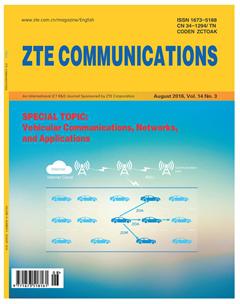
Vehicular Communications, Networks,and Applications
2016-10-13 05:54:28
ZTE Communications 2016年3期
ZHUANG Weihua
Professor ZHUANG Weihua has been with the Department of Electrical and Computer Engineering, University of Waterloo, Canada since 1993, where she is a professor and a Tier I Canada Research Chair in wireless communication networks. Her current research focuses on resource allocation and QoS provisioning in wireless networks, and on smart grid. She is a co?recipient of several best paper awards from IEEE conferences. Dr. ZHUANG was the Editor?in?Chief of IEEE Transactions on Vehicular Technology (2007?2013). She serves as the Technical Program co?chair of the IEEE Vehicular Technology Conference (VTC) Fall 2016 to be held in Montreal, Canada. She is a fellow of the IEEE, a fellow of the Canadian Academy of Engineering, a fellow of the Engineering Institute of Canada, and an elected member in the Board of Governors and vice president in Publications of the IEEE Vehicular Technology Society.
ZHU Hongzi
Professor ZHU Hongzi got his BS and ME from Jilin University, China in 2001 and 2004, respectively, and got his DE from Shanghai Jiao Tong University, China in 2009. He has been with the Department of Computer Science and Engineering, Shanghai Jiao Tong University, China since 2011, where he is an associate professor. His current research interests include vehicular networks, mobile sensing and computing, and wireless networks. Dr. ZHU is the leading guest editor of peer?to?peer networking and applications. He serves as the Track co?chair of the IEEE Vehicular Technology Conference (VTC) Fall 2016 to be held in Montreal, Canada and Technical Program Committee members of several prestigious conferences such as IEEE INFOCOM 2015-2017. He is a member of ACM, IEEE Computer Society, and IEEE Communication Society.
Avehicular ad hoc network (VANET) is a packet?switched network, consisting of mobile communication nodes mounted on vehicles, with very limited or no infrastructure support [1]. It supports communications among nearby vehicles, and between vehicles and nearby infrastructure/users, including vehicle?to?vehicle (V2V), vehicle?to?infrastructure (V2I), vehicle?to?roadside unit (V2R), vehicle?to?pedestrian (V2P) communications, collectively referred to as vehicle?to?everything (V2X) communications [2]. The paradigm of VANETs will improve road safety, facilitate intelligent transportation, support infotainment, data sharing, and location based services, and will be a critical component in the future Internet of Things. The growing importance of vehicular communication networks has been recognized by governments, academia, and industry worldwide.
The Federal Communications Commission in the United States has approved a radio spectral width of 75 MHz for Dedicated Short Range Communications (DSRC). Transport Canada supports the introduction of DSRC?based intelligent transportation applications in the frequency band 5850-5925 MHz. It is expected that the DSRC system will be the first wide?scale vehicular network in North America. The latest version of DSRC, IEEE 1609 Family of Standards for Wireless Access in Vehicular Environments (WAVE) [3] with IEEE 802.11p for channel access [4] has emerged for vehicular communications. In Europe, a car?to?car communication consortium has been initiated by European vehicle manufacturers, and is dedicated to further increase road traffic safety and efficiency by means of inter?vehicle communications [5]. The European Telecommunications Standards Institute (ETSI) has developed the intelligent transport systems (ITS) G5 standards for vehicular networks to operate on the 5 GHz radio frequency band [6], based on IEEE 802.11p physical and link layers. In Japan, the Association of Radio Industries and Businesses (ARIB) has issued the ARIB STD T?109 standard for vehicular communications using TV white space in the 700 MHz band [7]. In particular, the China Communications Standards Association (CCSA), together with the China telecom industry, has been actively participating in the 3GPP initiatives on LTE support for connected vehicles [8].
VANETs provide a promising platform for future deployment of large scale and highly mobile network services. Given the automobiles role as a critical component in our society, embedding Information and Communication Technology (ICT) services into automobiles has the potential to significantly improve our quality of life. This, along with great market demand for more reliability, safety, and entertainment value in automobiles, has led to many initiatives and support for deployment of vehicular networks and applications. The research and development activities for connecting vehicles via advanced communication and information technology have reached to a tipping point for significant impacts on society, economy, and daily life of ordinary people. Vehicular networks have unique networking characteristics, including highly dynamic network topology, distributed network control in peer?to?peer communications, and stringent service quality requirements for safety applications such as delay and packet delivery reliability. As a result, it provides both challenges and opportunities for further R&D; activities in order to achieve reliable, secure, accurate, and fast end?to?end information delivery in VANETs.
This special issue aims to present some recent research works for vehicular communication technology and its potential applications. It includes five technical contributions from leading researchers in vehicular communication networks. The first paper entitled “On Coexistence of Vehicular Overlay Network and H2H Terminals on PRACH in LTE” by Khan, Misic and Misic presents how to use the LTE physical random access channel (PRACH) to support vehicular machine?to?machine (VM2M) communications, and analyzes the impact of PRACH format and configuration parameters on the performance of VM2M subnetworks. The second paper is entitled “A Cooperative Forwarding Scheme for VANET Routing Protocols” by WU, JI, and YOSHINAGA. It focuses on how to improve the end?to?end packet delivery ratio in unicast routing protocols via multiple forwarding nodes and network coding. Numerical results demonstrate that the proposed strategies can improve the packet delivery ratio without increasing message overhead. The third paper, co?authored by HE and CAI, studies hybrid content distribution framework for large?scale vehicular ad hoc networks. It introduces a hybrid network solution to address scalability issue of content distribution in large?scale vehicular ad hoc networks. An overlay store?carry?and?forward content distribution network is established to model a large?scale VANET, and utility?based optimization is formulated to find optimal data packet routing solutions. The next paper, co?authored by YANG, ZHENG, LEI, and XIANG, is entitled “Heterogeneous Vehicular Networks for Social Networks: Requirements and Challenges”. It presents two social network architectures that embed social characteristics into heterogeneous vehicular networks. It discusses several use cases to analyze service requirements and associated challenges. The last (but not least) paper “A Cloud Computing Perspective for Distributed Routing in Vehicular Environments” is co?authored by Shivshankar and Jamalipour. It presents how to effectively apply cloud computing to address challenges of the spatio?temporal multicast (SMRP) distributed routing in VANETs. It proposes a new mechanism to exploit cloud computing in the routing process, which can increase service discovery rate and reduce the required resource and service discovery download time with roadside units and internet, in comparison with the vehicular clouds obtained directly through the SMRP based routing.
We would like to thank all the authors for choosing this special issue to publish their new research results, all the reviewers for their meticulous review comments and suggestions which help to improve the technical quality and presentation of this special issue, and the editorial official of ZTE Communications for all the support and help during the editorial process of this special issue. We hope that our readers will enjoy reading the articles and find this special issue helpful to their own research work. Working together, we will make connected vehicles and Internet of vehicles a reality in the near future.
References
[1] H. T. Cheng, H. Shan, and W. Zhuang, “Infotainment and road safety service support in vehicular networking: from a communication perspective,” Mechanical Systems and Signal Processing, Special Issue on Integrated Vehicle Dynamics, vol. 25, no. 6, pp. 2020-2038, Aug. 2011. doi: 10.1016/j.ymssp.2010.11.009.
[2] 3GPP, “Study on LTE support for V2X services (release 14),” Technical Specification Group Services and System Aspects, Tech. Rep. 3GPP TR 22.885, 2015.
[3] R. A. Uzcategui and G. Acosta?Marum, “WAVE: a tutorial,” IEEE Communications Magazine, vol. 47, no. 5, pp. 126 - 133, May 2009. doi: 10.1109/MCOM.2009.4939288.
[4] Draft Standard for Information Technology—Telecommunications and Information Exchange Between Systems—Local and Metropolitan Area Networks—Specific requirements—Part 11: Wireless LAN Medium Access Control (MAC) and Physical Layer (PHY) Specifications; Amendment 7: Wireless Access in Vehicular Environments, IEEE P802.11pTM/D8.0, 2009.
[5] R. Baldessari, B. B?dekker, A. Brakemeier, et al. (2007, Aug.). Car?2?car communication consortium manifesto. [Online]. Available: https://www.car?2?car.org/index.php?id=31
[6] Intelligent Transport Systems (ITS); European Profile Standard for the Physical And Medium Access Control Layer of Intelligent Transport Systems Operating in the 5 GHz Frequency Band, ETSI Standard ES 202 663 V1.1.0, Nov. 2009.
[7] 700 MHz Band Intelligent Transport Systems, ARIB STD T?109, Version 1.2, 2012.
[8] 3GPP. (2015, Mar.). LTE support for the connected car [Online]. Available: http://www.3gpp.org/news?events/3gpp?news/1675?lte_automotive