
The ancient Book of Changes inspires policies for modern Chinese scientific research
2016-10-12 06:47:40KeyanFang
科學中國人 2016年6期
Keyan Fang
1 Introduction
The output of scientific research in China ranks second in the world according to the Nature Index of 2015 (www.nature.com/nature/journal/v522/n7556_supp/full/522S34a.html) and the ISI Web of Science (http://thomsonreuters.com). Although important advances have been made, it should be noted that China has the largest population of scientific researchers due to the popularization of education in the past decades. Furthermore, investment in research funding has ranked second only to the US since 2006 and continues to increase. Due to this large body of the researchers and the increasing investment of money and time, there is little optimism about increasing the number of publications by Chinese researchers. More importantly, the ratio of publication in top journals to the number of researchers is not high, especially with regard to innovative research. Modern science in China was introduced from the Western world, which has been grafted onto Chinese culture. It is therefore helpful to closely examine traditional Chinese culture, which can contribute to an understanding of modern Chinese scientific research. The Book of Changes, an ancient Chinese book from the pre-historic period, is considered to be the origin of the Chinese culture and has had a profound influence on almost all aspects of ancient Chinese activities [1-2], which is rooted in Chinese work and life as a major cultural “gene” even nowadays.
2 The Book of Changes and its influences on current Chinese scientific research
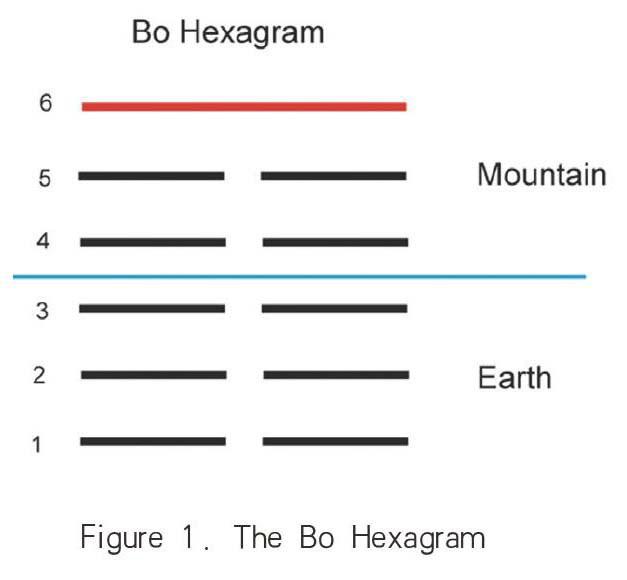
First, the Book of Changes seems to limit curiosity about nature, which is a key motivation for scientific research. This is because the Book of Changes is a symbol system of “yin” (straight line in Figure 1) and “yang” (broken line), the creative and receptive nature of the world, which constitutes 64 hexagrams to represent the universal rules of the world [1-2]. A thorough application of the ideas and rules of the Book of Changes can lead to a developed discipline. For example, the book of Huangdis Internal Classics [3], which was written more than 4600 years ago, is still considered to have revealed the key theories of Chinese medicine and is still widely applied in this discipline [4]. This situation is different from that of modern sciences, which are continuously updating. This may partly explain why the Chinese are good at learning but lack innovation: all the fundamental rules have been revealed, and the Chinese people have become accustomed to learning and applying the disciplines from the Book of Changes to answer new questions.
Second, the Book of Changes manifests a humanistic theory that leads people to think in intuitive and subjective ways. The way to apply these rules from the Book of Changes is through associative reasoning, which identifies the proper hexagram for a particular issue; this type of reasoning is largely based on feeling and is subjective. Third, the Book of Changes persuades people to think holistically rather than analytically; this approach influences Chinas current scientific research [5]. The Book of Changes is designed to regulate the “yin” and “yang” to keep their balance, instead of separating them. One key idea in the Book of Changes is that everything of the world is driven by “Qi”. So they consider everything has similar rules of Qi and believe in harmony of the all including human and culture. As Qi changes through time, the Book of Changes thus pays more attention to the changes through time than the spatial patterns [4, 6]. That is, the Book of Changes considers changes of the whole system rather than separates it. In the following section, two hexagrams in the Book of Changes are employed to represent scientific research and to suggest policies based on the rules in these hexagrams.
3 The Bo Hexagram and scientific research
The Bo hexagram is the 23rd of the 64 hexagrams in the Book of Changes. It shows the image of a mountain (the upper half of the hexagram) on earth (the lower half) (Figure 1). This hexagram symbolizes splitting apart because the mountain on earth will suffer from erosion and will gradually split apart [1-2]. There are three reasons to associate methods of scientific research with the Bo Hexagram. First, splitting apart the unimportant issues in the Bo Hexagram to identify the core is similar to the scientific research process of systematic analysis to disentangle ideal rules from the complex real world. Second, the Bo Hexagram is followed by the Fu Hexagram, which means “Return and Repeatable”. This concept is similar to scientific research, which often follows repeatable application of the rules advances revealed by research. Third, the six lines of the Bo Hexagram (Figure 1) can be associated with the six stages of scientific research, which are discussed below.
Figure 1. The Bo Hexagram
The first line of this hexagram symbolizes the splitting apart of the legs of the bed, which means the destruction of the base. This concept corresponds to the first step of scientific research, in which questions are raised to solve fundamental problems, meaning that researchers should pay attention to the basic issues in their field without considering whether their questions can immediately foster technological advances.
The second line of this hexagram suggests the splitting apart of the frame of the bed, which aligns with the proposition of a scientific hypothesis and a research design to test the hypothesis. For this step, the Book of Changes suggests that researchers should be aware of the “framework” of the scientific issue and design the research plan related to this issue.
The third line of the Bo Hexagram indicates that this step of splitting apart is relatively independent from the two previous steps and is closely related to the fifth line. This third step resembles the stage of conducting experiments and investigations. The Book of Changes specifies that experiments and investigations should be conducted subjectively and that researchers should not simply provide evidence to support the hypothesis but should also avoid evidence that does not support the hypothesis.
The fourth line of this hexagram connotes the splitting apart of the mattress, which is very close to identify the rules. This step is associated with analyzing and validating data. This step is parallel to revealing scientific rules and indicates that analysis should focus on answering scientific questions.
The fifth line of the Bo Hexagram symbolizes a string of fish being led to the sixth line. This step is associated with the scientific research step of summarizing findings to present a theory. The Book of Changes suggests that a summary of findings should be oriented toward theory so that it can be used for academic exchanges and technical applications.
The sixth line suggests good fortune for people with noble character but disaster for people with vile character. This concept corresponds to the final step of scientific research—academic exchange and the application of research findings to technological advances. For this step, ethics is highly important because science is a double-edged sword that can bring either good or bad fortune to society depending on the way that scientific findings are applied.
4 The Bi Hexagram and scientific research
The Bi Hexagram is the 22nd of the 64 hexagram in the Book of Changes, with a mountain (the upper half) being illuminated by fire (the lower half). It refers to enlightenment, decoration, culture and civilization [1-2], and it is likely the hexagram that is most similar to education and research systems. Below we introduce the six lines (i.e., the six stages) of this hexagram.
The first line of the Bi Hexagram suggests as little decoration as possible and encourages children to walk without being carried. This concept corresponds to pre-primary education for children. For this stage of teaching, it is preferable to maintain a childs nature and to not teach too much. It is also encouraged that the child should be taught to be independent, including walking by themselves without being carried. Many modern Chinese families try to provide the “best” education to ensure that their children learn as much as possible and to prevent the children from being left behind at the starting line.
The second line of this hexagram dictates that decoration should be based on its own attributes, such as a beard that is in accordance with a mans chin. This concept corresponds to teaching that occurs in school, which attempts to educate students in accordance with their aptitude. However, the evaluation of the quality of teaching is based on the total score of exams without sufficient attention to students with special needs.
The third line of the Bi Hexagram specifies proper adornment and warns against being over-decorated. This is the end of the lower half of this hexagram, which corresponds to college education. It encourages students to pay special attention to specific topics in which they are interested and in which they excel rather than to become overeducated. However, universities often teach as many as topics as possible and give each equal attention. Teachers often spoon-feed their students, which leaves little room for students to think independently.
The fourth line encourages simple dress for decoration, such as clothing in a plain color. The upper half of this hexagram corresponds to the start of ones research career. Young researchers are encouraged to try to simplify their research by initially selecting a specific topic. This is because young researchers often do not have the background on complex topics that experienced researchers have.
The fifth line of the Bi Hexagram illustrates people in low-lying areas receiving small material gifts from people on a hill or in a garden. This is a good scenario because the people from the lowlands care more about the sincerity of the people on the hill than they do about the material gifts. This stage often equates to leadership and corresponds to the acknowledgment of well-respected, leading scientists in their field. Honored scientists are encouraged to exert their influence to improve the academic atmosphere because they are well respected by young researchers.
The last line of the Bi Hexagram suggests that the lack of decoration is the best form of decoration. The last line in the Book of Changes is associated with the highest rank of the scientific research system. Scientific research is headed by the government, so this step can refer to the government, which can be interpreted to mean that the government should limit its role in scientific research. Research is for discovering the unknown, whereas administrative activities are for maximizing services, welfare and public interests. Scientific researchers have their own rules that cannot be based on solely administrative plans. Their innovation is non-material and driven by curiosity about nature or the inner will; technological advances are only a byproduct.
References
1. Rutt R. The Book of Changes (Zhouyi): A Bronze Age Document. Richmond: Curzon, 1996.
2. Shaughnessy E L. I Ching: the Classic of Changes. New York: Ballantine Books, 1996.
3. Veith I. The Yellow Emperor's Classic of Internal Medicine. Los Angeles: University of California Press, 1972.
4. Ding Z. Study of the scientific ideas in Chinese medicine and Zhouyi—their views on space and time (in Chinese with English abstract). Thesis. Beijing University of Chinese Medicine, 2001
5. Yang Z. Influences of zhouyi on chinese culture (in chinese with english abstract). Nature Magazine, 2005, 27: 1-3
6. Liu C. Zhouyi and Chinese image sciences (in Chinese with English abstract). Zhouyi Researches, 2003, 42-52
