
Complex Trilateral Relations
2016-09-26 08:56:41ShiYongming
Beijing Review 2016年37期
?
Complex Trilateral Relations
Can China, Japan and South Korea find a way out of their current plight?By Shi Yongming

The author is an associate researcher of Asia-Pacific issues, China Institute of International Studies
The two-day G20 Hangzhou Summit concluded on September 5. With the release of the leaders’ communiqué at the end of the summit, G20 members underlined their continued commitment to global governance based on multilateral policy coordination and the importance of inclusive and interconnected development worldwide.
Apart from discussing the global economy, the grand gathering in the garden city gave world leaders an opportunity to conduct bilateral meetings and exchange views on mutual concerns. Among these bilateral dialogues, the China-Japan and China-Republic of Korea (ROK), or South Korea,leaders’ talks drew much attention.
Recently, the relationship between the three most important countries in East Asia has been frosty. Now, China and South Korea face increasingly strained relations due to the dispute over the deployment of the THAAD anti-missile system in South Korea.
The eighth China-Japan-ROK Foreign Ministers’ meeting, which had been suspended for five years, was held in Tokyo on August 24. However, there are no signs of the resumption of the trilateral summit meeting in the near future.
The combined total GDP of China,Japan and South Korea accounts for 70 percent of East Asia’s total and 20 percent of the world’s total, thus their cooperation would greatly benefit the region and the world. There are expectations for the three nations to work in unison to drive economic growth, but a complex geopolitical climate has become an obstacle to cooperation. Compared with the ambitious Trilateral Cooperation Vision 2020 agreed by the three countries in 2010 at the third trilateral summit in South Korea, the current reality is grim. The nations must overcome these barriers in the future.
Japan’s hardline
Chinese President Xi Jinping held talks with Japanese Prime Minister Shinzo Abe after the closing ceremony of the G20 Summit. Both leaders emphasized that China and Japan areimportant neighbors, though national estrangement between the states runs deep. In recent years, Abe has taken a hardline stance on China and promoted historical revisionism as well as making use of almost every diplomatic occasion to denounce China. Understandably, this has antagonized the Chinese.
Taking the South China Sea issue for example, Abe once again spoke on the dispute between China and other Southeast Asian countries at the Hangzhou Summit. He repeated the old mantra, urging China to “follow the rules of international law.”
In January 2013 the Philippines unilaterally issued the South China Sea arbitration. The arbitral tribunal finally made a ruling on the dispute in July 2016, siding with the Philippines and approving almost all of its requests. An obvious fallacy of the verdict was the denial of Taping Dao’s island identity.
Actually, Taiping Dao, located in the South China Sea, covers an area of 46 hectares. The island produces dozens of tons of fresh water every day, which provides for hundreds of people living on the island. By any criterion, Taiping Dao is a natural island and it should be entitled to the rights, including exclusive economic zone(EEZ) status, as prescribed by international law.
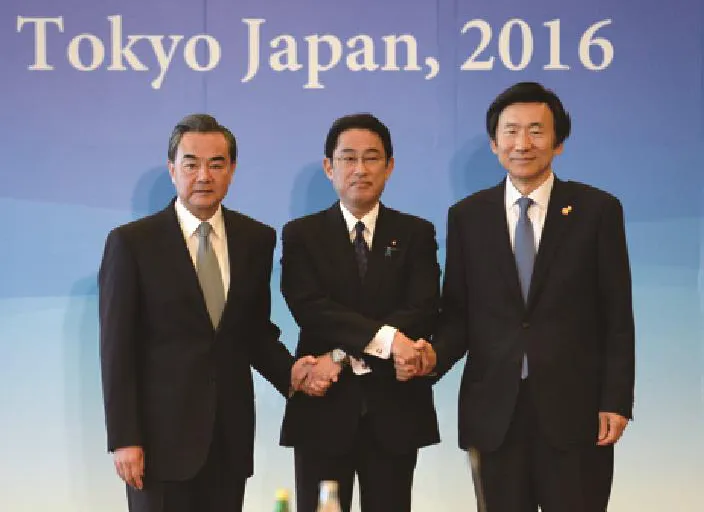
Chinese, Japanese and South Korean foreign ministers Wang Yi, Fumio Kishida and Yun Byung Se (left to right)attend the Eighth Trilateral Foreign Ministers’ Meeting in Tokyo on August 24
Yet, Abe is less willing to observe the rules of international law when questions concerning the uninhabited atoll Okinotori-shima, claimed by Japan, are mentioned. The dry land of the atoll is mostly covered by three concrete encasings constructed by the Japanese Government. Japan refers to the rocks as islands in a bid to claim the 200-nautical-mile EEZ surrounding it,triggering disputes with China and South Korea. Both China and South Korea state that the atoll is not an island and therefore cannot have an EEZ according to the UN Convention on the Law of the Sea (UNCLOS).
Owing to its interests, Japan doesn’t follow UNCLOS rules. After the arbitration, Japan sent more coast guard ships to Okinotori-shima waters, prohibiting Taiwanese fishermen of China from entering the vicinity. Abe’s opinion on the South China Sea issue reflects his double standard on international law.
Aside from maritime disputes between the two nations, Japan adopts hardline policies toward China on many other issues. This can be attributed to Abe’s right-wing convictions. Abe has a different view on historical Japanese aggression from what is widely accepted by the international community. Since assuming leadership in 2012, Abe has shied away from accepting responsibility for Japanese aggression in WWII and for lifting defense restrictions on the post-war constitution.
Following WWII, the United States formed an alliance with Japan to negate the threat of the former Soviet Union during the Cold War. The U.S. Government stopped investigating Japanese war crimes and left many war crimes unpunished. Meanwhile, U.S. authorities also suppressed the left-wing movement in Japan and weakened historical remorse and pacifism in the nation.
Today, Abe and his Liberal Democratic Party, Japan’s main right-wing political force, do not intend to maintain pacifism, as they seek to change the post-war constitution. Adhering to historical revisionism, Abe’s cabinet has taken many steps to deny historical aggression,including the alteration of historical textbooks,encouraging political figures to visit the Yasukuni war shrine that honors the Japanese that died in the war—including war criminals—and the approval of a new war bill in parliament. The Japanese prime minister always stresses that the constitution was imposed by a foreign country, despite the fact that the document has brought civil liberty, democracy and pacifism to Japan, helping to achieve peace and prosperity since WWII. If these elements are to be abolished, what will become of Japan?
Along with the great economic success, it is natural for Japan to pursue political influence in the world. Japan should achieve such influence through playing a constructive role in world affairs, however, what Abe has done is only to encourage other countries to overlook Japan’s historical responsibilities. Abe wants the international community to recognize its power and lobbies other governments to support Japan’s ambition of becoming a permanent member of the UN Security Council. As long as Japan fails to abandon its dream of replicating past imperial glories, it’s difficult to improve China-Japan relations.
ROK’s security concern
China and South Korea have made great progress in developing bilateral relations since the two states established such ties in 1992. The enhanced partnership underlines the political reconciliation in East Asia after the end of Cold War, with the development of China-South Korea relations not only diffusing the tense security situation in Northeast Asia, but also greatly promoting regional cooperation.
In recent years, the trilateral cooperation between the countries has been suspended due to rising tensions between China and Japan,and Japan and South Korea—though China and South Korea have achieved remarkable success in bilateral cooperation. The two states reached a free trade agreement in June last year, and the relationship has grown in significance, assisting the creation of a stable and prosperous Northeast Asia.
However, South Korea and the United States jointly decided to deploy the THAAD anti-missile system in South Korea in recent months. The deployment of THAAD will undermine China-U.S. and China-ROK strategic mutual trust. Washington regards THAAD as an extension of its missile defense network. Both Washington and Seoul allege that THAAD aims to counter the missile threat from North Korea. Yet the detection range of THAAD’s radar system reaches as far as China’s inland areas and Russia’s eastern Siberia. Thus, Washington has more convoluted strategic purpose, compared with South Korea’s security concern over its northern neighbor.
North Korea persists with its nuclear program and ballistic missile development,which is the biggest concern of South Korea. Furthermore, as the U.S. remains the South Korea’s most important ally, Washington has a bigger say on defense affairs. South Korea has so far failed to find a solution to the Korean Peninsula issue. If Seoul can establish a security dialogue with Beijing, it might help solve the bilateral plight caused by the deployment of THAAD.
China, Japan and South Korea must break down ideological barriers and solve their disputes before they can return to the prosperous path of trilateral cooperation. ■
Copyedited by Dominic James Madar
Comments to liuyunyun@bjreview.com
