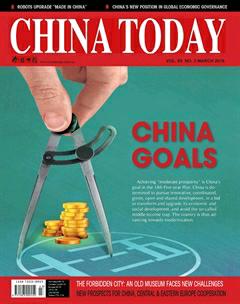
The Forbidden City: An Old Museum Faces New Challenges
2016-09-14 11:42:47ByCHENWEI
CHINA TODAY 2016年3期
By CHEN WEI
?
The Forbidden City: An Old Museum Faces New Challenges
By CHEN WEI
TEA sellers, fortune tellers, palanquins, coolies carrying loads on shoulder poles, bustling crowds passing shops on either side, and wide, green fields traversed by the Bianhe River – this was the daily life scenario in Bianjing, the Northern Song (960-1127) capital (now Kaifeng in Henan Province). All elements of this tableau appear in Qingming Festival at the Riverside created by Zhang Zeduan during the Song Dynasty.
From September 8 to November 8, 2015, this most famous painting and 283 precious objects from other national collections were exhibited in the Palace Museum in Beijing.
This was the first time in a decade that this silk painting was displayed to the public in its entirety. Palace Museum rules hold that the interval between exhibitions of calligraphy and paintings from the Yuan Dynasty (1271-1368) and earlier periods must be no less than three years. Anyone unable to see it last year would have to wait another three years of“rest” to view the painting.

The Palace Museum and the Louvre Museum jointly held an exhibition in May 2008 on Napoleon Bonaparte in the Forbidden City.
The year 2015 marked the 90th anniversary of the Palace Museum. On this occasion, works of the Song and Yuan dynasties, such as the calligraphic work Boyuan and the painting Spring Promenade, as well as calligraphy and paintings by five emperors of the Qing Dynasty – Shunzhi, Kangxi, Yongzheng, Qianlong, and Jiaqing – were on public display. These monarchs were calligraphers and painters. Their reigns marked the most prosperous period of the Qing Dynasty and witnessed a great artistic revival.
“This is a unique opportunity to see these artworks exhibited together. Furthermore, each exhibit is a treasure in itself,” said Zeng Jun, director of the museum’s Calligraphy and Painting Department.
In addition, five new areas of the ForbiddenCity are open to the public, increasing its publiclyaccessible space from 52 percent to 65 percent. The Cining (benevolent peace) Palace and the Shoukang (longevity and health) Palace are now open to visitors for the first time in 90 years. One may even walk on the section of the city wall from the Donghua (east prosperity) Gate to the Meridian Gate, and enter the tower at the corner of the fortress. The Forbidden City has also set up 18 exhibitions to ensure visitors have a rich and unforgettable visit.
Forbidden City or Palace Museum?
The Forbidden City is the most visited tourist site in Beijing. During his trip to the United States over 10 years ago, its curator Shan Jixiang proudly told a local peer that he worked in the Palace Museum. However, the American curator was puzzled and wondered if the Forbidden City and the Palace Museum were two different institutions.
The Forbidden City, built by the third Ming emperor from 1406 to 1420, is located on Beijing’s central axis. The residence of 24 emperors of the Ming and Qing dynasties (1368-1911), it is the world’s largest complex of wooden structure buildings and one of the oldest and best preserved palaces. The Palace Museum, on the other hand, was established in 1925 within the Forbidden City. It is the only museum in the world that receives more than 10 million visitors a year. According to the latest statistics, it houses a total of 1,807,558 registered antiques. Over 40 percent of China’s 4.01 million ancient valuable artworks are kept in the Palace Museum.
A scene unfolds every day in the Forbidden City: on the central axis from the Tian’anmen Gate to the Meridian Gate, as tour guides frantically wave their flags, loudspeakes in hand, and usher the tourist hordes along. Notwithstanding these throngs, numerous palaces to the east and west sides of the main axis still lie virtually desolate. In the museum, nearly 10,000 ancient objects are on permanent display. But the tourists who scurry from one site to another in the sprawling palace have no idea of their immense value.
One day at the entrance of the Exhibition Hall of Clocks and Watches, Shan saw guide shout to his travelers: “Come in, but you only have five minutes!”
Visitors are unaware that, in this palace which covers 1.12 million square meters, 1,500 full-time employees in 35 departments work closely with more than 100 cooperating organizations. All that we see: doors, windows, benches, wooden tables, gold objects and precious stones, calligraphy, paintings, steles, copper urns and artificial rock mounds and ancient trees and lawns, are entrusted to specialized teams for preservation and maintenance.
Before being appointed curator of the museum in 2012, Shan obtained his PhD in engineering and worked at the cultural relic and urban planning departments of Beijing municipal government. He has an ambition for the Forbidden City: transform a “tourist attraction” into a “museum” and change“tourists” into “audiences.” Things have changed since he formed this resolve: for instance, the Forbidden City closes on Monday for maintenance, a trial free-day has been held, a system limiting the number of daily visitors has been established, and it encourages on-line booking. Other measures have been taken: offices have moved out of the palace, a new ticket window opened near the Meridian Gate, and toilets for women installed in the square of the South Gate. “We must respect the dignity of the monument, but also the visitors,” Shan said.

Curator Shan Jixiang makes a speech about maintenance of the Forbidden City on December 29, 2013.

A visitor admires the painting Qingming Festival at the Riverside on September 8, 2015.
In fact, the Forbidden City does not lend itself to service as a museum. The doors and windows of its rooms and palaces are of wood and let in a significant amount of dust. To avert the risk of fire, to date there is still no electricity in some halls. On the other hand, “The space of each palace is comparted into five or six rooms. This complicates the narrative of the exhibition,” said Sun Miao, deputy director of the Exhibition Department.
That is why different set-ups are used to develop each exhibition, either by use of fiber-optic illumination or laminated glass (which transmits 20 percent of light), special display cabinets or antireflection glass.
In 2013, to eliminate any security risks, including fire, burglary, and earthquakes, as well as to avoid the deterioration of collections and ensure visitor safety, the museum launched a campaign to renovate the infrastructure, redevelop underground warehouses, and withstand the scrutiny of the World Cultural Heritage.
Accessible areas of the museum rose from 30 percent in 2002 to 65 percent today. They will reach their limit of 76 percent by 2020.
The curator will unveil more collections to visitors. A team of 90 experts is responsible for the protection, restoration and study of historical objects. Unfortunately, the results of its work are little known. Last year, the museum organized a major exhibition to display China’s high level antiquity restoration techniques.
Close to Life
For its 90th anniversary, the Palace Museum released a series of coloring books titled Coloring, the Forbidden City, inspired by the British coloring book The Secret Garden.
The museum recently staged a similar activity on its official Weibo account. By being offered three black-and-white drawings of old buildings, netizens are invited to fill in the colors imaginatively. Netizens have responded enthusiastically to the game and brought all their talent to bear: one crafted a picture with colored wire and beads, another a blue design with a simple ballpoint pen, while a third colorized the drawing with image processing software.
The museum’s service center has been in existence for 60 years now. Once, however, souvenirs were mostly reproductions from collections. Realistic and of high quality, they were expensive and not readily portable, so sales were sluggish. Since 2013, emulating the example of the Palace Museum in Taipei, practical and enjoyable cultural products have been developed.
They include headphones shaped like courtbeads, folding fans with a quip mimicking the king’s manner of speaking, baggage labels marked“absolute silence” (as seen on placards held at the vanguard of mandarin processions), a bookmark with a motif of Emperor Yongzheng fishing, as well as credit card cases inscribed with the Preface to The Orchid Pavilion by Wang Xizhi (303-361). These cultural products have been highly successful on the Internet, and changed the Forbidden City’s serious and austere image into one more relaxed.
Shan also uses a mobile phone case modeled after a robe worn by officials in the Ming Dynasty, which he displays whenever he gives a lecture. In one article, he advocates the integration of museums into society. According to him, “making museum culture popular” is a mission entrusted to museums in the new age. It is imperative to strengthen the interaction between museums and the public to satisfy the latter’s cultural demands.
Thus far, the museum has developed more than 7,000 spin-off products, including a number of smartphone applications: The Propitious Omens of the Forbidden City, The Beauties of Emperor Yinzhen and the Forbidden City News, etc., all of which are in popular demand. Among them, one titled A Day with the Emperor was created especially for children. Kids can experience what an emperor did all day from sunrise to sunset, and even play at online horse riding and archery alongside the emperor.
In 2015, the Forbidden City went even further. It cooperated for the first time with film producers to develop cultural products. Thus, to accompany the screening of Time to Love, a drama set in the Qing court, a series of memorabilia was issued: refrigerator magnets, T-shirts, and tote bags and mugs labeled “Without haste and with caution” (a rule of conduct Qing Emperor Kangxi conveyed to his successor).
Furthermore, the museum’s online shop on Taobao opened in 2008, but has only really taken off in the past two years. August 5, 2015 saw the launch of a promotional campaign in which 1,500 mobile phone cases were sold in one hour and over 16,000 orders logged in one day.

The Forbidden City is the most visited tourist site in Beijing.
Open, Positive and Outgoing
Over past years the Palace Museum conveyed an impression of mystery to the public. Yet even with little advertising, visitors flock to it. Officials previously gave few press interviews, and the Chinese, as in the days of the emperor, did not know what was happening behind its towering vermilion walls.
In 2011, the museum faced a serious crisis. On May 8, art works on loan from Liang Yi Museum in Hong Kong and on display in the Hall of Abstinence were stolen. And in July, a researcher accidentally broke a celadon glazed plate (a masterpiece from the Song Dynasty) during a test. These incidents led the museum managers to reflect on transparency in the management of the institution. For them, every citizen must be aware of what is happening at the museum and be assured of their right to participate in the management of its affairs.
Upon assuming office, Shan set himself a mission – to give 500 lectures to the media, schools, museum staff and public. He has already achieved this goal. Every two months, the museum organizes a press conference to inform the media as to the progress of its work and the list of tasks for the next period.
In 2009, for the first time in 60 years, the curators of the museums of the Forbidden City Taipei and Beijing met in what has been called an “icebreaking journey.” Subsequently, the exchange of personages and academics between the two institutions has multiplied. In October 2015, on the occasion of the 90th anniversary of the founding of the Palace Museum in Beijing, the Museum in Taipei lent eight works by Giuseppe Castiglione (a Jesuit painter at the Qing court) for an exhibition marking the 300th anniversary of Castiglione’s arrival in China. At the same time, the fifth academic seminar between the two museums was held.
Currently, the two museums are cooperating to edit a new compilation of the ancient texts collected by Emperor Qianlong, titled Tianlu Linlang, the name he gave to the imperial library.
The International Training Center for Museum Studies under the International Council of Museums was established on July 1, 2013 at the Palace Museum. This is the first professional training organization in museology for developing countries, particularly those in the Asia-Pacific region. In November of that same year, the first training course was organized there. More than 30 museum workers at medium-level and higher managerial positions from Africa and Latin America participated.
In April 2015, the International Institute for the Conservation of Historic and Artistic Works concluded a framework agreement with the museum. It entailed creating a training center to promote international research and exchanges in the field of restoration of artworks while improving technical levels in developing countries and the Asia-Pacific region.
The Palace Museum has also established partnerships with the Louvre Museum, the Tokyo National Museum, the German Archaeological Institute, and other scientific research institutions.
Of particular note, from 2013 the museum has invited external experts to the Forbidden City to restore some of the objects in its collections. In Beijing’s Dongcheng District some among the many craftsmen specializing in traditional crafts, such as lacquer, cloisonné, jade objects and lanterns are the descendants of Qing Dynasty Imperial Workshop artisans. These latter-day craftsmen are now helping to restore the museum objects and works of art that are most in need.
In 2015, in collaboration with the Beijing International Professional School, the museum opened an antiquity preservation program. Additionally, a series of activities including lectures have been organized with the help of the museum to attract more visitors and further raise its profile.
In sum, the Forbidden City, with the Palace Museum now an integral part of it, that looms so large in history and tradition is evolving into a more specialized facility, one more open and closer to the public.C
CHEN WEI is a journalist at China News Weekly.