Pinpointing The Problem
2016-09-13 00:59:07ChinapromotesprecisionmedicinetoprovidemorerapidandaccurateclinicaldiagnosisandtreatmentByWangHairong
Beijing Review 2016年34期
China promotes precision medicine to provide more rapid and accurate clinical diagnosis and treatment By Wang Hairong
?
Pinpointing The Problem
China promotes precision medicine to provide more rapid and accurate clinical diagnosis and treatment By Wang Hairong
A village in Yicheng County, Shaanxi Province, is home to a strange medical phenomenon. A family, dating back at least six generations, has no teeth. One of the family elders told local media that his late mother and his great-grand father were toothless,as are his children and grandchildren. Afficted family members usually had primary teeth, but their permanent teeth failed to grow after their baby teeth were lost. As a result, they have to eat food paste and liquids for the rest of their lives.
The mystery of the toothless family was unraveled in the 2000s by He Lin, Director of the Bio-X Center of Life Sciences at Shanghai Jiao Tong University and President of the Institutes of Biomedical Sciences at Fudan University.
Professor He identified the gene causing the disorder of the family, which was later named He-Zhao deficiency after him and two locals of Shaanxi—doctor Zhao Shuangmin and teacher Zhao Wanli—who first reported and studied the phenomenon in the family.
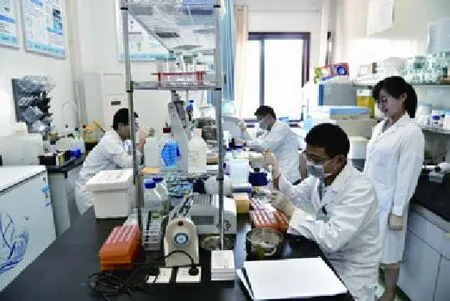
Scientists at a lab of the Hefei Institutes of Physical Science under the Chinese Academy of Sciences do experiments on August 10. The lab is engaged in making progress in precision medicine to combat malignant tumors
National strategy
He and his team have mapped and cloned several other important genes and made progress in hunting candidate genes of schizophrenia and other mental disorders.
Now, He is applying gene technology to clinical diagnosis and treatment. On July 27,he signed a letter of intent to cooperate with Xiamen City No. 5 Hospital to set up a laboratory for genetic diagnosis.
Currently, He serves as director general of the China Alliance of Personalized and Precision Medicine and Industry, which was set up in Shanghai on December 11, 2015, to promote the application of precision medicine.
The alliance is committed to promoting sharing of clinical experiences and other resources in personalized and precision medicine,popularizing relevant technologies and providing consulting services.
Genetic differences may lead to different reactions to health risks and treatments among individuals, said He. Citing an example of a 9-year-old boy with attention deficit and hyperactivity disorder, who died after taking a common drug to treat the disease, he said that the same drug can have obvious healing effects on some patients, less obvious effects on other patients, and adverse effects on the rest.
“Many factors can affect the effectiveness of a drug on an individual, while genetic polymorphism is the primary factor, and other factors include height, weight, gender, age,concomitant diseases, organ functions and environmental factors,” said He.
Precision medicine is an emerging approach for disease prevention and treatment that takes into account people's individual variations in genes, environment, and lifestyle,according to the defnition of the U.S. National Institute of Health.
That approach is made possible by cuttingedge technologies such as sequencing of the human genome, biomedical analysis and new tools for analyzing large datasets.
On January 20, 2015, U.S. President Barack Obama unveiled a Precision Medicine Initiative during his State of the Union address.
The promise of precision medicine, according to him, is to deliver “the right treatments at the right time, every time, to the right person.”He asked congress to invest $215 million into the project.
Meanwhile, China has also begun to attach importance to precision medicine. On March 11,the Ministry of Science and Technology convened the first expert meeting on precision medicine strategy. China decided to invest 60 billion yuan ($9 billion) in precision medicine by 2030, one third of which will be paid by the Central Government, and the rest come from local governments and enterprises.
A number of precision medicine alliances have sprouted up across the country. The Clinical Research and Application Alliance of Precision Medicine in China was founded on December 24, 2015. The alliance, initiated by the China-Japan Friendship Hospital (CJFH),comprises more than 20 renowned hospitals in various parts of the country. It aims to promote precision medicine in clinical research and diagnosis.
Some institutions and teams in the alliance started their clinical research and applications of pharmacogenomics around the beginning of the 21st century, said Wang Chen, an academician and President of CJFH.
Since 2004, Wang has been working on genetic testing to determine the clinical signifcance of genomics in some commonly used drugs and exploring ways to treat diseases by precision medicine.
Wang said that by December 2015, 127 quality hospitals nationwide had established precision medicine centers or individualized drug treatment centers. Thus, a provider network with a moderate scale for clinical application of precision medicine has been set up.
On June 27, the presidents of 15 cancer hospitals across the country formed an oncology precision medicine alliance.
Tong said. Now, with gene testing, a patient can learn about the optimal dose within 24 hours of having a blood test, he said.
Diagnostic advantages
Southwest Hospital, which is affliated with the Third Military Medical University in Chongqing Municipality, plans to conduct gene testing on 2,000 types of hereditary disease next year.
“Through gene sequencing technology, we can screen for genetic disease genes, prevent genetic diseases, and provide personalized disease treatment and effective drugs for patients,reducing the toxic and other side effects of drugs and the economic burden of patients,”said Yuan Zhihui, Director of the hospital's center of hereditary diseases.
Yuan said the effectiveness of drugs for some commonplace diseases is only around 50 percent. Precision medicine is expected to change this situation.
At a forum on world future science and technology on June 25, Cheng Jing, a medical professor at Tsinghua University, told the audience that a patient suffering from fever, diarrhea and respiratory diffculty was diagnosed with severe pneumonia in a hospital and paid close to 1,500 yuan ($225.5) in medication expenses daily, however the patient's condition got worse and worse, Then the hospital used a gene chip to identify the source of infection more precisely, treated the patient with erythromycin, and cured him at a daily expense of just 10 yuan ($1.5).
Precision medicine has been used in several departments of Beijing Chao-Yang Hospital and has made it easier for doctors to fnd the appropriate dose of warfarin for patients who suffer from cardiac infarction, said Tong Zhaohui, the hospital's vice president.
Warfarin is an anticoagulant used to prevent clots in blood vessels and their migration in the body. Too high a dose of the medicine might cause a patient to bleed, while too low a dose is insuffcient to protect against blood clots. A patient usually needs to be monitored for one to two months for doctors to fnd the right dose,
Bottlenecks
Despite progress in precision medicine, Tong thinks that currently, for ordinary Chinese citizens, precision medicine is no more than a concept. He believes the dawn of the precision medicine era is still some way off.
Currently, precision medicine is primarily used for disease diagnosis and helps people learn about future health risks, but after diagnosis, precision intervention is much needed, said Ji Jianxin, Executive Vice President of Diao Group,a pharmaceutical group based in Chengdu,capital of Sichuan Province.
Tong said that some basic medical science findings are yet to be converted into clinical therapies.
Zhu Hanqing, a strategic planning manager with Shenzhen-based BGI, a leading genomics research center, said that today, developing targeted drugs is the biggest challenge in oncology. Although some targeted anticarcinogens have been developed, to date no medicine has been found for many targeted spots, she said.
Another challenge for precision medicine is the cost for gene sequencing and other procedures such as setting up gene data banks and sharing data, Zhu said.
She said that the development of medicine is a very long and expensive process,which means that treatment is expensive for patients. Targeted cancer therapies currently cost more than 100,000 yuan ($15,050) per year, and most can only prolong a patient's life by a few months. The cost-effectiveness is an issue when justifying whether to develop a medicine, she said.
Currently, the cost of gene screening is mostly not covered by medical insurance, so when doctors advise patients to undergo a gene test, patients often refuse, according to Xinhua News Agency.
Lack of large gene databases and weak ability in analyzing big data are problems also facing the development of precision medicine in China, said Zeng Changqing, a professor with the Beijing Institute of Genomics under the Chinese Academy of Sciences.
Li Jinming, Vice Director of Clinical Test Center under the National Health and Family Planning Commission, told Xinhua that currently, more than 200 independent medical testing centers can do gene testing, yet the results of quite a number of laboratories are not precise,and that those of some top hospitals are not satisfactory either.
Moreover, most people in China do not have complete personal medical records,there are no national standards on medical information, and hospitals usually do not share information, said Wang Shan, Deputy Director of the Chinese Medical Doctor Association.
Zhu believes the establishment of databases will also raise concerns over privacy and ethical issues. Standards should be made to protect privacy and avoid discrimination against patients, she said.
Despite these challenges, Zhu is confdent that precision medicine will play a more and more important role in cancer treatment. “We have reason to be full of hope for the future,”she said. ■