Better Late Than Never
2016-09-13 00:59:07MitsubishiapologizesforsubjectingChinesetoforcedlaborduringWWIIByBaiShi
Beijing Review 2016年34期
Mitsubishi apologizes for subjecting Chinese to forced labor during WWII By Bai Shi
?
Better Late Than Never
Mitsubishi apologizes for subjecting Chinese to forced labor during WWII By Bai Shi
World War II (WWII) finally ended when Japan announced its unconditional surrender on August 15, 1945. But the battle waged by Chinese victims for compensation and apologies from the Japanese Government and Japanese companies involved in the war has never ceased.
On August 15 this year, the 71st anniversary of the end of WWII, 87-year-old Yan Yucheng,a Chinese survivor of forced labor, released the entire text of the settlement between himself and Japan's Mitsubishi Materials Corp. regarding compensation and an apology for Yan's suffering in a forced labor camp in Japan during the war, the Beijing-based China Youth Daily reported on August 15.
Yan was one of the Chinese victims who reached settlement deals with Mitsubishi Materials on June 1 this year. The Japanese company has now completed actions to compensate and apologize to Yan.
Tong Zeng, the activist who initiated demands for compensation and apologies from Japan on behalf of Chinese slave labor victims,was authorized by Yan to release the text of his arrangement on August 15.
Tong told China Youth Daily that Yan hoped the world could witness the completion of the agreement in which a well-known Japanese enterprise has fnally begun to apologize and show regret for the crimes it committed together with Japan's militarist government more than seven decades ago.
“The deal offers a valuable example for Japan and other countries to make settlements for war crimes,” Tong said.
In the document, Mitsubishi Materials recognizes the fact it forced nearly 4,000 Chinese to work in labor camps during WWII and subjected them to inhumane treatment. It is the frst Japanese company to offcially apologize to Chinese victims since the end of WWII.
The company has agreed to compensate each of the Chinese victims, the deceased as well as the survivors, 100,000 yuan ($15,000) for their suffering in Japanese labor camps. “On our part, we've come to a conclusion that we will extend our apologies and offer the money as a proof of these apologies,” a Mitsubishi Materials spokesman said.
The company also promised to continue to seek a comprehensive and permanent solution with all of the former laborers and their families and pledged to build a memorial to honor the victims. Furthermore, the company said it would continue trying to track down forced wartime laborers who remain unaccounted for in offcial records.
The settlement, negotiated between representatives of the company and the victims, was formally signed on June 1 by senior Mitsubishi Materials executive Hikaru Kimura and three survivors, including Yan, on behalf of more than 3,000 of the company's wartime forced labor from China.
Untold sufferings
As Japan expanded its military campaign in WWII, the island country was badly short of manpower to run its war machine. To meet the large demand for labor in heavy industry,particularly in coal mining and construction, the Japanese Government and some of the nation's corporations conspired to force captive locals to work as laborers. At that time, a large number of prisoners from the United States, Britain and China were forced to work in labor camps for Japanese industrial and mining enterprises. Mitsubishi Materials was one of them.
Yan was only 15 years old when he was abducted by Japanese soldiers and transported to Japan in 1944 from his hometown in Qinhuangdao City, North China's Hebei Province.
Yan told China News Agency that he was taken to the city of Lizuka in Japan's Fukuoka Prefecture to toil in a Mitsubishi coal mine until December, 1945, when he was set free and repatriated to China.
In Japan, “We worked over 10 hours a day. The Japanese guards and supervisors gave us only two meals a day, and the food was too poor to eat. We were always hungry,” Yan said.
“A total of 189 Chinese, including me, were brought to the coal mine in Lizuka. When we were free to return home, there were only 166 left; 23 died of inhumane treatment within a year,” Yan said.
According to statistics released by Japan's Ministry of Foreign Affairs after WWII, at least 39,000 Chinese people were forcibly brought to Japan between 1943 and 1945 to assume exceedingly hard labor in Japan's mines and factories. Today, historians identify such action by Japan's militarist government during the war as mass-kidnapping and human traffcking. Among the forced Chinese laborers,7,000 died during their hellish internment due to the rigors of labor, squalid conditions and lack of basic essentials like food and water. Some who tried to escape from labor camps were shot to death.
The Mitsubishi Mining Corp., a former part of Mitsubishi Materials, received a total of 3,765 Chinese workers during the war. They worked as slaves, suffering from hunger, cold and violence. By the end of the war, 722 Chinese workers had died in Mitsubishi's mines.
“I don't care about the amount of compensation,” Yan said at the compensation agreement signing ceremony held in Beijing on June 1, “I do care if Japanese companies recognize the facts of their crimes, if they feel guilty,and if they are willing to apologize for what they did in the past.”
“We have been fghting for the apology for over 20 years,” Yan said.
Efforts for justice
Not all Chinese victims, though, have agreed to Mitsubishi Materials' settlement. Sixty-three people have fled a lawsuit in Beijing.
Liu Shili, 91, who was forced to work for a year in a coal mine operated by Mitsubishi Mining, told Xinhua News Agency, “We refuse to accept the company's reconciliation deal.”
“We will hold the Japanese accountable for their war crimes in accordance with law and fght for our rights,” Liu said.
“The settlement deal is unfair to my late father and thousands of other victims like him,”said Pan Ying, whose father Pan Jingxiu tried unsuccessfully to sue the company for two decades. “We demand real compensation and will carry on our battle with the support of our country and our legal aid team,” Pan said.
Xu Jingbo, President of AS@IA, a Tokyobased news agency, told Shanghai-based ThePaper.cn that “I can feel that the words of apology offered by Mitsubishi are not sincere and thorough enough.”
“But the apology itself is a significant victory for Chinese victims,” Xu said, “After all, aJapanese company is eventually able to agree to apologize to Chinese victims for the crimes that it committed 71 years ago.”
Over the past 20 years, Tong has worked to help Chinese victims seek redress from Japan through legal means.
“The process is very hard because it involves China's domestic law, Japanese law and international law,” Tong said, “The settlement gives us a way to start reconciliation between Chinese victims and other Japanese companies.”
Actually, the Japanese Government doesn't support Mitsubishi Materials' decision to apologize, Tong claimed. But the government's attitude puts the company in a dilemma during its process of seeking business expansion in China. However, Mitsubishi Materials' board of directors decided to apologize, taking into account the company's humanitarian and human rights responsibilities as well as its business future.
According to Tong, as many as 35 Japanese companies are believed to have been involved in forced labor from 1937 to 1945, during Japan's invasion of China. Today, the Japanese Government has still yet to apologize for its war crimes including the mass-abduction of Chinese citizens.
Tong said that in his experience over the past 20 years, he has seen plenty of arrogance and rejection from Japanese government offcials and enterprises in numerous lawsuits and negotiations which sought compensation for the Chinese victims of Japan's war crimes.
With much effort, and assistance from lawyers in both China and Japan and many dedicated professionals, Chinese victims and their families have made some progress in recent years in claiming compensation.
In 2014, Japan's Mitsui Co. agreed to compensate Chinese ship owner Chen Shuitong for his losses during WWII. Chen leased his cargo ships to Mitsui in 1930s. During the war, the ships were commandeered by Japanese imperial forces prior to eventually being destroyed in the confict.
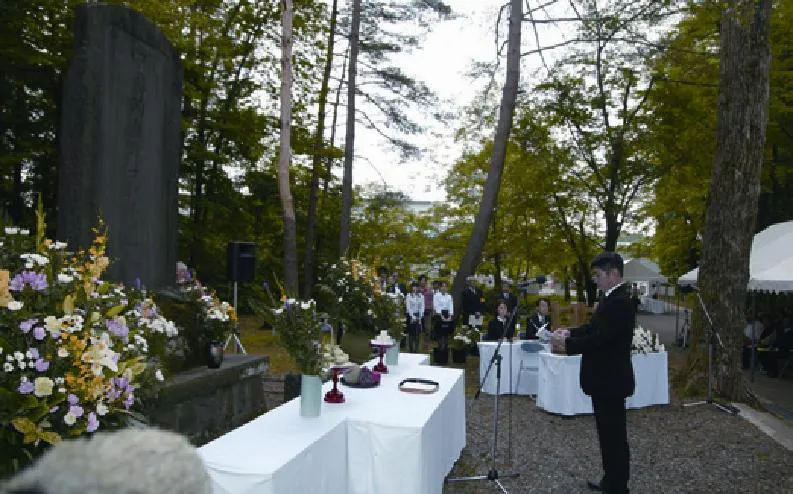
People from both China and Japan mourn Chinese victims who were killed in forced labor camps during WWII in a commemoration held in Odate City of Akita Prefecture in Japan on June 30, 2015
Chen's descendants had pursued compensation for near 70 years since the end of WWII. In 1988, the Shanghai Maritime Court accepted a lawsuit filed by Chen's family. In 2007, the court sentenced Mitsui to pay compensation of 2.9 billion yen ($28.91 million). To enforce the ruling, the court froze Mitsui's ship Baosteel Emotion in Zhoushan Harbor, Zhejiang Province, in 2014. Mitsui then agreed to follow the ruling and compensate the plaintiff.
Behind the compensation case, China's growing comprehensive national strength and international status are important factors contributing to the success of the compensation claims, said Tong.
To some extent, Mitsui's case can be considered a commercial dispute. But, the settlement of Mitsubishi Materials should be a milestone for Chinese victims demanding apologies and claiming compensation from Japanese companies, Tong continued.
“Today, there remain about 20 Japanese companies that enslaved Chinese workers but have not apologized. Therefore, we need to comment positively on Mitsubishi's settlement,encouraging others to correctly face history,”Tong said.
“Next, we will strive to seek the Japanese Government's offcial apology to Chinese forced laborers,” Tong said, “Only a formal apology made by the Japanese Government can initiate a new chapter of China-Japan relations.” ■