COLLABORATION FOR JOINT GROWTH
2016-09-13 00:58:59ChinacontinuestobethemajorpowerhouseandstabilizeroftheworldeconomyandiswillingtoshareopportunitieswithitstradepartnersByMeiXinyu
Beijing Review 2016年34期
China continues to be the major powerhouse and stabilizer of the world economy and is willing to share opportunities with its trade partners By Mei Xinyu
?
COLLABORATION FOR JOINT GROWTH
China continues to be the major powerhouse and stabilizer of the world economy and is willing to share opportunities with its trade partners By Mei Xinyu
Editor's Note: This edition of Beijing Review is specially devoted to analyzing the potential impact of the Group of 20 Summit taking place in Hangzhou this September. We've invited experts,academics and industry insiders from abroad and within China to express their opinions on topics such as the world economy's anemic recovery from the 2008 financial crisis, reform of the global fnancial and monetary system, and how China can contribute to global economic governance.
Since the G20 nations make up 85 percent of the gross world product, 80 percent of global trade and contain two thirds of the world's population, the group is an important platform for leaders of developed and emerging economies to work out mechanisms for long-term collaboration on a variety of issues.
The author is an op-ed contributor to Beijing Review and a researcher with the Chinese Academy of International Trade and Economic Cooperation

The world is facing the most economic and political uncertainties since the debt crisis in the 1980s: The United Kingdom will leave the EU; the banking crisis in Italy poses risks to the European fnancial system;price fuctuations of primary products are affecting many emerging economies; Japan's Abenomics has failed in reality; economic uncertainties and election debates in the United States cast a slur on the country's policy environment.
In the current circumstances, is China still one of the major powerhouses for world economic growth? Is it still the major stabilizer for the world economy?Major world economic organizations, from the International Monetary Fund (IMF)to the World Trade Organization to the Organization for Economic Cooperation and Development, respond to these questions affrmatively.
China has also showed its strong will to share with its trading partners the opportunities for sustainable growth, with the aim of better playing the role of powerhouse and stabilizer of world economic growth.
A larger role
Early in the 1980s, China started to serve as a stabilizer for the East Asian economy. Its role was completely recognized during the 1997 Asian fnancial crisis.
According to figures from the IMF and the People's Bank of China, comparing the coefficient of variation in the annual GDP growth rates of East Asian economies from 1980 to 2001, China was the lowest at 0.35, while the coefficient in all East Asian economies other than China and Japan was 0.49. Such a low coefficient of variation in economic growth rates fully demonstrates China's role in stabilizing the East Asian economy.
Moreover, during the 1997 Asian fnancial crisis, China maintained a stable exchange rate of the yuan, preventing further proliferation of competitive currency depreciation in the region. It is the stabilizing role China played that helped East Asian economies overcome the fnancial crisis. After the 1997 Asian fnancial crisis, East Asian economies didn't collapse or enter a “l(fā)ost decade”as did Argentina, Brazil and some other Latin American economies. Only three years after the crisis, East Asian economies resumed growth.
As the share of East Asian countries in the world economy was growing quickly, the 1997 Asian fnancial crisis should have soon spread to international financial markets. However, because of China's role in stabilizing the East Asian economy, the world economy was prevented from declining into a great depression, as it did in the 1930s.
During the prosperous frst decade of the 21st century, China and the United States together contributed half of the world's economic growth. The average annual growth of China's imports was more than twice the global average, driving growth in many other countries. After the U.S. sub-prime mortgage and European sovereign debt crises broke out, China established itself as the stabilizer of the global economy.
China's economic growth has slowed in recent years, but it still stood at 6.7 percent in the first half of 2016, and the economic outlook is more optimistic for China than for other major world economies.
According to the World Economic Outlook,updated in July by the IMF, the baseline global growth forecast for 2016 and 2017 has been modestly revised downward by 0.1 percentage point relative to the forecast given in the April edition. Similarly, the U.S. growth forecast for 2016 was revised downward by 0.2 percentage points, the eurozone's 2017 growth was also revised down by 0.2 percentage points, and India's growth forecast for 2016-17 was trimmed down slightly. But in China,the growth outlook was broadly unchanged relative to April, with a 0.1-percentage-point upward revision for 2016.
The value of China's imports has declined compared with a year ago, but that is because prices in international markets are declining, while the volume of China's imports maintains marked growth. The nation's demand for imported products is still able to provide its trading partners with enough room for growth. After several years of high growth, China's non-financial outbound direct investment still surged 58.7 percent in the frst half of 2016, demonstrating China's powerful dynamics to promote growth of its trading partners.
Based on the above conclusions, leaders of six major international fnancial organizations came to Beijing on July 22 for a “1+6 Roundtable” to discuss economic issues with Chinese Premier Li Keqiang. For the purpose of better playing the role of powerhouse and stabilizer of world economic growth and sharing sustainable growth with its trading partners, China hosted the roundtable in Beijing and is ready to host the upcoming G20 Summit in Hangzhou.
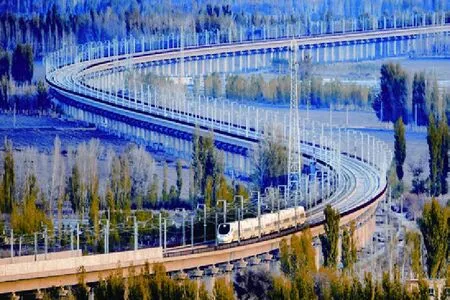
A bullet train runs on a railway bridge in Hami, northwest China's Xinjiang Uygur Autonomous Region
Mutual efforts needed
In intensifying cooperation with its trading partners, China has showed strong insight and execution capability again and again. It took only three years for China to complete the process of establishing the China-ASEAN Free Trade Zone—from feasibility study through decision-making to signing agree-ments—astonishing Japan, which had proposed such a free trade zone 10 years earlier than China but had been unable to create an agreement.
China has also demonstrated its sincerity in collaborating with ASEAN through working to wrap up negotiations on the Regional Comprehensive Economic Partnership (RCEP) as soon as possible, connecting its Belt and Road Initiative with ASEAN's development strategy, intensifying international cooperation in production capacity, and supporting the ASEAN Community Vision 2025 and the Master Plan on ASEAN Connectivity. China doesn't regard the RCEP as a means of competing with the U.S.-led Trans-Pacific Partnership (TPP),but it believes any sensible observer will not ignore the voices within the United States opposing the TPP and the facts that neither presidential candidate supports the TPP and House Speaker Paul Ryan said on August 4 that the TPP doesn't have support for a House vote this year. Together with its trading partners,China has the will and confidence to set up the RCEP as a regional free trade platform that is more stable.
But, one cannot clap with one hand. China's will to share growth opportunities also needs the collaboration of its trading partners. How active they are in developing the Chinese market will decide the size of their share of the “China cake.” The past decade has seen cases where different efforts in developing the Chinese market have led to different economic outcomes. Japan and South Korea provide the most typical example.
Japan had been the largest source of exports to China for quite a while since former U.S. President Richard Nixon visited China in 1972 and the embargo against trade with China was removed. It used to be unimaginable that South Korea could replace Japan in exports to China someday. However, due to wrong decisions for political purposes,Japan got off the “train” of Chinese economic growth in the frst decade of this century,when China's foreign trade kept soaring. South Korea, sparing no effort to develop the Chinese market, replaced Japan for the frst time in 2013 to become the largest exporter to China. In that year, China imported goods worth $183.1 billion from South Korea but only $162.3 billion worth of goods from Japan. The gap was further expanded in 2015, when China imported goods worth $174.5 billion and $143 billion from South Korea and Japan respectively.
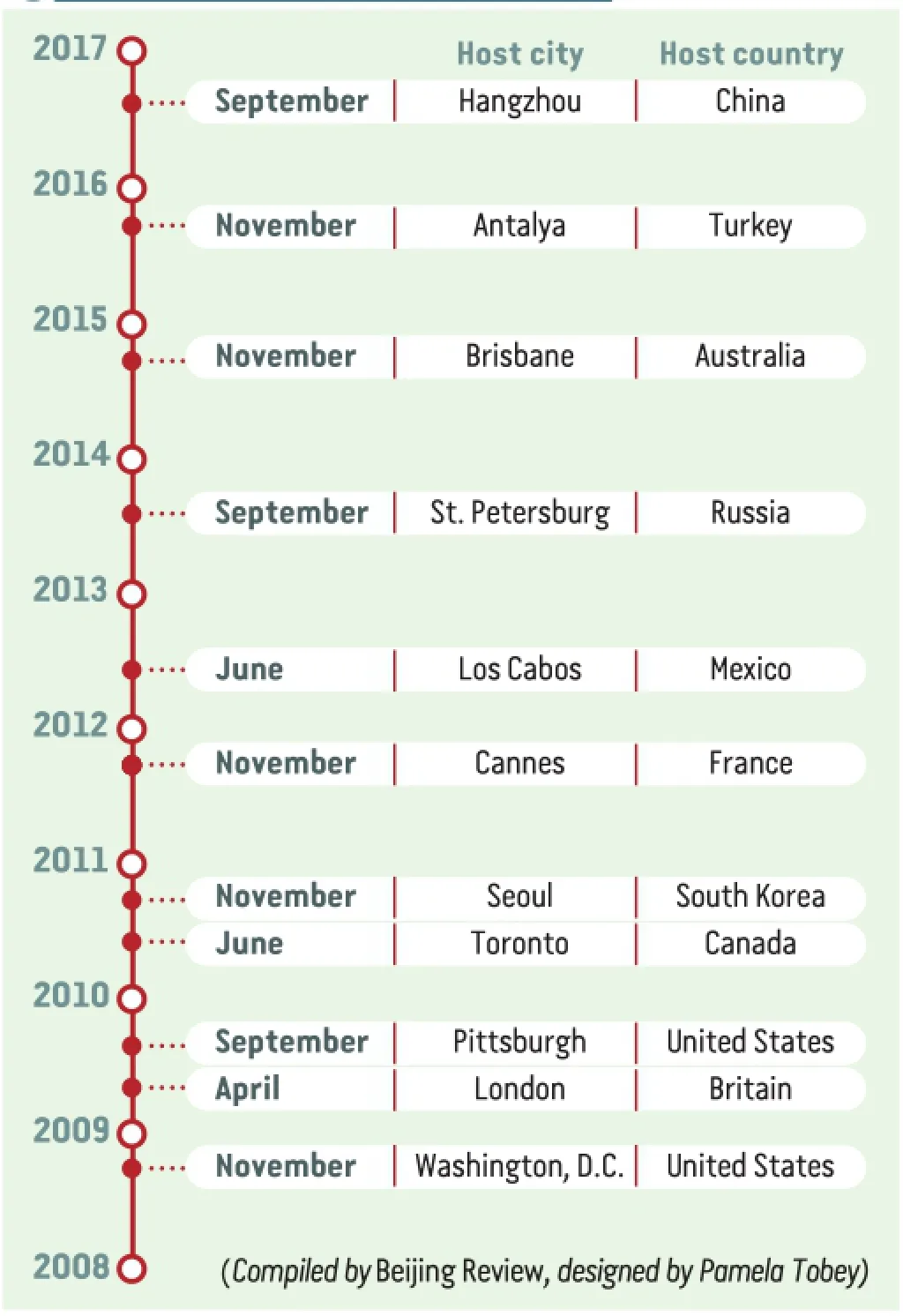
↓Timeline of G20 Summits
In the meantime, Japan, once a “top-notch student” among developed economies following World War II, also lagged behind the average level of per-capita GDP among high-income countries. In 2000, per-capita GDP of highincome countries was $22,749, while that of Japan equaled $37,292, over 60 percent higher than the high-income countries' average. In 2013, per-capita GDP of high-income countries reached $39,116, while that of Japan was $38,634.
Due to long-time close relations in economy and society, as well as historical and geographical connections, ASEAN members are China's frst choice of partner in setting up free trade zones. There are disputes between China and some countries in the region, and China will make no concessions on matters involving national territory and sovereignty. Beyond these disputes, though,China can still conduct mutually beneficial cooperation in economy and trade.
Former Philippine President Benigno Aquino III brought China to the Arbitral Tribunal over the dispute involving the South China Sea, but he also approved his nation's joining the Asian Infrastructure Investment Bank. Currently, the Philippines is performing well in economic growth, but the income gap in the country is very big and unemployment remains high. Its economy excessively relies on private consumption and the service sector and has also suffered trade defcits for many years. Potential risks in the Philippine economy must not be neglected, especially since its economic structure makes its economy fragile in the face of external changes. Changes in international economic and political environments will seriously affect its economy sooner or later, especially domestic consumption and remittances from overseas Filipino workers, which are of vital importance to the country's economy.
The Philippines, suffering from economic and social uncertainties, needs a peaceful and stable external environment. Economic and trade cooperation with China can facilitate its sustainable growth, and China can provide the Philippines with such help. In 2015, the Philippines' trade deficit grew very rapidly, partly because its exports to China declined sharply. Its exports to China in yuan-denominated terms dropped by 8.6 percent in 2015, and the decline grew to 13.1 percent in the frst four months of 2016. However, China's exports to the Philippines continued to increase, growing from 15 percent in 2015 to 27.4 percent in the first four months of this year. This means that the Philippines cannot develop without consumer goods, capital and equipment from China, but it is unable to take advantage of the fast-growing demand in the Chinese market and rapidly expand its exports to China, as other ASEAN members can. It will be greatly favorable news to the Philippine economy if the country can remarkably improve its relations with China. ■