HIG PRICE TO DIE
2016-09-07 07:44:55BYSUNJIAHUI孫佳慧
漢語世界 2016年4期
BY SUN JIAHUI (孫佳慧)
?
HIG PRICE TO DIE
BY SUN JIAHUI (孫佳慧)
Life can be hard. Death isn't easier.
活著不容易,死也不簡單
Hi gh housing prices have led to the term 房奴, or “house slave”. But your fnal resting p lace is becom ing just as much of a worry as your current resting place, giving rise to yet another depressing term, “grave slaves”. The skyrocketing cost of shuff ing off the mortal coil is burning up wallets around the nation.
According to the annual Green Book of Funerals: Report on Funeral Development in China released in 2015 by the China Funeral Association aff liated with the M inistry of Civil Affairs, in metropolises like Beijing, the cost of a cemetery burial ranges from 40,000 RMB to hundreds of thousands, with Beijing's annual disposable income per capita at just 48,000 RMB.

A1,000-strong procession of mourners march through the streets of Sanya, Hainan Province
The cemetery plot is, of course,the main cost, but that's just the beginning. A list of common death expenditures has become popular online: 2,500 RMB for time in the morgue (three days); 4,000 RMB for a shroud; 5,000 RMB for an urn; 3,000 RMB for body transportation; 2,000 RMB for cremation; 1,000 for depositing the ash at a funeral home;1,600 RMB for decorations in the viewing room; 2,500 RMB for renting a hall for the wake (one hour, 50 people); and 3,000 RMB for various funerary goods. Adding up all this (along with a cemetery plot for 30,000 RMB), the total cost was 54,600 RMB.
This, for somewhere like Beijing, is pretty m inimal. But, much like the trends weddings have experienced over the past few years, China's new found wealth has given rise to luxury funerals. One funeral in Wenling, a coastal city in Zhejiang Province, in 2011 received international attention. Five brothers commandeered the grounds of a high school to bid their mother goodbye,along with thousands of onlookers and attendees as well as nine limousines decked out in fowers, a uniformed marching band, and a 16-gun salute. According to reports from Chinese media, the funeral ceremony cost around fve m illion RMB in total and it happened right after Wenling passed a regulation against funeral “extravagance and waste”.
According to a fnancial statement from Fu Shou Yuan, one of the largest Chinese cemetery companies,its overall gross margin has remained at around 80 percent in recent years, which has caused w ide discussion about how much value peop le place on the big goodbye. Yes, people like a big send-off for their dearly departed,but the funeral industry is making a killing. The rampant prof teering has brought on comparisons to the real estate market and many are wondering if they can afford to die at all.
The thing is, on paper there are actually some very cheap urns and cemeteries, but the driving force for expensive funerals in China is the same as everywhere else: tradition. In the past, cremation was less common. Burial was always the proper way of dealing with corpses, hence the idiom, “入土為安”, meaning that the deceased can only rest after being buried. And for peop le who can afford it, burial is always the best option, complete with refned coffn, a spacious grave, and a big party for a great afterlife.
Funeral rites are a big issue for the whole fam ily, and in the old days,people paid attention to the age of the deceased, cause of death, social status of the fam ily, and even the fengshui of the grave site. And while the emperors and government off cials who turned their ancient tombs into the tourist attractions of today spared no expense in their interment, modernity has made folks less picky.
Extravagant funerals took a nosedive w ith Mao and New China,and in 1985, the Communist Party issued China's f rst funeral-related legislation, commanding citizens to “reject superstitious funerary customs and advocate frugal and reasonable ones”. But, in reality, the ruleswere selectively enforced from the very beginning. Even Mao himself was embalmed and laid in a vast mausoleum in Tian'anmen Square,w ith his jaundiced corpse a tourist attraction to this day, despite his opposition to the practice.
Today, though cremation is more universal and strongly advocated,Chinese peop le are still opting for grand funerals and burials. Cemetery p lots are hot real estate, especially because custom dictates that many who are cremated still want their overpriced urns buried.
Another factor in the boom ing cost of dying is China's aging population. In 2015, citizens aged 65 and over reached over 200 m illion and the number will be more than 250 m illion in 2020. As a result, the funeral industry is expected to reach 600 billion RMB by that time, according to the China Funeral Association.
As ever, land is a problem. With around 9.3 m illion peop le dying each year, China is set to run out of graveyard space in six years, according to Taiwan newspaper Want China Times. M ost cemeteries in China are government-controlled with the rest depending on perm its from the government, which owns the land. However, it's not clear whether more land w ill be allowed for graveyards. State monopolies on the graveyards are often blamed for the exorbitant fees and charges in the funeral industry, but with 9.3 m illion people to deal w ith every year, those fees are only going to get higher.
However, the market is stepping in; since 2004, certain parts of the funeral business have been gradually opened up. With more money entering the marketplace, a large number of one-stop-shop funeral services have emerged.
Zhang Kunren, director in charge of funeral direction at Eternal Shine,a funeral service company, statesthat their com pany can provide different packages for all needs, including cleaning and dressing the body,interment, contacting the crematorium and plot holders,holding the ceremony, and, if needed, moving a tomb to a different address and providing therapy for the fam ily,w ith prices ranging from 20,000 RMB to m illions. “It is the fam ily of the deceased who decide which services are needed. They can choose according to their needs and budget. Usually, clients tend to pay more attention to the ceremony arrangements and the choice of cemetery,” says Zhang.

Workers prepare to scatter the ashes of the deceased at sea in Guangxi Province
Such funeral service com panies indeed p rovide much assistance, but many com plain about hidden fees found in this sector, something of which the industry is well aware. “The arbitrary charges are not the on ly problem in this industry,” says Zheng Wen ji, vice-president of Eternal Shine. “The whole industry lacks professionalism. Without enough professional workers and facilities, most of the current services are too simple and crude, which doesn't show as much humane care as it should.”
Spending money isn't always a com fortable topic to speak about when dealing with the bereaved, so undertakers sometimes take advantage of the fam ily's grief and ignorance to charge more than needed. To some extent, in such a climate, the funeral industry is bound to be short on transparency.
Zheng believes the main problem in the industry isn't so much about the price as it is a problem of standardization and professionalism. “Compared with many traditional companies, our services are not cheap because we are targeting medium-to-high end clients. But our clients don't run away. They care less about the price than where their money goes and whether they are m isdirected.”
Currently, Eternal Shine are cooperating w ith three top hospitals and 15 funeral homes, investing in decorating mortuary rooms in the hospitals so that they can have the services there. Zheng and his coworkers believe they can make a difference by bringing more cultural content and a humanistic spirit to the industry, but they adm it it is not easy. “These businesses usually operate through a bidding, butbehind it, there are so many factors involved,” says Dong Xiaoping,another staffer w ith Eternal Shine. Since many are still controlled by local funeral homes which are usually directly aff liated w ith the M inistry of Civil Affairs, it's not hard to understand.
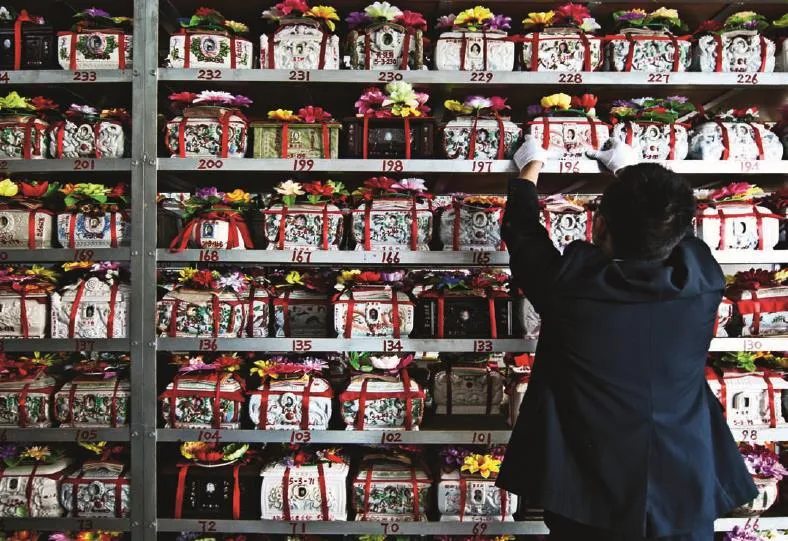
The p rice o f an u rn to hold crem ated rem ains can be as low as 24 RMB in Xiam en, bu t few choose this cheap option
As these practitioners are fnding their way, the government also makes an effort. The country's cremation rate has declined to 49 percent in 2012 from 53 percent in 2005 because of resistance from the general public,according to the m inistry. At a conference in 2014, the m inistry said it was targeting a cremation rate of nearly 100 percent by the end of 2020. This year, nine departments,including the M inistry of Civil Affairs and the National Development and Reform Comm ission, jointly issued guidelines saying that burials that take little or no land w ill be promoted over the next fve years. In certain densely populated areas, fam ily members are encouraged to share the same tombs,and ecologically friend ly funerals will be continually promoted, including storing cremated remains in buildings,walls, or towers.
Due to the cost to their pockets and the environment, more and more Chinese fam ilies are opting for a scattering at sea, for which there are government subsidies. When it was initiated in the 1990s, few were w illing to let go, but a shortage of land and the high cost of a burial has led more fam ilies down this more eco-friendly route.
O ther ideas have leaned more toward the creative. Biian, a Beijing undertaker company, is offering China's f rst space burial service, with the cheapest package starting at 5,600 RMB and the most expensive at 75,00 RMB. Despite constant inquiries, fe really buy this service, according to a China Daily interview w ith one of the group's founders, Xu Yi.
Another innovative solution is to turn ashes to crystals. Zheng says the company can help do this, but it is rarely chosen. In 2010, the website Tsingm ing.com was established as a place for peop le to worship the deceased online. So far, 618,387 “remembered people” are registered here. They all have a prof le page and their family, relatives, and friend can go there to leave their messages candles, and fowers.
Obviously, worshiping your loved ones online, in space, or in a crystal consume less resources than getting them a bural plot, but these options show no sign of replacing increasingly expensive funerals any time soon.