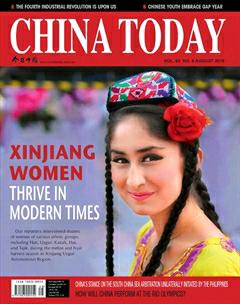
Law-abusing Tribunal Issues Ill-founded Award on South China Sea Arbitration,Draws Worldwide Criticism
2016-08-22 06:37:19
CHINA TODAY 2016年8期
THE tribunal handling the South China Sea arbitration case unilaterally initiated by the former Philippine government issued its final award on July 12, 2016, sweepingly siding with Manilas cunningly packaged claims.
The process and outcome of the three-year-long arbitration have drawn criticism from dozens of countries and numerous experts across the world. They point out that the panel has no jurisdiction and its decision is thus null and void.
Political Farce
Among other conclusions it reached in the 479-page award in blatant disregard of historical facts and general international law, the five-member tribunal denied Chinas long-standing historical rights in the South China Sea.
Chinese President Xi Jinping, in a meeting with visiting European leaders on July 12, said that China will not accept any proposition or action based on the award, and that Chinas territorial sovereignty and maritime interests in the South China Sea will under no circumstances be affected by it.
China has refused to participate in the proceedings, reiterating that the tribunal has no jurisdiction over the case, which is in essence related to territorial sovereignty and maritime delimitation.
The Chinese government has pointed out that territorial issues are not governed by the UN Convention on the Law of the Sea (UNCLOS), and that it has– in line with UNCLOS – excluded disputes concerning maritime delimitation from mandatory dispute-settlement procedures. Some 30 other countries have also made similar exclusions.
“The Ministry of Foreign Affairs of the Peoples Republic of China solemnly declares that the award is null and void and has no binding force. China neither accepts nor recognizes it,” the ministry said in a statement shortly after the award was announced.
Describing the arbitration as a political farce under the pretext of law, Chinese Foreign Minister Wang Yi said that by not participating in and not accepting the arbitration, China is upholding international law and regional rules.
The government of former Philippine President Benigno S. Aquino III filed the arbitration against China in 2013, despite the agreement his country had reached with China on resolving their disputes in the South China Sea through bilateral negotiations.
Although Manila asserted that its submissions do not concern territorial sovereignty or maritime delimitation, the Philippine Foreign Ministry, a day after launching the arbitration, described the purpose of the case as to “protect our countrys territory and oceanic area.”
Xu Liping, a senior research fellow with the National Institute of International Strategy at the Chinese Academy of Social Sciences (CASS), stressed that UNCLOS should never be allowed to serve as a tool for certain interest groups to decide on sovereignty-related disputes.
“The award, a typically unfair and arbitrary verdict, represents a huge blow to the worlds confidence in the international legal system and the integrity of arbitration proceedings,” he said.
Worldwide Criticism
Upon its release, the award, along with the tribunal, prompted a deluge of criticism from many countries and scholars.
A Pakistani Foreign Ministry spokesman said that maritime disputes in the South China Sea should be addressed in accordance with bilateral agreements and the Declaration on the Conduct of Parties in the South China Sea (DOC), adding that Pakistan opposes any imposition of unilateral will on others.
The DOC calls for states directly involved in territorial and maritime disputes to resolve their differences through peaceful negotiations. It was signed by China and all members of the Association of Southeast Asian Nations(ASEAN).
The Pakistani Foreign Ministry added that it respects the declaration China made in 2006 under UNCLOS not to involve a third party to resolve disputes over maritime delimitation.
The Thai Foreign Ministry, in a statement, also cited the DOC, saying that disputes in the South China Sea should be addressed on the basis of mutual trust to reflect the nature of the longstanding ASEAN-China relations.
Saeed al-Lawindi, a political researcher and international relations expert at Cairo-based Al-Ahram Center for Political and Strategic Studies, pointed out that the award is completely biased and could result in serious conflict in the region.
Tom Zwart, a professor of law at Utrecht University in the Netherlands, told Xinhua that the award will not resolve any issue in the region because the tribunal lacked jurisdiction in its ruling.
“From the outset, critics like me said that it would be very difficult to avoid sovereignty issues when handling the Philippines claims,” said the professor.
Zheng Yongnian, director of the East Asian Institute of the National University of Singapore, said the arbitration is a political issue manipulated by the United States which demands a political solution.
In the latest count, more than 70 countries and international organiza-tions, as well as over 230 political parties and groups in more than 90 countries, have voiced support for Chinas principled position. They thus far outnumber those backing the assertions of the Aquino administration and the United States, which is widely considered as a primary instigator behind the arbitration case.
The Chinese public has also kept a close eye on the South China Sea issue, standing firmly behind the governments resolve to safeguard Chinas sovereignty over the South China Sea Islands as well as its call for dialogue to settle the complicated disputes.
Negotiations Comply with International Law
While rejecting the award, the Chinese Foreign Ministry also reiterated that China will continue to work with directly concerned countries to resolve the relevant disputes in the South China Sea through negotiations and consultations.
The new Philippine president, Rodrigo Duterte, recently said that Manila is ready to talk to China even if the South China Sea arbitration tribunal rules in the Philippines favor.
China has said that the door of China-Philippines dialogue on the South China Sea issue is always open, but it will not negotiate with the Philippines on the basis of any ruling in the arbitration case.
In its statement, the Chinese Foreign Ministry said negotiations and consultations should be carried out “on the basis of respecting historical facts and in accordance with international law.”
Noting that China has solved border issues with 12 of its 14 land neighbors, with over 20,000 km of borderlines delineated and demarcated, Xu, the CASS scholar, said the record “is solid proof that China has been strictly lawabiding.”
China has been dealing with its border disputes on land in a very professional and thorough way, agreed Abraham Sofaer, a former legal adviser to the U.S. State Department, adding that“it is also shortsighted ... to assume that no hope exists for diplomacy on maritime disputes.”